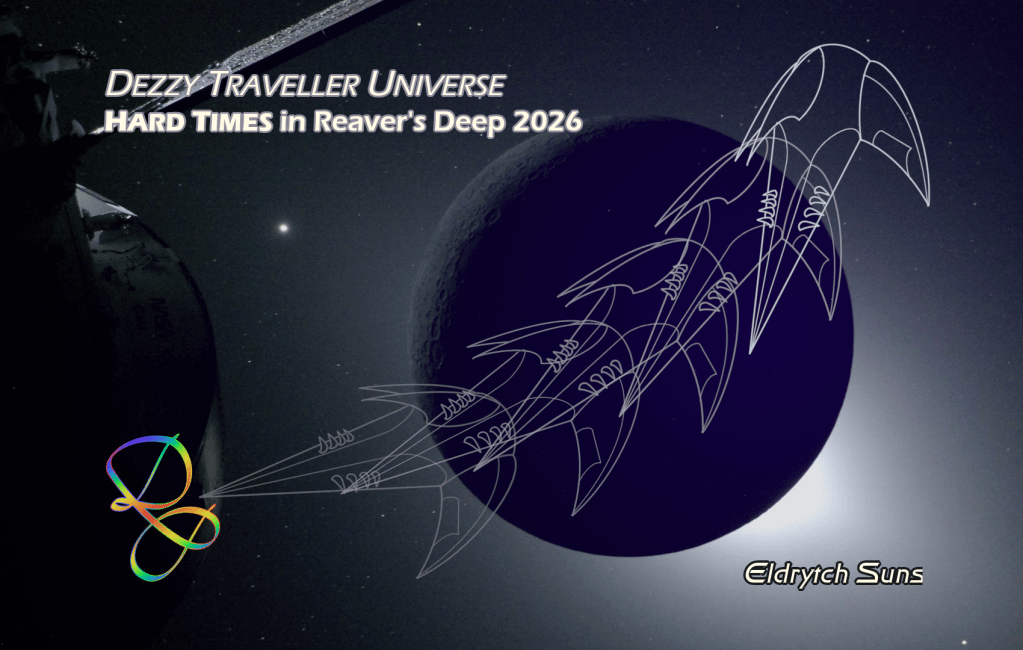
Eldrytch Suns Part 2
As mentioned in the article Hard Times in Reaver’s Deep, the Eldrytch Suns campaign takes place in a Planetary Romance setting. A big change is that the Maneuver Drive isn’t used. Other Gravitic technologies still exist (like the antigravity technology that make Grav-Vehicles function) at TL 11 or 12. This has a follow-on effect that space and starships are built on non-gravity hulls when designed below TL 12.
Acceleration Effects
So long as a ship accelerates at 1G, there’s no negative crew effects. Most sophont species evolved and survive in or around a 1G environment (and those that aren’t naturally acclimated to 1G commonly employ technologies that assist in functioning and surviving)
At higher acceleration, the crew and passengers risk G-induced loss of consciousness (see pp 47-48 of High Guard update 2022 for the relevant rules). Using gear like G-Tolerance Drugs and/ or G-Suits (from the Central Supply Catalogue) and Acceleration Seats or Benches (from High Guard) can help Travellers endure burning High-G maneuvers.
Burn-and-Coast
When traveling in-system, most commercial ships only carry enough Reaction Drive fuel to maintain thrust for an hour. Very few crews attempt to maintain continuous burn, after all, every ton that is carrying fuel to burn is one less ton that could be filled with cargo.
When traveling, each hour of fuel is broken down into ten 6-minute “burns”. Each burn is the same duration as a combat round, to make it easy when interrupting travel and entering combat to determine how much fuel a ship has available. A ship burns at a thrust value the Pilot determines for as many burns to build up delta-vee ΔV (that is velocity), then coasts until rotating 180 degrees and burning until the ΔV is zero. This is a really, really, really simplified version and doesn’t take into account any common variables that real-life Astronauts need to contend with.
ΔV is preserved through Jump. When the Jump drive is activated, the ship’s ΔV is noted. When that ship emerges from JumpSpace, it is still coasting at the same velocity. A Piloting check at a difficulty equal to the Astrogation check will determine the ship’s heading with regards to it’s destination. If the check is a success, no course adjustments are necessary. For every degree of failure, one additional burn is required to bring the ship back on course.
For these reasons, most crews will only use 3 burns to accelerate towards their destination, or towards the 100 D jump limit, knowing that it will take 3 more burns to decelerate when they arrive at their destination. With one hour of Reaction Drive fuel, this leaves 4 burns available for combat, course correction, or emergencies. In “secure” systems, some pilots will risk 4 or even 5 burns (after all time is credits for a Free Trader). In wilder systems, a cautious pilot will only use 2 or 1 burn to have as much fuel as possible for any of the above.
When coasting, the crew and cargo of a ship experience microgravity. Floating within the hull of the ship and using hand holds to climb and push their way through the ships interior. When a pilot needs to make a burn, they need to give enough warning for the rest of the crew to secure themselves. Otherwise, they’ll take falling damage equal to the force of the thrust being burned.
What happens when a ship runs out of Reaction Drive Fuel? or if the Reaction Drive is disabled? At this point, Sir Issac is in charge. The ship will continue on it’s ΔV until acted on by another force, and since space is big and empty, a ship in an uncontrolled drift can continue on for thousands of years, becoming a floating tomb for it’s crew (or a floating prison if anyone put themselves in a Low Berth before the life-support failed).
Ships of the Eldrytch Suns
Adapting most ship designs to the Eldrytch Suns is fairly simple. Most ships are TL 10-11 (TL 11 ships for the Jump-2 jump drives) and replace the Maneuver Drive with a Reaction Drive and add fuel for 1 hour. At TL 10, most Reaction Drives (up to 3G thrust) is “High Technology” (according to “Altering Tech Levels” on pg 71 of High Guard) and can apply up to 3 Advantages to the drive. Each Advantage reduces the amount of fuel needed to operate the Reaction Drive by 20%.
Ship Hulls should be designed with the “Non-Gravity” quality (at least if the ship is being designed below TL 12. Which makes the hull significantly less expensive (for that matter, the Reaction Drive is about 10% of the cost of the equivalent Maneuver Drive). But, if the ship is capable of more than 1G thrust, Acceleration Seats and Benches should be added. Which is another in-setting rationale for why commercial vessels like freighters and passenger liners don’t mount heavy Reaction Drives.
This alters the details of a ship’s cargo space, and it’s purchase price, maintenance and mortgage, but reasonably so. With the setting being retro, with swords and lasers, the image of a crew strapped in acceleration seats, burning limited fuel to accelerate, and heroically pushing the limits of their ship and their bodies fits quite nicely.
Reaction Drives in Close Combat
The Aslan have a saying in Trokh, “Aikhaakh ia ahya hkeiriysual aokhahte.” Roughly translated, it says “A reaction drive is a weapon.” A desperate maneuver that a pilot can try, should the enemy ship be in the same hex, and the pilot’s ship still has thrust available. The pilot points the drive at the enemy, and if they are in Adjacent range, ignites the drive. If all goes as intended, the targeted ship gets blasted by reaction plasma, and the pilot’s ship accelerates along a new vector.
The check is an opposed piloting check, the attacking ship’s difficulty begins at Very Difficult (12+) and the defending ship starts at Average (8+). After applying all modifiers, both pilots roll. If the attacking pilot wins the roll, the defending ship suffers 1D per point of thrust burned. If the attacking ship is larger, add 1D for every 100 dTons difference. If the defending ship is larger, subtract 1D for every 100 dTons difference (minimum 1D). If the defending pilot wins the opposed piloting check, the defending ship is able to avoid the attack, however docking, grappling, or boarding actions are not possible for either ship on that turn.
The defending pilot can choose to not actively avoid the attack. In this case the pilot may still attempt a docking, grappling or boarding action on the turn the attack is attempted. The check is no longer opposed, however the attacking pilot’s difficulty for their check is still Very Difficult.


Leave a Reply