Tag: rpg

  • A Crossroads in the Deep

    A Crossroads in the Deep

    A Settlement on the Underworld Frontier

    Far below the surface world, a vast Empire rules a web of tunnels and caverns. The Empire of the Spider Queen is a dark mirror of the Elven realms that bathes in the golden light of the Sun. The founders of the Empire of the Spider Queen were the losers of a war against their Elven cousins ages past, and driven from the sunlit world into the lightles underworld. Over generations, they recovered from their grievous loss, adapted to their subterranean world and forged a dominion to rival their sunlit cousins.

    Genzhymyl

    Genzhymyl has changed greatly over the past ten years. Initially a trading post on the K’Kephredoc River and along the shore of the lake, Genzhymyl lasted for decades as little more than a permanent camp. The closest settlement was K’zeldremn, which was on the far side of the nearby causeway tunnel.

    Genzhymyl experienced rapid change following the Year of Rage. Every House in every colony of the Empire of Spider Queen, including K’zeldremn fell into anarchy as the Demon Princes raged through the Underworld. As demonically-feuled riots and chaos tore the cities apart, refugees from K’zeldremn fled to Genzhymyl, swelling its population and growing it into a proper town, independent of domination by the Empire.

    The town’s architecture is a chaotic mess of pavilions, temporary, and permanent structures. The oldest buildings, dating from the original Flayed Matron Manor and Kyrzhiim’s Mill are made of set stone and reflect styles from the nearby city of K’zeldremn. The Dzhuol Goblin Tribes and surface-influenced styles are common among the semi-permanent buildings that have been used since before the Year of Rage. Many of the newer permanent buildings are built by Klaarg Azhgov and are designed to be very efficient and sturdy, if not decorative. Finally over the ten years since the Rage of Demons, the refugees have begun to build out their tent encampment into semi-permanent buildings, owing to no architectural style other than what is the fastest and most convenient to build at that time.

    Genzhymyl’s independence is secure for the moment, the Empire and her dispersed colonies will be rebuilding for a long time to come. Although the Demon Princes have been banished back to the Pit, Demons still roam freely in the Underworld. And it is still not known when the Demon Queen of Spiders will once more establish her direct authority over her Empire.

    Rulership in Genzhymyl

    Genzhymyl is governed by a town council consisting of Vethric Ghaul – owner of the Flayed Matron Manor, Ztorv – Preadarch (Cheiftan) of the Dzhuol (the Goblinfolk tribe across the K’kephredoc), and Johayya (Viscount) Ivynna Kvarik of Klaarg (Clan) Azhgov. Vethric acts as head of the council with Ztorv representing the Dzhoul, and Ivyanna representing Azhgov interests in Genzhymyl.

    The government of Genzhymyl becomes informal below the town council, though there are some semi-official positions that have become permanent during the past ten years. Town Herald is one such post, answerable to the town council, which makes official pronouncements and proclamations public, and likewise hears any statements made by the citizens to bring to the council’s attention. The current Town Herald is “The Khabtyn Dhahabei” (the Gold Captain in his native tongue), Ehriegan Staav, a human from a great city on the surface who has prospered as a broker in Genzhymyl for twenty years. The Khabtyn Dhahabei employs a dozen “Town Criers” as deputies.

    In addition to Town Herald, there is the post of Magistrate, who mediates disputes among the population in the name of the town council. Though not exactly a Judge, since laws in Genzhymyl are not codified, the Magistrate, and their Adjudicators provide for settlements without need for violence. The current Magistrate is a Svirfneblin woman, Ynzylith, the oldest child of the owner of the town mill, Kyrzhiim

    The Master of Markets directs the shops and stalls of the Genzhymyl Bazzar, it is their duty to maintain order and peace within the Bazzar as well as collecting the taxes and fees from the merchants trading within the settlement. At present the office is held by a ruthless woman, a Drow by the name of Avzenthe Djerrn. The Mistress of Markets (as she styles herself), employs a small team of “Managers” and “Collectors” to enforce her authority.

    Locations of Note

    • The Flayed Matron Manor
      • The Flayed Matron Manor is owned by Vethric Ghaul and managed by Jeegan Thatz. Over the past 200 years, the Flayed Matron has served as a way-stop, a gambling den, a brothel, an inn, and a tavern. Currently it is all of those, and serves as the council chambers for government.
        • Jeegan (a Half Orc/Human) is Vethric Ghaul’s chief Lieutenant. She manages the day-to-day operations of the Flayed Matron Manor in Vethric’s place when he is away or otherwise occupied. Jeegan is a priestess of the Mistress of Whips and is a sadist. She has leveraged this trait into a profitable arrangement at the Flayed Matron Manor, serving a special clientele of powerful,influential people who have masochistic or submissive needs that need to be fulfilled with discretion.
    • Kyrzhiim’s Mill
      • A large water mill used by the town for processing all manner of seeds and grains for a small fee. The owner, Kyrzhiim is a Svirfneblin and one of the wealthiest people in Genzhymyl. He lives in an ostentatious mansion on the shore of Lake K’kephredoc.
    • The Grey Lantern Inn
      • The primary house for renting rooms. Since the Year of Rage, the owner, Ghazrahd Sablemane (a Duergar with rarely-seen black hair and beard) has expanded the grounds from a single building to a small campus with stabling, barracks, and suites for extended leasing.
    • “The Tent”
      • Before the Year of Rage, a goblin by the name of Gheez set up a huge pavilion on the then-edge of the Camp. “The Tent” as it came to be called, offered cheap, moderately secure space for patrons to sleep for a few hours. Since then, Gheez has died and “The Tent” has been rebuilt as a permanent structure (but remains a large, open building) operated under management of Klaarg Azhgov through Virdiloma Yth.
      • The “innkeeper”, Virdiloma keeps a shrewd eye out among her tenants for those in desperate circumstance. Individuals who don’t have family, money, or friends who wouldn’t be missed, escaped slaves, or known fugitives from one of the power centers in the region. These vulnerable people are targeted for abduction or capture by Klaarg Azhgov.
    • The Genzhymyl Bazzar
      • Along the road stretching from the Flayed Matron Manor at one end to The Tent at the other. The Bazzar is the central forum of Genzhymyl. The Market here never fully closes, with commerce being practiced at all hours. Nearly anything can be found here for sale, timbers from the Yyngvath Forest, fish from the nearby lakes, exotic wares from the Surface word as well as the Deeps. Also, of course, slaves being auctioned by Klaarg Azhgov.

    New Background: Enslaved

    • Ability Scores
      • Strength, Constitution, Widsom
    • Feat
      • Alert
    • Skill Proficiencies
      • Insight and Survival
    • Tool Proficiencies (choose one)
      • Cooks’ Tools, Leatherworkers’ Tools, Potters’ Tools, Tinkers’ Tools, Weavers’ Tools, Woodworkers’ Tools
    • Equipment (these items are either stolen, or the property of the character’s owner)
      • A toolkit that matches the proficiency chosen, An Explorers’ Pack, (Un)Holy Symbol, Manacles
      • or 10 gold coins
    • Disadvantage
      • The Enslaved bears a permanent mark of their bondage, a tattoo, scar, brand (or similar). This mark is easily recognized by most people. All Social Interactions with folk who are aware of this mark are made at Disadvantage.

    The character is or was a slaved. Owned by another person, or household as property. They have either been granted their freedom, or escaped, but the marks of their bondage remain. If a fugitive, there is likely a bounty for their capture and return (GM’s discretion). The character’s time in servitude has taught them to remain aware of the people around them, reading their body language to divine their mood or to intuit their whims.

    Conclusion

    The caverns of Genzhymyl hold endless opportunities for adventures to explore the unknown along the periphery of the Empire of the Spider Queen. During the Year of Rage, earthquakes have changed the geography in the surrounding area, caving in and closing the tunnels that led to the surface, and revealing new passages. Secrets long hidden or lost in the Deeps have been revealed, waiting for the reckless, bold and curious to discover.

    The Township of Genzhymyl functions as a “home” for adventurers to return to when they need resupply, rest, or training. It’s independence and relative stability contribute to it’s reliability. Yet, since the catastrophe of the Year of Rage, Genzhymyl has become a new center of intrigue, as survivors and refugees jockey for power and influence. There is plenty of opportunity for “agents of fortune” to find good paying work and patrons in need.

  • Into the Black

    Into the Black

    Tell Them I’m Not Coming Back

    In the World Builder’s Handbook, there is a section regarding “empty” parsecs on Traveller navigational maps. In summary, “empty” parsecs are anything but. It’s likely more accurate to describe these parsecs as non-commercial. There are no easily navigable stars to jump toward, or gravity wells for maneuver drives to interact with. The result for ships jumping in is the promise of a difficult arrival in system, and a long, slow acceleration to go anywhere.

    These same circumstances apply in parsecs that have systems with active travel. Except that most jump and maneuver traffic never venture beyond the primary system’s gravity well.

    As described in the World Builder’s Handbook, there are plenty of potential gravity anchors to jump to. White Dwarfs, Brown Dwarfs, Rogue Planets (including Gas Giants), Asteroids are just a few, in a volume of more than 30 cubic light years, there is abundant room to add objects to draw Travellers into their next adventure.

    Bridging the Gap

    Some empty parsecs lie between two (or more) trading mains in a region. It is possible, even probable that Jump 1 traders would simply carry enough extra fuel (sacrificing cargo space, or using external fuel bladders) to make the extra jumps in series. However, in those parsecs that experience heavy pass-through traffic, a bridge station can be built.

    At minimum, a bridge station is the equivalent to a Class C Starport. Capable of docking 6,666.27 dTons of ships at once. They are often in orbit around Brown Dwarfs or Gas Giants and maintains a small fleet of skimmers to pull unrefined fuel off the high regions of the atmospheres. Bridge Stations that are heavily traveled will incorporate Fuel Refineries to offer Refined Fuel.

    Bridge stations will also have some basic maintenance facilities for civilian ships. Prices are often elevated, often double the normal cost of maintenance and repair elsewhere, but when a ship needs repair in-between established systems, the Captain pays what they need to in order to keep flying. Crew Accommodations, Brokerages, Storage, Hiring Halls, and an a variety of services are built into bridge stations. A successful bridge station eventually expands to accommodate nearly any service that a trader and their crew might need.

    Microjumping

    It is difficult and dangerous to jump within a parsec. As described in the World Builder’s Handbook, jumping through a cluster has a 1D penalty to Astrogation checks that changes every day. Jumping within a parsec would suffer a similar penalty. Jump computers aren’t designed for such short jumps, and work best when using a gravity anchor to calibrate arrival from out of Jump Space.

    Regardless of the distance jumped, a ship will spend ~168 hours in Jump Space. Fuel consumption for the jump is equal to 40% + 1Dx10% of a full Jump-1. These microjumps are impractical for any distance below 1 LY. (which is roughly (very roughly) ~ 25% of the distance across the breadth of a parsec). A microjump does not save time and is not fuel efficient. But, there are times where jumping to locations within the parsec is necessary.

    Pirate Bridges

    Pirate fleets, if they enjoy enough success, or become large enough can use an empty parsec as a location for a hidden bridge. A base station where pirate vessels can strike from and escape to. These pirate bridges also serve as a trading hub for stolen cargo, mixing and obfuscating the goods to a point where it becomes nearly impossible to track their theft. “Pirate” brokers negotiate sales of stolen cargo to willing buyers.

    It would seem, from an overview of an empty parsec on a subsector or sector map, that establishing a pirate bridge would be easy, even inevitable, to discover by the local Navies, and subsequently eliminated. After all, if a known pirate fleet uses Jump 2 ships to attack trade lanes, and there is an empty parsec within Jump 2 of several victimized systems. The Naval authorities can easily triangulate the parsec and send an anti-piracy task force to eliminate the threat.

    Keep in mind, a parsec is a volume of 30 ly3. enough space that can contain thousands of Sol-type star systems. As Douglas Adams famously said,

    “Space is big, it (the Guide) says. Really big. You just won’t believe how vastly, hugely, mind-bogglingly big it is. I mean, you may think it’s a long way down the road to the chemist’s, but that’s just peanuts to space.” (Why yes, I was looking for an excuse to use the famous quote from Hitchikers Guide to the Galaxy and I apologize for nothing.)

    Point being there’s a lot of space in space, and using Maneuver Drives, even the fastest Maneuver Drives need centuries to cross a single light year. So, unless the precise coordinates of the pirate bridge can be uncovered, simply knowing which parsec it floats in won’t reveal it’s location.

    Toll Bridge, Troll Bridge

    Building a bridge station is extremely expensive. Materials are sourced from the target parsec as much as possible. Because of this, many bridge stations are built within buffeted asteroids towed into orbit around a rogue gas giant. Even using raw materials mined from nearby sources, manufactured components need to be delivered from outside the parsec. Which is an intense logistics effort.

    Once operational, bridge stations charge premium fees for services. Nickel-and-diming ships that come through for everything, from berthing fees, fueling, and resupply, to restaurant meals, bar drinks, and rest stations. Think about the services (hotels, restaurants, bars) that surround major airports, or the services offered within major airports.

    Pirates often lurk near the jump points to the bridge station, obstructing incoming ships and extorting a “toll” for access to the station. These pirates don’t hijack or take their victim’s entire cargo. That would attract too much attention from the station’s security and reduce overall traffic.

    The same logistical challenges to build a bridge station in an empty parsec also affect protecting the station. Every security ship docked with the station, takes up docking space that can be used for revenue. Thus, bridge stations will keep as few vessels as possible on patrol at the station. Most of the time a single System Defense Boat, or a small squadron of Light or Heavy Fighters. Most of the time it’s easier (and cheaper) just to pay protection to the regional pirate fleet.

    Getting a message out from a bridge station to a neighboring parsec takes a minimum of one week. The response to that message will take a second week. Thus, for fourteen days, bridge stations in empty parsecs are on their own in an emergency.

  • Small Ships and Hard Times

    Small Ships and Hard Times

    Small Ship Campaigns at the End of the Rebellion War

    By 1121 3i, the Rebellion War had been in stalemate for two or three years. Fleet Actions and counter-actions have burned through entire front-line fleets and the reserves. For Lucan’s Imperium most of the remaining deca-kiloton and hecto-kiloton warships have been folded into his “Vengeance Fleet” with the singular goal of driving like a spear into Ilelish and dragging Dulinor’s head back to Capital as a trophy. The Solomani Front developed into a defensive struggle, with Imperial fleets holding the line and bleeding the Confederation dry.

    When the Black War began, first targeting the Hi Population worlds, then attacking the trade infrastructure, the targets were the resources needed to maintain these powerful Battleship fleets. Hoping to shock their adversary into a sudden collapse, the Black War only served to push the 11,000 worlds of the Imperium over the brink. By attacking the mechanisms that held interstellar civilization together, what started as a decline became a free-fall.

    By the end of 1124 3i, the Hard Times had begun

    Shifting to Commerce Raiding and Preserving the Big Ships

    With resources to keep the big cruisers and dreadnoughts battle ready dwindling fast, the major powers started turning to cannibalizing damaged ships to repair and refit the more capable ones. From 1121 through 1124 3i, the rapid decline in Tech Level hadn’t set in yet, but it was visible on the horizon. All the major navies could see a time when their TL 14 and 15 components wouldn’t be serviceable until after the War. Worse, none of the factions could see the end of that War. Especially Lucan.

    Lucan had become mad by then. Completely obsessed with “revenge” on Dulinor. In his all-to regular rages, he started authorizing “superweapons” and giving orders to non-existant fleets. Always and loudly proclaiming thatthis push was the one that would break Dulinor. It was only because his Imperium was the largest and richest faction by far that his reckless waste of resources didn’t cause a complete military and economic collapse.

    Cooler heads worked to preserve what battle fleets remained. Many of the still active fleets not engaged in deterrence, replaced their valuable capital ships of the line with much smaller, destroyer-sized squadrons. 5000 ton “pocket battlecruisers” and 1000 ton “strike cruisers” could be designed, built and deployed at a fraction of the cost in material and technology. Clever naming conventions held an illusion of the massive capital ships for the Admiralties still living at the high point of the war.

    Megacorporations suffered similar cutbacks. The old megafreighters massing in the hundreds of Ktons had been burned to a small fraction of their fleet. Like the battle fleets of the Navies, what few megafreighters had survived the Black War were travelling secure routes in the Core of the factions. No one risked the big freighters out in the no-man’s space of the Wilds.

    The result here was a return to small merchant freighters of 5000 tons or less, and for trade routes that crossed into the Wilds, the megacorps more than often simply contracted with independent tramp freighters to keep their cargo moving. This had a cooling effect on the war in general. At this smaller scale, even raiding commerce lines didn’t return the sort of results as jumping convoys of 50,000 or 200,000 ton freighters. That strategy too was downsized, then outsourced to Privateers.

    Pirate Kings and Merchant Princes

    Piracy has never been a “big ship” affair. Ships over 2,500 dtons tend to be too expensive to run are way too noticeable. There are millions of 400 ton Corsairs and 800 ton Mercenary Cruisers prowling the trade routes in charted space. But if a 10k ton pirated Light Cruiser started attacking shipping? That monster would be the top priority of every pirate hunting institution in the Sector.

    With the reduction in fleet strength, both among Navys and Corporate Fleets, the effectiveness of a pirate flotilla has increased greatly. Existing syndicates of pirate fleets claimed “toll fees” for safe passage through “their” space. With the threat of a strong Imperial, or Sector response that could easily outgun their corsair flotillas dwindling, Pirates became the wardens of the space-lanes. These resembled pocket-empires in some regions and crime families in others.

    A related condition affects the merchants and traders that continue to operate out in the Wilds. The same conditions that caused megacorporate fleets to withdraw to the relatively safe Core regions has opened opportunities for the owners and captains of small independent traders. Even though the Megacorporations have pulled back their fleets of multi-kiloton freighters, the demand for goods along the trade mains doesn’t change.

    The withdrawal of megacorporate naval power has empowered independent and local traders to attempt to fill the void. This has increased consumer prices across the board. After all, demand wasn’t falling but the delivery of supply carries a much higher risk. Trading fleets provide a measure of mutual protection and support, but not all Free Traders want to share profits, pay dues, and abide by the rules and bylaws of a fleet.

    In this new age of small ships, non-existant security, and isolation, the line between a Free Trader and Corsair can be very blurry.

  • Diggy out the Hole

    Diggy out the Hole

    The Rise an fall of Klaarg Tordenzme

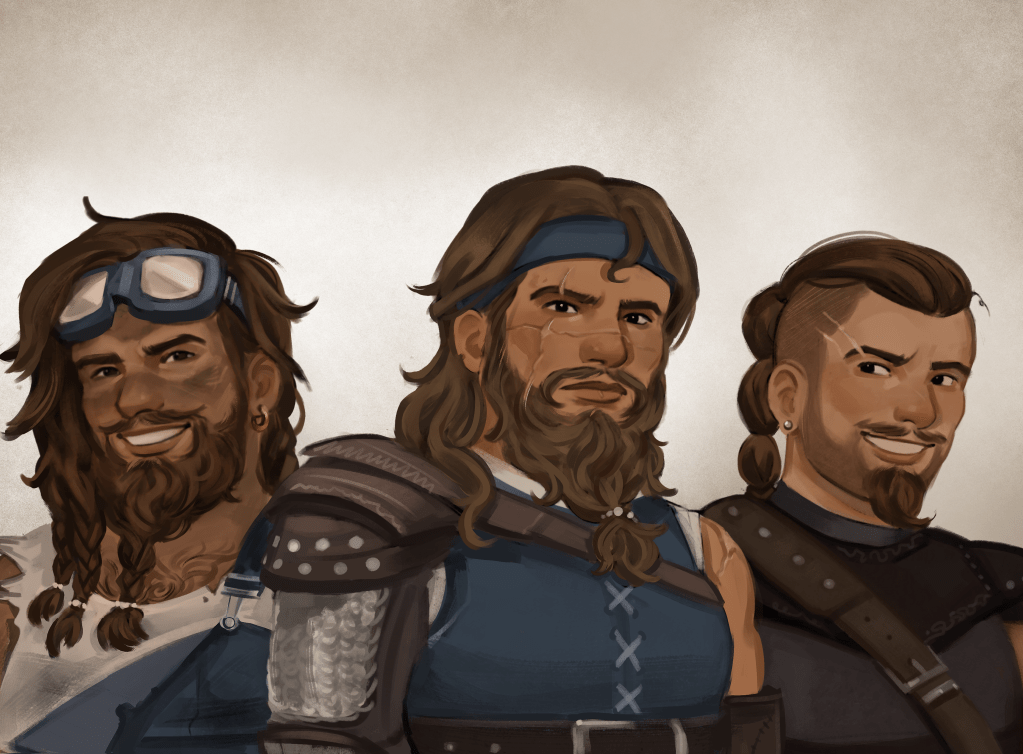
    Dwarves in fantasy roleplaying, especially in the modern sense, have become stereotypes. Loosely based on Gimli from Lord of the Rings, it’s a common shorthand, found in several fantasy settings beyond Middle Earth. Dwarves are short, bearded, stocky, gruff, capable of holding grudges across generations, masterful artisans and miners. Some sources describe Dwarven women as having beards, (like Xindi and Xandi on the masthead), others describe Dwarven women as lacking facial hair (like Disa from Rings of Power) and often Scottish coded. Part of this image is Dwarves living in extensive Clans.

    So widespread is this stereotype is that it’s common parlance. When the GM mentions a character is a Dwarf, the players will most often draw up powerful mental images of that character based on the previous description. While this “short”-hand is useful (see what I did there?), it can lead to confusion at the table as players make assumption about their Dwarven companions.

    Dwarves in the Dezzyverse

    In my campaigns I “reskin” dwarves just to shake up player assumptions. This is mostly just retitleing the names of dwarven things. I prefer to use the terms a people would use for themselves, as opposed to the terms that others would use for them. In the case of my campaigns, they call themselves Svakk as a people. (Indeed, calling them “Dwarf” might start a brawl) Though the Svakk refer to themselves most commonly by the name of their Klaarg (which is their word for “clan”). “Xandi of Klaarg Tordenzme” for example. The languages of the Svakk are collectively called Klaargspek, though like their cultural identities, most Svakk refer to their languages by the name of their Klaarg. “Tordenzme Klaargspek” or “Sohnrodt Klaargspek”.

    Even divided among dozens of distinct Klaarg, the Svakk people are tightly bound together, Klaargspek is understood even through different dialects spoken in different Klaarg. Klaargspek also shares a single runic alphabet, the Vaalbek.

    The Doom of Klaarg Tordenzme

    Once, Klaarg Tordenzme stood among the strongest and most wealthy Klaarg among the Svakk. Indeed, the grasp of Klaarg Tordenzme had stretched beyond the halls and citadels of the mountain realms, Tordenzme was a force within the kingdoms and empires throughout the lands, from sea to ocean. The heart of this mighty realm was their city of Dohrgraign. Deepest of the delves beneath the mountains, in this age, Dohrgraign was was the only city to make peaceful contact with the dark realms of the Underworld.

    Exotic and expensive trade passed through Dohrgraign, under the leadership of Theigns from Klaarg Tordenzme. Roads from the farthest realms stretched to the Grand Gate that led deep into the Underworld, a league-and-a-half below the surface world to the City of Dohrgraign. For centuries Klaarg Tordenzme stood among the greatest of these ancient empires.

    Then came the Doom of the Tordemzme, a prophecy delviered to Klarg Tordenzme that was defied, causing catastrophe. Over nine years of what the chronicles named “The Fall of Dohrgraign”, the city suffered endless misfortunes that resulted, finally in the gates being sealed from the outside world. Few detailed records survived the Fall and in the eight centuries after the Sealing, the city itself was lost to memory, fading into myth, a distant curse and reason to shun the descendants of Klaarg Tordenzme.

    Eight hundred years ago, during the reign of Theign Haaldbarg, a mysterious prophet known as the Black Vizier was recieved at court. The hooded and robed figure did not bow, nor show deference to Theign Halldbarg, speaking directly and openly their warning.

    “Trespass no further into the dark below the stone on which your thy city stands. Else the greed of Klaarg Tordenzme will become Dohrgraign’s downfall.”

    Insulted, Theign Haaldbarg ordered the Black Vizier thrown in chains. Yet, when the guards attempted to seize them, the Black Vizier vanished with a clap of thunder that felled all within two or three strides of the figure.

    Afterwards, the Black Vizier appeared again and again, and always delivering disaster where it stood. It is difficult to tell exactly when Theign Haaldbarg sealed the city, but there was one last evacuation towards the surface. History records that a foul miasma had arisen from the Wyrmansklovt and spread throughout the city, bringing horror and death. What few citizens of Dohrgraign still remained were commanded to flee to the surface.

    It was following this last escape from the Underworld that the tunnels connecting Dohrgraign to the surface collapsed. In the centuries which followed, the city that grew around the Grand Gate withered and fell into ruin and Dohrgraign was ultimately lost.

    The Doom of Klaarg Tordenzme was used by the klaargs for centuries as a warning against hubris. The few Tordenzme communities that survived the Doom have been marginalized by other klaargs as “cursed” based on this myth.

    The Year of Rage

    In the “current” year of my D&D campaign, it has been roughly ten years since the events detailed in the published adventure Out of the Abyss. With the incursion of demons, a small struggle between the Demon Prince of Undeath and the Patron Deity of Dohrgraign, the Keeper of Secrets Under the Mountain has caused lost passages to open once more as demons and the holy dead battled one another.

    The Year of Rage also corrupted the ambient magic of the Underworld. Mortals adventuring in the ruins of Dohrgraign risk Torment and corruption. The cursed city drew the Demon Prince to it. Dohrgraign had been a tomb for eight hundred years by the time the Year of Rage brought demons into the Underworld. The Keeper of Secrets Under the Mountain was not only the God of hidden treasures and secret knowledge but he is the Keeper of the Dead. Dohrgraign is one of his holy places under the mountain, and after eight centuries, it has become a secret as well.

    The Crossroads of the Underworld

    Dohrgraign was not a naturally occurring space. It was carved from the stone of the underworld by Klaarg Tordenzme over centuries. Following the seams and veins of ore, the Tordenzme miners uncovered the passages and caverns used by the civilizations below the surface. The closest of these caverns became the Gatehouse of Dohrgraign, another nearby cavern (a much larger cavern) would develop into the settlement known as Genzhymyl.

    In the present day, Genzhymyl has grown into a thriving trading center. It is independent from the competing realms in this region of the Underworld, The Empire of Llolth, the Azhgov Clan, and the various Goblinoid, Kuo-Toa, and Orcish communities that have settled in this area over the past several centuries. With the newly unblocked passages, Dohrgraign is once again able to be discovered.

  • You Got Battletech in my Traveller!

    You Got Battletech in my Traveller!

    No, you got Traveller in my Battletech!

    Two of my favorite games over my long gaming career are Traveller and Battletech. I’ve been playing both for over 40 years. Since I’ve recently moved to a new city, on a new coast of the US, and The 50th Anniversarry of Traveller is right-around-the corner. I’m starting a new campaign. With Battletech enjoying a renaissance, I’ve been throwing a healthy amount of Big Stompy Robots in my Science Fiction Adventure in the Far Future.

    The setting for this campaign leans more toward the Third Imperium than the Inner Sphere. Specifically my favorite era in Traveller’s Third Imperium, the Hard Times. I talked a bit about this back in June. The elevator pitch is, the Hard Times are a relatively brief period in the Third Imperium that takes place at the end of the Rebellion War. Technology and society are skidding towards a second Long Night in the Shattered Imperium of Megatraveller.

    How These Lego Bricks Fit Together

    Battletech’s setting features giant, piloted robot war machines called Battlemechs. They run between 20 and 100 metric tons and are powered by big fusion engines. They’re a lot more on the “space-fantasy” side of science fiction, but there’s a heavy layer of gritty over them. Sort of like Star Trek, there’s a whole glossary of technobabble that sounds enough like engineering and “science!”

    In Traveller terms, Battlemechs become practical around Tech Level (TL) 10. Fusion Power is practical here, which makes powering these war machines possible. The Inner Sphere setting ranges from a rough TL 10 or 11 in the classic Battletech era (between 3025 to 3062) to TL 12 at the height of the Star League (2750). The Clans were around the high end of TL12 and entering TL 13 so far as their engineering went, though the cluster of worlds from where they were exiled didn’t have the resources to fully exploit that level of development. Battlemechs as a practical war vehicle phases out by the time a civilization reaches TL 14, which is where fusion technology reaches it’s technological limits and more exotic power sources become commonplace.

    The average Tech Level of the Third Imperium during the Megatraveller Setting (Imperial Year 1116) was TL 12 with the maximum TL at 15 (and a couple of places like the Darrian Confederation boasting TL 16). The Hard Times sourcebook for Megatraveller goes into detail about how the average Tech Level of the Third Imperium slides backwards. Which is a great parallel to the decline experienced by the Inner Sphere through their many Succession Wars.

    Hey, Why Not Just Use the Battletech RPG Books?

    There’s nothing wrong with Mechwarrior 1st edition, 2nd edition and Catalyst Games’ A Time of War, and Destiny games. I’ve run and played them (except Destiny) over the years, but my preference and love stays with Traveller. I’ve internalized the system a lot deeper than I have the Battletech systems (which is saying a lot, because I’ve internalized Battletech down to my frakkin’ bones!) For me, it’s the life-path character generation system in Traveller. I also talk about it in more detail in this essay, long story short, Traveller Character Generation tells a story through the dice better than using a point-buy system or laying templates over one another. Rolling up a Traveller almost always has a surprise in the character that makes it exciting to play on Session 1.

    I also think in Traveller. The terminology comes more naturally to me, as we’ll explore shortly. As mentioned above, I have a good feel for where Battletech fits in the Traveller Universe, and it takes more work to fit Traveller in the Battletech universe. Advice to the new GMs out there, don’t be afraid to lean on what you know, running role-playing-games can be hard, no need to make it harder on yourself.

    Some Broad Strokes

    I’ll be using Traveller for character generation, setting info, personal combat and most space combat. I’ll be breaking out the hex-maps and Battletech Minis for vehicular combat. Both systems are 2d6 based, and the systems are pretty compatible. There are some fuzzy conflicts when dealing with Traveller small space ship combat vs Battletech’s Aerospace system, but I don’t think they’re insurmountable. Also, the Hard Times campaign isn’t about dogfights at the edge of atmosphere in a gravity well. The backdrop of War is context for the adventure.

    Most of the time, the Traveller skill system is used rules-as-written. However, when on the Battletech or Aerospace battlemap, the system will switch over to Battletech: Total War with the following modification:

    • Base Battletech Piloting is calculated using the character’s skill in Traveller Drive (Battlemech)
    • Base Battletech Gunnery is calculated using the character’s skill in Traveller Heavy Weapons (Battlemech)
    • Base Aerospace Piloting is calculated using the character’s skill in Traveller Pilot (Aerospace)
    • Base Aerospace Gunnery is calculated using the character’s skill in Traveller Gunnery (Aerospace)
      • Battletech and Aerospace Piloting skill starts at 5. This is equal to Traveller Skill at Level 0 (without any Characteristic bonuses)
      • Battletech and Aerospace Gunnery skill starts at 4. This is equal to Traveller Skill at Level 0 (without any Characteristic Bonuses)
    • For every Traveller Skill level gained, the corresponding Battletech/ Aerospace skill goes down by 1.
      • Example: A character with Traveller Skill Drive (Battlemech) 2, when moving over to the Battletech combat map, will have a Battletech Piloting skill at 3. (Base Battletech skill 5 – Traveller skill level 2 = 3.
    • This can also be reversed when adapting the NPCs in a Battletech scenario to Traveller.
      • Mechwarrior Mungo Bogsbane has Battletech Piloting 4 and Gunnery 2. His Traveller skills are Drive (Battlemech) 1 and Heavy Weapons (Battlemech) 2.
    • The Traveller Skill Jack of All Trades deserves special mention. Skill Levels in Jack of All Trades offset the penalties for trying skills without having at least Level 0 in the relevant skill. The full rules can be found in the Traveller Core Rulebook Update 2022 from Mongoose Publishing. Normally, characters need to have at least Skill Level 0 in the appropriate skill to operate a Battlemech, Aerospace vehicle or the weapon systems of either. These are too complex for someone who doesn’t have training to do anything more than flip switches, click buttons and yank levers in futility as the machine does nothing (best case scenario) or crashes in a catastrophic explosion (at worst..)
      Jack of All Trades allows a character to attempt an unskilled roll at a reduced penalty. Jack of All Trades 0 allows for the roll at a -3 penalty, with each skill level in Jack of All Trades reducing that penalty by 1. Until Jack of All Trades reaches Level 3, at which point the roll is at no penalty.
      When applied to Battletech’s Battlemech and Aerospace skills, These penalties are added to the base skill level. A character with Jack of All Trades 0 can roll Piloting at (5+3)= 8 and Gunnery at (4+3)= 7. Jack of All Trades 2 can roll Piloting at (5+1)= 6 and Gunnery at (4+1)= 5.

    Gearing up for the Cockpit

    The most critical piece of equipment for a Battlemech or Aerospace Pilot is their Neural Impulse Helmet AKA “Neurohelmet”. Neuohelmets provide direct neural links to the vehicle’s computer and sensors and are what makes Battlemechs and Aerospace craft more responsive than more conventional vehicles (even at high tech levels). Indeed, the Neurohelmet makes piloting Battlemechs and Aerospace craft possible in the first place. There are so many systems and subsystems that demand constant attention that no one person, or even a small crew of people could manage it all, but a Neurohelmet allows for a single pilot to control the vehicles full functionality.

    A Neurohelmet is a TL 10 device that masses around 6 kg and costs 10 kilocredits (KCr, 10,000 credits). It is a huge, bulky, ugly, and fixes the wearer’s face straight forward. There is a window roughly the size of the wearer’s face installed that displays visual readout data into the user’s field of vision. Inside there are multiple contact leads which use the user’s own brain to move and drive the battlemech as an extension of their body. The helmet rests on the user’s shoulders, protecting the users relatively fragile neck from injury, but restricting any head movement.

    The Neurohelmet’s bulk looks like it could deflect a direct hit from an Advanced Combat Rifle round. That is if the bullet wouldn’t damage all the internal electronics connected to the user’s brain. The Neurohelmet is not armor. Not even when deactivated. Its bulk comes from the complex hardware that creates the technological miracle which allows a human to control a titan.

    At TL 11, the Neurohelmet becomes safer and smaller. It’s no longer a rat’s nest of cabling connected to a six kilo dome. It’s half the mass that it was at TL 10, while direct connection through ports from helmet to cockpit are still necessary, a lot of the connections are wireless.. There remains safety bracing that protects the neck, but the user is able to turn their head and enjoy a restricted range of motion.

    AT TL 12, the Neurohelmet is half the size of the TL 11 helmet. It still fully covers the head, but does not require bracing to protect the neck. There is still neck protection, but not to compensate for having six extra kilos on your head. Direct connections to the cockpit have been reduced to one, two or three, depending on the model of the helmet. The user has a full range of head motion.

    Cybernetic Neural Impulse Cranial Implants (“NICIs”) are also TL 12 devices, and are cybernetic augments. The NICI at TL12 replaces portions of the pilot’s skull and cannot be removed. There is a jack-port installed to make a direct connection into the cockpit. Not counting surgery, the NICI costs 500 KCr. Using a NICI to pilot a Battlemech or an Aerospace vehicle gives the Pilot a +1 Dice Modifier (DM) bonus to Drive (Battlemech) and Pilot (Aerospace) checks. If using Battletech rules for tactical vehicle combat, add the +1 bonus to the roll (not the target number).

    The Cooling Vest is TL 10, costs 500 Cr and allows a Battlemech Pilot to survive the blazing heat in the cockpit of a Battlemech. It’s little more than cooling tubes wrapped around the pilot’s torso which circulate advanced cryogenic compounds and keeps the vital organs from cooking in the pilot’s body.

    Aerospace pilots wear an Improved Vacc Suit with enhanced temperature regulation since they often find themselves operating in the Vacuum of space or extremely thin atmosphere.
    At TL 11, the Cooling Vest is replaced with a specialized Hostile Environment Suit. The cost is much higher (22 KCr) but the HEV Suit provides protection similar to the Vacc Suit which permits the Battlemech Pilot a lot more combat endurance and focus when away from supplies.

    Some down-on-their-luck pilots try to make do with makeshift cooling vests that use cold-packs in place of circulated coolant. Cold-packs are, in essence frozen blocks of water ice or similar freezable material. The cost is almost negligible. Less than 20 Cr and the Tech Level to put one together is around 4. The pilot only needs a means to freeze and insulate the packs. However, fighting in a cold-pack vest only allows for ten-to-fifteen minutes of operation before any benefits are spent and heat exhaustion leading to stroke sets in.

    Character Creation and Development

    At it’s most basic, any skill result of Drive (cascade or any ground), Heavy Weapons (cascade or vehicles), Pilot (cascade or Small Craft), or Gunnery (cascade, Turret or Fixed) can be focused to Battlemechs or Aerospace as the player desires.

    However, should the GM desire a focused assignments for Battlemechs and Aerospace pilots, here are a couple of guidelines

    • Army – Mechwarrior (*must be a commissioned officer)
      • Survival: END 7+
      • Advancement: INT 6+
      • Assignment Skill List
        • 1: Drive (Battlemech)
        • 2: Heavy Weapons (Battlemech)
        • 3: Mechanic
        • 4: Electronics (Sensors)
        • 5: Heavy Weapons (Man-Portable)
        • 6: Recon
      • Rank Skills and Bonuses
        • Rank 1 (Lieutenant): Drive (Battlemech), Heavy Weapons (Battlemech) 0
        • Rank 2 (Captain): Leadership
        • Rank 3 (Major): Tactics (Military)
        • Rank 4 (Lt. Colonel): Admin 1
        • Rank 5 (Colonel): Broker 1
        • Rank 6 (General): SOC 10 or SOC +1 (whichever is higher)
    • Marines – Mechwarrior (*must be a commissioned officer)
      • Survival: END 7+
      • Advancement: INT 5+
      • Assignment Skill List
        • 1: Drive (Battlemech)
        • 2: Pilot (Aerospace)
        • 3: Heavy Weapons (Battlemech)
        • 4: Gunnery (Aerospace)
        • 5: Vacc Suit
        • 6: Gun Combat
      • Rank Skills and Bonuses
        • Rank 1 (Lieutenant): Drive (Battlemech), Heavy Weapons (Battlemech) 0 or Rank 2 Skills
        • Rank 2 (Captain): Pilot (Aerospace), Gunnery (Aerospace) 0 or Rank 1 Skills
        • Rank 3 (Force Commander): Tactics (Military or Naval) 1
        • Rank 4 (Lt. Colonel): Leadership 1
        • Rank 5 (Colonel): Jack-of-all-Trades 1
        • Rank 6 (General): Broker or Admin 1
    • Navy – Aerospace Pilot (*must be a commissioned officer)
      • Survival: DEX 7+
      • Advancement: EDU 5+
      • Assignment Skill List
        • 1: Pilot (Aerospace)
        • 2: Gunner (Aerospace)
        • 3: Vacc Suit
        • 4: Astrogation
        • 5: Mechanic
        • 6: Electronics (Sensors)
      • Rank Skills and Bonuses
        • Rank 1 (Ensign): Pilot (Aerospace), Gunnery (Aerospace) 0
        • Rank 2 (Sublieutenant): Astrogation 0
        • Rank 3 (Lieutenant): Tactics (Naval) 1
        • Rank 4 (Commander): Leadership 1
        • Rank 5 (Captain): Admin 1
        • Rank 6 (Admiral): SOC 10 or SOC +1 (whichever is higher)
    • Noble – Mechwarrior
      • Survival: INT 7+
      • Advancement: SOC 8+
      • Assignment Skill List
        • 1: Drive (Battlemech) or Pilot (Aerospace)
        • 2: Heavy Weapons (Battlemech) or Pilot (Aerospace)
        • 3: Vacc Suit
        • 4: Tactics (Military or Naval)
        • 5: Leadership
        • 6: Gambler
      • Rank Skills and Bonuses
        • Rank 1 (Ensign): Drive (Battlemech), Heavy Weapon (Battlemech) 0 or Pilot (Aerospace), Gunnery (Aerospace) 0
        • Rank 2 (Lieutenant): Leadership 1
        • Rank 3 (Force Commander): Advocate 1
        • Rank 4 (Lt. Colonel): Diplomat 1
        • Rank 5 (Colonel) +1 SOC
        • Rank 6 (General) +1 SOC

    When Mustering Out, vehicle or ship share benefits can be taken as a muster bonus of +1 DM when rolling on the following chart (used to provide a character with a personal Battlemech). Roll 2D + SOC + Muster Bonus

    • 4-: Dispossessed (no Battlemech or Aerospace vessel)
    • 5 – 7: Light class (20 to 35 tons)
    • 8 – 9: Medium Class (40 to 55 tons)
    • 10 – 11: Heavy Class (60 to 75 tons)
    • 12+: Assault Class (80 to 100 tons)

    The Battlemech Campaign Skills Package is designed for a Traveller campaign featuring Battlemechs and Aerospace fighters, similar to the Battletech Universe, Robotech Series’, Gundam Series’, Heavy Gear Universe, Mekton Universe and similar settings.

    Drive (Battlemech) 1, Electronics 1, Engineering 1, Gunnery (Aerospace) 1 Heavy Weapons (Battlemech) 1, Mechanics 1, Pilot (Aerospace) 1, Tactics 1

    Character Development

    After each adventure, Each character may roll EDU 8+. If successful, the player can either advance one of their character’s skills by 1 level, or they can adopt a new skill at level 0. When advancing skills this way, remember no character can have more total skill levels than three times their combined INT and EDU.

    Maintaining a Battlemech or Aerospace Craft

    Outside of repairs and rearming, Battlemechs and Aerospace craft require regular maintenance. Similar to space and star ship maintenance, once per year the Battlemech or Aerospace craft needs to be overhauled at a cost equal to 0.1% of the new cost of the vehicle. Divide by 12 to calculate a monthly maintenance cost.

    Example: A WHM-6R Warhammer Battlemech costs 6,070,984 Credits new. The yearly overhaul cost is 6,070,984 x 0.1% = 6,071 Credits. The monthly cost is 6,071 / 12 = 506 Credits.

    A SL-17 Shilone Aerospace fighter costs 3,399,045 Credits new, the yearly overhaul cost is 3,399,045 . 0.1% = 3,399 Credits. The monthly cost is 3,399/ 12 = 283 Credts

    Like a ship, skipping monthly maintenance risks a malfunction. For every monthly maintenance skipped, roll 2D + the number of months missed. On an 8+, the vehicle suffers a malfunction in the form of a critical hit, determined in the same manner as if the critical was suffered in battle. Using the Battletech chart, roll a location off of the Front/ Rear Critical table and apply a critical to the affected location.

    Battlemechs in the Rebellion War and the Hard Times

    Battlemechs and Aerospace craft are used by all the major factions in the Rebellion War. There are also countless Mercenary Outfits that use these war machines selling their services to the highest bidder. As implied by the Noble profession assignment above. Several Noble families possess ancestral Battlemechs and Aerospace craft.

    When compared to the state-of-the-art TL 15 weaponry that was deployed in the first years of the War, Battlemechs and Aerospace craft were outclassed. A company of TL 15 Battle Dress equipped infantry, TL 15 Grav Armor or a squadron of TL 15 armed space fighters are far more efficient and effective than an equivalent formation of TL 12 Battlemechs and Aerospace craft. However, as the war escalated between 1119 3i (3rd Imperium) and 1121 3i attrition forced all factions to press second and third line vehicles and equipment to the front. Battlemechs and Aerospace craft were re-deployed to replenish the attrition of years of war.

    When the War turned Black in 1122, Battlemechs and Aerospace craft became the instruments of scorched world strategies. Battlemechs as walkers were well suited to urban fighting, and the Aerospace fighters and bombers were very effective at everything from close-air support, escorting dropships, and orbital theaters. In a pinch they could be pressed into space combat. Hybrid Battlemech/ Aerospace vehicles, known by a variety of names, Veritech Fighters, Land-Air Mechs, Variable Aspect Mobile Suits and Hybrid Aeromechs, among others.

    Before the Rebellion War, Battlemechs and Aerospace fighters held a measure of prestige in the Noble Houses of the Moot. Nobles would use them to settle duels while showing off their wealth and means, in a similar way the aristocracy have used antiquated weapons and skills to settle disagreements while flexing on the less affluent. During the Rebellion War, Nobles wanting to cater to the imperial sensibilities of Lucan, Margaret, or the Ziru Sirca were eager to raise Household companies like ancient Lords calling their Banners. As the war dragged on, these same Noble houses were employed to share their tactical and technical knowledge in designing, and fielding Battlemechs and Aerospace fighters.

    In the Hard Times, the owners and employers of Battlemechs are in an excellent position to take over systems and pocket empires as Technologically Elevated Dictators. By 1125 3i, the major governments had retreated into core zones. leaving the Wilds open for pocket empires to develop. By 1130 3i, Virus has been released and was devastating the Imperium for the next seventy years.

  • For A Few C-Bills More

    For A Few C-Bills More

    Heists during the Year of Peace – 3051

    The Clan Invasion of 3050-52 was interrupted by an unexpected pause in 3051. The “year of Peace” provided more than a reprieve and a strategic opportunity for the Inner Sphere. While the leaders of the Great Houses were all on Outreach training for when the invasion begins again, Survivors, Mercenaries, Outlaws, and Pirates took advantage of a special set of circumstances

    Kerenskys Are Not Money, but Gold Still Is

    The Clans invading the Inner Sphere had survived for generations on the bare minimum of resources. Rebuilding their society as a rejection of what they saw as the greed and decadence of the Successor State houses. Their currency, Kerenskys is not representative of material wealth. The Kerensky is a market currency tied to the trade engaged with the Merchant Caste. The Clans value resources and technology. But from the materialistic perspective of the Inner Sphere, the Kerensky has no value, not even a residual value. As currency it means nothing to the conquered people. It is a fiat currency imposed on the vanquished by the victors.

    C-Bills and House Bills represent the material wealth of the empire that issues it. Whether that value is in preserved technology and communication as with the C-Bill or in Territory and Treasure as with the various House Bills. Ultimately, the Inner Sphere’s currencies can be traced to something of material value. This economic system of trade stretches back through the millennia of recorded human history.

    The Clans are on a Crusade

    In 3051, the Clans are not invading the Inner Sphere to seize it’s material wealth, nor are they taking territory, except in so far as the systems they seize bring them closer to their goal. The Clans are invading with the purpose of “liberating” Terra. The culture of the Clans, militaristic and austere suppresses the desire for material comforts and luxury. Especially among the Warrior Castes, who comprise the majority of the clansfolk that occupy the conquered systems. At this point, one year into the invasion, there hasn’t been enough time for the temptations of luxury to break the discipline culturally instilled in the Clanners. The Merchant Caste still manages trade and supply with a focus on practicality and resource allocation. Strategic objectives are primarily parts and supplies with immediate military applications, port resources and protecting communications facilities, including ComStar installations. Vaults and monetary reserves are of secondary, even tertiary concern. Only the senior strategic ranks concern themselves with the money of the inner sphere, and in that capacity only because money and luxury can be used to exploit greed in the hearts of local leaders of government, industry and militaries.

    Rumors Fly Furious and Thick

    The speed and shock with which the Clans have gouged their conquest out of the Lyran Commonwealth, Draconis Combine, and Rassalhague Republic left unimaginable fortunes laying undefended in hundreds of locations throughout the Occupation Zone. In some cases, not even the conquerors know the treasures resting on the very worlds they occupy.

    The tide of refugees fleeing in front of the invasion carry with them the knowledge and locations of these vaults. Some were the owners of these treasures, others guards, and yet others managers, and many simply lived in the communities where the banks, nobility, and corporations maintained the vaults. These are the hooks for missions and adventures that go beyond recreations of operations baattles that are usually recorded throughout the timeline.

    Raids and Heists can be just as exciting as battles over tactical and strategic positions, but without the scope of a large scale battle. At this scale the stakes are small and personal, the characters (and the opposition) are not trying to fight a war. They’re trying to grab treasure. There is little or no jingoistic patriotism here, there’s little motivation beyond getting paid. Something that would appeal to a mercenary and pirate campaign.

    Why 3051?

    This is a very unique year in the grand timeline of the Battletech Universe. In the Occupied systems, the Clan invaders haven’t had the chance to absorb the vices of greed and avarice. At least as far as wealth and luxury are concerned. Furthermore, the withdrawal of the Bloodnamed back to Strana Mechty has in effect frozen the invasion offensives and left behind Provisional Garrison troops to hold the systems they’ve captured. This combination of freebirths and dezgra units simultaneously discourage personal initiative (no one wants to risk retaliation from the caste system for breaking discipline) and unintentionally filled with persons who resist the system they live in (thus, more susceptible to the temptations of the inner sphere and “going native”).

    The Houses of the Inner Sphere are similarly paralyzed. Having been beaten back with few, if any, significant victories along a front that has grown to the size of the Free Worlds League, all the Great Houses of the Inner Sphere have been paralyzed just like the Clans. The Leadership of the Inner Sphere are sequestered for most of this year on Outreach as “guests” of Wolf’s Dragoons. Between that, and the near-collapse of the Rassalhauge Republic, Draconis Combine, and Lyran Commonwealth militaries, there are no opportunities to capitalize on strategic vulnerabilities.

    For both the Clans, and the Inner Sphere, 3051 is a tidal wave, frozen in time. Which leaves extensive opportunity for the type of smash-and-grab raiding and probing that small mercenary outfits do best.

    Hit ’em Where They Ain’t

    Throughout the year, the Clans are defending their occupied territories with Provisional Garrison forces piloting second-and third-line equipment. Under leaders tied to vague orders that amounts to little more than “Don’t lose any ground, not one step!” This has left the Occupied Zones wide open for probes and raids. In fact, if the Inner Sphere had anything to put together for a counter-offensive, 3051 could have been a bad year for “Operation: REVIVAL”.

    Setting up a raid is not much different for a mercenary company (even if that company is a lance) than fulfilling a short-term contract. Objectives, Mission Plans, and Logistics need to be outlined. In a mercenary contract, these are often laid out during contract negotiations, the employer defining the objective and (usually) arranging the logistics. When raiding, the “employer” are the mercenaries themselves. They are, in essence, writing their own contracts, and need to take into account these details.

    The Objective, has to be valuable enough to justify the expenses. Ammunition cost C-Bils, repairs cost C-Bills, fuel, hiring a transport to jump to the system, hiring a drop-shop to ferry the mercenaries planetside (and pick them up after), paying for “discretion”, all of it are expenses (and expensive). Much of it needs to be paid in advance, like buying passage to the system, and food for the trip (remember, mechwarriors and their mechanics gotta eat). The Objective has to be able to recoup those expenses, and turn a profit at the end.

    As a game-master, it’s your job to make the Objective worth the trip. Hitting a “vault” to come away with loot worth a million C-bils isn’t gonna be enough. Do some homework, figure out what the characters’ expenses are and make certain that, at least based on the intelligence the characters are given, the money is worth their time and efforts.

    For most heists, the opposition isn’t going to be focused directly on protecting the objective. The mercenaries are going to be hitting lightly defended targets. At least initially. Objectives deemed not strategically important won’t be directly garrisoned, and a response to incursions are going to be delayed. This is going to start a timer on the mission. The moment the mercenaries are detected, the garrison will move out to intercept them. Thus, the mercenaries need to be gone by the time the garrison arrives. In these scenarios, a pitched battle is failure and the characters are going to lose.

    This is the point where the game-master needs to drop in twists and hurdles to the plan. Maybe the drop ship is running late, maybe the extraction point has to be moved, maybe the vault isn’t where it’s supposed to be and the characters have to find out where it’s hiding, maybe the garrison isn’t where it’s supposed to be and the characters need to fight their way in.

    Here’s the devil in the details, once the characters have committed to the raid, once they have hired the jumpship and the dropship, it’s too late for them to walk away empty-handed. The point of no return for them was the moment they left for the objective. Aborting the mission after that is a loss, and a significant one at that. Jump ship travel is not cheap, and while Jumpship Captains see themselves as “above” the politics of war, they will make sure they get paid first.

    During the mission, the locals may not appreciate offworld mercenaries dropping in, taking all their stuff and blasting off. They may hate their occupiers, but they won’t stand still and be robbed. Furthermore, the locals know that their Clan occupiers will punish them for the actions of any Inner Sphere mercenaries who raid their settlements. Clan honor demands some sort of consequence for being injured. Even the appearance of collaboration between the locals and the raiders will demand harsh retribution after the mercenaries are long gone with their loot.

    Crossing The Lines

    An exciting option that could start a campaign is playing a group of occupiers that choose to raid their own garrison, and desert or defect. In most cases this is unthinkable. Betraying Clan Honor in this way is The WORST crime imaginable.

    Being “clanners” also puts the defectors in a terrible position. The occupied population hates them, their Clan hates them and the Inner Sphere hates them. From the defectors’ perspective, they don’t speak the language, don’t understand the culture, and don’t have a grasp of how C-Bills work. On the other hand, even second-line garrison troops are head-and-shoulders above most of their Inner Sphere counterparts, their tech, even old clan tech is decades more advanced than Inner Sphere tech. 3051 might be a freebirth or dezgra’s only opportunity to escape the prison of their society and, for as long as they can, live outside the legacy of Nicholas Kerensky’s memory.

    It Comes to an End

    By November of 3051, the Fifth Wave of Operation: REVIVAL is beginning, the Blood-named and elite clan military machine have returned from the Homeworlds. The Outreach Summit had finished by August, and the Inner Sphere had reorganized their defenses. By the end of 3051 the window of opportunity for small units to pull off raids in the Occupied Zone had closed. After the Battle of Tukayyid in May of 3052 would the Clan Invasion halt and the region start to adjust to the new “normal” that would carry forward into the next conflicts and wars.

  • Hand Grenades and Fireballs

    Hand Grenades and Fireballs

    When your friends are close enough to get singed

    From it’s wargaming roots, D&D has allowed Area of Effect attacks to split fighters in melee with one another. The phrase “I cast the fireball to hit the monster but not my friends” has been around since the beginning. Precisely measuring out squares or inches on a battle-mat to include the monsters and not the characters is a refined skill for grid-tacticians everywhere.

    I’ve always hated it. It slows combat to a crawl as players agonize over where the center of their Fireball, or their Cone of Cold, or Entangle Spell should be to get the most enemies and no party members.

    For me, this also breaks immersion. The splitting of combattants in melee assumes that two fighters stand still until they move to a new position. Bashing away at one another like a pair of Rock-em Sock-em Robots, anchored to the spot. This is not how fighting happens. Look at MMA fights, or boxing matches, wrestling (both intramural and pro), or even a football play or rugby scrum. Ain’t no one standing still long enough to precisely drop a 20 foot radius ball of fire so one guy gets burned ant the other doesn’t. All fighters in a melee are in constant motion, often grappling or piled up on the ground.

    I use the following House Rule in my games with regards to what happens when a spellcaster tries to put the edge of an AoE spell between two fighters in melee with one another.

    Area of Effect Attacks into Melee

    • Anyone who is in melee combat is affected by any AoE that would affect any combatant in that combat in that round. i.e – a spellcaster is not able to position an AoE effect in such a way that one combatant in a melee is affected while others are not. It’s either everyone in the combat or no one in the combat.
    • There is a “fringe zone” around the edge of an AoE that extends outside the limit of the AoE. Anyone within the fringe (a 5 foot (1.5 meter) border) who is also in melee combat with someone in the AoE is still affected, but in the instance of where a Saving Throw is necessary, the targets in this fringe zone have Advantage to that Saving Throw.

    Example: We have three potential targets of a fireball.
    Target 1 is the intended target of the spell and is within the AOE. Target 1 is affected as normal and makes a Saving Throw as per the rules.
    Target 2 is in the fringe zone and is in melee with Target 1. Target 2 is affected, but has Advantage to their Saving Throw.
    Target 3 is in the fringe zone and is not in melee with either Target 1 or Target 2. They are not affected by the spell.

    • If all combatants are in the fringe zone of an AoE, but none are in the AoE itself, no one in the combat is affected by the spell.
    • If a target is in the fringe zone but is attacking with a weapon that has the reach quality (like a Halberd), then the target is not affected by the AoE.

    Example #2: Same three potential targets of the fireballThe circumstances are the same, except Target 3 is outside the fringe zone, but is in melee combat with Target 2. In this case, Target 3is considered in the fringe zone.

    Example #3: as the previous example but with the inclusion of Target 4who is outside the fringe zone. If Target 4is in melee combat with Target 3, Target 4is considered outsidethe fringe zone. If an AoE spell has no Saving Throw (like SLEEP) then anyone affected by the spell is affected normally, whether or not they are in the finge zone. If an AoE has a Magic Attack Roll, and not a Saving Throw anyone affected by the fringe zone has a +5 Bonus to their Armor Class.

  • The Dezzy Traveller Universe

    The Dezzy Traveller Universe

    A ten term career of Traveller Gaming

    I’ve been playing and running the first Science Fiction Role playing game since 1985. My high-school buddy Chuck R ran an amazing multi-session adventure based on the Aliens movie released in ’86. It was brutal and so much fun. We made so many characters during that game. Xenomorphs are freakin’ deadly.

    So are player-characters. We killed as many PCs as the Xenos did. One of our players was super-proud of the Armored Fighting Vehicle he custom-designed, and the first time he rolled it out, his character lost control of the vehicle and ran over five characters he was coming to rescue.

    Good times!

    Life-Path Characters

    Traveller was also the first game to use a life-path method of character generation. Instead of generating a bunch of stats, choosing a class and diving into the life of an adventurer, Traveller characters start as 18 year old (or the age of majority for their species and culture) young adults. Players then start choosing career options. Choices are not guaranteed, the player has to make a check for their character to qualify for and join a career. If this check fails, the player can subject the character to the Draft, start a background as a Drifter (think “Space Hobo”), or can just begin game play with the background skills their character earned growing up. Players then roll checks for their characters in four-year terms, earning skills, advancing in their careers, having life-events, and most infamously, rolling Survival checks.

    In the early editions of Traveller, failing the survival check during character generation means the character died in their career. Start over, roll some new stats, make a new 18 year old character. This made character generation into a mini-game of it’s own. Because the careers that offered skills and benefits most effective for adventures were often the most dangerous, such as Marines or Scouts, there is a risk/reward decision. Every term spent in a dangerous career can return coveted skills like Pilot (Starship), Gun Combat, Recon, Heavy Weapons, you know all those cool action-adventure skills. But every term runs the risk of the character dying in service and all those skills are lost. But, they died a hero! Probably. Maybe.

    In latter-editions of Traveller, the survival check has been re-contextualized as less lethal. Failing a survival check now results in a “mishap” and often the end of a career or character generation. But, the character is alive and with an interesting story in their history.

    There are also less risky careers, just Citizens of the galaxy. Administrators, Academics, Scientists, and the like. Survival rolls are easy to succeed with (though there almost always is a slight chance the character fails and is “hit by the Space Bus”) and though the skills are really useful (try to get your Marine friend out of the local lock-up without any Advocate skill), they won’t cover shooting guns, stabbing goons, or flying space-fighters. Players can also choose to change careers during this process, and with that, the diversity of character options is, well… galactically huge.

    This often resulted in beginning adventurers having long histories and high skill values. It wasn’t unusual to see a group of Travellers start campaigns in their 30s and 40s, with high military ranks and contacts throughout Charted Space.

    In more recent versions of Traveller, the concept of character connections have been introduced. So instead of a half-dozen random strangers being thrown on a tramp-freighter, characters can be old service buddies, ex-lovers (or ex-spouses), and all sorts of other potential connections. This encourages players to not just care about their own character, but about the other players’ characters at the table. It’s easier to abandon some guy you met an hour ago in the spaceport bar to the ravenous tooth-beasties than it is to leave the person you served with during the best times of your life.

    Charted Space and the Third Imperium

    The default setting for Traveller is called “Charted Space”. Located in a slice of the Orion Arm of our galaxy and including Terra, it echoes the universes of Asimov, and Niven, Herbert and the sci-fi fiction just before Star Wars changed everything. Traveller was first published in 1977, the same year Star Wars entered theaters. The Third Imperium is a feudal interstellar empire that rules over eleven-thousand worlds. Charted Space includes the Imperium as well as empires of alien soceities such as the Aslan (Kzinti-inspired feline aliens), the Hivers, Vargr (terran wolves uplifted by an ancient alien culture), K’kree, and dozens of others.

    While many sci-fi settings use “galaxy” as a short cut to a large interstellar setting, Charted Space illustrates just how big space is, and how unwieldy a galactic empire would be. I’ve been playing in Traveller for 40 years and in all of that time I’ve barely scratched the surface of Charted Space. Fifty years in this sandbox has created a setting as deep as those of the Foundation, Known Space, DUNE, the Star Wars Galaxy, or the Star Trek Galaxy.

    To me, one of the fundamental technologies of Traveller that is strongest is communications. There is no “Subspace” or “Hyperspace” real-time communications. Instead communications travel at the speed of the fastest ships carrying them. There are dedicated couriers called Express Boats (or “X-Boats”) that deliver the mail and communications along established X-Boat routes between systems. However, not all inhabited systems are along the X-Boat routes, and it falls to smaller courier outfits to take the mail to the backwater systems (which is an opportunity for adventurers to earn some quick credits). This results in news taking weeks or months to cross the Imperium before it arrives at a given destination. This makes the Imperial frontier a bit like our world before the Telegraph was adopted. This also allows for people to outrun their past, or to make a living tracing those who hope to do so

    IMTU: In My Traveller Universe

    Traveller can be run in nearly any science fiction genre, not just the Third Imperium. Over the years it’s been adapted, inspired, or been incorporated in all sorts of setting. I’ll borrow a page from the creator of Traveller, Marc Miller and ask the rhetorical question, “How many different worlds can you think of?”

    Most of us can imagine different biomes grown to planetary scale, desert planets, forest moons, jungle worlds, swamp worlds, worlds covered in oceans and ice, so on and so forth. But, this method is ultimately limited. There are only so many forest planets that we can design until they all start looking and feeling the same. (Star Wars really has this problem, Tattooine, Jakku, and Pasaana are different worlds, but they all feel like the same desert world.)

    For Traveller, the solution was a game mechanic where the profile of a given world can be randomly generated. Instead of classifying worlds by biome, or by it’s ability to support live (like the class M planet in Star Trek), Traveller designs worlds by Size, Atmosphere, Hydrographics, Population, Government, and Law Level. Different combinations of World Profiles can identify different, multiple trade classifications such as agricultural, or industrial, or garden worlds, offering details that can make worlds feel different, and more diverse. Referees (the Traveller title for Game Master) can fill in entire subsectors of worlds for exploration in the course of an evening. Or, if necessary, on the spot.

    Every Referee applies the Traveller rules differently in their own campaign. In the community, we refer to this as “In my Traveller universe” (IMTU). My favorite part of this, is that the Traveller Univers is large enough to contain all of this diversity in setting and campaign. Mechanically, everything in Traveller, whether it is Classic, TNE, Mongoose, or 5.1 is similar enough to be useable with nearly everything else. Honestly, in that high school campaign where I played in Chuck’s adaptation of Aliens, I played an Aslan. Big ol’ lion dude with a pulse laser and RAM grenade launchers fighting Xenomorphs. If you want to make a Wookie, or a Vulcan, or a Geminon from Battlestar Galactica, they can fit into Traveller alongside the standard Vilani/Solomani human characters and the Vargr. IMTU becomes the shorthand for the setting differences that the player can expect from this particular instance of Traveller. It has been this way for 50 years almost.

    IDTU: In Dezzy’s Traveller Universe

    I should give you all a little bit of context here. When I first started playing Traveller in the ’80s, it was the first “Classic” version. The Third Imperium was set in Year 1105 (1107, by the time the Fifth Frontier War started). I mostly ran my games in the Solomani Rim sector because my two go-to Alien Modules, Aslan and Solomani were set near this area.

    In 1987, Traveller’s publisher, Game Designer’s Workshop and their partner Digest Group Publications produced the next version of Traveller, dubbed MegaTraveller, this expanded the mechanics, updated them a bit and advanced the Third Imperium to the year 1116. It also introduced a major change to the setting, dubbed the Rebellion, or the Shattered Imperium.

    In MegaTraveller, the Emperor Strephon is assassinated by the Archduke of Ilelish doman, Dulinor, and the stable Imperium fractures into a multisided civil war. Like all major changes to RPGs (and pop culture for that matter), this was a huge controversy. Even back in 1989 gamers were really eager to dive headlong into arguments and fights over the media they felt ownership of. In My Traveller Universe, I’d chosen to ignore the Rebellion War, and continue my Solomani Rim campaigns without jumping the timeline ahead nine years. It was still 1107 (or so) and the events taking place in the Rim were still in a (relatively) stable Third Imperium.

    1n 1991 I saw a supplement for MegaTraveller that caught my imagination.

    It was the Hard Times, and that cover just scratched all my Sci Fi Adventure itches. I still have my now 33 year old copy. The Hard Times advanced the Third Imperium timeline nine more years to 1125. The Rebellion War never ended with victory for anyone. Instead, all the factions fighting one another had exhausted their resources, and in the last years of war, had destroyed the infrastructure that allowed the Imperium to run. Economies collapsed, worlds failed, and communications broke down.

    Library Data, the thing that the Imperium kept up to date so Travellers would have some idea of what to expect as they journeyed from system to system, lost it’s regular updates. Travel data stopped being accurate. The system you left three months ago, might be completely different when you return. It might be dead. It might have had a change in government and isolated itself from the rest of the sector. It might have become part of a Pocket Empire, and no longer recognized Imperial Law. A rival fleet could have flown through and saturation-bombed the main world. The most valuable asset that a crew could have was often the records of the recent systems they visited. Hell, in the Hard Times, even the X-Boat Routes became unreliable. The mail couldn’t get through.

    My Traveller Universe advanced to the Hard Times on the spot.

    Then, I moved to California and GDW changed Traveller again! Another controversy, another round of edition wars. This time it was 1993. I was excited to find a new Traveller version to go along with my new city and new state.

    The New Era advanced the Third Imperium timeline to the year 1201. The collapse of the Hard Times had become a complete Apocalyptic catastrophe in year 1130 with the release of a superweapon, VIRUS. Essentially VIRUS was self-aware, weaponized software that spread through computer networks. So long as a given system was powerful enough to host an iteration of VIRUS, the weapon would turn that system against the societies that used it. Think Skynet from the Terminator Franchise. A malicious, aggressive, weaponized artificial intellect that desired the genocide or enslavement of all organic sentience it could find. VIRUS would infect a starship, and without warning purge all the airlocks (and crew) then if it were in proximity, turn any weapons on any nearby un-infected ships it could sense. VIRUS would set powerplants to overload, open habitats to vacuum, or poisonous atmosphers, or the ocean. Even most household appliances in the Imperium had enough processing power to host a fragment of VIRUS. Maybe your toaster couldn’t kill you on it’s own, but it certainly could infect the rest of your home, or vehicle and find something to murder you and your family with.

    By 1201 the survivors of VIRUS had started the long road to recovery. That’s what the New Era was about, reconnecting interstellar civilization and avoiding Vampire Fleets and Murder Warbots. There were parts of the New Era I enjoyed, and there were parts I really didn’t. For me, it had changed too much. The adventures and setting supplements presupposed that Traveller was specifically taking place in this setting with these environments. If you wanted to play Traveller In Your Traveller Universe and not in The New Era, you’d have to do a fair amount of extra work. In short, The New Era didn’t feel enough like Traveller for me to really enjoy it.

    My appreciation for VIRUS would come later.

    I was surprised to see the 4th edition of Traveller “Marc Miller’s TRAVELLER” when I found it in my FLGS in 1996. I picked it up on the spot, but it’s setting “Mileu 0” had the same issues for me that The New Era had. It was just too different from the Traveller I enjoyed, and the game mechanics had been changed again from the system used in TNE, which was different from the system used in MegaTraveller. For me, TRAVELLER 4 wasn’t the Traveller I wanted.

    Quick Link Interactive adapted Traveller to the d20 OGL in 2002. It drew me back to Traveller for the first time in almost ten years. I’d been running a lot of 3rd edition D&D in this time and Traveller20, as it came to be known, was really effective in introducing a whole new group of D&D gamers to the universe of Traveller. One of the elements of Traveller that was carried over to Traveller20 was the Life-Path mechanic adapted to the d20 system. Which I really adored!

    Mongoose Publishing came to my rescue in 2008 with it’s retro-design of Classic Traveller. I remember finding a copy of Mongoose Traveller in the dealer room at KublaCon. The hardback cover was an homage to the original little black books of Classic Traveller. That became my new go-to version of Traveller. I blew the dust off My Traveller Universe and happily returned to the Far Future.

    Since then, and the date of this writing, Marc Miller, with Far Future Enterprises published a Fifth Edition of Traveller, TRAVELLER5, in 2013 and a cleaned up revision 5.1 in 2019. Mongoose updated their version of Traveller into a Second edition in 2016 and published updated revisions in 2020 and 2022.

    In Dezzy’s Traveller Universe, I’m mainly using the 2022 version of Mongoose Traveller 2nd edition with a fair amount of the crunchy menchanics from TRAVELLER5.1 in the background. I am setting my next campaign in Diaspora sector during the Hard Times of 1125.

    Conclusion

    If it’s not clear by now, I really enjoy Traveller. It’s my favorite Sci-Fi game, and I think it’s enjoying a renaissance among the older generation of gamers. Recently, Mongoose Publishing has purchased the rights to Traveller from Marc Miller and Far Future Enterprise, which places the game in good hands for the foreseeable future. I’m excited to see what Mongoose Publishing does with their stewardship.

    As a role-playing community I think Traveller players have an opportunity here. We can introduce a whole new generation of gamers to Traveller and it’s rich history. Show them Your Traveller Universe.

  • Are You Afraid of the Dark?

    Are You Afraid of the Dark?

    Darkvision, Infravision, and Light in the Dungeon

    I’ve been playing D&D since the 80s. And I gotta confess. I never really liked how Darkvision (or Infravision, or Ultravision… etc) worked, either rules as written, or as played. Rules as written (5th ed, 2024), Darkvision allows your character to see in darkness as if it were dim light, and in dim light as if it were bright light out to the defined range. Such vision is monochromatic. Infravision from 1st ed is much the same, except that with infravision, the character sees sources of heat. Which allowed for all sorts of “creative” interpretations by Dungeon Masters and Players alike.

    The problem with the rules as written is, it’s just a flashlight from your vision that only your character can see. The rules imply that, except for being colorblind, the character’s vision is otherwise unimpaired. If a note, for example, is written on the wall with enough contrast, the character can read it without difficulty. Things lurking around in the dark are visible, and can be identified. They are rules designed to be simple to interpret, remember, and apply. Infravision is much the same, except instead of a flashlight, it’s IR Nightvision goggles.

    Rules as played, Darkvision and Infravision make being in the dark an inconvenience rather than a mystery. The difference between “dim light” and “bright light” are applied only mechanically, and even then, most penalties can be mitigated with class abilities or feats. There’s even the spell, Darkvision that confers the ability to a willing subject for 8 hours. Because the effects of being in the dark are so trivial, it’s often forgotten about. Exploring a dungeon is about as disorienting as a poorly-lit hallway. Descriptions include details that would likely be concealed, and when the dark is mentioned, it’s an uncommon enough detail that it becomes a hint that the adventure designers are concealing something.

    Let me tell you a story about a TPK

    Years ago, I ran a D&D campaign, and in the very first adventure, half the characters were humans, while the other half had Infravision. The characters went to the dungeon location a few miles from town and climbed down to brave danger and gather treasure. I asked how everyone was going to see down in the dark, and the players of the characters with Infravision announced they could see in the dark. Then everyone checked their character sheets. No one had brought torches, lanterns, lamps, no light sources. No one chose to go all the way back to town to get some light sources. everyone just strung rope between one another and the characters who could see in the dark led the unsighted deeper into the underground maze.

    The party ran into trouble after angering the troglodytes who lived in the caverns, and most of the party fell in combat. Except for two characters who fled when the battle was going poorly. Two human characters. And in the dark, with no light, they stumbled about until the troglodytes hunted them down. It was exciting, memorable, and some of those players tell the story about that TPK even after more than 25 years.

    The Dark is a tool for the Dungeon Master

    Part of tabletop roleplaying is the shared imagination at the table. Dungeon Masters can set the mood, pace the tension, bring the players into their characters’ experience. The dark forces the DM to describe the dungeon with senses other than sight. Sounds echo, unknown smells linger. the air can be suddenly cold, or warm, dry, or wet. Darkness closes in, and the characters’ world grows very small indeed.

    The dark also encourages the characters to stick together. One of the few comforts in these situations is simply knowing where your friends and allies are. Characters who head off into the dark by themselves often find trouble quick, fast, and in a hurry. Coming to the rescue becomes a terrifying race. Or worse, the stray character is never found, just the odd, broken piece of equipment marking their desperate fight for survival.

    The dark also grounds the environment in the players’ imagination. We expect it to be dark in deep caverns or abandoned mines. Reminding the players of the dark keeps them thinking like explorers instead of tourists. This way, when the characters enter a location even with dim light, the presence of light alone becomes a clue to the mysteries of the dungeon.

    Bring a Torch

    In current iterations of D&D there is a trend towards offering the “Standard Pack” of gear to begin their adventuring career. These packs often include critical, if often overlooked, items and among them are torches.

    Torches last one hour and cast bright light out to 20 feet and dim light an additional 20 feet. They throw shadows, and illuminate differences in color. At the DM’s discretion, a lit torch may be reflected from further still.

    I like to use torches (or candles, or lamp oil) as treasure at times. Since torches add 1 pound of encumbrance each, scrounging torches from the dungeon itself allows the group to extend their time underground. Light, even among populations that naturally possess darkvision, remains valuable. If for no other reason, no one really wants to fumble around in bad lighting, even if they can see through the darkness.

    Darkvision House Rules

    At my table, I define Darkvision as being able to perceive the magical energies that the world radiates. Perceiving these energies reveal them to be a constantly changing blend of all colors at once. In practical application, this still comes across as monochromatic, but I think it helps sell “the world is a magical place” theme.

    This also means that the environment when seen through Darkvision casts different shadows than the environment when seen by a light source. Clever people make use of this feature to aid in concealment. For example, perhaps a secret or concealed passage is present that when seen in Darkvision is concealed, but when a light source shines on it, the cast shadows reveal it’s presence without the need for a Wisdom (Perception) roll (or vice-versa). Messages written in a color of the same shade as the surrounding area would be all but invisible to Darkvision, but stand out clearly under direct light.

    Conclusion

    Tabletop Roleplaying is an exercise in immersion. The deep places of the world should feel dangerous, frightening. Denizens of the underworld have every advantage, after all, this is their native environment. The civilizations that have grown far from the open skies of the surface, use the dark of the underworld to their advantage. Natural hazards, cave-ins, deadfalls, areas of poisoned air, All of these are enhanced when presented from behind the curtain of the dark. Explorers need to be cautious, if not careful or they will find themselves lost in the dark.