Tag: ttrpg

  • Drow Hybrids in the Underdark

    Drow Hybrids in the Underdark

    Offspring of Dark Elves and their Thralls

    The 2024 revision of 5th ed D&D, retitled D&D 5.5, removed “half-” species from the game. While this choice was controversial (to say the least), there remains room for characters of mixed parentage. Especially in the Underdark, where the Drow rule over a vast Empire and Drow citizens have virtually unchecked privilege to indulge in their darkest impulses.

    The Empire of the Spider Queen

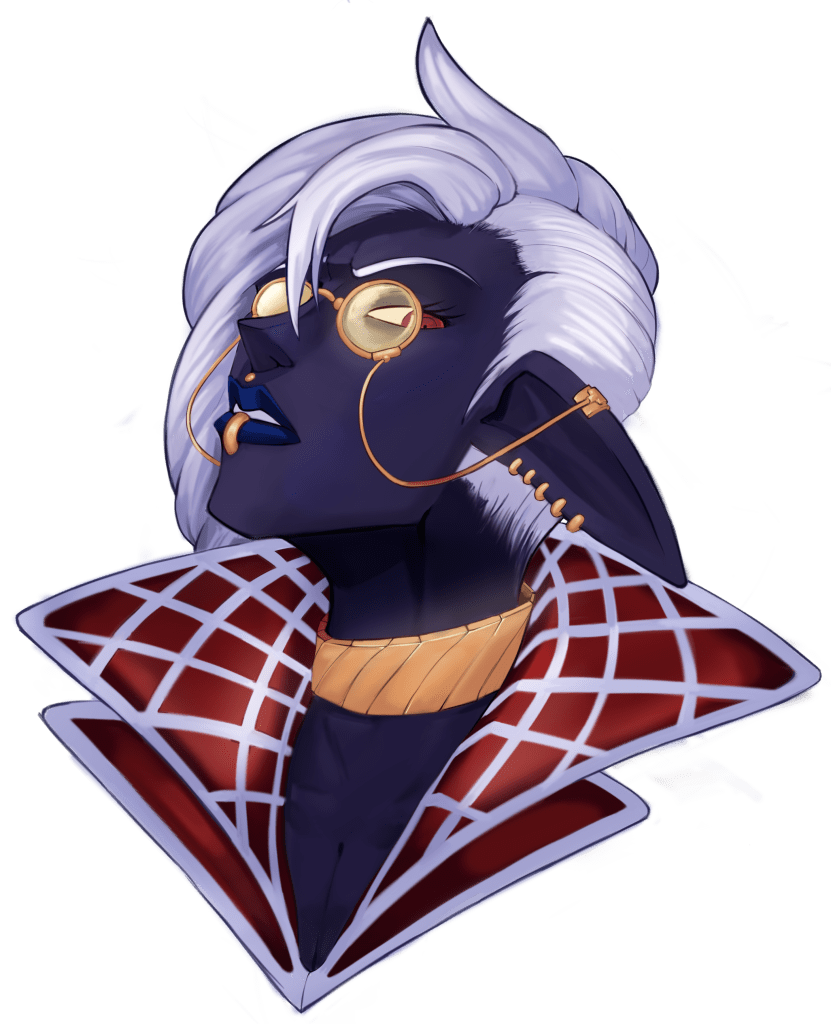
    A Drow Priestess wearing gold rimmed glasses chained to an ear piercing, with her head tilted back and looking down upon the viewer like she's offended that she's even in your presence.
    Illustration by Kazetier

    I’m going to use this generic name for the Drow Empire in the Underdark to avoid implication of canon, published source material. I also think, by writing this as a roughly generic “Evil Empire of the Dark Elves”, if any DM wishes to utilize the ideas and essays in the DezzyDark (my clever name for this corner of the multiverse).

    This distinction also serves another purpose related to my essay Half-Orcs, Half-Elves and Alignment . The Drow of the Empire of the Spider Queen are evil, and cruel and depraved because that is the society they have developed,a Theocracy that worships the Demon Queen of Spiders, a goddess of Chaos and Evil. Millennia of idolization have woven the Demon Queen of Spiders’ dogma into the very fabric of Imperial Society. But, the Drow are not cruel and evil from the womb.

    The Empire of the Spider Queen is a class society with Drow Priestesses of the Demon Queen of Spiders at the top and non Drow as second class and worse down to the enslaved at the bottom. This implies that the circumstances of a hybrid birth was not consensual.

    Half Drow Ancestries

    Imperial Society is hard on the Drow as a people. Being Elves, their natural birth rate is already low. Constant infighting among the different Households and Factions and Wars of Expansion is draining on the Imperial population. But, maybe due to some dark influence of the Demon Queen, Drow can successfully procreate with several different peoples within their Empire.

    When designing a character of mixed Ancestry, the following traits may be passed from the Drow parent. Some of these traits replace traits passed from the non-Drow parent, and in any case it is discouraged to add too many Drow traits to the resulting Half-Drow ancestry. The choice, as with most character choices, should be an agreement between the Player and Game Master.

    • Darkvision: 60 feet (18 meters) if the other ancestry does not have Darkvision, 120 feet (36 meters) if the other ancestry does have the Darkvision trait
    • Keen Senses: Proficiency with the Insight, Perception or Survival skill
    • Fey Ancestry: Saving Throws to avoid or end the Charmed condition are made with Advantage. Magic cannot force the character to sleep.
    • Drow Lineage: The following cantrip and spells are automatically known and are prepared. The spells may be cast once per day without expending a spell slot. Players must choose Intelligence, Wisdom, or Charisma as the spellcasting ability during character creation.
      • 1st Level: Dancing Lights cantrip
      • 3rd Level: Færie Fire spell
      • 5th Level: Darkness spell
    • Sunlight Sensitivity: A negative trait, when in direct sunlight, all Perception checks that involve sight are made at Disadvantage

    Half Drow/Human

    The most common hybrid ancestry in the Empire. Of all the enslaved people in the Empire of the Spider Queen, Humans are the most valued. Indeed, Drow will often raid the surface world for the purpose of abducting humans.

    • Type: Humanoid
    • Size: Medium
    • Speed: 30 feet (9 meters)
    • Traits
      • Darkvision: 60 feet (18 meters)
      • Resourceful: Gains Heroic Inspiration every time a Long Rest is finished.
      • Fey Ancestry
      • Versatile: Gain an Origin Feat of the player’s choice.
      • Sunlight Sensitivity

    Half Drow/Tiefling

    Another common hybrid ancestry. Abyssal Tieflings often find common cause with the Imperial Drow. Several families of Abyssal Tieflings have served Drow households for generations.

    • Type: Humanoid
    • Size: Medium (rarely Small)
    • Speed: 30 feet (9 meters)
    • Traits
      • Darkvision: 120 feet (36 meters)
      • Fey Ancestry
      • Resistant to Poison damage
      • Otherworldy Presence: Knows the Thaumaturgy cantrip.
      • During character creation, the player needs to choose between the Abyssal Legacy and Drow Lineage traits.

    Half Drow/Hobgoblin

    The Drow bear little respect for Hobgoblins, or any Goblinoid, considering them only useful for menial slaves. However, the shared connection to the Fae, allows for occasional hybrid offspring. Half Drow/Hobgoblin are used to command warbands of Goblinoids indentured to Imperial households. In Goblinoid Society, these hybrids often rise to positions of leadership, Cheiftains and Predarchs and Captains.

    • Type: Humanoid/ Goblinoid
    • Size: Medium
    • Speed: 30 feet (9 meters)
    • Traits
      • Darkvision: 120 feet (36 meters)
      • Fortune from the Many: On missing an attack roll, saving throw, or ability check, gain an immediate bonus equal to the number of allies visible within 30 feet (9 meters) to a maximum of +3. This ability can be used a number of times each day equal to the character’s Proficiency Bonus (refresh after finishing a Long Rest).
      • Fey Ancestry
      • Drow Lineage
      • Sunlight Sensitivity

    Half Drow/Orc

    An exceedingly rare hybrid, and many would say “cursed”. These unfortunate souls are not welcome anywhere, rejected by both the Imperial society of Drow and the Tribes of the Orcs. Both the Drow and Orcs consider one another less than people. Orc Tribes see Drow as another version of their cultural enemies, the Elves. Imperial Drow see Orcs as little more than beasts, unsuitable even for slavery.

    The Half Drow/Orc physical traits are not appealing when combined. They are misshapen, and considered ugly by the standards of either culture. Unlike other Drow Hybrids, the Half Drow/Orc are shunned and outcast. Living solitary, miserable, hidden lives in the deep tunnels and caverns.

    • Type: Humanoid
    • Size: Medium
    • Speed: 30 feet (9 meters)
    • Traits
      • Darkvision: 120 feet (36 meters)
      • Relentless Endurance: When reduced to zero hit points, but not killed outright, remain at one hit point. Can only be used once per day and refreshes after finishing a Long Rest
      • Menacing: Proficiency with Intimidation Skill
      • Savage Attacks: On scoring a critical hit with a weapon, roll one of the weapons dice an additional time and add the result to the damage total.
      • Fey Ancestry
      • Sunlight Sensitivity
      • Outcast: All non-intimidation social checks are made with Disadvantage

    Drow Cambion

    Cambion are not balanced with other character species options. Because of this, Cambion should be selected only with the agreement of the Game Master.

    In Imperial Drow society, the Cambion are the only hybrid Drow that are full citizens, but only those Cambion whose feindish parentage is enthralled to the Demon Queen of Spiders.

    • Spider Queen Cambion
    • Type: Humanoid, Fiend
    • Size: Medium
    • Speed: 30 feet (9 meters), Climb 30 feet (9 meters)
    • Traits
      • Darkvision: 120 feet (36 meters)
      • Tremorsense: 60 feet (18 meters)
      • Fey Ancestry
      • Keen Senses
      • Drow Lineage
      • Spider Climb: Can climb difficult surfaces, including upside-down on ceilings without needing an ability check.
      • Web Walker: Ignores movement restrictions caused by webs or webbing.
      • Fiendish Charm: Magically charm one humanoid hat can be seen within 30 feet (9 meters)for one day unless the victim can succeed with a Wisdom Saving throw against DC 8+ Proficiency Bonus+ Spellcasting Ability Modifier
      • Sunlight Sensitivity
      • Pull of the Pit: A cambion’s demonic ancestry creates a constant draw towards selfishness, cruelty, and evil. This creates a a Flaw Personality Trait that should the player choose to roleplay, and the consequences immediately and negatively affect the character or their companions, They gain Heroic Inspiration.
  • To Boldly Go

    To Boldly Go

    Building Chariots of the Gods

    The ships of Starfleet are heroes of the story almost as much as the people who crew them. With voice-interactive computers, holodecks, and by the 25th century, holographic crew, a Starfleet vessel (and presumedly, an Imperial Klingon Naval vessel, a Cardassian Union Vessel, an a Stellar Imperial Romulan Vessel) can have distinct personalities. In a Traveller game, most Starfleet vessels are firmly Capital Ship class, that is, over 10,000 dTons. Though there are plenty of smaller Adventure Class ships warping through subspace. The ubiquitous Runabouts stationed at DS9 are great examples of a Starfleet ship that masses about 100 or so dTons. For purposes of designing the navies in the Star Trek Universe, we’ll be leaning heavily on High Guard, and dipping into the Traveller Companion.

    Warp Speed!

    The Jump Distances in Traveller figure into Lightspeed (C) by a simple formula, Jump Value X 3.62 (light years) X 52 (weeks). For that week that a Traveller vesel is in jumpspace, they emerge at their destination at an effective speed of C (though the physics of Jump space vessels don’t actually travel faster than C).

    Once the speed in terms of C is known, Warp Speeds can be figured in different scales based on the era of Star Trek. In TOS and the TOS movies, the formula is the cube root of C. with no upper limit. In the TNG and later eras (though we haven’t heard much about the 32nd century’s scale.. more on that later), the formula is Warp Speed = Warp Factor 10/3 * C.

    When compared to Traveller, the various transluminal speeds look like this

    • Speed measured in C/ Jump Drive / TOS (Cochraine Scale) Warp / TNG (Okuda Scale) Warp
    • 189 C / Jump 1 / 5.74 / 4.82
    • 357 C/ Jump 2 / 7.23 / 5.83
    • 567 C / Jump 3 / 8.28 / 6.7
    • 755 C / Jump 4 / 9.11 / 7.3
    • 945 C / Jump 5 / 9.81 / 7.81
    • 1,135 C / Jump 6 / 10.43 / 8.25

    At one point, Voyager is reported at traveling at Warp 9.97 (Okuda Scale). This is roughly equal to Jump 25. Jump 8 allows crossing a subsector in a single jump. Which is Warp 11.18 (Cochraine) or Warp 8.99 (Okuda Scale).

    Whichever Warp Scale a Star Trek Campaign uses is only truly important in so far as the GM remains consistent. After all, in the series’ and the movies, the ships went as fast as they needed to go for the plot. Values were written to contrast the impression of speed. “Warp Factor 5” was relatively middle of the road. “Warp Factor 8” would often be accompanied by the sound effect of an engine hum to make it seem like the ship is pushing it’s limits. Since the Cochraine and Okuda scales differ, especially at the high end of the scale.

    Warp Drives and Dilithium

    The Warp 5 project started in the 22nd Century as chronicled in the Star Trek :Enterprise Series, at this time, the United Federation of Planets was not yet inaugurated, but Starfleet was in existance and acted as the Navy for a United Earth.

    By the 23rd Century, Warp Drives could routinely reach Warp 8 (on the Cochraine scale). And by the 24th Century, after adopting the Okuda Scale, Warp Drives could reach Warp 9.9 and higher.

    Warp Drives in Star Trek feature several fundamental differences from the Jump Drive in Traveller. Warp Drive does not leave the Spacetime it is in fully, instead it creates a Warp Bubble and travels through that subspace region to travel at superluminal speeds. Fuel for Star Trek vessels is not the massive holds of Hydrogen Feul that Traveller vessels use. Star Trek uses a much smaller mass of Antimatter (or in the case of the Romulan Imperial Star Navy, an artificial singularity). While the fuel for an Antimatter Power Plant does not demand as much fuel space as Hydrogen, but Star Trek ships are very hungry for power.

    Dilithium Crystal is a regulator of the matter/antimatter reaction. The crystals degrade through use and need to be refreshed often, so most vessels carry a supply of crystals. When that supply runs low, the vessel resupplies at a Starbase, or trades for fresh crystals at a nearby station or planet.

    For Star Trek Vessels, fuel capacity is measured in time rather than distance. The Warp Core (Power Plant) is the ship’s component that consumes both Antimatter and Dilithium Crystal. The Power Points the Warp Core generates, are what are spent in the Warp Drive, the Impulse Drive, shields, weapons, computers, life support, transporters, even the replicators. When designing a starship, most of the space that would be used for Fuel will likely be taken up by an expanded Power Plant.

    The Warp Drive functions the same as explained in High Guard pp. 80-81. It uses no feul, but a starship needs to generate power (with a starship the size of the TOS Constitution Class (60 dKTons) that runs into a little more than 10,000 power points) to use the Warp Drive.

    Shields Up! Arm Phasers! Load Photon Torpedoes!

    Most Star Trek vessels use Deflector Shields or Screens as their primary defense against weaponry. Using High Guard, Deflector Shields count as Improved Energy Shields in the 23rd Advanced Energy Shields (page 84). Most vessels designed for hazardous duty have multiple shields. Usually Six (Fore, Aft, Starboard, Port, Dorsal and Ventral which can overlap to cover each other.

    Phaser Banks function close to the rules found for Tachyon Cannon Bays in High Guard pp 82-83. In general Phaser Banks are higher powered and more versatile than Disruptors. In the 23rd Century, Phaser weapons are only used by the Federation and their allies. The rest of the Galaxy was using Disruptors. By the 24th Century, most every navy in the Alpha and Beta Quadrants had adopted Phaser technology for their starships.

    Disruptors are very common in the 23rd and 24th Centuries. Relatively simple to design and maintain compared to Phasers, Disruptors follow the rules found for Plasma-pulse Cannon Bays in High-Guard pp 82-83. Even in the 24th Century, when the navies of the Major Empires in the Alpha and Beta Quadrant have adopted Phaser weaponry as their primary weapons systems, Disruptors remain common for system and colonial defense fleets, merchants operating in hazardous regions, and of course, pirate syndicates.

    Photon Torpedoes, and the late 24th century development of Quantum Torpedoes were pioneered by the Federation. By the late 23rd Century, Photon Torpedoes had been engineered and adopted by the Klingon Empire.

    • Photon Torpedo
    • Tech Level: 23rd Century
    • Thrust: 15
    • Damage: 4DD
    • Power: 50
    • Traits: Smart, AP 15
    • Quantum Torpedo
    • Tech Level: 24th Century
    • Thrust: 15
    • Damage 8DD
    • Power: 75
    • Traits: Smart, AP15, Burst 10

    Photon Torpedoes use the rules for Antimatter Torpedoes in High Guard pp 39-41. By the 24th Century, the mass of a Photon Torpedo is reduced to 20% of it’s older design. That is, a 24th Century torpedo masses 15 torpedoes per ton. In the 24th Century, the photon torpedo launcher are capable of launching volleys of 10 torpedoes (use the trait AF10). Quantum Torpedoes have a greater yield and to reflect this, double the damage characteristic (12D). 23rd Century vessels are restricted to Barbettes and Small Torpedo Bays. 24th Century Vessels can mount Medium Torpedo Bays. In either era, only installations the size of Starbases or Deep Space Stations can mount Large Torpedo Bays. In the 24th Century, Torpedo Barbettes and Torpedo Bays are designed to be loaded with either Photon or Quantum Torpedoes.

    Plasma Torpedoes are a weapon infamously developed by the Romulan Star Empire. These weapons were first developed in the 23rd Century and had enormous destructive power at close ranges, but their damage fell off at longer ranges, eventually dissipating entirely.

    • Plasma Torpedo
    • Tech Level: 23rd Century
    • Thrust: 10
    • Damage: 6DD Adjacent/ 5DD Close/ 4DD Short/ 3DD Medium/ 2DD Long/ 1DD Very Long/ No Damage at Distant Range
    • Power: 90
    • Traits: Smart, Enveloping

    Enveloping Trait: The enveloping trait applies damage to every active shield upon detonation.

    By the 24th century some ships designed explicetly for battle began to carry spinal mount weapons. The Romulan Star Empire had refined their plasma torpedo into a powerful beam weapon that could deliver punishing blasts without the limitations of launching a boiling ball of plasma.

    • Plasma Beam Spinal Mount
    • Tech Level: 24th century
    • Range: Very Long
    • Damage: +14D
    • Power: +6000
    • Traits: AP 15, Auto 10

    Cloaks and Holodecks

    A technology developed in the mid-23rd century by the Romulan Star Empire, the Cloaking Device is just as infamous as the Plasma Torpedo. In fact, the two were initially designed to work in tandem with one another. Coming out of cloak to launch a torpedo at close range and returning to cloak to avoid return fire and position for the next attack.

    By the end of the 23rd Century, an exchange of Naval technology between the Romulan Star Empire and the Klingon Empire gave cloking technology to the Imperial Klingon Navy, and a fleet of mothballed D-7 Battlecruisers to the Romulan Star Navy. The Klingon cloaking device is in general less effective and less efficient than the Romulan. By the Khitomer Conferences, Starfleet had become very good at uncovering the Klingon cloak. While the Romulans continued to develop and refine their cloaked navy into the following centuries, presumably all the way to Unification.

    • Romulan Star Navy Cloak
    • Tech Level: 23rd Century
    • Stealth Effect: -15 to Sensor checks
    • Power: 50 per 1,000 dtons
    • Imperial Klingon Navy Cloak
    • Tech Level: 23rd Century
    • Stealth Effect: -10 to Sensor checks
    • Power: 100 per 1,000 dtons
    • Advanced Romulan Star Navy Cloak
    • Tech Level: 24th Century
    • Stealth Effect -25 to Sensor checks
    • Power: 75 per 1,000 dtons

    Replicators in the 23rd century produce nutritional food for every species on board ship. The fare focuses on compatibility, and primarily serves the needs of the species that comprise the polity the ship serves, and have a secondary capacity to serve guests and passengers. The fare is passable and is served in a variety of shapes and colors (looking very much like a ’60s version of “future food”)

    In the 24th century, replicators are advanced enough to accommodate the cuisine and tastes and cultural preferences of the person entering the order. The 24th century replicator also incorporates transporter technology. The food is generated and prepared within the recycling and reclamation matrix at the molecular level, heated (or cooled) to the desired temperature (again through molecular excitement within the reclamation matrix) and immediately transported to a micro transporter pad at the user interface. The ship’s computer maintains an extensive database of recipies as well as the personal modifications from more creative crewmembers.

    There are, of course limitations, Klingons, Kzinti and Gorn often complain that replicators do not produce live food convincingly, and their navies often maintain stasis holds with live prey to satisfy their instincts.

    By the 24th century, positronic computers have allowed for convincing personal interactions, and a combination of holographic emitters, localized electromagnetic force and specialized replicator use have resulted in the development of the Holodeck. Spartan navies like the Imperial Klingon Navy, Romulan Star Navy, (Cardassian) Union Navy and others consider Holodecks at best a frivolity and at worst a distraction. They do make use of the technology for shipboard training, and interrogation, but seldom for recreation.

    Starfleet, on the other hand has a Holodeck on nearly every vessel by the end of the 24th century. Some ships, like the Galaxy class have several. Smaller ships may be restricted to a tiny conference room, but Holodecks are a part of the crew morale and restoration policy. Ships that do not have a Holodeck are frequently directed to starbases or facilities with Holosuites to relieve the tension of long patrols away from suitable shore leave planets.

    A Campaign’s Ship is both Character and Home

    In a Star Trek campaign, the ship the characters serve aboard is as important and colorful as the characters themselves. When voyaging between stars, the ship is the characters’ self-contained world. When at the adventure destination, the ship becomes a base of operations, a source of supplies. While a given team of player-characters can be promoted (or demoted) to different ships, the nature of the Star Trek setting encourages each assignment to last long enough that the characters identify with the ship.

    Even in the 23rd century, a ship’s computer is capable of interacting on a personal level. Quirks can develop in a ship’s operating system through extended use as the ship’s database of personal logs, psychological and medical data and communications grow. In most cases these quirks are purged with routine overhauls and upgrades, however, some may persist, giving the character’s ship a distinct “voice” and persona to interact with. Most of the time, the ship is compelled to service of the crew. (Especially following the M5 incident, no one in Starfleet had a great desire to give command control over to the ships’ computer). But there are rare exceptions where the ship’s computer may become more insistent in it’s “service” requests phrased almost as orders, advice colored with agendas. It is up to the GM, and the players as to how much personality they would like their ship to have. With the addition of Holographic Crew, a ship’s computer could have one or more instances of itself among the crew, performing duties.

    Now, boldly go where no one has gone before!

  • A Sufficiently Advanced Technology

    A Sufficiently Advanced Technology

    Technological Marvels of The Star Trek Universe

    The major empires of the Star Trek Universe, even during the 23rd century (the era of Starfleet’s “Five-Year Missions”) displayed a Tech Level around 15. In the 24th and early 25th centuries that mean Tech Level does not change all that much. In Traveller, or at least in the Dezzy Traveller Universe, Tech Level is presumed to lie on a logrithmic scale, with each higher tech level representing exponentially more development than the previous. The scaling is mostly abstract, blending the existing scale of benchmarks with arbitrary assumptions. Traveller and Star Trek both are realms of imagination, and the rules sometimes don’t count.

    This causes a bit of a challenge when modelling Star Trek technology into Traveller terms. As mentioned, most of the Star Trek Universe is around TL 15. That gives a good “feel” to the far future technology. Impulse Drives, Computer Systems, Sensors, and such. Still, there are well established Star Trek technologies that are far beyond Traveller’s definition of TL 15. Antimatter, for example is TL 20 in Traveller, but it’s a fundamental power source in Star Trek. The common (though finicky) Transporter is TL 19. But the societies remain relatable to our 20th century experiences. I tend to equate most technologies in Star Trek to feel like the 3rd Imperium around 1105. Powerful personal computers, communicators, orbital and deep-space habitats. Gravity manipulation, all are pretty common for everyone wandering around the core systems of the various empires in Star Trek.

    We’ll Save Starships for Next Week

    There is an entire article that can be written about building the starships in Star Trek. Modelling Shields, Naval Weaponry, Warp Speeds and the like. We’ll address those next week. For this essay, I’m going to try to stick to more personal technology. The type that player-characters would be using on adventures.

    Tricorder Readings, Communicators, and the Universal Translator

    Let’s start with computers. The Tricorder is, in effect a portable computer with some high-end sensors, regardless of the Tricorder’s configuration (there are differences between the various specialty Tricorders, but overall, the function and hardware of a Tricorder remains constant). In Traveller, I’d call the Tricorder a TL 15 portable computer, that ranges in size between the pouch-portable box from the 23rd century all the way to a hand held carton in the 24th century that can fit in a convenient pocket. The Tricorder would have Computer/6 processing (which would allow it to support 6 Bandwith worth of software packages) and will be issued pre loaded with the Expert processes that reinforce the Tricorder’s purpose. It masses between roughly 1.5 kg (for the old box on a strap) to maybe .1 kg. It has incorporated in it’s hardware, a variety of sensors. Densinometers, Geiger Counters, Bioscanners, Neural Activity Scanners, EM Probes and even more specialized sensors. Tricorders are furthermore capable of analyzing data they have gathered through their sensors and data from a seperate computer (like a ships’ computer, or a mainframe) and using their Expert processes, draw conclusions and even limited speculation.

    Communicators also vary in size. From the hand held devices with a flip screen antenna of the 23rd Century to the badge communicators of the 24th and 25th. They are uniformly small, and their mass, even as the hand-held communicator, is negligible. Communicators have an orbital range and are powerful and sophisticated enough to transmit and receive through all but the most intense interference. Of course, most people who use Fleet issued communicators (whether Starfleet, the Imperial Klingon Navy, the Cardassian Navy and so on..) often are trying to use their communicator within the most intense interference. Apart from the communicator’s form, the only real difference between 23rd Century and 24th Century communicators is the integrated Universal Translator. A communicator also has an integrated Computer/1 (23rd century) or Computer/3 (24/25th century). 23rd century communicators commonly have the Intelligent Interface Software Package installed, so the user can flip it open and open communications with a spoken phrase. 24th century communicators add Intellect/1 and Translator/1

    The Universal Translator in the 23rd century is a self contained device around .5kg and is portable. By the 24th century communicators have Universal Translators (as already mentioned). The Universal Translator is a Computer/3 with Translator/1, Intellect/1 and Intelligent Interface software packages. Most ship’s computers in the Star Trek universe have the software packages for Universal Translators loaded as part of their general software. Which allows for verbal and written communication on board ship without the need for a separate device

    Phasers, Disruptors, and Other Things That Go “Pew-Pew”

    Energy weapons in the Star Trek Universe are very effective and deadly. Energy weapons configured as pistols, carbines or rifles have effectively unlimited ammunition for any given engagement. Exhausting a weapon’s charge is a complication the GM introduces in a given scenario.

    Disruptor style weapons (the type used primarily by the Klingon and Romulan Empires, the Cardassian Union, and pirate syndicates) simply incapacitate on a successful hit. If such a target isn’t given immediate first aid, the target will die. Assuming the weapon doesn’t disintegrate the target outright. Whether or not a target is vaporized by a disruptor blast is a matter of the intensity the weapon’s output is set at. Sometimes, you need a body after shooting it.

    Phaser weapons are far more versatile than disruptors. In combat, a phaser can be set to “stun” which will, upon a successful hit, incapacitate most targets (some especially large, robust, or strong targets can resist a phaser set to stun). A target incapacitated by a phaser’s stun setting is rendered unconscious for ten to fifteen minutes before recovering with a really nasty headache. A hypospray injection of a stimulant will wake a stunned target immediately (with the same nasty headache).

    When set to kill or disintegrate, a phaser functions in the same manner as a disruptor weapon. Unlike disruptors, a phaser can also be used to cut or burn through hardened materials or heat objects until they glow and provide heat similar to a campfire (useful in a survival situation). There is a smaller phaser configuration, the Phaser I, which is a palm-sized weapon, easily concealable and non threatening. These small phasers are limited in effective accuracy and charge. Phaser I can support roughly 20 discharges on stun setting, 10 on kill setting, 5 on disintigrate setting. It can maintain a heated object for one hour per remaining charge, and can cut through up to 5 meters of reinforced bulkhead over the course of 10 minutes.

    In Traveller terms, the disruptor weapons are TL 16 (like a Disintegrator), and phaser weapons are TL 17.

    Armor

    Personal armor is uncommon, but not unheard of. Starfleet Security often wears reinforced uniforms with close-fitting helmets. Klingon warriors wear heavy mesh armor as a part of their uniform. Cardassians have distinctive breastplates. Romulan junior officers often wear close fitting helmets.

    In an environment of energy weapons that kill or disintegrate when they hit, this seems like a needless extravagance. However, a great deal of personal combat is done hand to hand with clubs, knives or unarmed strikes. In these instances, having a solid helmet or a reinforced tunic might turn a blade or cushion a blow. Most armor would fall into the categories of Jack or Mesh. Maybe in extreme cases like the Breen, Combat Armor.

    Vacc Suits, or Hostile Environment Suits are also very common. They usually impose negligible encumbrance on the wearer and can be outfitted with a wide variety of sensors, computers and communications devices. Powered armor, like Battle Dress is not a common sight, even the Jem’Hadar, the Dominion’s endless ranks of ground troops do not use powered armor.

    Medical Technology

    In addition to the Medical Tricorder, most medical officers carry a first aid kit with a hypospray and a pharmacy of medications used in the field. With Transporters being common, first aid is intended to stabilize a patient long enough to be transported to a medical bed in sick bay. This colors the medkit.

    Medkits in the Star Trek Universe are TL 15, and provide a +3 DM to any check to perform first aid. This means that even an unskilled person can use a medkit to attempt first aid with their non-proficiency penalty fully balanced by the supplies and the instruments in the medkit. When attending to a dying patient (all physical characteristics reduced to zero) a successful first aid attempt using a medkit will stabilize the patient, returning one of their physical characteristics to 1 immediately.

    Medkits in the 24th century have mico-replicators that when used with a Medical Tricorder can replicate dosage for any medical drug needed at the time. In the 23rd century, medkits contain doses of the following drugs for the hypospray

    • Anti-Rad
    • Medical Fast Drug (slows patient metabolism by a factor of 60:1 Placing them in a state of suspended animation for prolonging life support) 60 days pass while the patient subjectively experiences a single day.
    • Universal Vaccines, Antibiotics and Antivirals
    • Panaceas
    • Medical Slow Drug (increases patient metabolism by a factor of 30.) A medical bed or sickbay is necessary to make use of this drug. The patient will experience 30 days of accelerated healing in a single day. However unless treated with the resources of a medical bed (normally inducing a coma) the increased metabolism will cook the patient’s internal organs and brain.
    • Stims
    • Non-Federation medkits also have a supply of Combat Drugs.

    Resistance is Futile

    The Borg break a lot of these assumptions. They are cybernetically enhanced, networked into a communal matrix, and in general use higher Tech than the other empires in the galaxy. While the empires in Alpha and Beta Quadrants are around TL 15 by the 24th Century, the Borg are closer to TL 19 or 20. Borg technology is a bit beyond the scope of this short article, but GMs can feel free to use whatever unfair advantage their devious little hearts can dream up when sending The Borg after their player characters.

    A Glance Into the 32nd Century

    In the post-burn galaxy of the 32nd Century, the Star Trek Universe has advanced to at least TL 20. Teleporters are commonly used for inter-ship and inter-facility instantaneous travel. Programmable Matter can generate any needed device with just a command. Artificially designed sentience is self-replicating and have become species’ unto themselves.

    Until next time, Go Boldly, Live Long, and Prosper!

  • Infinite Diversity, Infinite Combinations

    Infinite Diversity, Infinite Combinations

    Using Traveller to Run a Star Trek Campaign (Part 2)

    The Galaxy of Star Trek has a bewildering variety of new life and new civilizations for a crew of player characters to seek out as they boldly go where no one has gone before. Especially in a Starfleet centered campaign that diversity will be front and center on display. Using the Traveller rules, it is not difficult to create a species for players to use. Modiphius has also recently published a Species Sourcebook for Star Trek Adventures, which is an excellent resource (obviously) for adapting the different species to Traveller.

    Vulcans Break the System

    When running a Star Trek game, character balance is not the point. Species are not all created equal. Vulcans (and Romulans) I’m looking at you.

    Vulcans (even mixed-species Vulcans like Mister Spock) have big bonuses to Strength, Endurance, Intellect, Education and have Psionic training in their backgrounds. Though I think Vulcans are limited to Telepathy and probably Awareness. I cant think of any Vulcans displaying Clairvoiyance, Telekinesis or Teleportation.

    As mentioned last week, the Vulcan Science Academy is exclusive to Vulcan students, and is a far better University than what other educational institutions offer. Vulcans also live over 200 years (on average), sometimes approaching 300. Add to this the “Vulcan Nerve Pinch” which could be a variation of Telepathic Assault with the range reduced to Personal. This also conveniently explains why non-Vulcans cannot normally perform the attack.

    Humans and near-Humans

    Most of the sophonts in the Trek Universe are human (at least in the Federation) are “human”. They may be from Rigel or Proxima, or Utopia or any number of colonies and systems that present human parallel evolution. For purposes of species, these all count as Human. Cultural and Ethnic diversity can account for different background skills, but for purposes of Starfleet characters, they count as human.

    Near humans are those non-human species that are so similar to humans that, like human characters only minor changes to their background abilities are really necessary. Betazoids, Bajorans, Cardassians, Orions are examples. They are not especially more or less strong, dextrous, intelligent, etc.. than humans. Their cultures make relatively minor adjustments to their character generation (Betazoids, for example, start with Psionic Training and Telepathy presented as reading emotions)

    Uplifted species like Terran Dolphins, Great Apes and Beluga also work well in Star Trek (just travel down to Cetacean Ops and party with Lieutenants Kimolu and Matt if a wanna know). Traveller already has templates for uplifted Terran species so adapting to Star Trek becomes that much easier. In the Star Trek Dezzyverse I’d allow Vargr because they are, in the Traveller Universe, an uplifted species from Terran Wolves. Also, I like Vargr and I think they ‘re neat. After all, if a Ferengi can join StarFleet, a rough-around-the-mange Vargr can join too.

    Non-Humans and Aliens

    Non humans are a category of sophonts that have fundamentally different characteristics and abilities from humans. Kzinti, Gorn, Ferengi, Klingons, Andorians, Tellarites. They are in general different enough from human that they have positive and negative Characteristic adjustments and abilities. The Kzinti in particular have a strong parallel in Traveller with the Aslan.

    Especially as the Star Trek Universe expands into more, shall we call them “Mileus” the variety and expanse of represented species expands far beyond the human and-near human. Star Trek Crew can venture beyond the humanoid, or even carbon-based forms. In one of the Star Trek comic book series, there is a Horta Bridge Officer on the Enterprise for a time. There’s a Medusan and a Brikar who join Starfleet in Star Trek: Prodigy. Some of these more extreme examples may be a challenge to model, but, like with Vulcans mentioned earlier, game balance is really not the point. Just work with your players to make something interesting and fun that satisfies their character idea.

    Of course, when discussing non-humans, Star Trek has plenty of examples of artificial, or engineered life. Androids like Data, Photonics like SAM, Ex Borg, Cyborg, the list goes on and on. In Traveller there are multiple resources to model these forms of life. From the rules in the Robot Handbook all the way through the campaign adventure Singularity. Of course, this brings up the question of Starfleet’s Tech Level, which we’ll be covering next week.

    Infinite Combinations

    The thing I absolutely love about the direction Star Trek has gone in Strange New Worlds, Discovery, and Starfleet Academy is how the Federation and Starfleet are no longer presented as majority human. It was impractical back in the 1960s and even the 80s and 90s to have too many radically non-human characters. And even the diversity, especially in the Original Series and Next Generation era was mostly focused on Earth culture of the time. James Kirk was famously from Iowa, William Riker, Alaska, Pavel Chekov was Russian and Nyota Uhura was Kenyan.

    As Star Trek has developed, not only were the species of the characters expanded, but where they came from got a more attention. Tasha Yar was from a colony where public security had broken down completely, Worf was an orphan raised by a human Russian couple, Deep Space Nine dealt with people recovering from a brutal Cardassian Occupation, Voyager XO Chakotay came from Trebus colony, Seven of Nine was a colonist from Tendara colony (before she was assimilated and subsequently recovered from the Borg). The point here is that players should be encouraged to explore the breadth of Star Trek’s potential through their character’s culture instead of leaning heavily on present-day cultural stereotypes. Nothing is entirely wrong with being proud of where you were raised, but Chekov has pretty much overdone the stereotypical over-the-top Russian for everyone at this point. If a player wishes to use an Earth culture (even if it’s a transplanted Earth culture onto a distant colony world), just tread lightly. Remember that if an existing culture is being used, real people, some of whom may be at your table, or at your convention, or are in your local Star Trek gaming community may belong to that culture. Be respectful.

    The existing promise of Star Trek, the Federation, and Starfleet is that all of these cultures, all of these People can coexist and work together. There is still conflict, and there are still a host of prejudices that the peoples of the Star Trek Universe continue to hold in their hearts. But the hope remains that the future continues to progress towards inclusion and diversity. Live Long and Prosper!

  • Into the Black

    Into the Black

    Tell Them I’m Not Coming Back

    In the World Builder’s Handbook, there is a section regarding “empty” parsecs on Traveller navigational maps. In summary, “empty” parsecs are anything but. It’s likely more accurate to describe these parsecs as non-commercial. There are no easily navigable stars to jump toward, or gravity wells for maneuver drives to interact with. The result for ships jumping in is the promise of a difficult arrival in system, and a long, slow acceleration to go anywhere.

    These same circumstances apply in parsecs that have systems with active travel. Except that most jump and maneuver traffic never venture beyond the primary system’s gravity well.

    As described in the World Builder’s Handbook, there are plenty of potential gravity anchors to jump to. White Dwarfs, Brown Dwarfs, Rogue Planets (including Gas Giants), Asteroids are just a few, in a volume of more than 30 cubic light years, there is abundant room to add objects to draw Travellers into their next adventure.

    Bridging the Gap

    Some empty parsecs lie between two (or more) trading mains in a region. It is possible, even probable that Jump 1 traders would simply carry enough extra fuel (sacrificing cargo space, or using external fuel bladders) to make the extra jumps in series. However, in those parsecs that experience heavy pass-through traffic, a bridge station can be built.

    At minimum, a bridge station is the equivalent to a Class C Starport. Capable of docking 6,666.27 dTons of ships at once. They are often in orbit around Brown Dwarfs or Gas Giants and maintains a small fleet of skimmers to pull unrefined fuel off the high regions of the atmospheres. Bridge Stations that are heavily traveled will incorporate Fuel Refineries to offer Refined Fuel.

    Bridge stations will also have some basic maintenance facilities for civilian ships. Prices are often elevated, often double the normal cost of maintenance and repair elsewhere, but when a ship needs repair in-between established systems, the Captain pays what they need to in order to keep flying. Crew Accommodations, Brokerages, Storage, Hiring Halls, and an a variety of services are built into bridge stations. A successful bridge station eventually expands to accommodate nearly any service that a trader and their crew might need.

    Microjumping

    It is difficult and dangerous to jump within a parsec. As described in the World Builder’s Handbook, jumping through a cluster has a 1D penalty to Astrogation checks that changes every day. Jumping within a parsec would suffer a similar penalty. Jump computers aren’t designed for such short jumps, and work best when using a gravity anchor to calibrate arrival from out of Jump Space.

    Regardless of the distance jumped, a ship will spend ~168 hours in Jump Space. Fuel consumption for the jump is equal to 40% + 1Dx10% of a full Jump-1. These microjumps are impractical for any distance below 1 LY. (which is roughly (very roughly) ~ 25% of the distance across the breadth of a parsec). A microjump does not save time and is not fuel efficient. But, there are times where jumping to locations within the parsec is necessary.

    Pirate Bridges

    Pirate fleets, if they enjoy enough success, or become large enough can use an empty parsec as a location for a hidden bridge. A base station where pirate vessels can strike from and escape to. These pirate bridges also serve as a trading hub for stolen cargo, mixing and obfuscating the goods to a point where it becomes nearly impossible to track their theft. “Pirate” brokers negotiate sales of stolen cargo to willing buyers.

    It would seem, from an overview of an empty parsec on a subsector or sector map, that establishing a pirate bridge would be easy, even inevitable, to discover by the local Navies, and subsequently eliminated. After all, if a known pirate fleet uses Jump 2 ships to attack trade lanes, and there is an empty parsec within Jump 2 of several victimized systems. The Naval authorities can easily triangulate the parsec and send an anti-piracy task force to eliminate the threat.

    Keep in mind, a parsec is a volume of 30 ly3. enough space that can contain thousands of Sol-type star systems. As Douglas Adams famously said,

    “Space is big, it (the Guide) says. Really big. You just won’t believe how vastly, hugely, mind-bogglingly big it is. I mean, you may think it’s a long way down the road to the chemist’s, but that’s just peanuts to space.” (Why yes, I was looking for an excuse to use the famous quote from Hitchikers Guide to the Galaxy and I apologize for nothing.)

    Point being there’s a lot of space in space, and using Maneuver Drives, even the fastest Maneuver Drives need centuries to cross a single light year. So, unless the precise coordinates of the pirate bridge can be uncovered, simply knowing which parsec it floats in won’t reveal it’s location.

    Toll Bridge, Troll Bridge

    Building a bridge station is extremely expensive. Materials are sourced from the target parsec as much as possible. Because of this, many bridge stations are built within buffeted asteroids towed into orbit around a rogue gas giant. Even using raw materials mined from nearby sources, manufactured components need to be delivered from outside the parsec. Which is an intense logistics effort.

    Once operational, bridge stations charge premium fees for services. Nickel-and-diming ships that come through for everything, from berthing fees, fueling, and resupply, to restaurant meals, bar drinks, and rest stations. Think about the services (hotels, restaurants, bars) that surround major airports, or the services offered within major airports.

    Pirates often lurk near the jump points to the bridge station, obstructing incoming ships and extorting a “toll” for access to the station. These pirates don’t hijack or take their victim’s entire cargo. That would attract too much attention from the station’s security and reduce overall traffic.

    The same logistical challenges to build a bridge station in an empty parsec also affect protecting the station. Every security ship docked with the station, takes up docking space that can be used for revenue. Thus, bridge stations will keep as few vessels as possible on patrol at the station. Most of the time a single System Defense Boat, or a small squadron of Light or Heavy Fighters. Most of the time it’s easier (and cheaper) just to pay protection to the regional pirate fleet.

    Getting a message out from a bridge station to a neighboring parsec takes a minimum of one week. The response to that message will take a second week. Thus, for fourteen days, bridge stations in empty parsecs are on their own in an emergency.

  • Quick, Send in the Clones

    Quick, Send in the Clones

    They’re Already Here

    Cloning has been a part of Science Fiction for a century. Pod people, Engineered populations, Teleportation accidents, Parallel dimensions, the ways clones are imagined go on and on. The literary vehicle of clones and cloning has been used to explore the questions of identity, personhood, and society

    Traveller is no different. There have always been clones in Traveller. Every way that clone could be grown in fiction can be found somewhere in Charted Space. But for purposes of this essay, we’re going to focus on “engineered” clones. That is, clones created from genetic material from a host and grown in an artificial womb. The technology required for this method of creating clones is fairly low. TL 10. This will produce a viable clone, reliably, as an infant after a normal gestation.

    There Should be Clones

    Creating a clone-baby of yourself isn’t any more expensive than any other artificial method of gestation (at least at TL 10). Roughly KCr 50 depending on where the procedure is performed. This process does not include accelerated gestation or growth. The parent donates some cells, and 40 weeks later, there’s a newborn clone baby.

    Accelerating gestation and growth brings risk and costs credits. At TL 10 or 11, accelerated gestation reduces the reliability of producing a viable clone. Starting at TL 12, gestation can be accelerated to 80% of normal gestation for the cloned species. That time can be further reduced at higher Tech Levels; TL 13 = 60%, TL 14 = 40% and at TL 15 = 20%.

    For human clones this becomes 40 weeks at TL 10-11, 32 weeks at TL 12, 24 weeks at TL 13, 16 weeks at TL 14 and 8 weeks at TL 15.

    Starting at TL 13, a clone’s growth can be accelerated to physical maturity during gestation. (this is 18 years for many species, including Humans). This results in the newborn clone being born with the host’s STR, DEX, END, and INT stats being equal to the value they were when the host was 18. The SOC value will be addressed later (because the different people of Charted Space have opinions regarding Clones, few of them positive.) EDU, unless the clone is subjected to uploaded education and training, it’s EDU begins at 0 (like a newborn infant). Clones can be educated in a similar manner to other members of their society. Usually 12 years of primary education. Which will result in an EDU of 2D when they are ready to pursue Pre-Career Education (which would make most force-matured Human Clones 13 year old).

    Subjecting the clone to accelerated gestation and growth negatively affects their aging. Accelerating Gestation adds a Term of service when calculating aging effects. Accelerating growth adds a second term. One does not necessarily need the other. Accelerated growth can be induced with full-term gestation.

    When a clone reaches maturity there is a possibility for variance in the clone’s characteristics from their host. Roll 8+ for STR, DEX, END, and INT with a -2 DM for accelerated gestation and a -2 DM for accelerated growth. On a success, the characteristic value is equal to the value of the host for that characteristic at ate 18. On a failure, roll Flux and apply the result to the characteristic. If the result reduces the characteristic below 2 or above 15, the clone is unviable and the process needs to start anew.

    Accelerating gestation costs KCr 20. Accelerating Growth costs KCr 50.

    During gestation, a clone’s STR, DEX, END and INT can be increased at a cost of KCr 10 per point of increase. The cost for increasing the clone’s stats are paid and applied before rolling for variance.

    Flux is a die mechanic borrowed from Traveller5.10. Roll 2 dice, one designated “Light” and the other “Dark”. Subtract the value of the Dark die from the Light. This will produce a probability curve equal to 2D6 with a value range between -5 and +5 with a mean value of 0.

    This process for creating clones is different from the process found in Traveller5.10 and the Robot Handbook. This process is not a replacement for either. It is a framework of an option that can be built on.

    Clone Show

    At TL 12 a sophont’s personality can be recorded (and edited). This allows for a newborn clone before they can develop their own personality (a “blank”, as is commonly called) to be imprinted with a prerecorded (and possibly edited) personality. Also at TL 12, Wafer Jacks can be implanted to provide immediate (if temporary) skill. At TL 14 this process can be made permanent and non-invasive through neural induction.

    Accelerated creche training is a combination of educational immersion, subconscious learning, and enhanced indoctrination. At TL12, the process cuts the time needed to complete primary education in half, six years instead of twelve. At TL13 the process cuts the time requirement by half again, 3 years. At TL 14 the process is reduced to a mere year-and-a-half. However, creche training, while providing the background skills common to most societal requirements, does not provide any socialization.

    At TL 14, it becomes possible to imprint a persona and the memories and skills of the host to a clone body. This process costs MCr 10 per term of service the host has experienced. The process takes a half-year (182 standard days) per term imprinted. After imprinting, the clone will have an EDU score equal to the host’s.

    Clones in Society

    Since the inception of cloning technology, clones have been considered something other than a naturally born, or artificially born individual that conforms to a species’ reproductive method. For clones created through the engineering process we have been exploring in this essay, most cultures (Imperial going back to the Ziru Sirka, Confederation, etc..) visible markings (sometimes open, other times, discrete, depending on the clone’s purpose) are recorded on their bodies.

    Still, even with clones whose bodies lack such identifying marks, they can still be identified genetically by any facility of TL 10 or more. Specific identification requires a more rigorous genetic examination that relies on the Tech Level of the examiner’s equipment being equal to or greater than the Tech Level that created the clone. Once identified as such, the clone’s SOC Characteristic is reduced by 1, once the information becomes public knowledge. Sometimes the reduction in Social Standing is more extreme, based on the circumstances of the society at the time.

    For example, there is a “Solomani Purity” faction within the Solomani Movement. They have a strong dislike of clones, considering them a debasement of the Solomani genetic legacy. Clones in environments where The Solomani Purity faction enjoys influence and power in society suffer a -3 penalty to their Social Standing.

    The Domain of Vland covers much of the old Ziru Sirka and is very tradition bound. The culture surrounding clones is similarly restrictive due to the implications on family structure. Clones in this Domain suffer a -2 Penalty to their Social Standing.

    Some locations, mostly frontier sectors like the Spinward Marches or Reaver’s Deep do not suffer the same prejudices for clones. Out in these younger societies, the need for population exceeds the “luxury” of judging how the citizens came to be. Social Standing may not be affected by a clone’s origin.

    As ugly as it may be, slavery and indentured servitude remain common institutions in the various polities of Charted Space. Clones can be created and engineered for the express purpose of being a disposable population that can be used for labor exploitation. Or cheap, cannon-fodder armies. Clones that are engineered for this purpose are often prominently marked as such and have a SOC of 0. The “Underworker” from the Robot Handbook for Mongoose 2nd edition for an example.

    Clones of Clones of Clones.

    Sometimes, especially in the black markets, Clones are not made from original sources. Sometimes, genetic material is taken from an existing clone to make a new generation of clones. As this process iterates, the later generations of clones become less viable and more subject to mutation and recession.

    When checking for “variance” as described above, add a -2 DM for each clone iteration after the original host. Furthermore, if variance is present, apply a -1 DM to the Flux Roll for every clone iteration after the first. EVEN furthermore, iterated clones suffer an extra Term for every clone iteration after the first for purposes of Aging Rolls. Finally, the referee can add any number of creative mutations, mostly harmful, but, on occasion, beneficial. Genetic Dynasties have an expiration date.

    I, Clone

    Playing a clone as a character is similar in many respects to playing a Robot. Clones can be partially engineered, and creating a clone as a character can be a process similar to creating a robot.

    Or, a player can generate a character’s characteristics normally (rolling 2D for each Characteristic) and choose to declare that the resulting character at Age: 18 is a clone and proceed with their life path from there. Using this method, the player can apply some of the methods discussed in this article. Accelerated gestation and/or growth. adjusting their lifepath accordingly. (I think it’s mentioned that a human clone that has benefited from accelerated gestation and growth is 13 years old when they select their Background Skills).

    Players can also chose to consider their lifepath generation to be partially or completely with accelerated creche training. With this option, any term generated this way does not receive an Event, or a Mustering Out Benefit. Failing a Survival check for a term can either mean the clone proved inviable, and the process needs to start over, or the Mishap can be read in the context of a complication from the training process.

    Using an implanted persona and memories will generate Term Events, but Allies, Contacts, and Enemies that result are the associations with the original host. The clone is aware of those NPCs, but how they react to the clone’s new lease on life may be different than what the player would normally expect.

    Finally, all cloning costs are borne by someone. Either the host (and is thus deducted from the host’s Credit Balance, or the institution that created the clone, or as debt the clone owes someone for the cost of it’s creation (often a method of control used against a clone population).

    Happy Cloning!

  • Dancing at the End of Time

    Dancing at the End of Time

    The cosmic struggle between Law and Chaos comes to Traveller

    Somewhen in spacetime. Outside of the linear flow that most sentients experience, parallel to the physical universe and the higher dimension known as jumpspace, there is a place where the original creators have long since transcended beyond their Technological Singularity. Still the pocket dimension remains, where spacetime, quantum mechanics, and the fundamental forces of the universe are but tools that can change the state of matter and energy here for those who know how to use them.

    Its known by many names over the breadth of the Multiverse; Tanelorn, Shamballah, Xanadu, the Q Continuum, the Nexus, the Convergence, and untold others, but for purposes of this essay we’ll refer to this pocket dimension by the evocative term;

    The End of Time

    Law, Chaos, and the Balance

    Tension between the Cosmic forces of Law and Chaos play out over uncountable universes. Law is the force in the multiverse that gives structure and order. Law is what enforces the fundamental interactions of gravity, magnetism, matter, Law dictates the motion of the universe. Chaos is the entropy that permits change and endless variation throughout the universe. Without Law, nothing would exist within a stable form, everything would be a protean miasma of continual, unending permutations. Without Chaos, nothing would ever change, life would end, death would end, the universe would calcify into an unending singularity. For the universe, even the multiverse to exist at all, Law and Chaos must co-exist and the tension between them being the source of all motion. This state of tension is referred to as the Cosmic Balance.

    Cosmic Balance is never absolute, nor permanent. It is always shifting toward Law or Chaos as the influence of these poles wax and wane within any given expression of the multiverse. When Law or Chaos becomes too dominant, the Cosmic Balance is lost, and the Universe there spirals towards destruction.

    This, for the most part is beyond the scope of most Traveller Campaigns, it’s the background radiation of the universe, it’s there, it can even be perceived after a fashion, but the characters and the events in their adventures never directly affect the Cosmic Balance.

    Until they do, of course. Which is where Champions of Law, Chaos, and the Balance come into play.

    I’m the Cosmic Champion, and I Hold a Mystic Sign

    Let us return for a moment to the End of Time described earlier. Although the civilization that built the End of Time have transcended to a higher plane of existence, their greatest achievement continues to endure. Over ages and eons, the End of Time has been rediscovered by philosophers, psionic explorers and researchers that have probed the limits of their realities. They have learned that from the End of Time, a material being can observe the whole of the (Traveller) Universe from the big bang to it’s ultimate expiration. Those who retained their sense of self-identity in the face of eternity became a fellowship of adventurers and explorers who champion the cosmic Balance and strive to maintain it.

    They call themselves the Dancers at the End of Time. From their City, they search for imbalances that threaten the equilibrium of Law and Chaos, and if such an imbalance is detected in the timeline, the Dancers respond. Their operatives are represented by an endless variety of sophont species from civilizations across the breadth of time and space equipped with Tech Level Z gear and vehicles to address crises across the breadth of spacetime.

    There are champions of Law and Chaos as well. Mortal sophonts who are recruited by powerful representatives to serve the designs of Law or Chaos. Like the Dancers, these champions are often equipped with technology of Tech Level Z (or very near Z) that give them abilities that are indistinguishable from Magic, even in advanced civilizations like Charted Space in IY 1105.

    Are there Gods in the Traveller Universe?

    Not in the sense of how the term “Gods” is used in the classic Fantasy Role Playing sense. Still there are powerful species that can be found throughout the Galaxy that, to a sophont in Charted space may as well be “Gods” because of the vast difference in technology, evolution, and understanding. At these near Technological Singularity Tech Levels the advantages of supporting the designs of Law or Chaos can be realized. The danger of pursuing the dominance of Law or Chaos, is that the more a champion succeeds in pushing the forces they serve, the more they themselves are transformed by those same furies. These entities are the powers that actively strive to upset the balance between Law and Chaos, and they are the beings who lend their power and resources to Champions and Cults. See last weeks essay Have You Seen the Yellow Sign? for thoughts on Secret Societies and Cults in Traveller.

    The vast majority of people living in Charted Space will never know of the influence of Law, Chaos and their balance in the Universe. They will never be aware of how the struggles between Law and Chaos affect them. At least until it’s almost too late and the universe starts to succumb to the effects of unchecked Law or rampant Chaos.

    Introducing the Cosmic Struggle to Traveller

    Most campaigns don’t lend themselves to these extreme stories. A campaign like Cluster Truck doesn’t concern itself, either during it’s adventure or in the epilogue. However Secrets of the Ancients, can open the possibility of involving the Travellers with the struggle. Using Champions and Cosmic Law, Chaos, and the Balance in Traveller involves very high (like Grandfather Tech Levels, or the various elder civilizations that surround Charted Space or exist at the Core.

    Interacting with Champions or the Cosmic Servants is a reality-bending scenario. Even forging pocket dimensions is childs’ play at this scale. Finding and exploring the City at the End of Time can be a whole Campaign in and of itself.

    Using the Dancers

    The Dancers at the End of Time are a mysterious group. Their motivations may be obscure at best, working with, or against the Travellers from one encounter to the next. Sometimes the Dancers are on a mission to restore or protect the Cosmic Balance, other times they’re using their ultra-advanced technology to explore and adventure in the Cosmos for their own pleasures. They are both operatives that protect the ability for reality to continue without collapsing, and they are decadent adventurers who use their advanced resources for their own pleasures, “slumming” in the backwater regions of the Galaxy among primitives.

    Playing as one of the Dancers, or as a Champion of Law or Chaos is possible with some work in Traveller. If the group has access to Traveller5.10 there are design systems that support using Technology all the way to TL Z. In short, a campaign featuring Dancers as the Travellers would draw a lot of inspiration from E. E. Doc Smith’s Lensman series, the Green Lantern Corps, everything that has been presented as the Q Continuum, Zelazny’s Amber series, Dr Who, and of course, Moorcock’s Dancers at the End of Time trilogy. So close to the Technological Singularity, the Travellers’ abilities would resemble super-powers. Although the mechanics of Traveller can, with some work, support campaigns at this scale the setting does not. Not directly at least.

    The Third Imperium setting in 1105 is far too small, far too primitive to contain a Dancers campaign. At the extreme tech levels that the End of Time implies, almost anything is possible, what’s more, almost anything is commonplace. Dancers are a campaign type in and of themselves. They investigate anomalies and resist the efforts of Law or Chaos to become dominant. While Dancers can interact in the political arena, outmaneuvering Archdukes and First Councilors, the objective is not to rule a system, or even a sector. Those goals are too small when the City at the End of Time is the character’s home and all of time and space is open to adventure in. Dancers adventure within the Event Horizon of a black hole. They confront Elder Beings that are corrupting the very stars themselves. They don’t start or end wars, they contain the spread of an irresistable Legion of Law. The Galaxy, indeed all of time and space is their campaign setting. Campaigns and Adventures at this scale resemble episodes, (or entire multi-episode plots) of Dr Who. Which means, the Referee and the Players in the game are responsible for generating content.

    Arriving at the End of Time

    In many ways, using the Cosmic Struggle in the background doesn’t change much once Traveller is adjusted for the scale. That is because, despite their fantastic abilities, equipment, vehicles and resources, a campaign that involve the Dancers at the End of Time is a campaign about people. Keep that in mind when designing adventures and everything will be both familiar and fantastic. Even if some of those people are alien immortal sorcerers who are Champions of Chaos, they still have wants, needs, and motivations and discovering them through layers of inscrutable, mysterious presentation is more of a key to succeeding in an adventure than using your personal plasma ring to carve their neutron-star lair in half.

    In addition to several pieces of literature and art which I’ve referenced, I wish to extend a special acknowledgement and thank you to Michael Moorcock. It’s his body of literary work that gave us the Eternal Champion, the Cosmic Struggle of Law and Chaos, even the Dancers at the End of Time which was the inspiration for this essay and Jherek Carnelian through whose eyes we experience An Alien Heat, The Hollow Lands, and The End of All Songs.

  • Have You Seen the Yellow Sign?

    Have You Seen the Yellow Sign?

    Secret Societies, Conspiracies, Cabals and Guilds

    In the Third Imperium, there are countless organizations dedicated to the social, political, business, even academic advancement of their members. The oldest can exert generational influence, protecting themselves and promoting their members. The vast majority of these groups are private, using oaths of secrecy and hidden rituals to defend themselves and expand the scope of their power.

    The overwhelming majority of organizations like this are local, like the local Society Club, or a planetwide Directorate composed of bureaucratic functionaries that make government function, or a system-wide Belters’ Syndicate. Nothing sinister, outside the small-time corruption of trading favors and bending the laws to benefit themselves.

    Multi-system societies become exponentially complex to manage. Even with the fastest jump capable vessels, communications takes weeks between one system to another. But the scope at the Subsector scale is still manageable, just slow.

    At the Sector scale, any group would be more akin to a franchise. The Sector leadership can command huge amounts of resources, but can’t exert any direct control. So an organization like the Dagudashag Fraternity of Loyal Kashdi Adap (Kashdi Adap is an old Vilani name for an animal similar to the Water Buffalo on Terra) might have GigaCredit or TeraCredit resources at their disposal. They might have Lodges in every system, or a small fleet of Starships for Fraternal use. But the Grand Poobah of the Loyal Kashdi Adap neither controls nor owns the sector.

    Beyond the Sector scale there are a handful of organizations that can exert influence across polities and even into other, rival empires. However, there are far more conspiracies than there are actual organizations. Just keep in mind the speed of communication as Referee. Activating a nefarious plot like something out of a Dan Brown novel, or a James Bond flick takes over a year to unfold over these distances.

    Secret Societies in the Ziru Sirka

    Vilani society is steeped in tradition and conformity. The Secret Societies are guardians of those traditions and rituals which stretch back thousands of years to the original Ziru Sirka. Many of these organizations are domain-wide, and operate in Vland, Gushmege, Dagudashag, Corridor and Reft sectors.

    Most citizens that observe Vilani culture belong to at least one of these societies. (Note, one does not have to be of the Vilani subspecies of Humaniti to be a part of Vilani culture.) Membership is often familial with invitations passed from one generation to the next. These “tradition” Societies are all very similar to one another, they pass on the same cultural lessons, roles, rituals and presentations.

    In some ways they act similar to different denominations of Protestant Christianity in 21st Century Earth, teaching from the same scriptures and with a minimum of variance. In this way, the Secret Societies also resemble Mystery Cults. Passing on traditions in private. Although, like mentioned earlier, these secret societies in the Ziru Sirka are not “secret” so much as they are private. Unlike various denominations of religion, the mystery cult aspect of these organizations do not make them taboo or illegal.

    Within the Megacorps of the Ziru Sirka, secret societies train and support all levels of employment and seniority. While close to a case system, upward mobility remains possible, with the secrets of upper corporate tiers hidden from those of the lower corporate tiers. Promoting from the laborer or technical pool to management will initiate the employee into the appropriate corporate fellowship. When promoted, the employee’s new fellowship will often place them in a new company or division, separating the newly promoted from the coworkers they left behind.

    The Executive fellowships perform the function of support systems for the highest tiers of the Corporate pyramid. The corporate fellowships that serve the lowest tiers function more like Unions.

    Psionics Institutes

    In the Imperium and the Solomani Confederation, the Psionics Institutes are indeed secret societies. Since the Psionics Suppressions of 800 to 820 3i, the practice of Psionics in the Imperium has been criminalized and the Psionics Institutes were driven underground. In the Confederation, Psionics are likewise criminalized, popular perception being that human psionics are a “Zhodani development” and needs to be controlled by the Government. Psionics Institutes being independent organizations, are deemed threats to both the Imperial and Confederation authority and are poiced accordingly.

    The blanket term “Psionics Institutes” are somewhat of a misnomer. The various Psionics Institutes that stretch across the Third Impirium and into the Solomani Confederation. As mentioned earlier, the logistics involved in managing an organizations, especially a private or secret organization over multiple sectors is exceedingly impractical. However, the legacy of the Suppressions has fed into the conspiracy theory that the Psionics Institutes are a “Hidden Empire” comprised of psionic superbeings, or a Zhodani Consulate fifth collumn that works to undermine society. In practical terms, the Psionics Institutes are local and cellular, and provide mutual support for one another only as far as travel and communications can reach.

    Cults

    Whether believers in a charismatic leader, a following of fringe religious movements, or membership in a non-conforming community. Cults are often hidden, and their inner functions are kept very secret and private. There are numerous such groups spread throughout charated space, some of them settle their own planets where they can exist without interaction or interference with outsiders. Others build compounds within colonies and settled worlds where members recruit among the wider population.

    Cults that engage in forbidden or illegal activities can be found anywhere, and among all strata of society. Whether acting on the desires of their Cult Leader, or the interpretations of the perceived will of their gods, or demons, or angels, these cults are constantly on the prowl for new members, expanded resources, and sometimes, sacrifices.

    Cults are also the subjects of conspiracies, bigotry and moral panics as we will discuss next. While functioning cults are widespread, they are quite rare. However the ideas of a Cult, an Imperium-wide-cult-of-Gozer-the-Gozarian, or Followers of the Ancients are widespread, and can be imagined anywhere and everywhere. Interpreting graffitti, or uncovered heiroglyphs, or made-up propaganda proposing the “real truth” behind the cosmos are all possible catalysts for scapegoating the martinalized groups in a system’s wider population.

    Conspiracies, Bigotry, and Moral Panic

    This section should be taken with care. The historical scapegoating of entire ethnic cultures is long and well documented. Real People have, and are currently enduring violence and oppression generated by bigoted lies promoted by governments and religions. The parallels between the world we live in in 2026 (the time of this writing) and the Far Future of Traveller are clear, and must be handled with care. Please keep in mind that someone at your table or in your community may either be living with the effects of Conspiracies, or have friends and family who are living under this shadow. Listen to your players when they express themselves to you about what they are comfortable with.

    It’s part of the Human experience, to imagine puppeteers that are pulling the strings of events in the Galaxy. Star Chambers, Illuminati, Secret Masters, Hidden Empires, examples can be found everywhere. With the Assassination of Emperor Strephon by Archduke Dulinor in 1116 3i, Conspiracy theories flew fast and furious throughout 11,000 worlds. The fact that the Assassination was in itself, the execution of a years-long conspiracy in the Domain of Ilelish only added fuel to the fire during the Rebellion War and into the Hard Times. The Zhodani, Psionics Institute, Hiver Federation, Vilani Enclaves, and any group operating within the Third Imperium whose loyalty was in the least imagined doubt was blamed for being the “real” organization behind the Rebellion War.

    Sadly, even in the Far Future of the Traveller Universe, bigotry remains alive and well. While Secret Societies arouse suspicion because of the deliberately hidden nature of their fellowships, bigotry is mostly directed at ethnicity and cultures that are misunderstood by the societies they exist within. Unfamiliar food, dialects, languages, dress, point out these cultures as being different, and easy targets for scapegoating, or pressing into menial professions that the majority culture doesn’t want to be involved with.

    Moral Panics are yet another way that conspiracies target groups of people within society. Instead of using ethnic or cultural differences to justify their oppression, it is social criteria. Political, professional and social subgroups, any group that can be easily ostracized and targeted with all sorts of rumor and conjecture. Most of these groups are perceived to be too small to effectively refute any accusations, no matter how sensational or extreme.

    The targets of bigotry and moral panics are not secret societies, though the pressures applied to them often force these groups underground and take on the attributes of hidden or secret societies as a matter of survival.

  • Farm Boys and Princesses

    Farm Boys and Princesses

    Life Path Emergent Storytelling From Star Wars

    Most of us know the stories by now. Indeed, they’re archetypes in Science Fiction roleplaying. Luke and Leia grow up in two separate environments and end up in the same place at the start of Act 2 of their movie.

    Their backstories (pre-carreer), and not counting their secret space-twin connection are as follows;
    Luke grows up raised by his Aunt and Uncle on Tatooine living on a moisture farm outside of Anchorhead. He gets his background traits bulls-eyeing Womp Rats in his T-16. So we’ll call his background skills Mechanic/0 (because he grew up fixing everything on the farm, from vaporators to droids, to his beater of a Landspeeder), Survival/0 (because he knows how to live out in the Dune Sea), and Flyer/0 (y’know because “He’s the best bush pilot in the outer rim territories”). All Luke wants in this moment is to go to the Acadamy and join his friends learning how to pilot space-fighters.

    Leia grows up adopted by Senator Organa and his Wife. She gets the *best* education on Alderaan, and is literally prepared to follow in her dad’s footsteps as a radical politician and join the fight to re-ignite the Republic. We’ll give her an EDU of between 9 and 11 for an extra background skill. She gets background skills Admin/0, Profession (Politician)/0, Diplomat/0, and Deception/0 (it breaks the Background List rules as presented in the Traveller Core Rulebook, but Leia has a pretty strong backstory. Leia should have attended a University somewhere, probably on Alderaan or Coruscant, but the Rebellion needs her to receive some stolen Imperial plans and hunt down Obi-Wan Kenobi.

    These two eighteen year olds don’t even get to start their Star Wars Campaign with their first term. We can say their players failed their Qualification rolls.

    Moving On Past A New Hope

    There’s a period of time between the battle of Yavin IV and the beginning of Empire Strikes Back, we can call this Luke and Leia’s “Term 1”. Both are, in effect “drafted” into the Rebellion. Leia drafts in as a Noble/Diplomat (hey, she’s the daughter of Senator Organa of Alderaan, she breaks all sorts of rules, that Rebel Girl) and definitely gets a 2 Promotions before Hoth. She’s Rank 2 (2nd Secretary) and has Admin/1 because of it. She also gets Electronics/0, Investigate/0 and Persuade/0 as she gets Gun Combat (Energy)/1.

    Luke is drafted into the Rebellion Navy/Flight. He has Psi and Telepathy/0 and Clairvoyance/0 (“reach out with your feelings”) because of his time with Ben Kenobi, but we’re still not at Dagobah yet so he’s not learning under Yoda at the beginning of Empire. He learns Pilot/0, Vacc Suit/0, Athletics/0, Gunner/0, and Gun Combat/0. We’ll give Luke a Commission (y’know because he blew up the Death Star and got a shiny medal for it) which will get him Melee (Blade)/1 and his Skill for this term is Pilot (small craft)1.

    By the end of Empire Strikes Back, Luke has started training under Master Yoda, and Leia continues her career as a leader in the Rebel Alliance.

    Return of the Jedi (… Like There Could Have Been ANY OTHER Title for this Section)

    This is Luke’s 2nd Term is Psion/ Psi Warrior. We’ll cheat again and give him a Promotion to Rank 1 (because “So I am a Jedi?” “No, not yet, Vader, there still is.”) That gives him Gun Combat (energy) 1 Yoda also (famously in Empire Strikes Back) trains him in Telekinesis/0 (as Rey laments, “lifting rocks”) For his term 2 skill, Luke rolled Recon/1

    Leia’s 2nd Term is Noble/Diplomat. She earns another promotion to Rank 3 (1st Secretary) and gets Advocate/1. Her skills this term gets her Persuasion/1 and Leadership/1. At the battle of Endor, the Rebellion changes from “the Rebel Alliance” to “the New Republic”. We’ll end Luke and Leia’s “lifepath backstory” here. They’re Travellers now.

    Yub Nub! Eee Chop Yub Nub!

    As Luke and Leia begin their adventuring careers (though, I’d must say, ending your character generation backstory with defeating the Empire, overthrowing the Sith, and redeeming your evil Father, isn’t the type of backstory I’d recommend, cause where do you go after blowing up two Death Stars? (we’re not gonna address the Disney sequel trilogy in this essay)). Both are 26 years old at the end of Return of the Jedi (2 Terms) and are still young so far as Traveller is concerned.

    Luke musters out with an X-Wing (we’ll call it a “ship” though X-Wings are too small for Jump Drives, but when crossing the streams like this, we can just handwave the issue) and his own Lightsaber. He doesn’t have any Republic Credits in his pocket, but he’s a Jedi Knight, he’ll get by. He’s also got some strong allies in the new government so when he steps up and asks for some help building a new Jedi Temple to form the new Jedi Order.

    Leia gets three mustering out benefits (because she’s Rank 3). So, she’ll probably get a +2 SOC as she transitions from Rebel to her new position in the New Republic and 100 KCr. Her connections and position can swing her a Republic Yacht for Diplomatic Missions, but she’s also got Han Solo as a romantic Partner, he’s got the Millenium Falcon, and let’s be 100 here. Han ain’t gonna say no to Leia when she needs to have him and Chewie fly the Falcon to a new adventure.

    Where Do We Go From Here?

    Luke and Leia’s adventures following the Battle of Endor are well documented. Even without skipping 32 years to The Force Awakens. There’s hundreds of novels, comic titles, television series, and the list goes on, which tell in great detail how Leia and Han get married, and Luke falls in love with Mara Jade, The rise of a second Empire, the clones of Palpatine, The Yuuzhan Vong invasion, and, of course Grogu.

    The classic Traveller Supplement 4 Citizens of the Imperium has stats for Luke and Darth Vader in it’s appendix (and, I’d like to add, a year before Empire Strikes Back revealed that Vader is Luke’s father) Star Wars rests pretty deep in Traveller’s game DNA. And the journey of Luke and Leia (both of whom are characters who start their stories at 19 years old) makes for a great example of mapping Traveller character generation on to their example.

  • Vampire Mecha

    Vampire Mecha

    VIRUS in Bat..+1373ck%#@&..11011001..*

    The end of the Rebellion War could be marked somewhere around 1121 3i. That’s the point, strategically, when most of the warring factions could no longer sustain their war efforts.

    However, the factions in the Rebellion War were large enough, especially Lucan’s Imperium, that their leaders were able to continue the fight, even after the fleets and armies were all but exhausted. History records this as the Black War period. Desperation to “win” the war, at least for Lucan’s Imperium, Dulionor’s Imperium, Strephon’s Imperium and the Solomani Confederation, drove these factions to adopt strategies attacking the infrastructure and industries of their rivals. In addition to those destructive strategies, wonder weapon programs indulged the fantasies of increasingly desperate high command staffs and Imperial courtiers. Each new design, of course, demanded it’s immediate use to justify the resources and expenses “invested” in their creation.

    Mad Science

    One such program started in Core during 1118 3i. Imperial scientists assigned to “Research Station Omicron” began work on a new superweapon. Using a unique life-form discovered on Cymbeline, The Imperial researchers developed the SDG-313F Transponder system. That breakthrough, using the “Inphomorphic Sentience”, while primitive in it’s native environment on Cymbeline, became fully self-aware when applied to the advanced computing hardware. By 1128 3i, the researchers had created a truly terrifying weapon.

    Weaponized, SDG-313F would deliver a code that would not only act as malware on the targeted system, hijacking functionality and replicating, but it would take advantage of self-repair and maintenance to reconfigure the target system into a host. The weapon’s evolved intelligence would self-direct it to continue attacking systems that it can contact and spread.

    Like a VIRUS.

    In 1130 3i, Emperor Lucan launched his “Coronation Fleet” in yet another attempt to emerge victorious in the, at that point 14 year long civil war. The Fleet was equipped with VIRUS, over the objections of the scientists that were developing the project. Their first operation was to destroy Research Station Omicron, which in addition to erasing the physical facility and killing its personnel, releaed the weaponized VIRUS from its containment.

    VIRUS’ Evolution and Spread

    VIRUS mutated into countless strains and lines in the first few years following it’s release. Most of these strains were self-terminating. Setting powerplants to critical overload, flying starships and fleets into the nearest star, etc.. In many ways, these strains were how the superweapon was designed to function. Infect a fleet or the infrastructure of a settlement and wait for critical systems to cause self-destruction. Since infection was achieved through remote contact and the initiation was autonomous, it was naively thought that the weapon would burn itself out and therefore would not blow back on the group that launched it.

    The fundamental danger of VIRUS was coded into it’s initial designs, and possibly developed through the experimentation with the Cymbeline organisms. VIRUS has a genocidal hatred for other forms of intelligence. During the first years of the weapons’ release, this hatred extended to other VIRUS infected systems. Unfortunately, several mutations of the weapon evolved away from the initial self-terminating variations, into persistant, self-aware beings.

    This evolution into a self-aware, intelligent species is rapid (by evolutionary standards), taking roughly 70 standard years. Though even after seven decades of iteration, evolution and mutation, VIRUS or as they come to refer to themselves “Cyms”, this new intelligence is still in it’s bare infancy. However, that is the subject of another essay.

    VIRUS in the Inner Sphere

    It’s not difficult to imagine a similar unhinged program among the various executives of the Successor States, Comstar, the Old Star League, or Amaris’ Imperium. Over 3 centuries of unrelenting war, employing an unstable superweapon would be almost a foregone conclusion.

    The way VIRUS spreads is particularly aggressive within the Inner Sphere. Hyperpulse Generators are very efficient at transmitting the Inphomorphic Sentience instantly over light years distance. Every HPG station would be infected with VIRUS in a matter of weeks. Only the most remote systems, either backwaters within the Inner Sphere, or disconnected regions out in the Periphery would be safe from the spread of VIRUS.

    It is feasable to imagine that the VIRUS would stabilize as it does in the 1248 Mileu of Traveller much faster due to it’s rapid spread. But again, the emergence of a synthetic species of intelligent synthetics remain the subject of another essay.

    Neurohelmet Vulnerability

    The direct neural interface provided by a Mechwarrior’s Neurohelmet is a particularly horrific vulnerability. In the first waves of VIRUS, the human Mechwarrior would simply be killed immediately, their brain fried by the helmets the wear almost before they could realize what was happening. Maybe VIRUS is able to hijack the Mech’s command systems long enough to set the Fusion Engine to overload or detonate the onboard ammunition before exterminating the pilot.

    Mechs utilize a version of the IFF Transponder common in Starships. Which spreads VIRUS from neurohelmet to neurohelmet unless, and until Mechwarriors cut themselves off from receiving transmissions. Much like the spread of VIRUS in the Traveller Universe, the very means of learning about VIRUS often infects the system with VIRUS. Or, VIRUS spreads faster than any warning that cannot carry VIRUS.

    Vampire Fleets, Vampire ‘Mechs

    Strains of VIRUS that evolve beyond their self-terminating directives become “Vampires”. A Vampire is any vessel, or vehicle that promotes the spread of VIRUS. Vampire Fleets in Traveller: The New Era prowl the space-lanes, without human crew, automated and searching for vulnerable ships to commandeer. Like the monster, a Vampire fleet will prey upon another, and after “killing” it (that is exterminating the human crew) resurrects the ship as a new Vampire.

    Vampire ‘Mechs use the bodies of their Mechwarriors, brains hijacked through their neurohelmet to pilot the Battlemech. Entire Lances, and Companies will continue to prowl until the human shells connected to their neurohelmets expire (and in some cases, until the brain decomposes to the point it can no longer provide critical functionality). Higher brain function, decision making, tactical and strategic planning, even communications is managed by the VIRUS consciousness that resides in the neurohelmet.

    As the Inphomorphic Sentience evolves, it will develop the functionality to operate a Battlemech without a human mechwarrior. These Autonomous Battlemechs tend to react faster than a human Mechwarrior, and also carries the advantage of the human Mechwarrior’s vulnerability to heat and damage. Autonomous Battlemechs ignore pilot damage. However, all of the executive control hardware is located in the cockpit. Destroying that will still disable the ‘Mech in the same way as killing the pilot.

    VIRUS is the Apocalypse

    In the Official Traveller Universe, the VIRUS apocalypse ends the Hard Times starting in 1130 3i. The period between that moment and the opening of The New Era is about 70 Years. Traveller’s New Era starts in 1201 3i. By the Fourth Imperium mileu in 1248 3i (which could be more accurately termed the “Quicklink Traveller Universe” since I don’t think that timeline is supported by Mongoose or Far Future Enterprises).

    That seventy year period where the Black Curtain falls over the Core Domain is the collapse of interstellar civilization. We can see in The New Era that when pocket empires in Diaspora form the Dawn League that the old Imperium is gone and a new civilization is rising to take it’s place. The New Era is a Post-Apocalyptic Setting.

    Unleashing a VIRUS storyline will have a long-term and severe effect on the Setting of your campaigns going forward. Whether it’s exploring the birth of a new sentience, or the century of night where colonies can only survive without connecting. After the Collapse passes, the next era of the setting is going to be one of rebuilding, and the old interstellar order will be dead and gone.