Tag: ttrpg

  • Galley Service in Traveller

    Galley Service in Traveller

    Space food by Tech Level

    Out in the vastness of empty space, Your crew still needs to eat. Whether it’s food-in-a-tube from TL 6, or TL 15 replicated food. Eating also adds (dare I say) “flavor” to an otherwise boring series of downtime activities. The Life Support portion of the monthly Running Costs of operating a Space Ship or Starship covers the most basic nutritional needs for each person on board the ship. Normally running somewhere around Cr 1,000 per stateroom (Cr 3,000 per double occupancy stateroom) and Cr 1,000 per person. This is food that will keep a person adequately fed with some small variety. Sort of like Meals, Ready to Eat packages. This food is designed to travel with a minimum of environmental demand. It doesn’t need refrigerated, it’ll last for years, and is shelf-stable. As anyone who has lived off this for an extended length of time can tell you, the menu gets real old, real fast.

    There are two tech level factors that affect the quality of food on board a ship. The first is the TL of the ship itself, specifically the TL of the Life Support Systems. The second is the TL of the location where the resupply is taking place. Advances in preservation and preparation allow for more palatable and satisfying fare.

    Ship’s Larder

    Starting around TL6, and until TL9 this is some variety of “food in a tube”. TL9 is the lowest tech level where Jump Drive is an option, and this means most ships at these tech levels are intended for in-system travel with voyages lasting weeks. Galleys are luxuries at this stage, and even the most extravagant are little more than a common room with a table, chairs, and a microwave.

    TL 10 and 11 is where “reconstitution” modules are developed. This is more advanced than simply re-hydrating meals with hot water. Reconstiution uses a common base of proteins and carbohydrates to restore food resemble a wide variety of textures, flavors and smells. By the very nature of the process, the food is absent any meat product, though meats can be prepared this way. Still, it’s a critical detail for venturing into the Two-Thousand Worlds. K’kree can scent a meat eater.

    TL 12 through TL13 is where recycling organic matter reaches its peak. At this stage food can be created from compost material. From there, food can be flavored and textured into the desired composition. The process takes a few minutes (roughly 15) and the result can be eaten immediately, or further prepared through any other recipe.

    TL 14 and TL15 is where true food synthesis can create edible footstuffs in nearly any form imaginable. By combining organic chemical elements, Food can be created on demand (so long as those chemical elements remain available) in a matter of moments.

    Resupplying at Port

    Part of Life Support costs are keeping materials on hand. Even at the higher Tech Levels, equipment needs to be serviced, stores need resupplied. However, the quality of rations remain limited by the lower tech level between the ship and the port of resupply.

    TL0 through TL5 is limited to primitive food preservation techniques, smoking, salting, canning. It is possible that if a ship has to resupply here, the crew might be loading pemmican and hard tack like their ancestors on tall ships during the age of sail.

    TL6 through TL8 allow for processing foods, dehydrating and/or industrially preserving it to be shelf-stable.

    At TL9, cryogenic preservation allows for some fresh food to be added to a ships’ stores. Bulk is still an issue, it’s really difficult to miniaturize a side of beef, or a 1000kg bluefin tuna. TL9 is where the food can be maintained in cryogenic storage indefinitely.

    At TL15, stasis is in its infancy but does allow for food to be stored in a state of freshness. Food stored in stasis doesn’t need thawed or reconstituted. It can be prepared and eaten immediately.

    Bread Alone

    Using Life Support in this manner should enhance the immersion in the setting. If it becomes an annoyance in your campaign, don’t lean on it so much. The point is not to punish the characters but to give storytelling material for players to experience. Illustrate how, after months of living off of rations made from reconstituted algae, or recycled garbage and poop the intense pleasure of eating food freshly prepared.

    Think about the scene from the Matrix where the crew of the Nebuchadnezzar is eating their plates of gruel. Then compare it to Cypher eating the steak in the Matrix. The promise of a good meal after months of deprivation makes for a powerful motivator.

    Take the original Star Trek series, their replicated food was multicolored simple solid shapes. Compare that to the Next Generation where the replicator could create food to the taste of the person ordering it, whether it is “Tea, Earl Grey, Hot” or “Gakh”, and even the difference between replicated Gakh and when it is served live. As Any Klingon would tell you, Gakh is best served live.

    Science fiction roleplaying should have that same sensory feel. From Captain Pike’s exaggerated home kitchen on board the Enterprise to Luke Skywalker drinking a tall glass of blue milk. Engineers setting up stills to make rot-gut hooch from the basic amino acids and carbohydrate soups in the storage bins, “good for two things, de-greasing engines and killing brain cells” Keeping a bottle of Scotch from Rigel, or a red wine from Chateau Picard. These are ways to breathe life into the downtime stuck in Jump Space.

    Brand Loyalty

    This is also a part of world building for your campaign. Create companies and brands who can supply ships with these supplies. Military ships, of course are supplied by their branch’s quartermaster, but as any Imperial Scout can tell you, the ISS ration menus are “uninspired” to say the least. Adding a common, regional brand to the campaign, think “Triple F Burgers” from the Battletech game, or “Biscuit Baron” from WEG Star Wars. Can add role-playing moment. Smuggling a crate of Romulan Ale has more of a connection to the Star Trek Universe than simply running prohibited spirits through the Federation.

    Having a regional, or even subsector supplier of ships’ rations can give players a reason to head to that area of space.

  • Monsters with Clockwork Hearts

    Monsters with Clockwork Hearts

    The Mazynik of Arjenvís

    The most recent “species” to emerge in Arjenvís are the Mazynik. The Mazynik are a clockwork, machine people made possible through many of the engineering discoveries made by the scholars of the Ynstyuit Yazingyeijny college. They have been a part of the population of Arjenvís for generations at this point. Sadly, the Mazynik in all of their forms have been used as slave labor almost since their inception.

    There are seven primary variants of Mazynik

    • Type I – Tiny Mazynik designed for companionship. The type I are roughly the size of house cats or large rats and their differential brains have the cognitive abilities of a human child.
      • These Mazynik are often programmed for a variety of simple tasks for which their size and general design are suited. Fetching and retrieving small items, delivering small parcels and physical messages (like written notes), cleaning chores, vermin control, and simplistic minor patrolling. Their limbs end in small claws for grasping and gaining traction, and most Type I designs have a small dart launcher built into the body
      • Type I Mazynik can be found nearly anywhere in Arjenvís, including the rivers (for those models adapted for swimming). They are more common in the affluent Canton, like the Stare Miasto, and the Jyarmarck. But even in the slums of the Brzek Krreft, older Type I Mazynik, refurbished from spare parts can be found wandering the narrow alleys on errands or still carrying out instructions from owners who have long forgotten or simply lost them.
    • Type II – Small Mazynik designed as assistants and servants. The type II are the size of a medium to large dog and have the cognitive abilities of an average adult human.
      • These Mazynik are more capable than the smaller Type I models, and are designed to perform functions that demand greater strength and durability. The Type II models are often used to deliver small burdens, perform larger household chores (think “Roomba”), act as guards and sentries, and assist people with complex tasks by providing extra manipulative limbs.
      • Like the Type I, the Type II Mazynik can be found virtually anywhere in Arjenvís. From the estates of the Stare Miasto down to the ghettos of the Brzek Kreft. They are most common in the Jyarmarck, where they are set to delivering packages of purchased goods to destinations, and in the Zmiana, where they work towing barzos along the various canals or working the southern fields.
    • Type III – Human-sized Mazynik designed to be laborers. The type III are the size of an adult human, and have the cognitive abilities similar to the Type I.
      • The Type III Mazynik is a design intended for human-sized menial tasks. Whether household (minor repairs, cleaning, personal assistants) or industrial (labor, or dangerous/ strenuous activity). They are designed and programmed for obedience and servitude, behaving as loyal companions.
      • The Type III Mazynik can be found nearly anywhere in Arjenvís, but are most commonly found in the most wealthy cantons, the most wealthy households and industries, which can afford the expense of purchasing and maintaining the clockwork mechanisms that allow them to function
    • Type IV – Human-sized Mazynik designed for combat as guards or gladiators. The Type IV are also the size of an adult human and have the cognitive abilities similar to the Type II.
      • Type IV Mazynik are designed for heavier labor than the type III or for combat. They often resemble clockwork suits of armor, imposing and dangerous. They are in general human sized, but are larger than most average people.
      • The Type IV are less common than type I, II, or III Mazynik. Partially due to expense, and partially because of the much more narrow scope of their designed functionality. They are most commonly found near properties of the wealthiest citizens of Arjenvís, where they are used as sentries and guards or in the deepest depths of the Czarny Grzbiet Mine, where their immunity to the toxic gasses and their phenomenal physical prowess permit mining veins that would otherwise be impossible.
    • Type V – Large Mazynik the size of an ox or draft-horse. The Type V are designed to pull and carry large, heavy loads, or serve as mounts. They have cognitive abilities similar to the Type I.
      • The Type V Mazynik is very nearly a small vehicle. It’s designed as a six-limbed being, much like a centaur, a quadraped lower body and a humanoid torso. This frame allows for functions that permit the Type V to not only carry a passenger or two, or pull a burden but also manipulate objects with hands. There are Type V variants that are designed as bipedal forms that are nearly twice as large as a typical person, and other design variants that resemble large beasts.
      • Type Vs are much more rare and expensive than the more common Type I, II, or III but they can still be found in all Cantons in Arjenvís. The most common use are along the canals of the Zmiana, and the steep face of the Czarny Grzbiet and Nozca Stok cantons, pulling trolleys and barges.
    • Type VI – Large Mazynik roughly twice the size of an average adult human. The Type VI are designed to command and manage other Mazynik, their differential brains are the most advanced commonly available and they have cognitive abilities that, while still superior to humans as a whole, are within the human spectrum.
      • The Type VI Automat is a very sophisticated clockwork device. It’s nearly the size of a Type V, but has a much more advanced machine intelligence built into it’s design. The Type VI is designed for complex, independent tasks and can adapt to circumstances to an extent that they are still addressed by it’s programming.
      • Type VI are status symbols among the aristocracy of the canton and are seldomly encountered without cause in Arjenvís. They are often employed as automated stewards, chamberlains, or major-domo for households and estates. Many are in service of the Vlatza as supervisors of Type IV and V Automat which function as guards.
    • Type VII – Gargantuan Mazynik the size of buildings, designed to be “smart” buildings the type VII are expensive and rare in the extreme. Type VII can be used for a variety of purposes, from intelligent libraries to self-functioning factories and leisure residences. Type VII support between 1 and six differential brains that function in concert, depending on the Mazynik’s designed purpose. Each brain, taken by itself, have cognitive abilities which vary from that of a child to that of a mature human. When multiple brains are working in concert, the combined brains of a Type VII can perform cognitive feats of genius.
      • The Type VII Mazynik is a building sized clockwork artifact. It’s so big, in fact, that it functions like an actual building, with individuals living and existing within it’s rooms and halls. As such, the Type VII is seldom mobile, but unlike other Mazynik, the Type VII can direct it’s Actions and Abilities within itself as well as without.
      • The Type VII is rare in the extreme. There are but a handful in all of Arjenvís.

    History

    Mazynik were first developed in the manufactory of Kahlazst Vahn Ztiyer. A member of the Vahn Ztiyer household of III Canton, Kahlazst was an Artificer and a minister of the Ynstyuit Ynzingyeijny school in the Kolygiom Zyle Wednye.
    The first Mazynik designed would become the type I and type V, both of these first prototype models were meant to do work as a replacement for beasts and animals. Kahlazst designed what would become the type II as a mechanical assistant.
    These early Mazynik had primitive differential brains by current standards, but were capable of independent action with minimal supervision. As the usefulness of Kahlazst’s Mazynik became more apparent, the two core mechanisms, the differential brain and the corespring were refined and developed into ever more sophisticated iterations. Eventually the Automat was capable of matching most people in terms of intellect, but not creative thought. This made Mazynik very useful for menial labor, guard-work, and heavy labor. They could be programmed with base skills, and their difference brains would adapt them to the environment in which they were operating.

    Anatomy

    Individual Mazynik are designed to perform their directive purposes. They are generally built to resemble people and/or animals that are familiar to most people. The heart of most Mazynik (type I – VI) is the Corespring, which will allow for a day’s operation when fully wound. Type VII instead utilizes a steam engine to maintain a continual operation (so long as the engine remains fueled, that is).

    Genetics and Reproduction

    Mazynik do not reproduce biologically, they are built. They do have the ability, however to manufacture one another. Either with or without the involvement of people. Depending on the resources and facilities available, manufacturing an individual Mazynik will take periods dependent upon their complexity. This includes programming of their differential brains.

    • Type I6 to 12 weeks
    • Type II6 to 20 weeks
    • Type III12 to 28 weeks
    • Type IV 24 to 48 weeks
    • Type V18 to 36 weeks
    • Type VI30 to 50 weeks
    • Type VIIone to five years

    Mazynik designed by the same person, persons or factory will share a general resemblance to one another.

    Growth Rate & Stages

    Mazynik do not naturally grow. Their bodies can remain the same throughout their lives (for lack of a better term). However, their differential brains will experience a progression of development that reflects their accumulation of experience up to where their capacity of data storage is reached.
    Juvenile – This is the first stage of cognitive development. The Mazynik has it’s base cognitive routines and can communicate and perform the tasks for which it was designed, but not much outside of that scope.
    Prime – This is a long stage of development where the Mazynik cognitive abilities have expanded to a point where it can formulate and adapt it’s functionality based on learned experiences. Prime stage is recognized when a Mazynik can first adapt independently beyond it’s initial programming and lasts until it’s cognitive storage reaches capacity.
    Fading – This is the last stage of development where the Mazynik’s cognitive abilities have reached a point that to incorporate new experiences and new data, older experiences and older data must be eliminated. This tends to cause the development of eccentricities within the Mazynik’s persona as they begin to “forget” memories they once recalled flawlessly or skills they once had or experiences they once lived. Additionally, fading can also be brought on by damage or wear within the differential brain itself, leading to a diminished capacity.

    Ecology and Habitats

    Mazynik are curious in that they can exist in almost any environment even thrive if they are purpose-designed for those conditions. However, resources available in an urban, technologically sophisticated environment provide the most favorable conditions that Mazynik can function within.

    Dietary Needs and Habits

    Mazynik do not require sustenance in the way that biological species do. So long as their coresprings or engines remain wound or fueled, Mazynik will continue to function. However, Mazynik do require steady maintenance in the form of lubrication of moving parts, cleansing of components, care for and replacement of worn materials, etc.. Going without these essential will lead to malfunctions which can ultimately become critical enough to permanently disable the Mazynik.

    Domestication

    The Mazynik are completely domesticated as a species.  Though some advanced individuals (mostly Type VI and Type VII) can carry out self-directed “manumissions”, Mazynik are designed to follow the direct inclinations and command of those whom they serve.

    Uses, Products & Exploitation

    Mazynik are used in Arjenvís in all manner of menial, labor intensive, and dangerous tasks. They act as servants, laborers, companions, soldiers, even vehicles and homes.  To the powerful and wealthy of the city, they are merely clever tools, or toys to be used until their utility or novelty comes to an end, whereupon they are discarded.

    Naming Traditions

    Industrial, labor, and guard Mazynik are normally designated by a serial code, and recognize themselves when that code is referred to. More personalized Mazynik, those who serve as companions, assistants and servants are often given nicknames by their owners. Finally, there are some Mazynik (mostly type VI, but any sufficiently experienced Mazynik) who will name themselves

    Mazynik and Warforged

    Mazynik are not Warforged. Warforged are sentient beings with agency and free will. Mazynik are automata, and even if they have been given their manumission, they are only an imitation of sentience. Warforged are animated by magic and do not rely on wound clockwork.

    Mazynik are limited in their function. Though they are capable of great proficiency for the jobs they are designed for, they are abysmally incompetent when attempting tasks not related to their purpose. Warforged are as adaptable as any mortal person born and raised.

  • Seers, Tramps and Thieves

    Seers, Tramps and Thieves

    The Caravanserai Who Camp in the City of Miseries

    Not everyone in Arjenvís are monsters, prey, or prisoners. There are one people who know secrets, who travel out beyond the walls of the city to other lands. Despite Arjenvís deepest wishes for no one to escape once locked behind her walls, against the monumental, terrible will of the city who will not let go of the souls in her iron grip. The Caravanserai continue to slip in and out with seeming impunity, bringing rumors of lands beyond the horizon, as well as trading in exotic wares from foreign artisans.

    The Caravanserai camp away from the estates of the aristocracy, setting up in hidden places among the poor neighborhoods or abandoned buildings. Though they can be found in most of the Canton, somewhere, excepting I Canton, the Kziazekyr. Their camps are able to be taken down and moved in a single night.

    Cartomancy

    Of all the various forms of divination, the Caravanserai prefer, excel at cartomancy. The decks used vary from Caravan to Caravan, but the pattern is the same. The Caravanserai Diviner uses the Vaghanesqa Ròdho to read the fortunes of those who search them out.

    Vaghanesqa Ròdho

    The dealer separates the High Deck from the Lesser Deck and shuffles both separately. They place the High Deck to their left and the Lesser Deck to their right. The dealer then deals cards from the High Deck.

    • I. This is the Mandĭn (Fortune) card. It represents what the seeker (the person the reading is for) will become at the end of their journey.
      • this card is dealt face down, perpendicular to the dealer
      • the top of the card (for determining if the card is inverted or not) is the short edge facing to the dealer’s left
    • II. This is the Ègo (Self) card. it represents the seeker as they are at present.
      • This card is dealt face up and crosses the first card
      • the top of the card is the short edge of the card that faces away from the dealer
    • Deal four cards from the High Deck face up starting on the far side of the Self cards and passing clockwise.
      • each card is dealt perpendicular to the last with one short edge facing the cross of the first cards dealt, is the top of the card.
    • III. The Mashkar e Jivendesko (Midwinter) card.
      • dealt to the wheel at twelve o’clock
      • this card represents where the seeker is departing from, and returning to.
    • IV. The Prago e Primaverako (Spring Threshold) card
      • dealt to the wheel at three o’clock
      • this card represents the first leg of the seeker’s journey
    • V. The Mashkar o Milaj (Midsummer) card
      • dealt to the wheel at six o’clock, opposite Mashkar e Jivendesko
      • this card represents the farthest away the seeker journeys from home.
    • VI. The Prago e ćhonesko (Autumn Threshold) card
      • dealt to the wheel at nine o’clock, opposite Prago e Primaverako
      • this card represents the final leg of the seeker’s journey
    • Deal 8 cards from the lesser deck in pairs around the wheel
    • VII. The O vudar (Doorstep) card
      • dealt to the wheel at one o’clock.
      • this card represents that which is sending the seeker on their journey
    • VIII. The Obstàkulo (Obstacle) card
      • dealt to the wheel at two o’clock.
      • this card represents the first challenge to the seeker, holding them back from the Prago e Primaverako and must be overcome before the seeker can cross the Spring Threshold
    • IX. The Amala (Comrades) card
      • dealt to the wheel at four o’clock.
      • this card represents the friend or ally that will help the seeker following the Prago e Primaverako
    • X. The Corripen (Setback) card
      • dealt to the wheel at five o’clock.
      • this card represents a problem or defeat that the seeker must endure before they can move forward to the Mashkar o Milaj
    • XI. The Pauza (Respite) card
      • dealt to the wheel at seven o’clock
      • this card represents the restoration of the seeker following the Mashkar o Milaj
    • XII. The Bibaht (Misfortune) card
      • dealt to the wheel at eight o’clock
      • this card represents unexpected adversity before the seeker can begin their final part of their journey
    • XIII. The Gardeno (Warden) card
      • dealt to the wheel at ten o’clock
      • this card represents the fearsome guardian of the prize the seeker hopes to attain.
    • XIV. The Prèmio (Prize) card
      • dealt to the wheel at eleven o’clock
      • this card represents the reward the seeker earns and brings back to their start at Mashkar e Jivendesko

    After the Prèmio is dealt, the dealer reveals the seeker’s Mandĭn card.

    The Journey

    The reading of the cards is framed as the seeker journeying to discover their fortune. The seeker asks the diviner (dealer) what fortune they want to know. The diviner, as they read the cards, describe what each card means in context of it’s position. Since the four Thresholds (Mashkar e Jivendesko, Prago e Primaverako, Mashkar o Milaj, and Prago e ćhonesko) are dealt before the remainder of the wheel, the reading can only be made after all the cards are dealt.

    Following the Prèmio card being dealt to the wheel, the diviner leads the seeker through the journey of the wheel. The diviner reads the wheel, starting with the Maskar e Jivendesco and Ègo and progressing clockwise.

    The beginning of the journey, represented by the O vudar, Obstàkulo, and the Prago e Primaverako cards are read together as a “Spring Season” of the Journey. Prago e Primaverako translates to “Spring Threshold”. The Spring Season represents the conditions of the journey’s start (the O vudar) and the first real obstacle before arriving at the Spring Threshold (the Obstàkulo). The Spring Threshold card reveals the first turning point of the journey, showing a place or person that will point the seeker forward. It is the reward for taking on the journey.

    The next part of the journey, represented by the Amala, Corripen, and the Mashkar o Milaj cards are read together as a “Summer Season” of the Journey. Mashkar o Milaj is Midsummer and is the midpoint of the journey, The Summer Season is the first half of the pilgrimage through the wilderness towards their fortune. In Summer, allies and comrades are found, setbacks are endured and Midsummer is the threshold to the deepest, and most dangerous part of the journey.

    The deepest part of the journey, represented by Pauza, Bibaht and the Prago e ćhonesko are read together as the “Autumn Season” of the Journey. The Prago e ćhonesko, the Autumn Threshold, is the place where the Self is killed and reborn. The Autumn Season starts with a short rest, but quickly descends into misfortune until the seeker confronts the parts of themselves that they must change before they can complete the journey. These three cards unveil the form that the events take.

    Passing through the deepest shadow of the Autumn Threshold the end of the journey is represented by Gardeno, Prèmio, and the Mashkar e Jivendesko cards. Read together, these cards are the “Winter Season” and when the Mashkar e Jivendesko is read, signifying the return of the seeker to where they started, the Mandĭn is revealed showing the seeker what their fortune makes them into.

    Storytelling with Divination

    Divination like cartomancy can be effective in helping Game Masters and Players tell stories at the table. Beyond the scene where the fortune-teller lays cards out on their velvet table, the fortunes themselves become the seed of new stories. This can be utilized to develop bespoke adventures that are tailored to the characters.

    When developing story in this manner, the reading should be for the entire group as a whole, instead of individuals. While personal, individual readings can motivate the subject directly, it does focus a lot of the burden on that character and the other members of the party can start to feel like sidekicks. Even in a focused reading, as GM, make sure to include the other characters in the interpretation.

    An option, likely the simplest, but still, the most challenging to design around is to use the reading as a form of emergent storytelling. Neither the GM, nor the players know what the cards are going to tell them, and when the reading is complete, there is an outline for a story arc. Everyone involved should make notes about the reading, because those notes will maintain a level of consistency and fate to the adventure as it progresses. As a GM, consult with the players as to what they want the fortune to mean for their characters. The point here is to follow the player’s choices and interpret their fortune, not to build a railroad that forces them onto the predetermined route to the end.

    A second option, which requires a little more work, but will be easier to design around is to stack the deck prior to the reading. Again, with the players’ input, figure out what they want the fortune to mean. The GM then can select cards and place them in an order that will conform to the players’ intentions. Again, everyone should take notes regarding the reading, and the point remains to follow these designs to guide the characters to their fortune, and avoid railroading them to a destination.

    A third option is to use the divination as a Red Herring. This is not to suggest that the divination is false, but that interpretations vary and can mislead. As with the previous options, it’s up to the Game Master and Players to discuss as to what the fortune means. However, the GM should re-interpret the reading to subvert the players’ intentions towards their characters.

    The Vaghanesqa Ròdho is designed to resemble the Hero’s Journey to make the design of a narrative easier. The four thresholds serve as turning points in the story with the lesser cards acting as story elements. Other reading layouts can be adapted with a little thought and effort. Divinations are ways of telling the story of the future regardless of the means used to tell fortunes.

    .

  • Religion in the City of Miseries

    Religion in the City of Miseries

    The Doctrine of the Vyara Zabor Church and the Faith of Cults

    Within Arjenvís, there is but one recognized religious institution, the Vyara Zabor Church. The Church provides a structure and stability to the lives of Arjenvís’ citizens which the Vlatza or the Boyars of the Canton cannot. The Priesthood comforts, the Biurokratyzm manages, and the Inquisition enforces Church Doctrine. The divine mysteries of the Vyara Zabor Church are reserved for these institutions, the faithful need not know anything more than service to Arjenvís in this life will be rewarded with joy everlasting in the next.

    While the Vyara Zabor Church is the sole legal religion in Arjenvís, there remain several underground cults operating in secret and offering a personal connection with the subject of worship. All are outlawed by law and each cult cell is under constant threat of being attacked by the Inquisition and it’s congregation condemned to torture and execution.

    The Vyara Zabor Church

    The Vyara Zabor Church predates Arjenvís, being but one of many faiths in the region. When the city was founded, Xiezer Dzynis had brought his personal Praladt, Sorzhya Judtzhrenka and she gave the blessings of the Sun-Father over the founding of the settlement. When the first canton were established, Praladt Sorzhya established a temple to the deities of the Vyara Zabor Church and invited priests to serve as faculty within the new temple.


    The Vyara Zabor Church grew along with Arjenvís, enjoying support from the Vlatza of the Kziazekyr (I Canton) and the Boyars of the others. As the city grew larger and larger, the Biurokratyzm also became more deeply rooted in the byzantine administration of Church and City. Prelate Sorzhya’s successor, Aandton became Starszy Praladt, an office which evolved into the modern Arzykapwan.


    A little more than five hundred years before the present day, the magical prowess of the priesthood began to wane. As priests lost the ability to work divine magic over the decades, the Arzykapwan Carythni declared the age of miracles to have ended, and Church doctrine branded the practice of divine magic to be heretical and the work of fiendish spirits. The order of the Inquisition was established to enforce this doctrine throughout Arjenvís.

    Today, the Vyara Zabor Church no longer worships the deities that Praladt Sorzhya brought to the founding of the city so many years ago. The stories surrounding those deities are dismissed as mythology, and used as metaphorical lessons to teach the young lessons in morality, rather than introducing them to the power and majesty of the pantheon.

    The Vyara Zabor Church defends and perpetuates the class distinctions within Arjenvís.  It is through the doctrine of the Church that the lot of the poor classes remain in servitude to the aristocracy.  All social traditions, childbirth, prayer, marriage, work and service are dictated by the Church and in some cases (mostly revolving around work and marriage) enforced by the Boyars.

    The object of worship of the Vyara Zabor Church in Arjenvís is the city itself.  Arjenvís is presented as mother and father both, and the people as children of the city itself.  To this end, the Vyara Zabor Church prohibits worship of any competing Deity or Faith.

    The Vyara Zabor Church is a hierarchical organization with their head in the office of the Arzykapwan (ar-zee-KAP-van). They preside over the council of Praladt who in turn preside over the church Priesthood.

    The Biurokratyzm, however is far more politically powerful, being the church administrators. Often it is the Zarzad (the Administrative Directorate) which selects the members of the Paladt when the seats need filled. It falls to the clerks within the Biurokratyzm to maintain the records and collect the tithings.

    The Inquisition enforces the orthodoxy of the Church, investigating heresy and punishing those who stray beyond the doctrine. The Inquisition operates outside of the hierarchy of the Vyara Zabor Church, answerable to the Praladt council and the Arzykawan. Individual Inquisitors have broad authority to pursue their investigations into heresy throughout Arjenvís acting as judge, jury and executioner. The Wylki Inkvizyor (weel-KEE ink-VEEZ-eeor) or “Grand Inquisitor” sits in supreme judgment of Church Dogma, subject only to the authority of the Arzykapwan.

    The Vyara Zabor Church is very rigid in it’s traditions and insistence on being the sole legal Church in Arjenvís. Priests minister to their congregations, reinforcing Zaborisc doctrine and dogma through sermons and acting as the authority between the Church and the people.

    When someone joins the Priesthood or the Biurokratyzm, they leave their families behind, swearing their first allegiance to the Church itself in the person of the Arzykapwan. Marriages are encouraged to remain internal to this subculture, with children born of these unions dedicated to the church in the same manner as their parents.

    If anyone within the Church hierarchy wishes to marry outside it, they are required to expunge themselves from their duty and position before doing so. Such people must acquire dispensation from the Biurokratyzm, and though the process is legal, it is strongly discouraged. Those who do expunge themselves in this manner find themselves (and their spouses and children) forsaken by both Church and shunned by the citizenry.

    Outlaw Cults and Heresy

    Even after the Arzykapwan Crythni wrote the Proclaimation of Orthodoxy and declared the worship of deities heresy, some people within Arjenvís clung to faith in their old Gods. Relics and artifacts were hidden, shrines were moved to secret, hidden places. Clerics, especially those blessed by their gods with power over the undead were forced to keep their magic hidden lest they be dragged before the Inquisition and judged.

    The Sun-Father was the original patron deity of Arjenvís. Some of the evidence of faith continues to live on within the Vyara Zabor Church in runes and symbols. But ever since the Morning of the Black Dawn, the Sun-Father’s connection to Arjenvís has weakened almost to nothing. Still, there are very small cults throughout the city that look to the sky during Midsummer and pray that the Sun-Father returns and delivers Arjenvís from the monsters and misery

    The Suffering Martyr is a deity that is widespread among the lower classes. The deity is an exemplar of resilience and endurance in the face of horrible adversity. The Suffering Martyr is a deity of hope and mercy. Within the Brzek Kreft there is a miracle, a well, the Zdnuthia Issekah provides clean, fresh water. It has resisted all attempts to tear it down (it is back on the following morning) or befoul the waters (the poisons and pollutants are purified the moment they contact the water in the well) or even prevent people from visiting the well (there are ruins surrounding the plaza where the well rests that stand testament to all the times the Vyara Zabor Church or the Boyars (except for the Mysv) tried to wall the location off). It is a divine miracle in the face of denial. The Inquisition maintains a watch over the location and tries to discover the identities of people who come to the well and draw water.

    Of course there are multiple Feindish cults in Arjenvís, even among the Aristocracy, promising power, wealth, luxury, anything the mortal heart desires. Representatives of most of the Demon Lords and Archdevils can be found as the guides and objects of devotion of one cult or another. Still, the authorities of Arjenvís and the Inquisition zealously hunt these cults down and crush them. For Arjenvís holds a monopoly on inflicting misery, and jealously guards her domain.

    Monsters in Priestly Vestments

    Like all who are in positions of authority within Arjenvís, the leadership of the Vyara Zabor Church are all monsters. Primarily, they are predatory intelligent undead (vampires, ghouls, liches and so forth). This is one of many reasons that Divine magic and Clerical abilities are outlawed in Arjenvís, after all, it wouldn’t do for the undead masters of the Church to turn themselves.

    But, there is an additional layer of monstrosity within the Vyara Zabor Church. Even though the undead in leadership often possessed near-miraculous abilities (or at least abilities that could be presented as “miraculous”, there are both undead and mortal clergyfolk that are sworn to Arjenvís as Warlocks.

    The City of Miseries as a Warlok Patron The Undying (from the Sword Coast Adventurers Guide supplement). This patron should not be generally be available to player characters, since the theme of most campaigns in Arjenvís is the struggle to escape and survive the city. The abilities of the Undying patron Warlock, like the powers of the undead mentioned above are often passed as miracles and blessings from Arjenvís. The Warloks also serve to undermine the power of Divine Magic in the city, presenting the façade that the Vyara Zabor Church bestows power and blessings on it’s faithful too, through the priesthood of course.

    Conclusion

    The City of Miseries does not abide a challenge to it’s control over the suffering of it’s people. She jealously guards her possession of the people who live within her walls and obsesses over the mortals she steals from other worlds and cities. The comfort and hope that the Gods can bring to the people of Arjenvís is not tolerated. Mercy is not a luxury that can be found here, even by the wealthiest, and most powerful denizens. The Vyara Zabor Church sees to that.

  • Rats in the Slums

    Rats in the Slums

    The Wererats of Arjenvís

    VIII Canton, the Brzek Kreft (“verge of blood”), is home to the least and lowest of the inhabitants of Arjenvís. It stretches along the Southeastern bank of the Nozca Kreft river below the Jyarmarck (VII Canton), East of the Nozca Stok (III Canton), and wraps along the Linia Rynkowa road (the “Market Line” the border between the Jyarmarck and the Brezk Kreft) all the way East to the bottom of the Prohodt (“processional”), the road that leads from the great gates of Arjenvis to the seat of Arjenvís power, the Kziazekyr.


    The Brzek Kreft, is a warren of tight alleys, ramshackle buildings and workhouses. For the first 60 years of Arjenvís, the Brzek Kreft was a semi-permanent shantytown that grew outside the walls of the founding Cantons. Homeless and undesirable people denied a place to live within the walls of the city congregated here.


    The laborers in the Black Ridge Mines crowd the workhouses of the Trzy Makti (the “Three Mothers”) and are daily marched through the Wohz Wohlu Gate into the Norzca Stok canton. On the far side of VIII Canton, The Dommzey Tzlote workhouse provides laborers to the industrial fisheries on the Norzca Kreft river.

    The maze of alleys and narrow streets that form the VIII Canton

    The Lords of the Lowest

    Unlike the other canton which climb the slopes of the Judoas Kraigas, the river bottom of Brzek Kreft is ruled by a complex network of cartels that control competing territories throughout the slum.

    The leadership of the cartels are the nearest monsters to humanity in all of Arjenvís. Wererats. The wererat curse affects most mortal people. Humans, Halflings, Dwarves, even Orcs and Goblinkind can be brought into a nest of wererats.

    The head of the largest cartel in the Brzek Kreft, the Svenzy sits on the council of Boyars for all of Arjenvís. Called “The Myzj”, this lord of wererats may not be the strongest, or the most powerful wizard or priest of the city, but they have the tightest control over VIII Canton. Every rat from the banks of the Nozca Kreft river to the walls surrounding the First Canton, the Kziazkeyr are their spies. Even the mighty Striogi Boyars and the Vlatza himself cannot fully control the legions of rats as effectively as the Myzj.

    Wererats, even the wererats of the Brzek Kreft live in symbiotic community with both the people and the rats of the cities they inhabit. They remain monstrous, their curse pushing them to acts of violence and depravity, the spreading of urban entropy throughout their domains. At the same time, they need mortals to live amongst. Unlike more predatory monsters like Vampires, Ghouls and Werewolves, wererats cohabitate rather than dominate.

    Ironically, the mortals of the Brzek Kreft are, as a rule, happier than the residents of the more prosperous canton in Arjenvís. The wererats of the cartels, while preventing Brzek Kreft from developing beyond the poor slum that it has been since it grew out of the shantytown along the shore of the Nozca Kreft don’t visit horrors among their mortals. The least of the citizens of Arjenvís are thereby shielded from the nightly predations of the nobility.

    A Slum of Ghettos

    The Brzek Kreft is divided into several Ghettos.  Some, like the Ratzveny ghetto is centered around an institution, in this case the Szvenzy Cartel and the Myzj. Other ghettos are ethnic enclaves, like Hravzton, where Goblins, Halflings and Gnomes have built a community scaled to accommodate their stature, or the Klaarg, where the Szef of the Kuznia presides over his clan of Dwarves.  Still others are defined by their architecture or location like the Zdunthia Issekah or the Obuz.  In all cases a ghetto is governed by its own cartel. Those cartels, much like the ghettos themselves are constantly changing as their fortunes rise and fall.

    The Brzek Kreft has little in the way of formal infrastructure.  Its streets are not uniformly wide, nor uniformly paved (if they’re paved at all).  The sewers are a chaotic tangle of warren-like tunnels which are barely adequate for the purpose of draining rainfall from the streets, and wholly inadequate for keeping the place free of filth.  Brzek Kreft began as a shantytown, and in the decades since has only grown.

    The two primary industries in the Brzek Kreft are the workhouses which provide cheap labor to the factories and mines throughout Arjenvís, and the fisheries along the Nozca Kreft river which process the cheapest catches and unsold fish from the markets at the end of the day.

    It deserves mentioning that prostitution, or similar sex-work is not considered illicit, nor confined to the Brzek Kreft. While the cartels certainly use the profession as a means to generate revenue and provide services to the population, a prostitute, courtesan, or exotic dancer is no more or less specialized than a dockworker or a tradesman. Even in a City of Miseries, sex work remains work.

    Factions Within the Brzek Kreft

    The largest and most powerful organization within the Brzek Kreft is the Szvenzy Cartel. The Szvenzy receive tribute and fealty from all the other cartels eventually, whether directly as a “tax”, or indirectly when smaller cartels pay their tribute to the cartels over them.

    There are several major cartels that rival the Szvenzy, but are as yet unable to challenge them.

    1. The Lukzen Klaarg is an extended clan of people from an underground ancestry, Dwarves, Goblins,some Orcs and some Humans. The Lukzen both run the sewers beneath the Brzek Kreft and the miners who work the Czarny Grzbiet mine. All cartels of course operate in all facets of life within the Brzek Kreft, but the Lukzen are very successful as smugglers, avoiding the city’s more oppressive taxes and supplying various forms of contraband.
    2. The Ezka Cartel operate along the banks of the Nozca Kreft river along both banks, they jealously guard this lucrative terriroty. Only the Szvenzy are permitted to operate in the Ezka territory freely, and only then because the Ezka are unable to stop them.
    3. The Sheroty Cartel work near and within the Jyarmarck markets. They run protection, and petty theft there as well as extortion, blackmail, and secrets. The Sheroty adopt young, often orphaned or otherwise neglected children to become a part of their cartel, and as these children grow into adults, they are free to join other cartels in the Brzek Kreft or remain as recruiters or lieutenants of the Sheroty.
    4. The Toleria Cartel run most of the gambling houses and games in the Brzek Kreft. They loan money, regulate the houses and arrange events for their customers to wager on. While not as refined as the high stakes games that the more affluent cantons offer, these events do draw aristocratic patronage in the form of “slumming”.
    5. The Pralnia Cartel fence stolen goods throughout the Brzek Kreft. They also sanction and regulate many of the larger robberies of Noble households, and launder the more recognizable loot. The Pralnia Cartel also adjudicates and administers contract theft for clients
    6. The Zrebne Cartel is the only cartel in Brzek Kreft that engages in only one activity. The Zrebne are assassins and contract killers. They do not engage in other rackets that other cartels do. They are also not the exclusive cartel that engages in contract murder. They are the premier organization that can be employed for contract killings, and the Zrebne Cartel collect contracts throughout Arjenvís.
    7. The Vyara Zabor Church aggressively maintains a presence in the Brzek Kreft. The Priesthood is most prominent here. Since there is very little political influence Brzek Kreft has within Arjenvís itself, the Biurokratyzm are much less interested in the slum. Indeed, administrative assignment to the Ozmye Skron temple is considered a “punishment posting” among the ambitious clerics. The Inquisition is very active in Brzek Kreft as the crowded, lawless slum and it’s ghettos teeming with the desperate poor is ever rife with heresy. Most of the Inquisitorial order within the church begin their careers here, since opportunity to exercise their authority is abundant and oversight is lax.

    It’s October, and spooky season, so for this month I’ll be exploring my Fantasy Horror setting of Arjenvís, originally introduced in this blog here. Happy Halloween if you celebrate, or Samhain, or Dia de los Muertos. Stay safe, have fun, and brave your fears.

  • The Triangle

    The Triangle

    Adapting the Classic FASA Trek Campaign Setting

    There is a sector of space in the old FASA Star Trek tabletop RPG game that rests where the United Federation of Planets, Klingon Empire and Romulan Star Empire meet. It is a collection of hundreds of inhabited systems independent of control from any of the three major powers in the Quadrant. It was published in 1985, right in the middle of the Original Series movie run, just after Star Trek III: The Search for Spock and before Star Trek IV: the Voyage Home. Two years before Star Trek: The Next Generation premiered in 1987.

    It Looks Small on the Map

    A colorized map of the Triangle, originally published by FASA in 1985, though I don’t know who to credit with the colorized graphics of this image1

    When compared to the full map of the Alpha/ Beta quadrants of the Star Trek Universe, the Triangle Secor is small. Only a handful of parsecs on each side. However, as discussed in the article O God, Thy Sea is so Great, even at this scale, the sector is vast, 243.25 ly3 (a very rough estimate for illustrative purposes based on the map scale.) It’s got 75 star systems that are listed, with the potential for hundreds more. Warp Drives at least capable of Warp Factor 5 (125 C in TOS Warp Scaling) or Warp 3.58 (in TNG Scaling) would be necessary to voyage between most systems in less than a year.

    Warp Factor in Star Trek was expressed in different scales depending on the era of the show or movie. In The Original Series, the Warp Factor was the cube root of it speed measured against the Speed of Light (C). In The Next Generation onwards, the function was speed = Warp Factor ^ 10/3 x C with Warp Factor 10 being a limit at infinity. It’s all made up numbers anyway, but having a solvable function allows for measurable consistency.2

    This would be relatively slow for the era that the Triangle Campaign was originally designed for, being the TOS movie era. However, in context, the TOS movies (and TOS television episodes) were about the Constitution Class cruiser Enterprise and her 5 year mission into deep space. Civilian Freighters, and Patrol Cruisers don’t need engines capable of speeds at 512 C for an area like the Triangle.

    A Near Frontier

    The Triangle remains unclaimed by any of the three powers which border it. Though the Federation, Klingon Empire and the Romulan Star Empire keep watchful presences in the sector, mainly watching one another, none of them have any authority nor jurisdiction out here. This has allowed the Triangle to develop into a sector of free worlds, pocket empires, pirate havens and homestead colonies.

    This environment is similar to the interstellar frontiers past the claimed systems of the major powers in the quadrant. Except, in the Triangle, the Federation, Klingon Empire and Romulan Star Empire have spread to encompass this sector, creating a pocket between them. Unlike the borders and neutral zones between any two of these empires, this area is tri-lateral, which has made establishing a negotiated border impossible. It would take all three powers to agree to the details of any such treaty which, especially in the era that the supplement was set, could not be possible.

    Instead, the worlds of the Triangle are in a perpetual state of Cold War between the surrounding empires. Each exerting influence against the others, brokering deals, using the sector as a place to infiltrate rivals while maintaining deniability. The settlements within the Triangle swing from being willing pawns in this conflict to brokers making a profit off of the espionage. Especially the multi-system alliances and pocket empires are very good at extracting technological and political resources from one major power or the others to expand their own influence among their neighbors.

    Unconstrained Capitalism, Cartel Piracy, Syndicated Privateers

    Of course the Triangle is a fertile environment for less “formal” powers in Alpha and Beta Quadrants to conduct themselves in the open without entanglements from the overwhelming influence of the major powers in the quadrants. The Ferengi Alliance and Orion Syndicates are less restrained in the sector, free to operate unconstrained and with the power of their polities to back them up. After all, any one Syndicate or the Ferengi Alliance is vastly more powerful in all respects than any pocket empire, or alliance within the Triangle.

    But the presence of the Syndicates and the Ferengi has a stabilizing influence. Freelance piracy or raiding has to operate quietly, or risk attracting attention from the Syndicates. The safer option for these small, independent operations is to operate under the sanction of one of the Syndicates or another.

    There is no Section 31

    The three major powers operating in the Triangle, while not projecting a Naval or Fleet presence into the sector, instead the intelligence agencies operate with very little oversight. Starfleet Intelligence, Imperial Klingon Intelligence, and the Romulan Tal Shiar all play a dangerous game of cloak-and-dagger, peddling influence among the local systems and simultaneously weakening their rival powers. Missions in the Triangle revolve around all the classic spy operations, theft, intelligence gathering, assassination, and turning agents.

    When this supplement was published in 1985, Section 31 had not been added to the Star Trek Universe, so it isn’t called out in the Triangle, or the Triangle Campaign. Truthfully, the Ferengi Alliance isn’t called out either, since they won’t make an appearance in Star Trek for another two years in The Next Generation. Just because the source material from the time is too early to have current elements of Star Trek, that is no reason why we can’t fill them in to our TTRPG campaigns.

    Section 31, is at it’s best when it “doesn’t exist” in the setting. When it was first introduced in Deep Space Nine, the organization was a secret institution within the Federation and Star Fleet Intelligence community. The Federation has the Diplomatic Corps, Starfleet has it’s Intelligence Branch, both of these organizations are acknowledged publicly and operate with oversight from their respective service branches. Ultimately, the Diplomatic Corps and Starfleet Intelligence have to answer to the Federation Government. Section 31, because it’s deniable, has no such oversight. Which in a setting that features Cold-War style espionage makes for a great antagonist.

    Since Section 31 is really well known among the audience of Star Trek today, the subject will most likely show up. This presumption can be really well used by a GM. “It’s a Section 31 plot”, is a red herring that never stops giving gifts. It’s almost never a Section 31 plot. Don’t accuse your players of metagaming, instead concede their characters (especially if they have Federation backgrounds in the Diplomatic Corps, or Starfleet Intelligence) have heard rumors since the academy that “Section 31” as some sort of bogeyman. If the players wish to play a campaign as Section 31 agents, that works as well, but working for an unaccountable secret agency isn’t morally grey, it’s morally void. As the old saying goes “be careful what you wish for”.

    The Ship is an NPC

    This is an element core to Star Trek. Even a city-sized capital ship like the Galaxy Class has a personality and identity that makes it more than just a collection of engines, hull and circuits. Even in The Original Series era, the ship’s computer has voice interface and a personality. Heck, it had to be voice-acted by Majel Barret Roddenberry for years.

    In the Triangle, the ship the characters crew is much smaller. To borrow an element from the classic West End Games’ Star Wars Role Playing Game, the ship can best be described as the Stock Light Freighter. The crew of the ship should be small enough that the characters can run it on their own, but can support a small number of specialists and support crew (which is a great source of replacement characters in the field). Unlike the standard Star Trek campaign, the Triangle doesn’t feature big Cruisers, even the multi-thousand ton heavy freighters are not appropriate for the player ship, though the big freighters can be the subject of an adventure.

    Technology is a Tell

    Phasers (both hand phasers and shipboard) are distinctive Federation weapons. There is a distinct difference between a Romulan and Klingon Cloaking Device (the Romulans have a much more refined Cloak), Bat’leth are Klingon martial weapons with a long cultural history of martial arts surrounding it. This all means that the equipment and the technology a crew of characters use can reveal who they’re working for if they aren’t careful.

    Disruptors are common enough weapons that their origin really reveals nothing about the person using it. It’s kind of like the “AK-47” of the Star Trek Universe. This applies to the hand Disruptor, and the shipboard weapon system. Tricorders, Communicators, Universal Translaters, Transporters are all common in the Star Trek setting and don’t raise much suspicion. After all, the Ferengi trade in everything!

    Hand Phasers, especially the Type I phaser (the little palm-sized device) is almost designed for espionage. Unlike Disruptors, the Phaser can be set to stun, wound, disintegrate, heat matter, and doesn’t look like a weapon. This was originally a feature used by Starfleet to arm their crews without presenting as carrying weapons. The “stun” setting allows to subdue adversaries without killing them. For Pirates and Espionage Agents, this is a valuable little device, concealable, innocuous and capable of stunning a target for later interrogation (or ransom), or disintegrating them and leaving no evidence (or witnesses) behind.

    The Prime Directive Doesn’t Apply

    The Triangle Sector has been settled for a century or more. The worlds have been visited by the Syndicate, Ferengi Merchants, the Klingon Empire and Romulan Star Empire, none of whom restrain themselves with a “Prime Directive”. Even undiscovered worlds (with a few exceptions) have had encounters with warp capable civilizations. Federation, or Starfleet sponsored crews are not expected to adhere to the Prime Directive like their counterparts out in the exploration branch of their service. Intelligence Operatives are expected to prioritize the mission over considerations like the Prime Directive. (And, of course “Section 31” doesn’t play by the rules anyway.)

    The various interstellar alliances and pocket empires in the sector also have no Prime Directive restraining their development. In fact the interstellar rivalries, supported by the major powers are constantly seeking any advantages they can get. This could lead to adventures where the characters are hired to smuggle technology to local governments.

    Latinum Pays the Bills

    Federation characters have to learn how to conduct trade with money in the Triangle. Since they come from a post-scarcity civilization and “have no use for money”, In the Triangle, however, only worlds that are directly supported by the Federation (like the Baker’s Dozen worlds) use the proxy currency of Federation Credits. Everybody else uses either local currency, or thanks to the Ferengi Alliance, gold pressed latinum.

    Federation characters who go through the Federation Diplomatic Core or Starfleet Intelligence should have as part of their skill list a skill that allows them to use money. In Traveller, which is the system the author is most familiar with, this is represented by the “Broker” or “Trader” skills. Star Trek Adventures and other game systems will have similar skills to cover this function. Understanding how to conduct commerce with cash-money isn’t difficult, the skill rolls that will come from these challenges will represent the character’s understanding of value. Buying a replacement coil-inducer for the plasma conduit (mmm.. that’s some good engineering babble there) from your friendly local Ferengi will require a skill check, and failure would result .at the minimum. in overpaying. Other consequences could apply, the merchant could sell the character a less-than-quality item by talking them out of the part they picked out in the first place.

    Without having a culture of money, it’s just hard to judge the value of a strip of latinum. After all, in the Federation all most people need to do is walk over to the replicator and say “Earl grey, decaf” and they get a nice cuppa. Walking into space-Starbucks and ordering a venti raktagino-mokka will require an exchange of money for goods. Considering raktagino is a Klingon drink, the person selling it to might react violently when the character tries to explain that they don’t have the latinum on them right now.

    The skill check can also take the place of keeping a ledger of how much money the character has. If the skill roll succeeds, the character has the money on hand and can buy the thing. If the skill roll fails, they can’t affoard it.

    The purpose here is to make the setting feel more Star Trek. If using money is casual, then it doesn’t feel like the characters come from a society that doesn’t use money. It also allows for those characters who do know how to sling some latinum (like Beckett Mariner from Lower Decks) to have moments of shining in the spotlight. Other factions could face similar challenges. Klingons from the Empire might find trading in latinum to be a slight on their honor. Romulans might only trade in Imperial currency because holding money that isn’t authorized by the Empire could be seen as treasonous.

    Now, slip out of that maroon uniform and into some civilian clothes, belt on a holster and your disruptor and take your Free Trader into the Triangle.

  • A Fist Full of C-Bills

    A Fist Full of C-Bills

    ..and A Pocket-full of Credits

    Science Fiction money takes many forms. From primitive cultures trading precious baubles to vast financial networks that process electronic and digital transactions through subspace and hyperspace communications. For adventurers with bills to pay, the way they access their money can be a challenge as they jump from one star system to the next. This article relates to some ideas posted in O God, Thy Sea is so Great and Money Makes the World Go ‘Round.

    Don’t Sweat the Small Stuff

    In our real world, budgets and finance can get detailed. Most of us have had the experience of scraping every corner and couch cushion for loose change to go down to the corner store with. Some of the reasons we play role-playing games is to take a break from worrying about if we can afford that extra box of mac-and-cheese or not.

    The “small stuff” can all be abstracted into lifestyle. In Traveller, lifestyle is related to the Social Standing characteristic (at least in the Third Imperium setting). Adventurers with a low lifestyle, sleep in a fleabag flat and eat kibble from a grey box labeled “food”, those with a high lifestyle, stay in luxury apartments and eat fresh, or exotic meals. Don’t dwell too much on the details though, lifestyle is a player choice for their adventurers, there might be a regular cost, or not. Keep the action focused on the adventure and not the downtime.

    Sometimes, the Small Stuff is the Adventure

    This is different from looking over character sheets and noticing if a character has enough centi-credits to live well during the adventure. These are adventures where the characters have lost access to their normal resources. The bank fails, they’re robbed, a new government won’t accept their money (the classic “we don’t accept Federation Credits, only Gold Pressed Latinum”). The objective on these adventures is to survive without money until they recover their means to rejoin the markets.

    Speaking of Gold Pressed Latinum

    In the main cultures of most sci-fi settings, currency is electronic. (Think cryptocurrency, but hyper-efficient). In cultures where technology is advanced enough to manage an interstellar society, this form of currency is practical and mostly efficient. It also reduces incidents of fraud, the possibility of devaluation because some explorer discovers a colossal source of precious metal, or a technology like the Star Trek replicator is developed. Data as currency is extremely efficient to use. Anyone who has made a purchase with a card over the internet has experienced this convenience.

    While efficient and convenient, even at highly technically advanced cultures, there remains a need for a more physical currency. In Star Trek, that’s “Gold Pressed Latinum” which is made from a unreplicatable, rare, element suspended in gold. Other settings use similar things, though in places like the Inner Sphere, or the 3rd Imperium, that sort of hard currency is tied to the electronic economy and minted by the governmental authority.

    Hard currency has another benefit. Cold, hard, cash is difficult to trace. Especially over interstellar distances. Tracing technology can be defeated, and unlike bills, or proxy currency, as any Ferengi can tell you “Latinum is Latinum everywhere in the galaxy”. For crews and companies that don’t want to leave a trail of money behind them as they operate, sometimes across hostile borders, having a valuable, difficult to track currency is a must.

    From an adventuring perspective, hard currency gives a fun æsthetic for heist or treasure-seeking adventures. Think about the old World War 2 Movie “Kelly’s Heroes”, that would work so well in the Battletech Universe. A group of mercs learning about a cache of hard currency, like a bank in occupied territory and taking an “unauthorized expedition” to grab the vault before it gets moved somewhere “safe”. Most of the ideas presented in, Money Makes the World Go Round, can be applied, especially with regards to what happens after your holds are filled with pallets of currency.

    Battlemechs, Tanks, Space Fighters, and Starships

    Big ticket items are common in Science Fiction settings. What would Star Wars be without the Millenium Falcon? Hammer’s Slamers without Grav Tanks? Gundam without Mobile Suits? In most settings, the characters belong to organizations that assign them to their war machines or ships. Maintenance for these big ticket items is covered by the organization.

    But in settings where the characters are the crew of a Free Trader, or the pilots of a mercenary company of Battlemechs, these costs are a foundation of the campaign. We see this in Firefly, “Find a crew, find a job, keep flying”. Star Wars Episode IV also shows this off. Han Solo is charging 10,000 to take Ben and Luke to Alderran. He’s in debt to Jabba who is threatening his ship. Point being, everything involved with these big ticket items are expensive. From purchasing them to maintaining them to repairing or improving them. Costs run into the millions of credits, and they’re recurring. Ships need fuel, weapons eat ammunition, crew need food, water and air on long space journeys.

    When designing adventures, the Game Master needs to take the costs into account when they’re adding rewards. The adventurers need to make enough money to cover their expenses while turning a profit. This pushes this style of campaign into a higher scale of economy. While a group of scoundrels may well be able to retire from adventuring and “go legit” if they score a million C-bills, in a campaign that revolves around a company of Big Stompy Robots, that same million C-bills might cover two or three months of maintenance. For the owners of a starship a single Megacredit will run out quick, fast, and in a hurry.

    Filling Contracts

    Especially in Mercenary campaigns, contracts are common. These are great for Game Masters and Players Alike. Contracts outline what the adventure is expected to be. Where to go. What to do, and how much the compensation is going to be at the end. Longer term contracts can also include covering maintenance, repair, and fuel, relieving the players from that accounting for a time.

    Contracts are not only applicable to the mercenary campaign. Worlds can contract free traders to deliver mail to them, or maintain trade with nearby systems, free traders can serve as a temporary solution to these systems until they build their own fleets and infrastructures. Still, it’s an opportunity for characters to go places, do things, and have adventures.

    Many settings have an independent authority to mediate contracts and enforce their terms. The Mercenary Review Board in Battletech, merchant guilds, megacorporate syndicates, Imperial ministries, serve these roles as arbiter, and holds payment in escrow until the terms of a contract are fulfilled. But some science-fiction settings do not. Crews need to negotiate guarantees and protections for themselves, as do the parties they are contracting with. For a GM, this can lead to double-crosses, backstabs and other creative ways to introduce twists in an adventure that threatens to become boring.

    Outrunning Your Mortgage

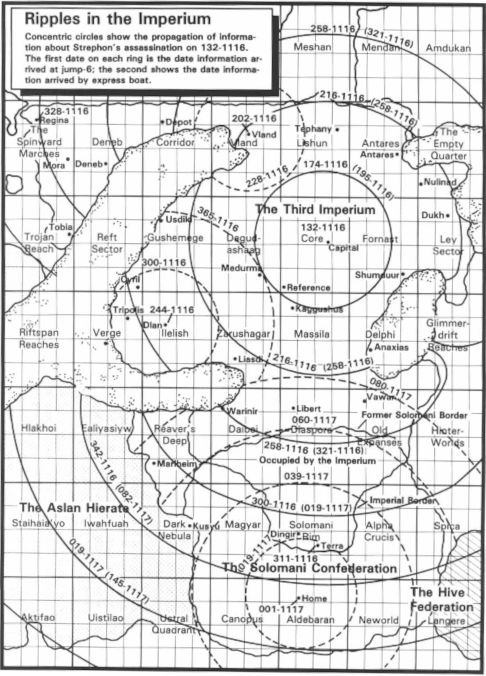
    Especially in settings like Traveller, where interstellar communications travel at the speeds of the fastest courier as described in O God, Thy Sea is so Great. A group of adventurers can skip their bank note on their big ticket item. Jumping out to the fringe of “civilized” space and joining the pirates and nomads and homesteaders out past the perimeter. Or, in a setting where wars rage between empires, hiding from their lien-holder in one empire by escaping into it’s rival.

    This is in essence, stealing the things that are mortgaged. Considering star ships, battlemechs, tanks and space fighters are really really expensive the finances won’t just write off the loss. After all, the characters just ran off with tens of millions of C-Bills (or Megacredits) of their money. Collection agents, Repo men, Skip-tracers and Bounty Hunters will follow the ship, and the characters everywhere they go. Running them down, even out on the periphery to drag them and their ship back to face consequences.

    Characters can run, they can even run fast, but they’ll never run far enough to ever be comfortable not looking over their shoulder. Even Han Solo ended up in carbonite, hanging as a trophy in Jabba the Hutt’s palace.

  • The Guild Empire

    The Guild Empire

    ..and Eldritch Suns

    Years ago just after the third Pirates of the Carribean movie, I was inspired to design a Spelljammer setting. I called it “Eldritch Suns” and it used a lot of the worldbuilding from Disney’s Treasure Planet. Solar sails, magic cannon, wheellock pistols and cutlasses. Like Treasure Planet, the setting would take 75% age of Sail, Age of exploration and 25% Space Fantasy. The Eldritch Suns have never been far from my mind.

    The Astral Sea and the Frontier

    The Astral Sea is the void between systems. It is the places on the maps of the cosmos where “Here be DRAGONS” is inscribed as a warning. The Astral Sea needs to be crossed in order for ships to cross from one system to the next.

    Systems in the Astral Sea are termed wells, bubbles of matter which function like the star systems we are familiar with. They have a central point where all bodies revolve. Since this is a space-fantasy setting, those central points aren’t stars as we understand them, they are geysers of Æther that flood out, and return in a chaotic network of currents. These wells are distinct from one another, each varying in how time passes and drift among one another like corks floating in a barrel of water.

    When two or more wells begin to experience regular travel between them, for trade, or immigration, they will establish a route through the Astral Sea, these are termed “Mains” and they will slowly synchronize how the wells relate to one another. Calendars will slowly begin to synchronize, their relative positions within the Astral Sea will start stabilizing, even the languages of their peoples will become more familiar in respects to one another. In general, the more mains, connecting wells for longer periods of time will accelerate the process of synchronization. An example of a mature result of this process are the seven core wells of the Guild Empire.

    The Antagonist; The Guild Empire

    The Guild Empire was loosely based on the East India Company from Pirates 3. A mercantile empire that dominated the setting with the resources to launch fleets and armies. It was focused on seven core wells;

    1. Roidahç; (ROH-ih-dosh)
    2. Elgen Trencz; (EL-gen TRENZ)
    3. Jharigo; (JER-ih-go)
    4. Kazzaq: (kaz-AK)
    5. Fauchaq: (fow-SHAK)
    6. Ausaq: (aw-SAK)
    7. Rhiannon: (REE-ann-on)

    These wells have a dense and very old network of mains with each other, and as a result, are fully synchronized. They share a single Imperial Calendar which passes at the same rate among the worlds of all seven wells. They have a single Imperial Language (uncreatively named “Imperial”) which is common to all seven wells (though local dialects still proliferate, making for distinctions between provinces and cultures.)

    The Guild Empire has grown more powerful than any realm in this region of the Astral Sea. It is aggressive, expansive, and greedy. Its fleets and armies are comprised of people from all seven core wells as well as the Empire’s colonies. Most enlisted people serving as crew or troops are poor volunteers, recruited on the promise of pay and adventure. Others are virtual slaves, victims of impressment. The Officers are from aristocratic families who have purchased their commissions from the Imperial Guild Directorate. Throughout the setting there are Guild Governors, Directors, Assayers, Brokers and an extensive bureaucracy that exists primrily to extract wealth from the colonies and trading mains of the frontier to return to the Core.

    Anatomy of a Well

    The heart of a well is the Ætheric Geyser. These are holes in the Astral Sea which connect to the Elemental Plane of Æther (often referred to as the “Etherial Plane”. The flood of Æther flows out from the geyser until the draw of the Elemental Plane of Æther becomes great enough to pull the flood back to the geyser. In systems with no other bodies, this stabalizes into currents flowing in and out.

    When material bodies move through these currents they disturb these stable currents, diverting them into endless bends and eddies and stagnant pools, making navigation a specialist job. The currents of Æther can be harnessed with sails and rigging, which allow for vessels to move through the Æther.

    Every body in the well blocks the radiant energy shining from the geyser over a limited region behind the hemisphere facing out. These become shadows of the Negative Material Plane, umbral bays where the energies of death replace the spirit power of life.

    The Stuff of Worlds

    The term “world” refers to planets, moons, asteroids and other material bodies orbiting one another within a well. To varying degrees, each such body is composed of a combination of Air, Earth, Fire and Water, though not all elements need to be present for a world-body to exist. The closer these elements are to balance, the more recognizable the denizens of the world are to the common mortal peoples of the Astral Sea; Humans, Elves, Dwarves, Gnomes, Orcs, etc…

    In general, these bodies all orbit the geyser at the heart of the Well, though exceptions, while uncommon can be found. Different ratios of these four elements will exhibit different characteristics that most Astral-faring sages have recorded in catalogues.

    The influence of the Guild Empire likewise affects the variance of worlds within it’s dominion. The most extreme combinations of elements are increasingly rare, and the amount of balanced bodies are growing more and more common. Even the orbits of the worlds within the core wells have grown more ordered and regulated.

    Out on the Frontier is where the weird extremes can still be found. Worlds permanently in the umbral bay of enormous planets of Air and Water. Systems with two (or more) geysers feeding Æther into the well. Wandering orbits. Rogue worlds drifting through the Astral Sea. This is where the setting focuses it’s attention, far from the rigid structure of the core of the Guild Empire.

    Suns Beyond Counting

    The Astral Sea stretches on forever. The Frontier is the region closest to the Imperial colonies. Out there, there are few realms that can launch a fleet of ships into the Æther and the Astral Sea and no multi-well empires. Free Traders, Pirates, Adventurers and Explorers travel between wells out here and create faint mains to connect them.

    On the Frontier, legendary hordes of treasure can be found, fantastic beings and fabulous locations can be discovered. Campaigns among the Eldritch Suns should focus on near-constant voyages, following the mains, or forging new ones from well to well in search of fame and fortune. No one world should be heavily detailed. Only the adventure locale, and maybe the port needs any attention. Adventurers arrive at port, follow their nose into an adventure and return. Maybe uncovering rumors to their next destination. They fill their hold with supplies and hire some crew and venture forth again.

    This brings up the subject of a crew. The vessels that cross between wells, even the smaller ones, require dozens, if not hundreds of people to crew. Most tabletop roleplaying campaigns have only six adventurers or less, which leaves a lot of NPCs. The crew of a vessel can be used as replacements for fallen adventurers, sources of new adventurers for new players joining the campaign. Henchmen, hirelings and prize crew are also excellent uses of extra crew members.

    Finally the crew are a source of adventure in and of themselves. After all, a mutiny is always possible on the high Astral Sea.

  • O God, Thy Sea is so Great, and My Boat so Small

    O God, Thy Sea is so Great, and My Boat so Small

    Space is BIG

    One common quirk of science-fiction roleplaying, whether it be Traveller, Star Trek, or Battletech is that the Universe starts to seem rather small. The characters jump from world to world having adventures but they only stay as long as the adventure lasts. Once the adventure is done, they’re back on their ship and off to another world, light-years distant. The routine of interstellar travel shrinks an impossibly vast universe into a travelogue. Alien worlds, might be strange, but they’re not memorable, the planet of purple-people-eaters fades into the background along with the forest moon of cannibal teddy bears, and the world of cheese.

    Timekeeping

    One way to keep space feeling big is to keep track of time as it passes. The Universe is not a static place, everything is always in motion. Seasons change, years pass, even the stars themselves grow old and die. It helps to reinforce that your characters are on a voyage if the Universe continues to unfold even as the players hop from system to system. In Traveller, each jump between systems takes a week. Normally this is expressed in downtime, but the important thing for timekeeping is, that as the characters jump from world to world weeks pass as they are isolated in jumpspace.

    The Battletech Universe is different, jumps of 30 light years happen in an instant, but the drives require a week to recharge, and it takes days of sublight travel to reach the jump point where the drives can be engaged. Again, this is often considered downtime, but the time still passes.

    Even Star Trek, where warp travel doesn’t isolate the ship or it’s crew, the distance between systems is *vast*. It takes days or weeks for a vessel, even traveling hundreds of times the speed of light to transition from one system to the next. As Game Master, take advantage of this, let events develop without the characters needing to be involved. Keep the Universe a dynamic, ever changing place.

    Distance and Scale

    It’s time for a little Astronomy. Get out your notebooks and calculators. As I am writing this essay, I have just flown across the North American Continent from Washington DC to Sacramento. That trip of 3,000 miles (4800 km) took all day (actually it also took all night, because of an unexpected layover in Phoenix, but that’s a whole different story). One Astronomical Unit (AU) is 150 million km. One Parallax Second (ParSec) is 3.26 light years. To put all of this in scale, for Dezzy to travel to work takes about an hour (I live 30 miles from the office) by car. For Dezzy to cross the country (the US) takes a day (six-ish hours) by jet. If Dezzy was to fly to Mars, it’s a journey of eight months. Flying out to Jupiter’s moon Europa takes around 6 years. If Dezzy wanted to send a message home at light speed, it would be more-or-less immediate from most places on Earth, 1.25 seconds to the moon, 15 minutes to Mars and 35 minutes to Europa.

    Why am I throwing all these numbers at you? Well, it’s to illustrate a point. Like Douglas Adams famously said many years ago, “Space is big. You just won’t believe how vastly, hugely, mind-bogglingly big it is. I mean, you may think it’s a long way down the road to the chemist’s, but that’s just peanuts to space.” Traveling between worlds or star systems shouldn’t feel like driving to the next town over or even flying across country. In-system travel should take at least days, if not weeks unless the vessel is moving at 75% of C (light speed) or more. The point of emphasizing distance is to impart the vastness of space to the players.

    Because of the enormous distances involved, the setting needs to feel different based on scale. This can be accomplished not only with travel times, but with communication lag.

    The Mail Must Go Through

    On a planetary/ moon scale, real time communications is fairly straightforward. We experience it today in our decidedly non-science-fiction real world voice and video calls can be made in real time anywhere on the planet where a signal can be reached. The slight delay to lunar orbit can make conversation slow, and possibly awkward, but not impractical. Physical mail can be sent nearly anywhere in a mater of weeks, or even days or hours if extra resources are employed.

    On an interplanetary scale, real-time communications are not really possible. Even between nearby planets (assuming both worlds are in their close orbits), electromagnetic communications still take between fifteen minutes to an hour to reach their destination. Conversations start to resemble e-mail or messaging, even with voice or video

    Communication with the outer worlds takes hours or days. Relays are needed to even send an electromagnetic signal out that far that can deliver something as dense as voice or video communications. Settings at this scale begin to resemble the telegraph and rail eras of the 19th century. News travels over continental distances, but need to move between telegraph or railroad stations. If the recipient of the message is five days away from the closest station, then all news that recipient receives is at least five days old. Even if the setting is heavily populated, it is still possible and even preferable to present a tangible sense of isolation

    On an interstellar scale, unless Faster Than Light travel and communication is employed, news travel at generational speeds. Its simply not possible to maintain a cohesive society at this scale. Without FTL travel, an interstellar setting is a planetary or interplanetary setting. To use an example from fiction, in the novel Three Body Problem (spoilers), the invading fleet from Alpha Centauri (rougly 4.3 light years) takes 300 years to journey to the Sol system. That’s using technology so far advanced beyond what humans have developed that it may as well be magic.

    FTL Travel Changes Everything

    Interstellar settings with Faster-Than-Light travel flips communications on it’s head. Even in settings where direct communications through subspace, or hyperspace relays are possible, it is often quicker to send a ship from place to place delivering messages. This can be physical media, where a mail ship drops off packages and mail to the starport, but it can also be electronic or digital media where the mail ship simply flies in-system and transmits their messages to their destinations.

    This brings an Interstellar setting to resemble the world-spanning empires of the 16th to 19th centuries. Worlds take weeks or months to interact, large interstellar empires and megacorporations lay most of their authority on colonial governors or directors of local headquarters.

    There is a brilliant map in Megatraveller that displays how news of Emperor Strephon’s assassination spread throughout the Third Imperium. The common communication routes were the Express Boats that could jump 4 parsecs in a week, which was the limiting factor for the spread of the event. There was a second communication route used by the Imperial government and the Navy that used Couriers that could jump 6 parsecs in a week. Using this map, the GM could see who knew about the assassination, when, and how they would react.

    The map also illustrates how much distance the news had to travel. In the setting, Emperor Strephon was assassinated on the 132nd day of the Imperial Year 1116. That news took 200 days to reach Terra, on the rimward fringe of the Imperium. That was from Emergency jumps running a Pony Express route (delivering the mail through a relay of riders and fresh horses) at a pace of around 850 C. That shows that the Third Imperium is really, really vast.

    Keep Real-Time Communication Exclusive

    The Star Trek and Star Wars settings have tropes where conversations over enormous distances occur. Which works against the scope of the setting. The Enterprise is often shown as the “only ship in the Sector” that can respond to the inciting incident of the episode. The orders are delivered from StarFleet headquarters in a direct Subspace communication. Even though the Enterprise was thousands of light years distant Captain Kirk could have a video chat with the Admiralty, and receive updates while delivering progress reports. Lord Vader has video chats with Emperor Palpatine from the Phone Booth on board his Super Star Destroyer while the Emperor is at the heart of the Empire on Coruscant. This shrinks the universe to planetary scale. It’s no more inconvenient to phone HQ for info than it is to open a Zoom Call to Hong Kong from London.

    Both settings retain their sense of scale by showing that these real-time communications as requiring equipment that demands resources that are unavailable to the average citizen. Vader is the Dark Lord of the Sith, he has the biggest and bestest, literally a “Super” Star Destroyer. The Enterprise is the Flagship of the Federation. Subspace and Hyperspace Communications are not available or even a component of adventure sized ships like the characters would be crew of. A small colony carving out a settlement may not have the resources to build such a communications array.

    The Star Trek movie Into Darkness and Star Wars: Revenge of the Sith really undermines the scope of their settings (spoilers for both movies). In Into Darkness there’s a scene where “John Harrison” escapes capture on Earth by teleporting to the heart of the Klingon Empire. Using technology explained as “Transwarp Beaming” but it was effectively instant teleportation over hundreds of light years. The Enterprise follows at Warp and arrives close enough to threaten Harrison with a long-range bombardment in an indeterminate, but very short interval. This is a planetary scale event. The distances are just numbers because there is no appreciable time investment.

    In your campaigns, if your adventures travel interstellar distance this casually, then alien worlds become little more than exotic cities that can be reached by tourists on vacation. The sense of wonder is erased.

    Time is Relative

    In settings where Near-Lightspeed and Faster than Light travel is a factor, characters can age faster or slower than the rest of the setting when traveling. This is another way to emphasize the distances involved.

    When traveling at Near-Lightspeed, the subject of relativistic speeds age slower. Characters who regularly travel at these velocities start to subjectively move forward in time. They leave one world, travel for a week at relativistic speeds, and when they arrive at their destination, they have only aged a week, but the setting has gone through months of time. The GM needs to juggle three periods of time. The time from the origin passes quickly as the characters are in transit, the time on board ship seems to pass normally, and the time at the destination would be the distance travelled divided by the velocity of the vessel. This allows characters to experience vast spans of time over the course of their career while their physical life spans are unchanged.

    At Faster than Light Travel, the relativistic equation starts to flip on it’s head. Especially in settings where Jump Drives crosses the distance instantly, but the vessel has to spend a period of time (usually a week) in hyperspace, or jump space. The characters age, but the setting doesn’t. This starts to age the characters faster than the universe around them.

    In Warp-Drive settings, the ships spend travel time in a bubble of real space while the universe outside slows to a standstill. When the ship emerges, the crew, like a Jump Drive crew have aged the time they were at warp, but the universe has only aged a much smaller interval. It takes the Enterprise much, much less time to move through the galaxy at warp than light does.

    This allows adventurers the possibility of outrunning the consequences of their actions (for a time). So long as the adventurers can travel faster than the news of what they did, they can arrive in a new system before anyone can know what they’ve done. Of course, the trap here is that the adventurers need to keep moving. At least until the consequence exhausts it’s urgency.

    Setting Scale and Campaign Scope

    It’s important to apply the scale of your setting to complement the scope of the campaign you wish to run. It is tempting, especially with a game like Traveller with it’s procedurally generated system for creating worlds to create sectors’ worth of star systems, worlds, and moons. It can be fun, dreaming up pocket empires, cities, starports and NPCs to populate them. However, unless you plan to run a series of campaigns over the course of years, developing anything beyond a subsector beforehand is mostly futile. The same goes for system detail. Unless an extended adventure takes place in a single system, most groups of adventurers will never explore any given place beyond the world where the adventure takes place, and even then, the adventurers often only encounter those locations described in the adventure itself.

    Point being, unless the adventurers choose to visit a location, they won’t. You as the GM can encourage the adventurers to visit a location, but the ultimate decision is with the players. It’s the GM’s job to seed reasons for the players to want to visit the interesting locations that are designed. That being said, as GM you can present a campaign that happens in a single star system, with a plot similar to the Expanse. That type of campaign will resemble an Interplanetary Setting, with it’s distances and travel/ communication times. Everything outside of the campaign system doesn’t need any real detail. News can arrive as the GM chooses, but it is not anything that needs to be designed beforehand. Don’t make more work for yourself than you must.

    There is a balance for a campaign that revolves around travel. For example, in a Battletech campaign where the characters make up a mercenary company, contracting their military service with planetary governments and empires for c-bills, interstellar travel is common. The Company fulfills a Contract on a world, gets paid, and then they’re off to the next contract on the next world. System Detail only needs to be relevant to the current contract, and possibly outlines of the next contracts on offer. This is more of an example of a Interstellar scope on an Interstellar scale. While the campaign may never visit more than a dozen worlds or so, you as the GM can make the setting seem big. That’s part of the appeal. The mercenaries aren’t stuck on just one world or in one system. The conflicts cover hundreds of systems and thousands of light years of distance. Part of the appeal of a campaign like this is adventuring in space.

    Deep Space Exploration, like Star Trek is the ultimate expression of Campaign Scope and Setting Scale. Leaving the familiar stars behind to explore… (dare I say?) strange, new worlds. Here, the GM can use time dilation to illustrate how vast the universe is. Traveling from world to world, and revisiting some can show how much time passes on the worlds left behind. Friends who stayed on the outpost the adventurers visited at the beginning of the campaign, can have aged significantly by the time they return and the adventurers have only aged a couple of years. Campaigns out here are stories of isolation and self-sufficiency. Like the crew of a ship far beyond the boundaries of Empire, help is months or years away if it can be reached at all. News from home can be years old. I’d even go so far as to make FTL communication like subspace or hyperspace have significant delays. The goal for campaigns of this sort is, like the crew from Star Trek: Voyager, is to turn the characters’ starship into it’s own little world sailing through the stars.

    West Marches, Distant Stars

    A gaming group can adopt a setting to run a multiple-campaign game using science fiction. In this framework, GMs develop different areas in the setting, and multiple groups of players can experience adventures travelling between GMs and their areas. Coordination is key, understanding where each group of players are in time and space will inform what is occurring in the universe as it unfolds. Groups that encounter one another can exchange news and even crew. As a campaign like this matures, it becomes epic. Like a science-fiction franchise, the more campaigns that play becomes identifiable as unique expressions of the setting while remaining a part of the greater setting.

    Conclusion

    I’ve presented, a lot in this essay. Turns out, since space is big, discussing role-playing in a space setting starts to get big as well. All of this doesn’t need to be applied to any given rpg as a whole. Like all science fiction gaming, the freedom to pick and choose what works for you is a part of the fun.

    Happy Star Trek Day

  • 3051

    3051

    Battletech’s Lost Year

    3049 and 3050 were disastrous years for the Inner Sphere. The Clan Invasion began. The invading, mysterious armies looked and fought like aliens. The peripheral bandit kingdoms and pirate havens fell almost without a fight. What few reports leaked from those first battles showed everything from unknown war machines that violated all principles of known battlemech engineering to jump-capable warships the like hadn’t been seen for 200 years, since the First and Second Succession Wars.

    When the invasion washed over the peripheral systems of the Lyran Commonwealth, the Rasalhague Republic and the Draconis Combine proved the worst stories true. The Successor State Houses were neither unified, nor ready for the four coordinated Juggernauts that went from victory to victory, marching steadily towards the heart of the Inner Sphere. By the end of 3050, the Houses of the Inner Sphere had won only a bare handful of battles. All while losing hundreds of systems and nearly the entirety of the Rasalhague Republic, including its capital at Rasalhague.

    Radstadt

    On the last day of October in 3050, the Elected Prince of Rasalhague, fleeing the loss of the capital system jumped into the Radstadt system, recently conquered by Clan Wolf, and hosting the IlKhan’s flagship, the Dire Wolf. In the chaos that followed, the Elected Prince burned their ship hard to escape, with the Clan scrambling to pursue. The Flying Drakøns, the Elected Prince’s fighter escort bought time for their Prince to escape by engaging in a desperate, suicidal attack on the Dire Wolf, forcing the clan aerospace squadrons to break their pursuit of their prey to defend their IlKhan. A Rasalhague pilot, Tyra Miraborg dove her crippled Shiloh fighter into the bridge of the Dire Wolf, killing IlKhan Leo Showers. She would never know how her sacrifice would change the course of the invasion.

    A Year of Peace

    The loss of the IlKhan threatened the unity of the invasion. By tradition and culture, the Clans were exorbitantly competitive in all aspects of their society. From the individual to entire Clans. Only the IlKhan had the invested political power to lead a coordinated operation across all the Clans as a whole. Even then, each of the invading Clans would compete and bid against one another for the “honor” of attacking systems. Warriors and Commanders would engage in duels for rank, positions, equipment, or spoils.

    The Khans of the invading clans met at Radstadt to decide a way forward, and chose to elect a new Ilkhan. Thus, they called all of the Bloodnamed warriors in the invasion, and returned to the distant systems from which they came from. Leaving behind only second and third line troops to garrison the conquered systems while they elected a new IlKhan. The process would take a full year. That year was 3051.

    Peace for the Inner Sphere, Occupation for the Clan

    When the elite of the clans left to elect their new IlKhan, they left Provisional Garrison Clusters (PGCs) consisting of the freeborn, the disgraced, and solhama to hold their conquests. 1,000 light-years from their homes, barely supplied, and unsupported, the occupying armies and aerospace forces were spread thin across hundreds of hostile systems. The PGCs were subject to guerilla raids, resistance movements, and insurrections; ugly, violent, all-too-personal conflicts fought in urban centers among civilian populations.

    The leaders of the PGCs were placed in an impossible situation. Forced to govern captive populations, maintain order, and defend against revolts or uprisings without losing any captured territory, or resources. They were expected to make do with what they were given, and remain victorious in any and all conflicts with the Inner Sphere. In short, the armies were expected to accomplish the impossible, then hand control back to the bloodnamed warriors upon their return. If successful in their mission, they would not be thanked and only barely acknowledged for doing a job as expected. Anything less than meeting that standard would mean a loss of honor at best, disgrace and reassigned to the labor caste at worst.

    Probing Attacks

    The armies of the Inner Sphere that opposed the invasion were almost reduced to nothing. Entire Regiments and Brigades had been wiped out as the invading Juggernaut rolled over system after system. When the invasion abruptly paused, The Lyran Commonwealth and Draconis Combine wasted no time in throwing together lance, and company sized reconnaissance forces to test the readiness of the occupiers. Scouting missions, Raids, and Smash-and-Grab operations struck all along the Front. In the first months of 3051, these were irregular formations of shattered units that escaped systems as they fell, or bottom-of-the-barrel mercenary outfits signed on to hasty contracts, even ceremonial units and Solaris VII gladiators were folded or pressed into service. Resistance operations were contacted and given support, propaganda from the Inner Sphere was smuggled into occupied systems, surviving militias were given supplies smuggled in system by networks of criminals who had operated black markets for centuries before the Clans invaded.

    Following the Outreach Summit of January 3051, the Lyran Commonwealth, Rasalhauge Republic, and Draconis Combine, coordinating with the Federated Suns, Capellan Confederation and Free Worlds League began to apply increasing pressure to the thinly-spread and poorly supplied Provisional Garrison Clusters the Clans had left behind.

    Resistance and Insurgency

    As 3051 wore on, the intelligence services of the Inner Sphere polities developed extensive deep-cover networks throughout occupied space. By the time the Clans resumed their offensive in November of 3051, The Inner Sphere had become well-prepared for the Clan threat.

    For their part, the clans under the leadership of newly-elected IlKhan Ulric Kerensky were better unified and better able to understand the nations they were invading. But the Clans continued to have a blind spot where their Provisional Garrison Clusters were concerned. Most to the leadership continued to disregard the analysis and opinions of the very people they left behind for a year. Lessons learned by a hard-fought occupation, Intelligence gathered from first-hand sources went unheard because they came from the mouths of the despised.

    3051 as a Developing Story

    3051 represents a lot of unexplored, untapped potential for story. The Provisional Garrison Clusters occupying the captured worlds have several growth arcs. Colonization, or using a large underclass to expand Imperial ambitions, or being a (very literal) outsider in someone else’s home… or just being a person, used by an impersonal aristocracy, taken far from the place where they grew up, among the people, music, food they are familiar with and dropped somewhere else where everything is alien.

    We have had this story, in our very real planet Earth for thousands of years. Through the lens of ridiculous, giant, stompy robots and 8 foot tall genetically engineered super-soldiers, we can tell our own versions of this story. As novels, as campaigns, as scenario packs or as table top roleplaying adventures.

    Going all they way back to the Iliad

    In college I read a treatment of the Iliad. When the armies of King Agamemnon built their infamous horse and infiltrated the gates of Troy, the ensuing sack was motivated by far more than simple plunder and the rape of a city. The soldiers of Agamemnon had been laying siege for 10 years. Ten years away from home. Ten years across the sea in another land, fighting and dying without contact with their families, or their communities that are, for all intents and purposes, on another planet.

    When Troy fell, the soldiers in the army took out ten years of personal sacrifice and frustration on the newly-defenseless citizens of Troy. They took a bloody revenge for their lost decade of life. This perspective is from a story that is some 2,500 years old.

    Getting Real for a Moment at the End

    As I’m writing this, and when I’ll publish this essay on September 2, 2025, I’m a couple days more than two weeks from my 56th birthday. I have lived my entire life in the U S A. When I was young, the most recent war my parents’ generation lived through was Vietnam. I was 22 in 1991 during the First Gulf War, and though I wasn’t serving in the armed forces, most of my peers were, and they were deployed to Kuwait. One of my very close friends witnessed the “Highway of Death”. He, and my youngest brother were deployed to Iraq during the Second Gulf War in the years following 9/11. My grandparents’ generation fought in World War 2.

    Today, right now, there is a terrible war in Gaza, where my country is complicit (if not outright a direct participant) in a Genocide of the Palestinian people. There is another war in Ukraine, where the Russian Federation has been waging an aggressive war of conquest since 2022 and if you count from the annexation of the Crimean Peninsula, you can argue there has been a state of war since 2014.

    I believe it’s important to tell our own stories about these subjects of war and struggle from our perspective. It’s the job to re-contextualize the lessons of history through their own lens and pass them forward so the next generation can learn from them. It’s our turn, and if you’re younger than me, it’s your turn too. We will always have war, we’ll have evil violence inflicted on each other. In 25 years, there will be another war in another part of the world and the youth of that time will be told to fight in it.

    But, the thing about nationalism in war, it seeks to dehumanize “the enemy”. The people on the other side of the conflict aren’t human, they can’t be. Because it’s soul-destroying to kill another human being, regardless if the cause is justified or not. We must keep reminding ourselves, with each passing year that people are human. Not sub-humans, not “animals” but people. We need to see ourselves in others. That’s called Empathy, and if we lose that trait, then we might as well start dropping atomics on each other until no more tribes remain.

    I am sorry/ not sorry for harshing the mood about painting up and playing with toy models of big stompy robots with politics and the real world that we all need to escape from for a couple of hours every weekend. It needed to be said, though. If the vehicle for showing how alike we are is to pretend to be space-cowboys and eight-foot-tall super-soldiers, then buckle up buttercup, we’re going on a trip.

    Special Thanks

    I’ve been playing Battletech since ’86 or there-abouts. This universe isn’t from my imagination, it’s from the collective brilliance of thousands of minds over more than four decades. The current stewards of this legacy are the fine folks at Catalyst Game Labs. I’m playing in their sandbox

    There is also a Battletech Wiki over at sarna.net. This is a heroic work that catalogues the endless details of the Battletech universe, I may not remember when the Outreach Summit happened in Universe, but Sarna does. I appreciate the resource, and encourage you to go give them a look.

    I also want to thank the Black Pants Legion for all their hard work. It’s through them that I’ve rediscovered my love for the lore of Battletech. I feel like I’m a teenager again playing Battletech with my friends and dreaming of how awesome it would be to pilot my WHM-6R Warhammer through the battlefields of the 31st Century.