Tag: GM Advice

  • Alignment and Personality

    Alignment and Personality

    More Dezzy’s House Rules for D&D

    Alignment is an artifact of the earliest days of D&D. According to legend, Gary Gygax adopted the mechanic after the players in those early campaigns kept lying, cheating, and murdering one another (and the nearby town) to get treasure and magic items. Alignment was also inspired by Moorcock’s Eternal Champion stories where cosmic forces of Law and Chaos struggled to shape the multiverse. Characters, like the Eternal Champions were agents of those forces. Alignment also served as shorthand, identifying friends and foes, “good-guys” and “bad-guys”. It worked fine for those early development from wargaming, but as players explored the game, it became a crutch, or worse, a straitjacket.

    Alignment As Short-hand

    How I run alignment currently is as a short-hand to help with character consistency. In a time when weeks or months can pass between game sessions, how we remember our characters drifts. A trait that was central to the character can become neglected, especially of the current multi-session adventure provides little opportunity to express that trait. Sometimes the motivation behind a characters actions looses it’s focus. Having a simple, evocative term to help ground the character has value.

    As first edition AD&D defines Alignment, there are two axes that creates the term. One axis is a Law – Neutrality – Chaos (which is also the original Alignment spectrum), the other axis is Good- Neutrality – Evil. The combination of them tells us something about the character. Lawful characters are inclined to order and structure, Evil characters are self-serving and callous, Neutral characters have no strong associations with the poles of that axis.

    There is a well known problem with the Good-Evil axis in this system. “Good” and “Evil” in the real world are generally considered subjective based on the consensus of the culture that one is acting within. (an admittedly crude definition, I’m no Philosophy major). In the context of Dungeons and Dragons, Good and Evil are objective and aligned with cosmic forces that reflect in the outer planes. In practical terms, what constitutes Good or Evil is in the hands of the Game Master and the Players in the campaign.

    In these early editions, Alignment is restrictive towards what classes players may choose for their characters. Paladins, most famously, must be Lawful Good. Thieves cannot have Good as a component of their alignment, Druids must be “true” Neutral (meaning neutral on both axes). This often led to endless debates over what all that meant. Can a Thief really be Lawful Neutral? Their class abilities, especially Picking Pockets, Sneaking Around and that Back Stab attack are hardly reflective of a Lawful mindset. Are characters following a Chaotic Good Deity simply prevented from being Paladins? What about rebels fighting a tyrannical kingdom? Can they be Lawful and still fight the established order? Can they be Good and still support slavery because it’s legal? It was a murky pool to wade into.

    5th ed Personal Characteristics

    5th edition added more tools for character definition, Personal Characteristics. Four categories; Personality Traits, Ideals, Bonds and Flaws were one sentence or one phrase descriptors of a character’s persona. They were more detailed than just a simple two axis alignment and since the persona categories used sentences and phrases, players could define their characters much more precisely. They’re no longer simply “Chaotic Neutral”, 5th ed characters are Chaotic Neutral and Have Never Lost Their Child-like Sense of Wonder, Never Sticks to A Single Set of Rules, Does What They Can to Protect the Natural World, and Is Always Changing Their Mind.

    The “Ideals” category often has alignment recommendations. Helping the player to choose an Ideal that compliments their Alignment choice.

    Finally, ever since 3rd edition, alignment restrictions on classes have been removed, which has removed Alignment from being a requirement to make a character. In modern D&D Alignment has become nothing more than a soft statistic that shapes but not defines a character.

    Personal Characteristics as Alignment Replacement

    This is the mechanic I’ll be using in my D&D games going forward. The classic alignment axis system still exists, but only as an organizing framework for the outer planes and as shorthand for minions, NPCs and Monsters, not player characters.

    For player characters there are three Personal Characteristics that serve the purpose that Alignment did.

    Bonds: the connection the character has with others, family, companions, their home village, etc..

    Ideals: the character’s motivations, why they continue pursuing adventure even after they experience setbacks and obstacles.

    Flaws: those aspects of a character’s personality that hinder their own efforts.

    At character creation, each personal characteristic is assigned a short statement that describes them. Each characteristic will reflect an alignment component; Good, Evil, Lawful, Chaotic, or Neutral. Bonds and Ideals cannot be in opposing alignments, one cannot be good, while the other is evil, or one cannot be lawful wile the other is chaotic. Neutral alignment is not considered in opposition with any other alignment. These two personal characteristics can have the statements that invoke the same alignment.

    Flaws must invoke an alignment in opposition to at least one of the two other personal characteristics. In the case of Neutral Bonds or Ideals, the Flaw has to be non-neutral.

    If the players play their personal characteristics appropriately and in a way that disadvantages the character by the choice, the Game Master may award them Heroic Inspiration, if the character already has Heroic Inspiration they may give it to another character who does not, and if everyone in the party has Heroic Inspiration, the player can increase their character’s Doom Die by 1 die type (maximum of d8)

    Seasons change, and so did I

    (with apologies to the Guess Who for the line)

    Players may choose to change their character’s personal characteristics when the character gains a new Experience Level. They may add an additional Bond, Ideal, and Flaw when they advance to Tier 2, and again at Tiers 3 and 4. These changes and additions are optional to the player and can only be chosen upon gaining a new experience level.

    Conclusion

    This house rule for Alignment isn’t a straitjacket, and should not be enforced as such. These traits are intended to be tools for character development. Relating them to alignments helps to define a character’s morality and ethics. While the subjective terms “Good” and “Evil” are employed as components of this mechanic, I argue here that those terms, and we’ll thrown in Law, Chaos and Neutrality in there too, are intended for each group of gamers to determine for themselves and agree to amongst one another. These terms of moral and ethical philosophy can and will change for each of us over the course of our lives. Gods only know what I thought was “Good” and “Evil” when I first started playing Dungeons and Dragons four and a half decades ago are not the same as they are at the time I’m writing this, and will likely evolve some more before I’m finished playing D&D.

    (If I get my wish, that will be another four and a half decades from now, I’m not eager to reach the end of this journey any time soon)

    Point being, Dungeons and Dragons (and all tabletop roleplaying games) belong to everybody playing them and we’re allowed to define alignment and personality traits to suit our table just as much as we can decide whether or not Orcs have pig snouts or not. There is no wrong answer, there never was.

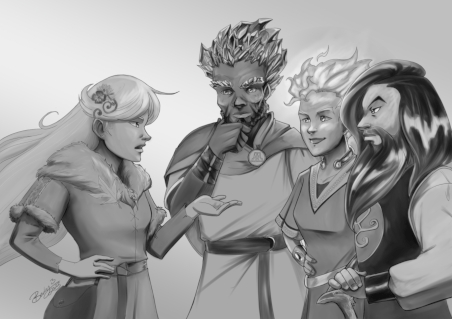
    (Featured Art by Becky Peltier http://www.artofbeckypeltier.com)

  • Money Makes the World Go ‘Round

    Money Makes the World Go ‘Round

    The difference between Treasure and Money

    Your characters have done it! You’ve journeyed deep into the earth below the ruined castle. Overcame traps and foes alike, solved ancient puzzles, and killed the Great Beast in it’s lair. Your characters gaze over the accumulated wealth of centuries, jewels and coin and gemstones. Your hirelings start scooping treasure into heavy sacks to carry to the surface, and then home. Everybody is rich!

    Except you’re not, not yet.

    Currency and taxation

    This is getting a bit into the weeds with regards to worldbuilding. Where the adventurers find treasure can be important. Finding a centuries-old cache of coins leads to a problem,the realms that minted those coins may no longer exist. This leads to an issue when the characters try spending the coin back in town.

    One reason currency is minted is to attest to its purity. Gold in particular is more valuable the more pure it is. 100% pure (24 karat) gold is worth more than 75% pure (18 karat) or 50% pure (12 karat) gold. When a realm stamps their mark on a coin it’s a guarantee of purity in the metal. Everyone who trades in the coin of the realm can be confident that the gold is of a minimum purity (usually 75% or 50%, depending on the wealth of the realm minting the coin). Coins from elsewhere don’t enjoy that confidence. Especially old coinage. Instead of valuing the coin based on it’s declared value, coins are valued on the weight and purity of the metal in the coin.

    If the adventurers have their treasure appraised, they can either pay a fee (usually 10% of the value of coins appraised) to a Jeweler to value the coins based on the metal they contain. If the adventurers have access too and proficiency with Jeweler’s tools they may appraise their own treasure by making a Intelligence check with proficiency against a Difficulty class set by the Game Master. Adventurers who know the appraised value of their treasure have Advantage on Charisma checks when negotiating a sale of the coin.

    Ancient coins from realms lost to history, can also be valued as historical or collectors’ pieces. To the right buyer, a box of 3,000 year old coin from an extinct empire might be worth far more than either the value of metal, or the declared value stamped on the coin. This can add detail and steps to cashing in on your treasure hoard that players may not be interested in. Not every player of Dungeons and Dragons enjoys haggling with money-changers over the relative value of copper. To keep things simple, and to minimize accounting, it’s recommended that the Game Master simply assign a percentage that treasure is worth in currency (usually between 50 and 80% .

    The coins can be melted down and sold by weight. The price for precious metals will always be less than the currency value of the coin that can be minted or the jewelry that can be made from it and depends on the purity of the metal. Appraising the precious metal will give the adventurers Advantage on Charisma check when negotiating a sale.

    Using Treasure to Pay for Goods and Services.

    Sometimes, it’s unavoidable, treasure is the only resource that is available to pay for a room and meals at the roadside inn, or when purchasing a mule and cart from a local homestead. Or maybe the characters want to avoid entanglements with the local government. In this case, the characters need to persuade the merchant or inkeep to accept their coin. After all, gold is gold, even if it doesn’t carry the stamp of the ruling sovereign. This would be a Charisma (Persuasion) check against the NPC’s Intelligence (or Charisma, depending on the scene) bonus plus 10. Give Advantage if the characters know the value of what they’re trading (having someone appraise their treasure qualifies). Or Disadvantage if the source of the treasure has a bad reputation. No one wants to take cursed silver from the haunted halls.

    At best, the treasure shouldn’t be worth more than their declared value, even on a natural 20. Otherwise, a successful Persuasion gives the characters their asking value, and a failed Persuasion gives them only half that. A natural 1 throws other complications into the transaction.

    But bartering treasure isn’t like shopping at Ye Olde K-Marte. If a patron isn’t taking legitimate coin, they aren’t too keen on giving exact change in coin of the realm. Accepting illegitimate currency is a crime in most settled areas. At best, it’s just a minor crime and a fine will reconcile the legal issue. At worst, it’s counterfeiting, or espionage, and the characters face imprisonment, or the headsman’s axe.

    Money as a Motivator

    In the early days of D&D, characters earned experience points, in fact, most of their experience points from the gold piece value of the treasure they brought out of a dungeon. One gold piece = one experience point. Fighting monsters and ad hoc experience was at best one quarter or one third of your character’s experience total.

    As Matt Colville once said, “how a game rewards it’s players is what the game is about.” In the case of early D&D, that meant getting treasure. Your characters advanced based on how much treasure they “won” or earned or stole. This led to players to scouring every inch of the adventure for every single coin or item of value. Later editions abandoned this experience point method, which is overall a good thing. Getting better at adventuring because you’re rich, or the instances where novice adventurers become superheroes because they found a treasure hoard worth more than a kingdom was kind of silly.

    Still, moving the experience motivation away from treasure had a drawback. D&D rewarded encounters and combat, so that’s what players focused on, and that became rather boring. It also cut off one of the classic reasons that people take up adventuring in the first place. Finding treasure.

    TANSTAAFL

    Players should be motivated by something more than experience points. We’re in the year 2025, computer gaming can scratch that itch just fine if all the player wants is to level up their characters over and over.

    During Session 0 of a campaign, the Game Master ant the Players should set expectations and define the role of treasure in the story. During this stage, you can establish the importance of money in the setting and in the campaign. There is a big difference between a band of dirt-poor adventurers doing everything necessary to scrape enough coin together to buy their next night at an inn and a court romance of aristocratic adventurers for whom money isn’t an issue, but treasure can buy prestige and power.

    Once established, the role of money and treasure should be used. Don’t handwave the important expenses for the campaign. In the campaign where the characters are scraping for coins, charge the characters for every round of drink, and every transaction, no matter how trivial. The characters are struggling, and their players should be always aware of that fact. In the campaign of noble adventurers seeking status or glory, the minor costs, like buying a round for the house in the tavern to loosen tongues, or flipping the minstrel a couple of gold to (quite literally) sing their praises doesn’t need to be tracked. However, the value of treasure is of critical importance as well as the conspicuous consumption. Keeping up a Aristocratic Lifestyle, paying for an entourage, keeping up with courtly fashion (no one wants to be seen at this season’s ball wearing last years fashions!) the accounting may be different, but the fundamental is the same, Treasure is important, and will affect the characters’ advancements.

    Money Is Money

    Players sometimes only care about gold pieces, or platinum pieces. Silver, copper or electrum are simply not valuable enough to be bothered with. Just remember, most large amounts of treasure is not going to be neatly divided by coin. It takes time to sort through hundreds of coin to pick out all the gold or platinum, which are much rarer than copper or silver. Also, platinum and silver are pretty similar in color, and with the really poor lighting in dungeons separating the platinum from the silver would be s-l-o-w. In dungeon lighting conditions (such as those defined as “bright light” in the 5e rules, it will take 1 hour to sort through 500 coins. In dim light, that time doubles.

    In a similar manner to the current change problem as described earlier, tossing around gold for every purchase is going to cause problems. Most communities smaller than cities don’t have enough coin to break gold and platinum down to lower value coin. When the tavern’s house ale cost 5 copper pieces for a pint, slapping a gold piece down, even for a round for the house is twenty pints. Consider this, if the local tavernkeep is selling fare for copper pieces, they’re not going to have an abundance of coin to make change.

    But it’s Not All Taxes and Crime

    Don’t go overboard with relieving the adventurers of their hard-won treasure. Part of the fun of finding mounds of treasure is spending it. Let the adventurers commission magic items, specialized armor, purchase noble title or church ranks. Large purchases like a stronghold, or ship can be planned and enhanced. Wizards need sanctuaries, Priests need temples, Warriors need fortresses and Thieves need hideouts.