Tag: GM Advice

  • Only Human

    Only Human

    Electric Head, Cannibal Core, the Television Said..

    Most Tabletop Roleplaying Games feature humans as the dominant species in the setting. The reasoning is straightforward, Players, being humans themselves, can most easily identify with their characters when they are human as well. It also saves on lore-overload. With humans, whether they’re from Earth, Corellia, Rigel IV, or Vland do not require an essay explaining what they are. Roll up a character, and get playing, no need to wonder about why your Vulcan has green blood, or your Wookie looks suspiciously like Bigfoot. Also, with a human-centric setting, all the gear is easily designed and described. No trying to explain the kinesthetics of a laser rifle made for Hivers when your lasgun looks pretty much like the rifles and carbines that exist today on the real world.

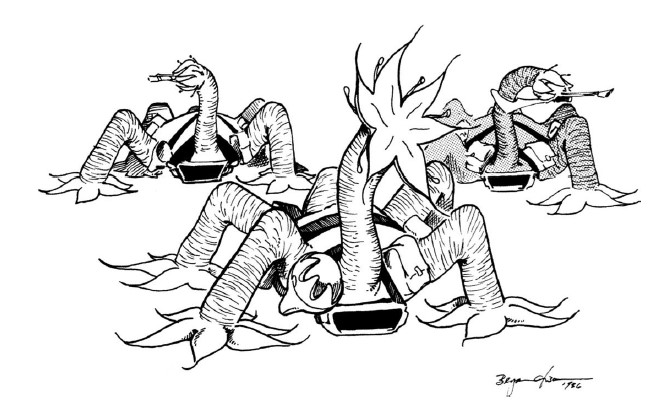
    A group of Hivers suited up and packin’ Hiver-heat!

    Impact of a Human Universe

    Human centered universes are scaled and designed to be convenient for humans. If Humans are the default species, the habitats and furnishings are familiar. Even if it’s a “space-chair” that floats it’s a chair that is designed for bipedal mammals with arms, legs, feet and hands. No need to slow the game down describing it and making the player describe how their character takes a seat. Buildings and vehicles are scaled for 1.75 meter tall 68 kg operators and passengers. Computers are designed with keyboards for manipulative digits and the ability to communicate through voice. Doorknobs are made for people with opposable thumbs.

    It’s why most of the aliens in Star Trek and Star Wars are near-human. Even Wookies, at 2.2 meters tall are human enough to pilot a YT-1300 Stock Light Freighter. All of the bumpy headed aliens of the Star Trek Universe are compatible enough that a member of one species can be disguised as a member of one of the other species. Of course, the practical reason for this is that the actors are themselves humans and it’s cheaper and more practical to throw a rubber mask on and spirit-gum some extra hair and be an alien on screen. Just look at what was needed in Return of the Jedi to operate and act Jabba the Hutt. Poor guy only got to leave his couch of perpetual indulgence after the Special Editions were released and computer graphics could be used to let the big ‘ol slug slither around Mos Eisley.

    It’s fun to speculate what a Hutt civilization, or a Tholian civilization would be like. It’s a nice place to visit as a role-player. Stepping out of the familiar into the alien, is a fun exercise, but not something many players would want to deal with week in and week out for the length of a long campaign. Being unable to pass through a door because it’s scaled for a Jawa is a challenge, Not being able to pass through ALL the doors in the city because it’s all scaled for Jawas is just tedious.

    There is Infinite Diversity in the Human Condition

    The danger of the default-human setting is that everyone starts to look, sound and act like the culture the players and game masters live in. Even a setting that presents itself as highly diverse, like Star Trek is mostly causation, especially in The Original Series. If the game master isn’t careful, the distant world of Efate can start to feel like Los Angeles, or Dallas or Tampa Bay.

    The contrasting issue is also a danger. It’s all to easy to lean on stereotypes of “exotic” human cultures. Every desert planet starts to feel like Algeria or Egypt. The primitive worlds start to look a lot like aboriginal and tribal cultures as portrayed in the pulps. As GMs I’m not saying that every world needs to have a unique culture with roots going back centuries. But if you’re designing the next world the PCs are visiting, recognize when you’re shortcutting the humans that live there as someone else’s real culture. If you spend the time to look at your setting elements, you’ll also find it really easy to change the people of the place enough to make them unique without diving into worn out stereotypes.

    Humans are highly adaptable, and as a species, we can make tools to survive in every climate imaginable, including space. Over the course of generations, populations of humans living in different climates will evolve physical characteristics that help them survive in the climate where they live. Furthermore, the humans that have evolved in one climate are able to have children with other humans from other climates and the genetic mix gives humanity a near infinite variety. You can use this for your player characters and your npcs in a campaign. It’s easy for a band of eight characters to be visually and culturally unique from one character to the next.

    More Human Than Human

    with apologies to Rob Zombie

    There has been an unfortunate standard set in tabletop role playing games over the decades of making humans the “default” species, and as such not giving them bonus or disadvantageous abilities or modifiers. Humans are characters that were played as rolled. Which, while balanced, didn’t excite players. Especially when other species could see in low light, or have superhuman agility or strength or inherent weapons like claws or fangs.

    But this really doesn’t need to be true. Humans have adapted several exceptional abilities based on their environments. People from high altitudes have developed expanded lung capacities and efficient oxygen consumption, people from cold climates have evolved heavy bodily hair, people from climates that experience excessive exposure to sunlight develop elevated melanin deposits in their skin. The list goes on and on.

    Game balance is a bit over-rated. Character abilities do not need to be a zero-sum balance. Depending on a character’s origins, it could be justifiable for human characters to have resistance to environmental toxins, or radiation, or prehensile lower extremities. Even tails. Just look at science fiction. Humans have a broad variety of almost superhuman abilities and crippling vulnerabilities. A people who evolve in orbital freefall might have exceptionally long limbs, flexibility and dexterity, but suffer incredibly under 1G pressures. People who evolve on distant dark worlds may develop the ability to see deeper into the infrared spectrum but become colorblind.

    Cat-Girls and Dog-Faced Boys

    Body modification is commonplace in several science fiction settings, for that matter, body modification is pretty common in the modern world. Human characters can begin game play modified to present as aliens, anthropomorphic animals, or any other unique combination. With enough cyberware, aesthetic surgeries, or biochemical therapies, a character’s identity can have infinite diversity.

    Again, most of this is cosmetic, but in some cases, being a modified human character can come with some abilities or modifiers, as mentioned above. Players and GMs can use some of the alien species from published settings. Aslan and Vargr from Traveller, Lyrans, Kzinti and Gorn from Star Trek, and the Lepi from Star Wars as guidance for what benefits or modifiers a character might employ on their character sheet.

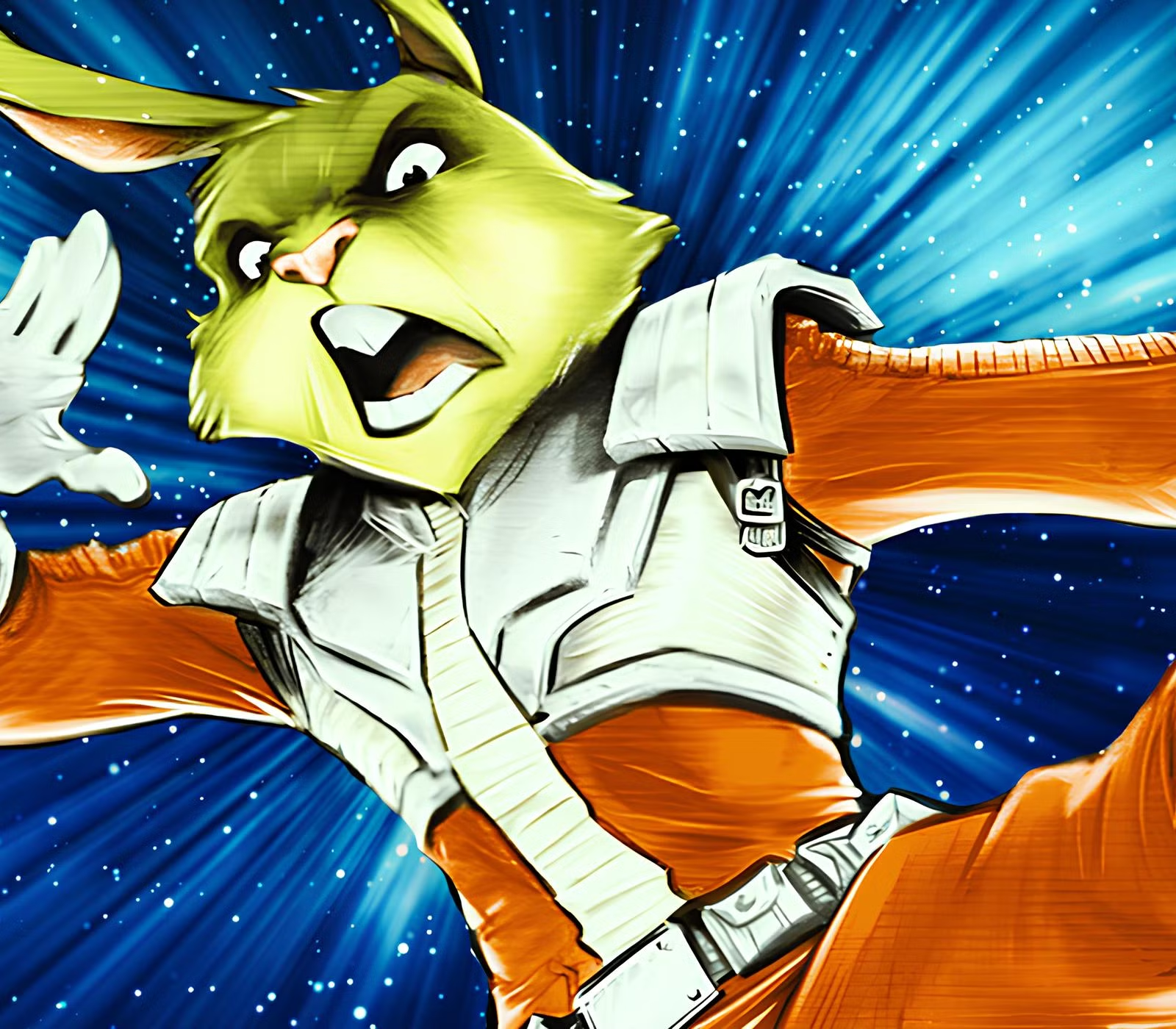
    Jaxxon, the Green Space Bunny and acquaintance of Han Solo

    Humaniti in Traveller

    In the 3rd Imperium of Traveller, humans are the majority species. Humaniti is so widespread in Traveller that there are 3 branches of humans that would be conisdered “Major Species”. Two of these species, the Vilani and the Zhodani are humans originally from Earth. 300,000 years earlier an advanced alien empire, the Ancients abducted groups of humans from Earth and brought those humans with them as they traveled among the stars. They seeded two human colonies in systems favorable to human development, Vland (where the Vilani evolved) and Zhodane (where the Zhodani evolved). The Ancients had also taken other species from Earth (and other planets, the Ancients were not shy about seeding forms of life on different planets just to see what happens) which in the case of Terran wolves, is where the Vargr originated). The humans who were left on Earth, evolved into the Solomani.

    In the current era of My Traveller Universe (3i 1125, the beginning of the Hard Times) the 3rd Imperium has Solomani populations towards the rimward sectors, Vilani populations towards the coreward sectors, and the majority of the Imperium is populated by people of mixed Vilani-Solomani ancestry. The Zhodani, being the people of a rival Empire are rare as Imperial Citizens, but in the spinward and coreward sectors (“behind the claw”) Vilani-Solomani-Zhodani ancestries are uncommon, but not unheard of.

    What does this mean? In this case this is an clear indication that humans are one species with several sub-species. The distinctions of Vilani, Solomani, Zhodani, and any of the hundreds of minor sub-species of humaniti are cultural and ethnic at best. For most characters, “human imperial citizen” commonly refers to the Solomani-Vilani ancestry, but there is nothing stopping a player from describing their human character having an ancestry that is regionally distinctive.

    As mentioned, several ancestries of the human species have developed interstellar empires, and have distinctive cultures and subcultures. The Traveller source material, especially the Alien Modules can provide deep dives into the three major cultures, Solomani, Vilani, and Zhodani. Vilani and Solomani cultures have blended over centuries into the society that is described in the 3rd Imperium. At the Rimward border of the Imperium, the Solomani have carved out what could be described as a Solomani ethno-state.

    The Solomani Sphere

    In the long history of Traveller, one of the pivotal events was the Solomani Rim War (3i 990 – 1002). In this conflict, the 3rd Imperium attempted to reassert authority over the worlds of the “Solomani Autonomous Region”. The war resulted in a contested victory for the 3rd Imperium when the Sol system was conquered. The Solomani Confederaion was unable to retake the homeworld of humaniti, and the 3rd Imperium was eager to bring an end to the war by 3i 1002. For the next 114 years, the occupied worlds of Diabei, Diaspora, the Old Expanses and the Solomani Rim were a powder-keg of ethnic conflict.

    The Solomani Confederation, previously the Solomani Sphere is distinct from the 3rd Imperium. Like most interstellar empires, the Solomani Confederation does not have a single cultural expression, but it does have a common, shared mythology. The Solomani Hypothesis, that theorises (with strong evidence in support) humaniti developed and evolved on Terra (Earth) first, and was spread into the stars first by the Ancients and then by their own technology.

    The term”Solomani” gets overused in the Confederation. One major reason stems from the Solomani Hypothesis; because humaniti originated on Earth, the Solomani are the original humans and are thus superior to all other branched species of humaniti. The Solomani Party is the political organization that governs the Confederation. The Solomani Cause is the political strategy that promotes Solomani humans outside of the Confederation. The Solomani Cause has also been the rallying point surrounding the “liberation” of Terra from the 3rd Imperium and further restoring the Solomani Sphere to it’s pre-3i 990 extents. The Solomani Movement is the Cause as a factor in politics outside the Confederation.

    Aren’t the Solomani the Bad Guys?

    It’s somewhat of a debate in the Traveller community as to whether or not the Solomani Confederation are the “bad guys” of the Rim. The veneration of the Solomani Hypothesis and the Solomani Cause gives some “supremacist” overtones, or at the very least a classist society with Solomani Humans in the position of privilege. The Solomani Party being the dominant political faction (indeed, the only legal faction) within the Solomani Confederation leans hard towards authoritarian govenrments with some really bad associations throughout history.

    It’s been pointed out that the Solomani Confederation isn’t monolithic, in the same way as the Emperor isn’t a monolith in the Third Imperium, the Hive Federation, or the 29 Clans in the Aslan Hierate are monolithic for those empire. The Solomani Confederation covers about six sectors, and contains about 2,000 inhabited systems. If you think about the current diversity of cultures, ethnicities and governmental bodies in our one star system, the idea that the Solomani Party holds and iron-fisted grip on society throughout the Solomani Confederation is farcical. Even if a given Traveller campaign portrays the Solomani Party as oppressive, it’s not the Empire from Star Wars, or the Mirror Universe Terran Empire of Star Trek. Remember the distances involved and times to send communications from one system to another that we explored in this blog.

    The Solomani of the Confederation aren’t jackbooted thugs checking for “genetic purity” at ubiquitous checkpoints. The Solomani Confederation, like all the major empires of Traveller is best described as a “tribe”. It’s a nationalistic tribe that promotes the Solomani Cause, but that’s not much different than the 3rd Imperium promotion the Emperor, or the Zhodani Consulate promoting Zhodani Psionic Society. They’re not “supremacist” but their cultures promote their own Empires.

    In My Traveller Universe, the Solomani Confederation are antagonists, at least in the rimward areas of Diaspora sector. In the Rebellion War, the Solomani Confederation launched the “Second War of Solomani Liberation” to liberate the Sol system, and reclaim the systems of the Solomani Sphere. The Imperial Occupied Region covers the four rimward subsectors of Diaspora sector, ,as well as the majority of the Solomani Rim sector. The further rimward in Diaspora one goes, the more Solomani Confederation operations one will encounter.

    During the Hard Times, in Diaspora, the Occupied Subsectors are aligning much closer to the Solomani Confederation. The vision of a re-established Solomani Sphere is clearer than it’s been in a century. The Solomani Confederation has not suffered nearly as badly as Lucan’s 3rd Imperium and the stability offered by the Confederation Navy has helped these systems weather the Black War and the Imperial Decline. It’s not an example of the Evil Empire winning, it’s an example of how a portion of the vast 3rd Imperium is keeping back a second Long Night.

  • Galley Service in Traveller

    Galley Service in Traveller

    Space food by Tech Level

    Out in the vastness of empty space, Your crew still needs to eat. Whether it’s food-in-a-tube from TL 6, or TL 15 replicated food. Eating also adds (dare I say) “flavor” to an otherwise boring series of downtime activities. The Life Support portion of the monthly Running Costs of operating a Space Ship or Starship covers the most basic nutritional needs for each person on board the ship. Normally running somewhere around Cr 1,000 per stateroom (Cr 3,000 per double occupancy stateroom) and Cr 1,000 per person. This is food that will keep a person adequately fed with some small variety. Sort of like Meals, Ready to Eat packages. This food is designed to travel with a minimum of environmental demand. It doesn’t need refrigerated, it’ll last for years, and is shelf-stable. As anyone who has lived off this for an extended length of time can tell you, the menu gets real old, real fast.

    There are two tech level factors that affect the quality of food on board a ship. The first is the TL of the ship itself, specifically the TL of the Life Support Systems. The second is the TL of the location where the resupply is taking place. Advances in preservation and preparation allow for more palatable and satisfying fare.

    Ship’s Larder

    Starting around TL6, and until TL9 this is some variety of “food in a tube”. TL9 is the lowest tech level where Jump Drive is an option, and this means most ships at these tech levels are intended for in-system travel with voyages lasting weeks. Galleys are luxuries at this stage, and even the most extravagant are little more than a common room with a table, chairs, and a microwave.

    TL 10 and 11 is where “reconstitution” modules are developed. This is more advanced than simply re-hydrating meals with hot water. Reconstiution uses a common base of proteins and carbohydrates to restore food resemble a wide variety of textures, flavors and smells. By the very nature of the process, the food is absent any meat product, though meats can be prepared this way. Still, it’s a critical detail for venturing into the Two-Thousand Worlds. K’kree can scent a meat eater.

    TL 12 through TL13 is where recycling organic matter reaches its peak. At this stage food can be created from compost material. From there, food can be flavored and textured into the desired composition. The process takes a few minutes (roughly 15) and the result can be eaten immediately, or further prepared through any other recipe.

    TL 14 and TL15 is where true food synthesis can create edible footstuffs in nearly any form imaginable. By combining organic chemical elements, Food can be created on demand (so long as those chemical elements remain available) in a matter of moments.

    Resupplying at Port

    Part of Life Support costs are keeping materials on hand. Even at the higher Tech Levels, equipment needs to be serviced, stores need resupplied. However, the quality of rations remain limited by the lower tech level between the ship and the port of resupply.

    TL0 through TL5 is limited to primitive food preservation techniques, smoking, salting, canning. It is possible that if a ship has to resupply here, the crew might be loading pemmican and hard tack like their ancestors on tall ships during the age of sail.

    TL6 through TL8 allow for processing foods, dehydrating and/or industrially preserving it to be shelf-stable.

    At TL9, cryogenic preservation allows for some fresh food to be added to a ships’ stores. Bulk is still an issue, it’s really difficult to miniaturize a side of beef, or a 1000kg bluefin tuna. TL9 is where the food can be maintained in cryogenic storage indefinitely.

    At TL15, stasis is in its infancy but does allow for food to be stored in a state of freshness. Food stored in stasis doesn’t need thawed or reconstituted. It can be prepared and eaten immediately.

    Bread Alone

    Using Life Support in this manner should enhance the immersion in the setting. If it becomes an annoyance in your campaign, don’t lean on it so much. The point is not to punish the characters but to give storytelling material for players to experience. Illustrate how, after months of living off of rations made from reconstituted algae, or recycled garbage and poop the intense pleasure of eating food freshly prepared.

    Think about the scene from the Matrix where the crew of the Nebuchadnezzar is eating their plates of gruel. Then compare it to Cypher eating the steak in the Matrix. The promise of a good meal after months of deprivation makes for a powerful motivator.

    Take the original Star Trek series, their replicated food was multicolored simple solid shapes. Compare that to the Next Generation where the replicator could create food to the taste of the person ordering it, whether it is “Tea, Earl Grey, Hot” or “Gakh”, and even the difference between replicated Gakh and when it is served live. As Any Klingon would tell you, Gakh is best served live.

    Science fiction roleplaying should have that same sensory feel. From Captain Pike’s exaggerated home kitchen on board the Enterprise to Luke Skywalker drinking a tall glass of blue milk. Engineers setting up stills to make rot-gut hooch from the basic amino acids and carbohydrate soups in the storage bins, “good for two things, de-greasing engines and killing brain cells” Keeping a bottle of Scotch from Rigel, or a red wine from Chateau Picard. These are ways to breathe life into the downtime stuck in Jump Space.

    Brand Loyalty

    This is also a part of world building for your campaign. Create companies and brands who can supply ships with these supplies. Military ships, of course are supplied by their branch’s quartermaster, but as any Imperial Scout can tell you, the ISS ration menus are “uninspired” to say the least. Adding a common, regional brand to the campaign, think “Triple F Burgers” from the Battletech game, or “Biscuit Baron” from WEG Star Wars. Can add role-playing moment. Smuggling a crate of Romulan Ale has more of a connection to the Star Trek Universe than simply running prohibited spirits through the Federation.

    Having a regional, or even subsector supplier of ships’ rations can give players a reason to head to that area of space.

  • Monsters with Clockwork Hearts

    Monsters with Clockwork Hearts

    The Mazynik of Arjenvís

    The most recent “species” to emerge in Arjenvís are the Mazynik. The Mazynik are a clockwork, machine people made possible through many of the engineering discoveries made by the scholars of the Ynstyuit Yazingyeijny college. They have been a part of the population of Arjenvís for generations at this point. Sadly, the Mazynik in all of their forms have been used as slave labor almost since their inception.

    There are seven primary variants of Mazynik

    • Type I – Tiny Mazynik designed for companionship. The type I are roughly the size of house cats or large rats and their differential brains have the cognitive abilities of a human child.
      • These Mazynik are often programmed for a variety of simple tasks for which their size and general design are suited. Fetching and retrieving small items, delivering small parcels and physical messages (like written notes), cleaning chores, vermin control, and simplistic minor patrolling. Their limbs end in small claws for grasping and gaining traction, and most Type I designs have a small dart launcher built into the body
      • Type I Mazynik can be found nearly anywhere in Arjenvís, including the rivers (for those models adapted for swimming). They are more common in the affluent Canton, like the Stare Miasto, and the Jyarmarck. But even in the slums of the Brzek Krreft, older Type I Mazynik, refurbished from spare parts can be found wandering the narrow alleys on errands or still carrying out instructions from owners who have long forgotten or simply lost them.
    • Type II – Small Mazynik designed as assistants and servants. The type II are the size of a medium to large dog and have the cognitive abilities of an average adult human.
      • These Mazynik are more capable than the smaller Type I models, and are designed to perform functions that demand greater strength and durability. The Type II models are often used to deliver small burdens, perform larger household chores (think “Roomba”), act as guards and sentries, and assist people with complex tasks by providing extra manipulative limbs.
      • Like the Type I, the Type II Mazynik can be found virtually anywhere in Arjenvís. From the estates of the Stare Miasto down to the ghettos of the Brzek Kreft. They are most common in the Jyarmarck, where they are set to delivering packages of purchased goods to destinations, and in the Zmiana, where they work towing barzos along the various canals or working the southern fields.
    • Type III – Human-sized Mazynik designed to be laborers. The type III are the size of an adult human, and have the cognitive abilities similar to the Type I.
      • The Type III Mazynik is a design intended for human-sized menial tasks. Whether household (minor repairs, cleaning, personal assistants) or industrial (labor, or dangerous/ strenuous activity). They are designed and programmed for obedience and servitude, behaving as loyal companions.
      • The Type III Mazynik can be found nearly anywhere in Arjenvís, but are most commonly found in the most wealthy cantons, the most wealthy households and industries, which can afford the expense of purchasing and maintaining the clockwork mechanisms that allow them to function
    • Type IV – Human-sized Mazynik designed for combat as guards or gladiators. The Type IV are also the size of an adult human and have the cognitive abilities similar to the Type II.
      • Type IV Mazynik are designed for heavier labor than the type III or for combat. They often resemble clockwork suits of armor, imposing and dangerous. They are in general human sized, but are larger than most average people.
      • The Type IV are less common than type I, II, or III Mazynik. Partially due to expense, and partially because of the much more narrow scope of their designed functionality. They are most commonly found near properties of the wealthiest citizens of Arjenvís, where they are used as sentries and guards or in the deepest depths of the Czarny Grzbiet Mine, where their immunity to the toxic gasses and their phenomenal physical prowess permit mining veins that would otherwise be impossible.
    • Type V – Large Mazynik the size of an ox or draft-horse. The Type V are designed to pull and carry large, heavy loads, or serve as mounts. They have cognitive abilities similar to the Type I.
      • The Type V Mazynik is very nearly a small vehicle. It’s designed as a six-limbed being, much like a centaur, a quadraped lower body and a humanoid torso. This frame allows for functions that permit the Type V to not only carry a passenger or two, or pull a burden but also manipulate objects with hands. There are Type V variants that are designed as bipedal forms that are nearly twice as large as a typical person, and other design variants that resemble large beasts.
      • Type Vs are much more rare and expensive than the more common Type I, II, or III but they can still be found in all Cantons in Arjenvís. The most common use are along the canals of the Zmiana, and the steep face of the Czarny Grzbiet and Nozca Stok cantons, pulling trolleys and barges.
    • Type VI – Large Mazynik roughly twice the size of an average adult human. The Type VI are designed to command and manage other Mazynik, their differential brains are the most advanced commonly available and they have cognitive abilities that, while still superior to humans as a whole, are within the human spectrum.
      • The Type VI Automat is a very sophisticated clockwork device. It’s nearly the size of a Type V, but has a much more advanced machine intelligence built into it’s design. The Type VI is designed for complex, independent tasks and can adapt to circumstances to an extent that they are still addressed by it’s programming.
      • Type VI are status symbols among the aristocracy of the canton and are seldomly encountered without cause in Arjenvís. They are often employed as automated stewards, chamberlains, or major-domo for households and estates. Many are in service of the Vlatza as supervisors of Type IV and V Automat which function as guards.
    • Type VII – Gargantuan Mazynik the size of buildings, designed to be “smart” buildings the type VII are expensive and rare in the extreme. Type VII can be used for a variety of purposes, from intelligent libraries to self-functioning factories and leisure residences. Type VII support between 1 and six differential brains that function in concert, depending on the Mazynik’s designed purpose. Each brain, taken by itself, have cognitive abilities which vary from that of a child to that of a mature human. When multiple brains are working in concert, the combined brains of a Type VII can perform cognitive feats of genius.
      • The Type VII Mazynik is a building sized clockwork artifact. It’s so big, in fact, that it functions like an actual building, with individuals living and existing within it’s rooms and halls. As such, the Type VII is seldom mobile, but unlike other Mazynik, the Type VII can direct it’s Actions and Abilities within itself as well as without.
      • The Type VII is rare in the extreme. There are but a handful in all of Arjenvís.

    History

    Mazynik were first developed in the manufactory of Kahlazst Vahn Ztiyer. A member of the Vahn Ztiyer household of III Canton, Kahlazst was an Artificer and a minister of the Ynstyuit Ynzingyeijny school in the Kolygiom Zyle Wednye.
    The first Mazynik designed would become the type I and type V, both of these first prototype models were meant to do work as a replacement for beasts and animals. Kahlazst designed what would become the type II as a mechanical assistant.
    These early Mazynik had primitive differential brains by current standards, but were capable of independent action with minimal supervision. As the usefulness of Kahlazst’s Mazynik became more apparent, the two core mechanisms, the differential brain and the corespring were refined and developed into ever more sophisticated iterations. Eventually the Automat was capable of matching most people in terms of intellect, but not creative thought. This made Mazynik very useful for menial labor, guard-work, and heavy labor. They could be programmed with base skills, and their difference brains would adapt them to the environment in which they were operating.

    Anatomy

    Individual Mazynik are designed to perform their directive purposes. They are generally built to resemble people and/or animals that are familiar to most people. The heart of most Mazynik (type I – VI) is the Corespring, which will allow for a day’s operation when fully wound. Type VII instead utilizes a steam engine to maintain a continual operation (so long as the engine remains fueled, that is).

    Genetics and Reproduction

    Mazynik do not reproduce biologically, they are built. They do have the ability, however to manufacture one another. Either with or without the involvement of people. Depending on the resources and facilities available, manufacturing an individual Mazynik will take periods dependent upon their complexity. This includes programming of their differential brains.

    • Type I6 to 12 weeks
    • Type II6 to 20 weeks
    • Type III12 to 28 weeks
    • Type IV 24 to 48 weeks
    • Type V18 to 36 weeks
    • Type VI30 to 50 weeks
    • Type VIIone to five years

    Mazynik designed by the same person, persons or factory will share a general resemblance to one another.

    Growth Rate & Stages

    Mazynik do not naturally grow. Their bodies can remain the same throughout their lives (for lack of a better term). However, their differential brains will experience a progression of development that reflects their accumulation of experience up to where their capacity of data storage is reached.
    Juvenile – This is the first stage of cognitive development. The Mazynik has it’s base cognitive routines and can communicate and perform the tasks for which it was designed, but not much outside of that scope.
    Prime – This is a long stage of development where the Mazynik cognitive abilities have expanded to a point where it can formulate and adapt it’s functionality based on learned experiences. Prime stage is recognized when a Mazynik can first adapt independently beyond it’s initial programming and lasts until it’s cognitive storage reaches capacity.
    Fading – This is the last stage of development where the Mazynik’s cognitive abilities have reached a point that to incorporate new experiences and new data, older experiences and older data must be eliminated. This tends to cause the development of eccentricities within the Mazynik’s persona as they begin to “forget” memories they once recalled flawlessly or skills they once had or experiences they once lived. Additionally, fading can also be brought on by damage or wear within the differential brain itself, leading to a diminished capacity.

    Ecology and Habitats

    Mazynik are curious in that they can exist in almost any environment even thrive if they are purpose-designed for those conditions. However, resources available in an urban, technologically sophisticated environment provide the most favorable conditions that Mazynik can function within.

    Dietary Needs and Habits

    Mazynik do not require sustenance in the way that biological species do. So long as their coresprings or engines remain wound or fueled, Mazynik will continue to function. However, Mazynik do require steady maintenance in the form of lubrication of moving parts, cleansing of components, care for and replacement of worn materials, etc.. Going without these essential will lead to malfunctions which can ultimately become critical enough to permanently disable the Mazynik.

    Domestication

    The Mazynik are completely domesticated as a species.  Though some advanced individuals (mostly Type VI and Type VII) can carry out self-directed “manumissions”, Mazynik are designed to follow the direct inclinations and command of those whom they serve.

    Uses, Products & Exploitation

    Mazynik are used in Arjenvís in all manner of menial, labor intensive, and dangerous tasks. They act as servants, laborers, companions, soldiers, even vehicles and homes.  To the powerful and wealthy of the city, they are merely clever tools, or toys to be used until their utility or novelty comes to an end, whereupon they are discarded.

    Naming Traditions

    Industrial, labor, and guard Mazynik are normally designated by a serial code, and recognize themselves when that code is referred to. More personalized Mazynik, those who serve as companions, assistants and servants are often given nicknames by their owners. Finally, there are some Mazynik (mostly type VI, but any sufficiently experienced Mazynik) who will name themselves

    Mazynik and Warforged

    Mazynik are not Warforged. Warforged are sentient beings with agency and free will. Mazynik are automata, and even if they have been given their manumission, they are only an imitation of sentience. Warforged are animated by magic and do not rely on wound clockwork.

    Mazynik are limited in their function. Though they are capable of great proficiency for the jobs they are designed for, they are abysmally incompetent when attempting tasks not related to their purpose. Warforged are as adaptable as any mortal person born and raised.

  • The Triangle

    The Triangle

    Adapting the Classic FASA Trek Campaign Setting

    There is a sector of space in the old FASA Star Trek tabletop RPG game that rests where the United Federation of Planets, Klingon Empire and Romulan Star Empire meet. It is a collection of hundreds of inhabited systems independent of control from any of the three major powers in the Quadrant. It was published in 1985, right in the middle of the Original Series movie run, just after Star Trek III: The Search for Spock and before Star Trek IV: the Voyage Home. Two years before Star Trek: The Next Generation premiered in 1987.

    It Looks Small on the Map

    A colorized map of the Triangle, originally published by FASA in 1985, though I don’t know who to credit with the colorized graphics of this image1

    When compared to the full map of the Alpha/ Beta quadrants of the Star Trek Universe, the Triangle Secor is small. Only a handful of parsecs on each side. However, as discussed in the article O God, Thy Sea is so Great, even at this scale, the sector is vast, 243.25 ly3 (a very rough estimate for illustrative purposes based on the map scale.) It’s got 75 star systems that are listed, with the potential for hundreds more. Warp Drives at least capable of Warp Factor 5 (125 C in TOS Warp Scaling) or Warp 3.58 (in TNG Scaling) would be necessary to voyage between most systems in less than a year.

    Warp Factor in Star Trek was expressed in different scales depending on the era of the show or movie. In The Original Series, the Warp Factor was the cube root of it speed measured against the Speed of Light (C). In The Next Generation onwards, the function was speed = Warp Factor ^ 10/3 x C with Warp Factor 10 being a limit at infinity. It’s all made up numbers anyway, but having a solvable function allows for measurable consistency.2

    This would be relatively slow for the era that the Triangle Campaign was originally designed for, being the TOS movie era. However, in context, the TOS movies (and TOS television episodes) were about the Constitution Class cruiser Enterprise and her 5 year mission into deep space. Civilian Freighters, and Patrol Cruisers don’t need engines capable of speeds at 512 C for an area like the Triangle.

    A Near Frontier

    The Triangle remains unclaimed by any of the three powers which border it. Though the Federation, Klingon Empire and the Romulan Star Empire keep watchful presences in the sector, mainly watching one another, none of them have any authority nor jurisdiction out here. This has allowed the Triangle to develop into a sector of free worlds, pocket empires, pirate havens and homestead colonies.

    This environment is similar to the interstellar frontiers past the claimed systems of the major powers in the quadrant. Except, in the Triangle, the Federation, Klingon Empire and Romulan Star Empire have spread to encompass this sector, creating a pocket between them. Unlike the borders and neutral zones between any two of these empires, this area is tri-lateral, which has made establishing a negotiated border impossible. It would take all three powers to agree to the details of any such treaty which, especially in the era that the supplement was set, could not be possible.

    Instead, the worlds of the Triangle are in a perpetual state of Cold War between the surrounding empires. Each exerting influence against the others, brokering deals, using the sector as a place to infiltrate rivals while maintaining deniability. The settlements within the Triangle swing from being willing pawns in this conflict to brokers making a profit off of the espionage. Especially the multi-system alliances and pocket empires are very good at extracting technological and political resources from one major power or the others to expand their own influence among their neighbors.

    Unconstrained Capitalism, Cartel Piracy, Syndicated Privateers

    Of course the Triangle is a fertile environment for less “formal” powers in Alpha and Beta Quadrants to conduct themselves in the open without entanglements from the overwhelming influence of the major powers in the quadrants. The Ferengi Alliance and Orion Syndicates are less restrained in the sector, free to operate unconstrained and with the power of their polities to back them up. After all, any one Syndicate or the Ferengi Alliance is vastly more powerful in all respects than any pocket empire, or alliance within the Triangle.

    But the presence of the Syndicates and the Ferengi has a stabilizing influence. Freelance piracy or raiding has to operate quietly, or risk attracting attention from the Syndicates. The safer option for these small, independent operations is to operate under the sanction of one of the Syndicates or another.

    There is no Section 31

    The three major powers operating in the Triangle, while not projecting a Naval or Fleet presence into the sector, instead the intelligence agencies operate with very little oversight. Starfleet Intelligence, Imperial Klingon Intelligence, and the Romulan Tal Shiar all play a dangerous game of cloak-and-dagger, peddling influence among the local systems and simultaneously weakening their rival powers. Missions in the Triangle revolve around all the classic spy operations, theft, intelligence gathering, assassination, and turning agents.

    When this supplement was published in 1985, Section 31 had not been added to the Star Trek Universe, so it isn’t called out in the Triangle, or the Triangle Campaign. Truthfully, the Ferengi Alliance isn’t called out either, since they won’t make an appearance in Star Trek for another two years in The Next Generation. Just because the source material from the time is too early to have current elements of Star Trek, that is no reason why we can’t fill them in to our TTRPG campaigns.

    Section 31, is at it’s best when it “doesn’t exist” in the setting. When it was first introduced in Deep Space Nine, the organization was a secret institution within the Federation and Star Fleet Intelligence community. The Federation has the Diplomatic Corps, Starfleet has it’s Intelligence Branch, both of these organizations are acknowledged publicly and operate with oversight from their respective service branches. Ultimately, the Diplomatic Corps and Starfleet Intelligence have to answer to the Federation Government. Section 31, because it’s deniable, has no such oversight. Which in a setting that features Cold-War style espionage makes for a great antagonist.

    Since Section 31 is really well known among the audience of Star Trek today, the subject will most likely show up. This presumption can be really well used by a GM. “It’s a Section 31 plot”, is a red herring that never stops giving gifts. It’s almost never a Section 31 plot. Don’t accuse your players of metagaming, instead concede their characters (especially if they have Federation backgrounds in the Diplomatic Corps, or Starfleet Intelligence) have heard rumors since the academy that “Section 31” as some sort of bogeyman. If the players wish to play a campaign as Section 31 agents, that works as well, but working for an unaccountable secret agency isn’t morally grey, it’s morally void. As the old saying goes “be careful what you wish for”.

    The Ship is an NPC

    This is an element core to Star Trek. Even a city-sized capital ship like the Galaxy Class has a personality and identity that makes it more than just a collection of engines, hull and circuits. Even in The Original Series era, the ship’s computer has voice interface and a personality. Heck, it had to be voice-acted by Majel Barret Roddenberry for years.

    In the Triangle, the ship the characters crew is much smaller. To borrow an element from the classic West End Games’ Star Wars Role Playing Game, the ship can best be described as the Stock Light Freighter. The crew of the ship should be small enough that the characters can run it on their own, but can support a small number of specialists and support crew (which is a great source of replacement characters in the field). Unlike the standard Star Trek campaign, the Triangle doesn’t feature big Cruisers, even the multi-thousand ton heavy freighters are not appropriate for the player ship, though the big freighters can be the subject of an adventure.

    Technology is a Tell

    Phasers (both hand phasers and shipboard) are distinctive Federation weapons. There is a distinct difference between a Romulan and Klingon Cloaking Device (the Romulans have a much more refined Cloak), Bat’leth are Klingon martial weapons with a long cultural history of martial arts surrounding it. This all means that the equipment and the technology a crew of characters use can reveal who they’re working for if they aren’t careful.

    Disruptors are common enough weapons that their origin really reveals nothing about the person using it. It’s kind of like the “AK-47” of the Star Trek Universe. This applies to the hand Disruptor, and the shipboard weapon system. Tricorders, Communicators, Universal Translaters, Transporters are all common in the Star Trek setting and don’t raise much suspicion. After all, the Ferengi trade in everything!

    Hand Phasers, especially the Type I phaser (the little palm-sized device) is almost designed for espionage. Unlike Disruptors, the Phaser can be set to stun, wound, disintegrate, heat matter, and doesn’t look like a weapon. This was originally a feature used by Starfleet to arm their crews without presenting as carrying weapons. The “stun” setting allows to subdue adversaries without killing them. For Pirates and Espionage Agents, this is a valuable little device, concealable, innocuous and capable of stunning a target for later interrogation (or ransom), or disintegrating them and leaving no evidence (or witnesses) behind.

    The Prime Directive Doesn’t Apply

    The Triangle Sector has been settled for a century or more. The worlds have been visited by the Syndicate, Ferengi Merchants, the Klingon Empire and Romulan Star Empire, none of whom restrain themselves with a “Prime Directive”. Even undiscovered worlds (with a few exceptions) have had encounters with warp capable civilizations. Federation, or Starfleet sponsored crews are not expected to adhere to the Prime Directive like their counterparts out in the exploration branch of their service. Intelligence Operatives are expected to prioritize the mission over considerations like the Prime Directive. (And, of course “Section 31” doesn’t play by the rules anyway.)

    The various interstellar alliances and pocket empires in the sector also have no Prime Directive restraining their development. In fact the interstellar rivalries, supported by the major powers are constantly seeking any advantages they can get. This could lead to adventures where the characters are hired to smuggle technology to local governments.

    Latinum Pays the Bills

    Federation characters have to learn how to conduct trade with money in the Triangle. Since they come from a post-scarcity civilization and “have no use for money”, In the Triangle, however, only worlds that are directly supported by the Federation (like the Baker’s Dozen worlds) use the proxy currency of Federation Credits. Everybody else uses either local currency, or thanks to the Ferengi Alliance, gold pressed latinum.

    Federation characters who go through the Federation Diplomatic Core or Starfleet Intelligence should have as part of their skill list a skill that allows them to use money. In Traveller, which is the system the author is most familiar with, this is represented by the “Broker” or “Trader” skills. Star Trek Adventures and other game systems will have similar skills to cover this function. Understanding how to conduct commerce with cash-money isn’t difficult, the skill rolls that will come from these challenges will represent the character’s understanding of value. Buying a replacement coil-inducer for the plasma conduit (mmm.. that’s some good engineering babble there) from your friendly local Ferengi will require a skill check, and failure would result .at the minimum. in overpaying. Other consequences could apply, the merchant could sell the character a less-than-quality item by talking them out of the part they picked out in the first place.

    Without having a culture of money, it’s just hard to judge the value of a strip of latinum. After all, in the Federation all most people need to do is walk over to the replicator and say “Earl grey, decaf” and they get a nice cuppa. Walking into space-Starbucks and ordering a venti raktagino-mokka will require an exchange of money for goods. Considering raktagino is a Klingon drink, the person selling it to might react violently when the character tries to explain that they don’t have the latinum on them right now.

    The skill check can also take the place of keeping a ledger of how much money the character has. If the skill roll succeeds, the character has the money on hand and can buy the thing. If the skill roll fails, they can’t affoard it.

    The purpose here is to make the setting feel more Star Trek. If using money is casual, then it doesn’t feel like the characters come from a society that doesn’t use money. It also allows for those characters who do know how to sling some latinum (like Beckett Mariner from Lower Decks) to have moments of shining in the spotlight. Other factions could face similar challenges. Klingons from the Empire might find trading in latinum to be a slight on their honor. Romulans might only trade in Imperial currency because holding money that isn’t authorized by the Empire could be seen as treasonous.

    Now, slip out of that maroon uniform and into some civilian clothes, belt on a holster and your disruptor and take your Free Trader into the Triangle.

  • A Fist Full of C-Bills

    A Fist Full of C-Bills

    ..and A Pocket-full of Credits

    Science Fiction money takes many forms. From primitive cultures trading precious baubles to vast financial networks that process electronic and digital transactions through subspace and hyperspace communications. For adventurers with bills to pay, the way they access their money can be a challenge as they jump from one star system to the next. This article relates to some ideas posted in O God, Thy Sea is so Great and Money Makes the World Go ‘Round.

    Don’t Sweat the Small Stuff

    In our real world, budgets and finance can get detailed. Most of us have had the experience of scraping every corner and couch cushion for loose change to go down to the corner store with. Some of the reasons we play role-playing games is to take a break from worrying about if we can afford that extra box of mac-and-cheese or not.

    The “small stuff” can all be abstracted into lifestyle. In Traveller, lifestyle is related to the Social Standing characteristic (at least in the Third Imperium setting). Adventurers with a low lifestyle, sleep in a fleabag flat and eat kibble from a grey box labeled “food”, those with a high lifestyle, stay in luxury apartments and eat fresh, or exotic meals. Don’t dwell too much on the details though, lifestyle is a player choice for their adventurers, there might be a regular cost, or not. Keep the action focused on the adventure and not the downtime.

    Sometimes, the Small Stuff is the Adventure

    This is different from looking over character sheets and noticing if a character has enough centi-credits to live well during the adventure. These are adventures where the characters have lost access to their normal resources. The bank fails, they’re robbed, a new government won’t accept their money (the classic “we don’t accept Federation Credits, only Gold Pressed Latinum”). The objective on these adventures is to survive without money until they recover their means to rejoin the markets.

    Speaking of Gold Pressed Latinum

    In the main cultures of most sci-fi settings, currency is electronic. (Think cryptocurrency, but hyper-efficient). In cultures where technology is advanced enough to manage an interstellar society, this form of currency is practical and mostly efficient. It also reduces incidents of fraud, the possibility of devaluation because some explorer discovers a colossal source of precious metal, or a technology like the Star Trek replicator is developed. Data as currency is extremely efficient to use. Anyone who has made a purchase with a card over the internet has experienced this convenience.

    While efficient and convenient, even at highly technically advanced cultures, there remains a need for a more physical currency. In Star Trek, that’s “Gold Pressed Latinum” which is made from a unreplicatable, rare, element suspended in gold. Other settings use similar things, though in places like the Inner Sphere, or the 3rd Imperium, that sort of hard currency is tied to the electronic economy and minted by the governmental authority.

    Hard currency has another benefit. Cold, hard, cash is difficult to trace. Especially over interstellar distances. Tracing technology can be defeated, and unlike bills, or proxy currency, as any Ferengi can tell you “Latinum is Latinum everywhere in the galaxy”. For crews and companies that don’t want to leave a trail of money behind them as they operate, sometimes across hostile borders, having a valuable, difficult to track currency is a must.

    From an adventuring perspective, hard currency gives a fun æsthetic for heist or treasure-seeking adventures. Think about the old World War 2 Movie “Kelly’s Heroes”, that would work so well in the Battletech Universe. A group of mercs learning about a cache of hard currency, like a bank in occupied territory and taking an “unauthorized expedition” to grab the vault before it gets moved somewhere “safe”. Most of the ideas presented in, Money Makes the World Go Round, can be applied, especially with regards to what happens after your holds are filled with pallets of currency.

    Battlemechs, Tanks, Space Fighters, and Starships

    Big ticket items are common in Science Fiction settings. What would Star Wars be without the Millenium Falcon? Hammer’s Slamers without Grav Tanks? Gundam without Mobile Suits? In most settings, the characters belong to organizations that assign them to their war machines or ships. Maintenance for these big ticket items is covered by the organization.

    But in settings where the characters are the crew of a Free Trader, or the pilots of a mercenary company of Battlemechs, these costs are a foundation of the campaign. We see this in Firefly, “Find a crew, find a job, keep flying”. Star Wars Episode IV also shows this off. Han Solo is charging 10,000 to take Ben and Luke to Alderran. He’s in debt to Jabba who is threatening his ship. Point being, everything involved with these big ticket items are expensive. From purchasing them to maintaining them to repairing or improving them. Costs run into the millions of credits, and they’re recurring. Ships need fuel, weapons eat ammunition, crew need food, water and air on long space journeys.

    When designing adventures, the Game Master needs to take the costs into account when they’re adding rewards. The adventurers need to make enough money to cover their expenses while turning a profit. This pushes this style of campaign into a higher scale of economy. While a group of scoundrels may well be able to retire from adventuring and “go legit” if they score a million C-bills, in a campaign that revolves around a company of Big Stompy Robots, that same million C-bills might cover two or three months of maintenance. For the owners of a starship a single Megacredit will run out quick, fast, and in a hurry.

    Filling Contracts

    Especially in Mercenary campaigns, contracts are common. These are great for Game Masters and Players Alike. Contracts outline what the adventure is expected to be. Where to go. What to do, and how much the compensation is going to be at the end. Longer term contracts can also include covering maintenance, repair, and fuel, relieving the players from that accounting for a time.

    Contracts are not only applicable to the mercenary campaign. Worlds can contract free traders to deliver mail to them, or maintain trade with nearby systems, free traders can serve as a temporary solution to these systems until they build their own fleets and infrastructures. Still, it’s an opportunity for characters to go places, do things, and have adventures.

    Many settings have an independent authority to mediate contracts and enforce their terms. The Mercenary Review Board in Battletech, merchant guilds, megacorporate syndicates, Imperial ministries, serve these roles as arbiter, and holds payment in escrow until the terms of a contract are fulfilled. But some science-fiction settings do not. Crews need to negotiate guarantees and protections for themselves, as do the parties they are contracting with. For a GM, this can lead to double-crosses, backstabs and other creative ways to introduce twists in an adventure that threatens to become boring.

    Outrunning Your Mortgage

    Especially in settings like Traveller, where interstellar communications travel at the speeds of the fastest courier as described in O God, Thy Sea is so Great. A group of adventurers can skip their bank note on their big ticket item. Jumping out to the fringe of “civilized” space and joining the pirates and nomads and homesteaders out past the perimeter. Or, in a setting where wars rage between empires, hiding from their lien-holder in one empire by escaping into it’s rival.

    This is in essence, stealing the things that are mortgaged. Considering star ships, battlemechs, tanks and space fighters are really really expensive the finances won’t just write off the loss. After all, the characters just ran off with tens of millions of C-Bills (or Megacredits) of their money. Collection agents, Repo men, Skip-tracers and Bounty Hunters will follow the ship, and the characters everywhere they go. Running them down, even out on the periphery to drag them and their ship back to face consequences.

    Characters can run, they can even run fast, but they’ll never run far enough to ever be comfortable not looking over their shoulder. Even Han Solo ended up in carbonite, hanging as a trophy in Jabba the Hutt’s palace.

  • O God, Thy Sea is so Great, and My Boat so Small

    O God, Thy Sea is so Great, and My Boat so Small

    Space is BIG

    One common quirk of science-fiction roleplaying, whether it be Traveller, Star Trek, or Battletech is that the Universe starts to seem rather small. The characters jump from world to world having adventures but they only stay as long as the adventure lasts. Once the adventure is done, they’re back on their ship and off to another world, light-years distant. The routine of interstellar travel shrinks an impossibly vast universe into a travelogue. Alien worlds, might be strange, but they’re not memorable, the planet of purple-people-eaters fades into the background along with the forest moon of cannibal teddy bears, and the world of cheese.

    Timekeeping

    One way to keep space feeling big is to keep track of time as it passes. The Universe is not a static place, everything is always in motion. Seasons change, years pass, even the stars themselves grow old and die. It helps to reinforce that your characters are on a voyage if the Universe continues to unfold even as the players hop from system to system. In Traveller, each jump between systems takes a week. Normally this is expressed in downtime, but the important thing for timekeeping is, that as the characters jump from world to world weeks pass as they are isolated in jumpspace.

    The Battletech Universe is different, jumps of 30 light years happen in an instant, but the drives require a week to recharge, and it takes days of sublight travel to reach the jump point where the drives can be engaged. Again, this is often considered downtime, but the time still passes.

    Even Star Trek, where warp travel doesn’t isolate the ship or it’s crew, the distance between systems is *vast*. It takes days or weeks for a vessel, even traveling hundreds of times the speed of light to transition from one system to the next. As Game Master, take advantage of this, let events develop without the characters needing to be involved. Keep the Universe a dynamic, ever changing place.

    Distance and Scale

    It’s time for a little Astronomy. Get out your notebooks and calculators. As I am writing this essay, I have just flown across the North American Continent from Washington DC to Sacramento. That trip of 3,000 miles (4800 km) took all day (actually it also took all night, because of an unexpected layover in Phoenix, but that’s a whole different story). One Astronomical Unit (AU) is 150 million km. One Parallax Second (ParSec) is 3.26 light years. To put all of this in scale, for Dezzy to travel to work takes about an hour (I live 30 miles from the office) by car. For Dezzy to cross the country (the US) takes a day (six-ish hours) by jet. If Dezzy was to fly to Mars, it’s a journey of eight months. Flying out to Jupiter’s moon Europa takes around 6 years. If Dezzy wanted to send a message home at light speed, it would be more-or-less immediate from most places on Earth, 1.25 seconds to the moon, 15 minutes to Mars and 35 minutes to Europa.

    Why am I throwing all these numbers at you? Well, it’s to illustrate a point. Like Douglas Adams famously said many years ago, “Space is big. You just won’t believe how vastly, hugely, mind-bogglingly big it is. I mean, you may think it’s a long way down the road to the chemist’s, but that’s just peanuts to space.” Traveling between worlds or star systems shouldn’t feel like driving to the next town over or even flying across country. In-system travel should take at least days, if not weeks unless the vessel is moving at 75% of C (light speed) or more. The point of emphasizing distance is to impart the vastness of space to the players.

    Because of the enormous distances involved, the setting needs to feel different based on scale. This can be accomplished not only with travel times, but with communication lag.

    The Mail Must Go Through

    On a planetary/ moon scale, real time communications is fairly straightforward. We experience it today in our decidedly non-science-fiction real world voice and video calls can be made in real time anywhere on the planet where a signal can be reached. The slight delay to lunar orbit can make conversation slow, and possibly awkward, but not impractical. Physical mail can be sent nearly anywhere in a mater of weeks, or even days or hours if extra resources are employed.

    On an interplanetary scale, real-time communications are not really possible. Even between nearby planets (assuming both worlds are in their close orbits), electromagnetic communications still take between fifteen minutes to an hour to reach their destination. Conversations start to resemble e-mail or messaging, even with voice or video

    Communication with the outer worlds takes hours or days. Relays are needed to even send an electromagnetic signal out that far that can deliver something as dense as voice or video communications. Settings at this scale begin to resemble the telegraph and rail eras of the 19th century. News travels over continental distances, but need to move between telegraph or railroad stations. If the recipient of the message is five days away from the closest station, then all news that recipient receives is at least five days old. Even if the setting is heavily populated, it is still possible and even preferable to present a tangible sense of isolation

    On an interstellar scale, unless Faster Than Light travel and communication is employed, news travel at generational speeds. Its simply not possible to maintain a cohesive society at this scale. Without FTL travel, an interstellar setting is a planetary or interplanetary setting. To use an example from fiction, in the novel Three Body Problem (spoilers), the invading fleet from Alpha Centauri (rougly 4.3 light years) takes 300 years to journey to the Sol system. That’s using technology so far advanced beyond what humans have developed that it may as well be magic.

    FTL Travel Changes Everything

    Interstellar settings with Faster-Than-Light travel flips communications on it’s head. Even in settings where direct communications through subspace, or hyperspace relays are possible, it is often quicker to send a ship from place to place delivering messages. This can be physical media, where a mail ship drops off packages and mail to the starport, but it can also be electronic or digital media where the mail ship simply flies in-system and transmits their messages to their destinations.

    This brings an Interstellar setting to resemble the world-spanning empires of the 16th to 19th centuries. Worlds take weeks or months to interact, large interstellar empires and megacorporations lay most of their authority on colonial governors or directors of local headquarters.

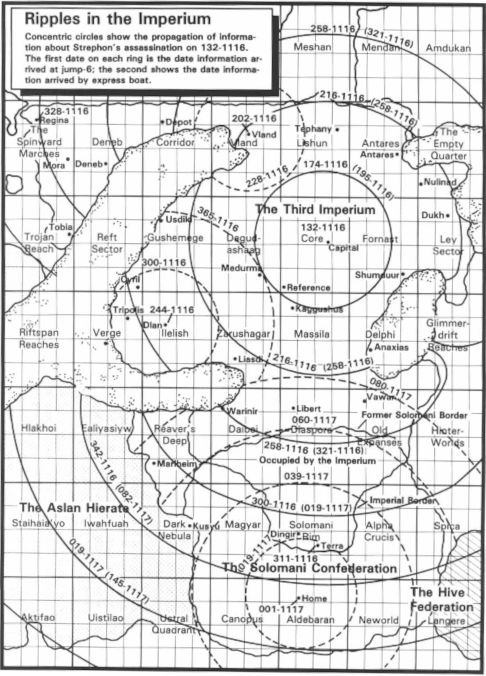
    There is a brilliant map in Megatraveller that displays how news of Emperor Strephon’s assassination spread throughout the Third Imperium. The common communication routes were the Express Boats that could jump 4 parsecs in a week, which was the limiting factor for the spread of the event. There was a second communication route used by the Imperial government and the Navy that used Couriers that could jump 6 parsecs in a week. Using this map, the GM could see who knew about the assassination, when, and how they would react.

    The map also illustrates how much distance the news had to travel. In the setting, Emperor Strephon was assassinated on the 132nd day of the Imperial Year 1116. That news took 200 days to reach Terra, on the rimward fringe of the Imperium. That was from Emergency jumps running a Pony Express route (delivering the mail through a relay of riders and fresh horses) at a pace of around 850 C. That shows that the Third Imperium is really, really vast.

    Keep Real-Time Communication Exclusive

    The Star Trek and Star Wars settings have tropes where conversations over enormous distances occur. Which works against the scope of the setting. The Enterprise is often shown as the “only ship in the Sector” that can respond to the inciting incident of the episode. The orders are delivered from StarFleet headquarters in a direct Subspace communication. Even though the Enterprise was thousands of light years distant Captain Kirk could have a video chat with the Admiralty, and receive updates while delivering progress reports. Lord Vader has video chats with Emperor Palpatine from the Phone Booth on board his Super Star Destroyer while the Emperor is at the heart of the Empire on Coruscant. This shrinks the universe to planetary scale. It’s no more inconvenient to phone HQ for info than it is to open a Zoom Call to Hong Kong from London.

    Both settings retain their sense of scale by showing that these real-time communications as requiring equipment that demands resources that are unavailable to the average citizen. Vader is the Dark Lord of the Sith, he has the biggest and bestest, literally a “Super” Star Destroyer. The Enterprise is the Flagship of the Federation. Subspace and Hyperspace Communications are not available or even a component of adventure sized ships like the characters would be crew of. A small colony carving out a settlement may not have the resources to build such a communications array.

    The Star Trek movie Into Darkness and Star Wars: Revenge of the Sith really undermines the scope of their settings (spoilers for both movies). In Into Darkness there’s a scene where “John Harrison” escapes capture on Earth by teleporting to the heart of the Klingon Empire. Using technology explained as “Transwarp Beaming” but it was effectively instant teleportation over hundreds of light years. The Enterprise follows at Warp and arrives close enough to threaten Harrison with a long-range bombardment in an indeterminate, but very short interval. This is a planetary scale event. The distances are just numbers because there is no appreciable time investment.

    In your campaigns, if your adventures travel interstellar distance this casually, then alien worlds become little more than exotic cities that can be reached by tourists on vacation. The sense of wonder is erased.

    Time is Relative

    In settings where Near-Lightspeed and Faster than Light travel is a factor, characters can age faster or slower than the rest of the setting when traveling. This is another way to emphasize the distances involved.

    When traveling at Near-Lightspeed, the subject of relativistic speeds age slower. Characters who regularly travel at these velocities start to subjectively move forward in time. They leave one world, travel for a week at relativistic speeds, and when they arrive at their destination, they have only aged a week, but the setting has gone through months of time. The GM needs to juggle three periods of time. The time from the origin passes quickly as the characters are in transit, the time on board ship seems to pass normally, and the time at the destination would be the distance travelled divided by the velocity of the vessel. This allows characters to experience vast spans of time over the course of their career while their physical life spans are unchanged.

    At Faster than Light Travel, the relativistic equation starts to flip on it’s head. Especially in settings where Jump Drives crosses the distance instantly, but the vessel has to spend a period of time (usually a week) in hyperspace, or jump space. The characters age, but the setting doesn’t. This starts to age the characters faster than the universe around them.

    In Warp-Drive settings, the ships spend travel time in a bubble of real space while the universe outside slows to a standstill. When the ship emerges, the crew, like a Jump Drive crew have aged the time they were at warp, but the universe has only aged a much smaller interval. It takes the Enterprise much, much less time to move through the galaxy at warp than light does.

    This allows adventurers the possibility of outrunning the consequences of their actions (for a time). So long as the adventurers can travel faster than the news of what they did, they can arrive in a new system before anyone can know what they’ve done. Of course, the trap here is that the adventurers need to keep moving. At least until the consequence exhausts it’s urgency.

    Setting Scale and Campaign Scope

    It’s important to apply the scale of your setting to complement the scope of the campaign you wish to run. It is tempting, especially with a game like Traveller with it’s procedurally generated system for creating worlds to create sectors’ worth of star systems, worlds, and moons. It can be fun, dreaming up pocket empires, cities, starports and NPCs to populate them. However, unless you plan to run a series of campaigns over the course of years, developing anything beyond a subsector beforehand is mostly futile. The same goes for system detail. Unless an extended adventure takes place in a single system, most groups of adventurers will never explore any given place beyond the world where the adventure takes place, and even then, the adventurers often only encounter those locations described in the adventure itself.

    Point being, unless the adventurers choose to visit a location, they won’t. You as the GM can encourage the adventurers to visit a location, but the ultimate decision is with the players. It’s the GM’s job to seed reasons for the players to want to visit the interesting locations that are designed. That being said, as GM you can present a campaign that happens in a single star system, with a plot similar to the Expanse. That type of campaign will resemble an Interplanetary Setting, with it’s distances and travel/ communication times. Everything outside of the campaign system doesn’t need any real detail. News can arrive as the GM chooses, but it is not anything that needs to be designed beforehand. Don’t make more work for yourself than you must.

    There is a balance for a campaign that revolves around travel. For example, in a Battletech campaign where the characters make up a mercenary company, contracting their military service with planetary governments and empires for c-bills, interstellar travel is common. The Company fulfills a Contract on a world, gets paid, and then they’re off to the next contract on the next world. System Detail only needs to be relevant to the current contract, and possibly outlines of the next contracts on offer. This is more of an example of a Interstellar scope on an Interstellar scale. While the campaign may never visit more than a dozen worlds or so, you as the GM can make the setting seem big. That’s part of the appeal. The mercenaries aren’t stuck on just one world or in one system. The conflicts cover hundreds of systems and thousands of light years of distance. Part of the appeal of a campaign like this is adventuring in space.

    Deep Space Exploration, like Star Trek is the ultimate expression of Campaign Scope and Setting Scale. Leaving the familiar stars behind to explore… (dare I say?) strange, new worlds. Here, the GM can use time dilation to illustrate how vast the universe is. Traveling from world to world, and revisiting some can show how much time passes on the worlds left behind. Friends who stayed on the outpost the adventurers visited at the beginning of the campaign, can have aged significantly by the time they return and the adventurers have only aged a couple of years. Campaigns out here are stories of isolation and self-sufficiency. Like the crew of a ship far beyond the boundaries of Empire, help is months or years away if it can be reached at all. News from home can be years old. I’d even go so far as to make FTL communication like subspace or hyperspace have significant delays. The goal for campaigns of this sort is, like the crew from Star Trek: Voyager, is to turn the characters’ starship into it’s own little world sailing through the stars.

    West Marches, Distant Stars

    A gaming group can adopt a setting to run a multiple-campaign game using science fiction. In this framework, GMs develop different areas in the setting, and multiple groups of players can experience adventures travelling between GMs and their areas. Coordination is key, understanding where each group of players are in time and space will inform what is occurring in the universe as it unfolds. Groups that encounter one another can exchange news and even crew. As a campaign like this matures, it becomes epic. Like a science-fiction franchise, the more campaigns that play becomes identifiable as unique expressions of the setting while remaining a part of the greater setting.

    Conclusion

    I’ve presented, a lot in this essay. Turns out, since space is big, discussing role-playing in a space setting starts to get big as well. All of this doesn’t need to be applied to any given rpg as a whole. Like all science fiction gaming, the freedom to pick and choose what works for you is a part of the fun.

    Happy Star Trek Day
  • Hand Grenades and Fireballs

    Hand Grenades and Fireballs

    When your friends are close enough to get singed

    From it’s wargaming roots, D&D has allowed Area of Effect attacks to split fighters in melee with one another. The phrase “I cast the fireball to hit the monster but not my friends” has been around since the beginning. Precisely measuring out squares or inches on a battle-mat to include the monsters and not the characters is a refined skill for grid-tacticians everywhere.

    I’ve always hated it. It slows combat to a crawl as players agonize over where the center of their Fireball, or their Cone of Cold, or Entangle Spell should be to get the most enemies and no party members.

    For me, this also breaks immersion. The splitting of combattants in melee assumes that two fighters stand still until they move to a new position. Bashing away at one another like a pair of Rock-em Sock-em Robots, anchored to the spot. This is not how fighting happens. Look at MMA fights, or boxing matches, wrestling (both intramural and pro), or even a football play or rugby scrum. Ain’t no one standing still long enough to precisely drop a 20 foot radius ball of fire so one guy gets burned ant the other doesn’t. All fighters in a melee are in constant motion, often grappling or piled up on the ground.

    I use the following House Rule in my games with regards to what happens when a spellcaster tries to put the edge of an AoE spell between two fighters in melee with one another.

    Area of Effect Attacks into Melee

    • Anyone who is in melee combat is affected by any AoE that would affect any combatant in that combat in that round. i.e – a spellcaster is not able to position an AoE effect in such a way that one combatant in a melee is affected while others are not. It’s either everyone in the combat or no one in the combat.
    • There is a “fringe zone” around the edge of an AoE that extends outside the limit of the AoE. Anyone within the fringe (a 5 foot (1.5 meter) border) who is also in melee combat with someone in the AoE is still affected, but in the instance of where a Saving Throw is necessary, the targets in this fringe zone have Advantage to that Saving Throw.

    Example: We have three potential targets of a fireball.
    Target 1 is the intended target of the spell and is within the AOE. Target 1 is affected as normal and makes a Saving Throw as per the rules.
    Target 2 is in the fringe zone and is in melee with Target 1. Target 2 is affected, but has Advantage to their Saving Throw.
    Target 3 is in the fringe zone and is not in melee with either Target 1 or Target 2. They are not affected by the spell.

    • If all combatants are in the fringe zone of an AoE, but none are in the AoE itself, no one in the combat is affected by the spell.
    • If a target is in the fringe zone but is attacking with a weapon that has the reach quality (like a Halberd), then the target is not affected by the AoE.

    Example #2: Same three potential targets of the fireballThe circumstances are the same, except Target 3 is outside the fringe zone, but is in melee combat with Target 2. In this case, Target 3is considered in the fringe zone.

    Example #3: as the previous example but with the inclusion of Target 4who is outside the fringe zone. If Target 4is in melee combat with Target 3, Target 4is considered outsidethe fringe zone. If an AoE spell has no Saving Throw (like SLEEP) then anyone affected by the spell is affected normally, whether or not they are in the finge zone. If an AoE has a Magic Attack Roll, and not a Saving Throw anyone affected by the fringe zone has a +5 Bonus to their Armor Class.

  • Failing Forward

    Failing Forward

    Making Failure less Frustrating

    There are nights when the dice just hate everyone at the table. Except the DM. Players can’t roll above a 6 and their characters can’t accomplish even the simplest task. Nothing happens and the characters are stuck. The only door blocking their path can’t be opened, the speed-bump combat becomes a slog of swing-and-a-miss, the stream, easily crossed, ends up washing the whole party away. The first time these things happen, it’s kinda funny, “Remember that goblin that no one could hit and we had to just run away?”. But over the course of a game session it looses it’s charm, “Failed AGAIN? I have a plus 12 to the roll and I can’t roll higher than 3! @&#! this dungeon!

    Failing forward helps with this. The basic principle is this. Your character succeeds in their roll, but if they fail to score higher than the Target Number, the character suffers a consequence. The classic example of this is “you force the door open, but make such a racket that anyone within a hundred feet hears your entry.” Or, “You knife the guard, but, as he falls, he slaps the panic button at their station” characters can progress, but there’s an added challenge.

    Let the Player Choose

    Often when a character fails forward, it helps engagement to ask the player what the consequence should be. This helps give the player a hand in the fate of their character, and gives the Game Master a clue as to what the player is expecting from the adventure. The player should express their character’s consequence as briefly as they can. The consequence should be proportional to the degree of failure, and the consequence should never be more effective than success.

    The Game Master could alternatively let the player group choose. This helps to avoid putting a player, who might not be comfortable improvising like this, on the spot. The final decision on consequence needs to have the consent of the character’s player, and approved by the Game Master. This encourages everyone at the table to remain engaged with the game as it’s being played.

    Keep it Proportional

    As mentioned, failing forward should never be a better result than success. Failing forward progresses the adventure at a cost. If the failure is slight, or the task relatively minor, failing forward should apply slight consequences. If the failure is great, or the task critical, failing forward should extract a much greater price.

    The goal here is to allow a path forward with a cost. Some of the build up of narrative drama grows from dwindling resources. Dropping your character’s rations down a crevasse or breaking your lantern can be just as tense as loosing 2d10 hit points.

    A Brief Word About Combat

    I’m not a big fan of brushing off damage as a fail forward. Just having a minimum rolled damage, or half-damage result tends to throw off the balance of monster stats in Dungeons and Dragons. Furthermore, it is not any less frustrating and it doesn’t change anything except to continue to whittle down the adversaries’ hit points. Again I’d fail forward, allowing say a hit on the target, but the character hurts themselves for minimum damage, or they loose some ammunition. Or they don’t do damage but gain a cumulative +1 bonus to hit each time they miss until they do hit. Maybe they do damage, but the GM gets to move their character 5 feet (roughly 1.5 meters) maybe placing the character in a less advantageous position.

    My point here is that combat, whether you employ failing forward or not, should be dynamic, even if you’re not playing on a battlemap. Very little is less exciting than endlessly whittling away hit points from one another’s pile. But, that is a whole ‘nother essay.

    Things That Should Not Fail Forward

    Failing forward is not appropriate for all situations. Saving Throws, Death Saves, All-or-Nohing tasks are but a few. With these situations, one either succeeds, or fails and suffers the consequences. Also, NPCs and adversaries should never fail forward. The GM shouldn’t ever be frustrated by the Players’ Characters’ success in the adventure. TTRPGs aren’t adversarially competitive games (even Call of Cthulhu!). Or at least they aren’t any more.

    Remember, the Game Master’s job is to provide challenges to the players who resolve them through their characters. TTRPGs have evolved a long way from it’s wargaming roots. Even if you’re not “telling a story” with your adventure, you are engaging in drama. The purpose, is to have fun, not slog away under a series of cold dice rolls.

  • The Silver Princess

    The Silver Princess

    Adapting early D&D Adventures

    One of my favorite old adventures for D&D is Palace of the Silver Princess by Jean Wells (and re-written by Tom Moldvay). I want to focus on Jean’s adventure, because it is really good and introduces a role-playing element that was missing for those first half-dozen years of D&D, a story.

    The controversy surrounding this adventure deserves mention, and it has been the subject of a huge volume of articles and analysis over these past four and a half decades. I won’t rehash it here. It involves that mix of Satanic Panic, Sexual Panic, and Mysogyny that was sweeping the MidWest in 1980 and would consume the country for the next decade. It got Jean’s original published adventure pulled from shelves, then rewritten by tom with some controversial illustrations removed to appease the angry moralists (who wouldn’t ever play D&D because they got far more satisfaction from displaying Moral Fiber).

    A cropped image of Illusion of the Decapus by Laura Roslof.

    Art by Erol Otus. Soup’s on fam!

    I can feel my “moral fiber” fraying at the ends… Again, if you want to explore this early controversy in D&D, there are a lot of very detailed and attributed articles out there.

    The thing I like about Palace of the Silver Princess, and why I choose it to adapt it to 5th edition and run it for the new generation of gamers is what Jean Wells brought to D&D through it. Palace of the Silver Princess is a Fairy-Tale Romance. With a hidden valley, a lost princess and a bold knight all under a wicked curse that a group of heroes can break.

    I also believe that this is what a woman’s perspective (in 1980, when beardy wargaming dudes were arguing over whether or not a Bec-de-Corbin was more effective against Field Plate than the Bohemian Ear Spoon) brought to role-playing games. The effort was both well appreciated by this blogger, and well punished by executives.

    Getting to the Point

    When I adapt these adventures to play in 5th edition D&D (but, these principles can be adapted to the game system you prefer) I start with the source material. Most of these old adventures can be found as pdfs for cheap all over the internet. What you’ll need most is a notebook or text file to jot down notes.

    First, read through the adventure. For most of these early adventures it’s not much. 32 to 64 pages, anything longer would normally be called a “supermodule” even then, Temple of Elemental Evil is only 128 pages long. Read through the whole thing, take notes.

    Next, compare the encounters to the resources in the rule set you want to convert to. Most adversaries have stat blocks in the rules you are using. Orcs, for example can be found in every edition of D&D (even the 2024 monster manual see my article about it). For most adventures, the balance of the encounters doesn’t change all that much in the context of the rules. If anything, many encounters get easier. Going back to Orcs for a moment, in first edition AD&D and BECMI, orcs are a hard fight for a first level party, one-to-one. They often have more hit points than most first level classes, and equal hit points to a fighter. They fight like a fighter, and have equivalent armor and weapons. By the time 3rd edition and later, the balance swings towards the player-characters. Same holds true for most other creatures in these early versions.

    Adjust the encounters. after reading through the adventure and noting all the encounters as written, take a look in the context of the adventure’s plot. If it looks too hard, adjust some details to make it easier. If it looks too easy, beef it up a little. Don’t just consider the raw stat blocks, look at the context of the encounter. Is it an ambush? Is the adversary asleep, or distracted, or can they be easily fooled. All encounters are not toe-to-toe combats. Consider the encounter’s challenge in light of what it is supposed to do for the adventure. This is also your opportunity as Game Master to tailor the adventure that is published for a wide audience to your group of player characters.

    Don’t be afraid to change things. Does one of the characters have a flaw that drives them to hate a monster type, but that monster doesn’t appear in the adventure? Add them in. It’s really easy to take an Orc encounter and make it a Hobgoblin encounter. Do your players not like fighting Zombies? Replace them with a construct of a similar CR. Does your setting not have flashy magic? Change that spell from fireball to a pot of flaming oil that drops in the same spot. Tailoring an otherwise generic adventure to your specific party of player-characters will make the adventure a lot more impactful and memorable.

    Finally, take all these notes and make them easy for you to reference during game play. You don’t have to rewrite the whole thing. Just look at the notebook you wrote all these thoughts down on and put it on a format that will help you run the adventure at the table. Don’t rely on having the books at the table, then at the start of the encounter, flip back and forth. That will kill all the momentum that the adventure is building and frustrate both you and your players. My point here is to make it easy on yourself in the way that’s easiest for you to understand. If you are brand new and haven’t developed this skill, don’t worry. Use the format that is printed in the adventure as a guide. As you run more adventures in D&D, you’ll discover what works best for you.

    Old Adventures are a Great Resource

    There is now a fifty-year library of content for Dungeons and Dragons now. Not just Dungeons and Dragons published by Wizards of the Coast and TSR before that. There are adventures and content published by dozens (if not hundreds) of third-party companies going back to the beginning. There is an inexhaustible supply of adventures that we can choose from.

    Lots of these early adventures were touchstones for the D&D community. Adventures like Keep on the Borderlands, Sinister Secret of Saltmarsh, Village of Hommlet, Slave Pits of the Undercity, Vault of the Drow and so many others were run and played at countless table, and it formed a common reference for players. It didn’t even matter that your table didn’t play in the supported campaign world, you could plug the adventure into your home setting and play it nearly out of the box. When you use these adventures at your table, for your players, who may have not even heard of it, you connect yourself to this legacy.

    One More Thing

    Converting these old adventures also teach you skills that can be used in your Game Master career. By reading and analyzing adventures, you are teaching yourself how they are designed. You can learn what elements of adventure design appeal to you and use these skills in creating your own adventures.

    This is a technique taught to art students for centuries. Go to where the masters’ works are on display, bring your supplies and reproduce it. The student’s effort probably won’t look like the masterwork, but it will teach the student to apply the same techniques and learn skills that their instructor couldn’t teach.

    Converting the early adventures for fantasy roleplaying into a modern system will improve your GM skills. They might even inspire you to design your own unique adventures.

  • Alignment and Personality

    Alignment and Personality

    More Dezzy’s House Rules for D&D

    Alignment is an artifact of the earliest days of D&D. According to legend, Gary Gygax adopted the mechanic after the players in those early campaigns kept lying, cheating, and murdering one another (and the nearby town) to get treasure and magic items. Alignment was also inspired by Moorcock’s Eternal Champion stories where cosmic forces of Law and Chaos struggled to shape the multiverse. Characters, like the Eternal Champions were agents of those forces. Alignment also served as shorthand, identifying friends and foes, “good-guys” and “bad-guys”. It worked fine for those early development from wargaming, but as players explored the game, it became a crutch, or worse, a straitjacket.

    Alignment As Short-hand

    How I run alignment currently is as a short-hand to help with character consistency. In a time when weeks or months can pass between game sessions, how we remember our characters drifts. A trait that was central to the character can become neglected, especially of the current multi-session adventure provides little opportunity to express that trait. Sometimes the motivation behind a characters actions looses it’s focus. Having a simple, evocative term to help ground the character has value.

    As first edition AD&D defines Alignment, there are two axes that creates the term. One axis is a Law – Neutrality – Chaos (which is also the original Alignment spectrum), the other axis is Good- Neutrality – Evil. The combination of them tells us something about the character. Lawful characters are inclined to order and structure, Evil characters are self-serving and callous, Neutral characters have no strong associations with the poles of that axis.

    There is a well known problem with the Good-Evil axis in this system. “Good” and “Evil” in the real world are generally considered subjective based on the consensus of the culture that one is acting within. (an admittedly crude definition, I’m no Philosophy major). In the context of Dungeons and Dragons, Good and Evil are objective and aligned with cosmic forces that reflect in the outer planes. In practical terms, what constitutes Good or Evil is in the hands of the Game Master and the Players in the campaign.

    In these early editions, Alignment is restrictive towards what classes players may choose for their characters. Paladins, most famously, must be Lawful Good. Thieves cannot have Good as a component of their alignment, Druids must be “true” Neutral (meaning neutral on both axes). This often led to endless debates over what all that meant. Can a Thief really be Lawful Neutral? Their class abilities, especially Picking Pockets, Sneaking Around and that Back Stab attack are hardly reflective of a Lawful mindset. Are characters following a Chaotic Good Deity simply prevented from being Paladins? What about rebels fighting a tyrannical kingdom? Can they be Lawful and still fight the established order? Can they be Good and still support slavery because it’s legal? It was a murky pool to wade into.

    5th ed Personal Characteristics

    5th edition added more tools for character definition, Personal Characteristics. Four categories; Personality Traits, Ideals, Bonds and Flaws were one sentence or one phrase descriptors of a character’s persona. They were more detailed than just a simple two axis alignment and since the persona categories used sentences and phrases, players could define their characters much more precisely. They’re no longer simply “Chaotic Neutral”, 5th ed characters are Chaotic Neutral and Have Never Lost Their Child-like Sense of Wonder, Never Sticks to A Single Set of Rules, Does What They Can to Protect the Natural World, and Is Always Changing Their Mind.

    The “Ideals” category often has alignment recommendations. Helping the player to choose an Ideal that compliments their Alignment choice.

    Finally, ever since 3rd edition, alignment restrictions on classes have been removed, which has removed Alignment from being a requirement to make a character. In modern D&D Alignment has become nothing more than a soft statistic that shapes but not defines a character.

    Personal Characteristics as Alignment Replacement

    This is the mechanic I’ll be using in my D&D games going forward. The classic alignment axis system still exists, but only as an organizing framework for the outer planes and as shorthand for minions, NPCs and Monsters, not player characters.

    For player characters there are three Personal Characteristics that serve the purpose that Alignment did.

    Bonds: the connection the character has with others, family, companions, their home village, etc..

    Ideals: the character’s motivations, why they continue pursuing adventure even after they experience setbacks and obstacles.

    Flaws: those aspects of a character’s personality that hinder their own efforts.

    At character creation, each personal characteristic is assigned a short statement that describes them. Each characteristic will reflect an alignment component; Good, Evil, Lawful, Chaotic, or Neutral. Bonds and Ideals cannot be in opposing alignments, one cannot be good, while the other is evil, or one cannot be lawful wile the other is chaotic. Neutral alignment is not considered in opposition with any other alignment. These two personal characteristics can have the statements that invoke the same alignment.

    Flaws must invoke an alignment in opposition to at least one of the two other personal characteristics. In the case of Neutral Bonds or Ideals, the Flaw has to be non-neutral.

    If the players play their personal characteristics appropriately and in a way that disadvantages the character by the choice, the Game Master may award them Heroic Inspiration, if the character already has Heroic Inspiration they may give it to another character who does not, and if everyone in the party has Heroic Inspiration, the player can increase their character’s Doom Die by 1 die type (maximum of d8)

    Seasons change, and so did I

    (with apologies to the Guess Who for the line)

    Players may choose to change their character’s personal characteristics when the character gains a new Experience Level. They may add an additional Bond, Ideal, and Flaw when they advance to Tier 2, and again at Tiers 3 and 4. These changes and additions are optional to the player and can only be chosen upon gaining a new experience level.

    Conclusion

    This house rule for Alignment isn’t a straitjacket, and should not be enforced as such. These traits are intended to be tools for character development. Relating them to alignments helps to define a character’s morality and ethics. While the subjective terms “Good” and “Evil” are employed as components of this mechanic, I argue here that those terms, and we’ll thrown in Law, Chaos and Neutrality in there too, are intended for each group of gamers to determine for themselves and agree to amongst one another. These terms of moral and ethical philosophy can and will change for each of us over the course of our lives. Gods only know what I thought was “Good” and “Evil” when I first started playing Dungeons and Dragons four and a half decades ago are not the same as they are at the time I’m writing this, and will likely evolve some more before I’m finished playing D&D.

    (If I get my wish, that will be another four and a half decades from now, I’m not eager to reach the end of this journey any time soon)

    Point being, Dungeons and Dragons (and all tabletop roleplaying games) belong to everybody playing them and we’re allowed to define alignment and personality traits to suit our table just as much as we can decide whether or not Orcs have pig snouts or not. There is no wrong answer, there never was.

    (Featured Art by Becky Peltier http://www.artofbeckypeltier.com)