
A ten term career of Traveller Gaming
I’ve been playing and running the first Science Fiction Role playing game since 1985. My high-school buddy Chuck R ran an amazing multi-session adventure based on the Aliens movie released in ’86. It was brutal and so much fun. We made so many characters during that game. Xenomorphs are freakin’ deadly.
So are player-characters. We killed as many PCs as the Xenos did. One of our players was super-proud of the Armored Fighting Vehicle he custom-designed, and the first time he rolled it out, his character lost control of the vehicle and ran over five characters he was coming to rescue.
Good times!
Life-Path Characters
Traveller was also the first game to use a life-path method of character generation. Instead of generating a bunch of stats, choosing a class and diving into the life of an adventurer, Traveller characters start as 18 year old (or the age of majority for their species and culture) young adults. Players then start choosing career options. Choices are not guaranteed, the player has to make a check for their character to qualify for and join a career. If this check fails, the player can subject the character to the Draft, start a background as a Drifter (think “Space Hobo”), or can just begin game play with the background skills their character earned growing up. Players then roll checks for their characters in four-year terms, earning skills, advancing in their careers, having life-events, and most infamously, rolling Survival checks.
In the early editions of Traveller, failing the survival check during character generation means the character died in their career. Start over, roll some new stats, make a new 18 year old character. This made character generation into a mini-game of it’s own. Because the careers that offered skills and benefits most effective for adventures were often the most dangerous, such as Marines or Scouts, there is a risk/reward decision. Every term spent in a dangerous career can return coveted skills like Pilot (Starship), Gun Combat, Recon, Heavy Weapons, you know all those cool action-adventure skills. But every term runs the risk of the character dying in service and all those skills are lost. But, they died a hero! Probably. Maybe.
In latter-editions of Traveller, the survival check has been re-contextualized as less lethal. Failing a survival check now results in a “mishap” and often the end of a career or character generation. But, the character is alive and with an interesting story in their history.
There are also less risky careers, just Citizens of the galaxy. Administrators, Academics, Scientists, and the like. Survival rolls are easy to succeed with (though there almost always is a slight chance the character fails and is “hit by the Space Bus”) and though the skills are really useful (try to get your Marine friend out of the local lock-up without any Advocate skill), they won’t cover shooting guns, stabbing goons, or flying space-fighters. Players can also choose to change careers during this process, and with that, the diversity of character options is, well… galactically huge.
This often resulted in beginning adventurers having long histories and high skill values. It wasn’t unusual to see a group of Travellers start campaigns in their 30s and 40s, with high military ranks and contacts throughout Charted Space.
In more recent versions of Traveller, the concept of character connections have been introduced. So instead of a half-dozen random strangers being thrown on a tramp-freighter, characters can be old service buddies, ex-lovers (or ex-spouses), and all sorts of other potential connections. This encourages players to not just care about their own character, but about the other players’ characters at the table. It’s easier to abandon some guy you met an hour ago in the spaceport bar to the ravenous tooth-beasties than it is to leave the person you served with during the best times of your life.
Charted Space and the Third Imperium
The default setting for Traveller is called “Charted Space”. Located in a slice of the Orion Arm of our galaxy and including Terra, it echoes the universes of Asimov, and Niven, Herbert and the sci-fi fiction just before Star Wars changed everything. Traveller was first published in 1977, the same year Star Wars entered theaters. The Third Imperium is a feudal interstellar empire that rules over eleven-thousand worlds. Charted Space includes the Imperium as well as empires of alien soceities such as the Aslan (Kzinti-inspired feline aliens), the Hivers, Vargr (terran wolves uplifted by an ancient alien culture), K’kree, and dozens of others.
While many sci-fi settings use “galaxy” as a short cut to a large interstellar setting, Charted Space illustrates just how big space is, and how unwieldy a galactic empire would be. I’ve been playing in Traveller for 40 years and in all of that time I’ve barely scratched the surface of Charted Space. Fifty years in this sandbox has created a setting as deep as those of the Foundation, Known Space, DUNE, the Star Wars Galaxy, or the Star Trek Galaxy.
To me, one of the fundamental technologies of Traveller that is strongest is communications. There is no “Subspace” or “Hyperspace” real-time communications. Instead communications travel at the speed of the fastest ships carrying them. There are dedicated couriers called Express Boats (or “X-Boats”) that deliver the mail and communications along established X-Boat routes between systems. However, not all inhabited systems are along the X-Boat routes, and it falls to smaller courier outfits to take the mail to the backwater systems (which is an opportunity for adventurers to earn some quick credits). This results in news taking weeks or months to cross the Imperium before it arrives at a given destination. This makes the Imperial frontier a bit like our world before the Telegraph was adopted. This also allows for people to outrun their past, or to make a living tracing those who hope to do so
IMTU: In My Traveller Universe
Traveller can be run in nearly any science fiction genre, not just the Third Imperium. Over the years it’s been adapted, inspired, or been incorporated in all sorts of setting. I’ll borrow a page from the creator of Traveller, Marc Miller and ask the rhetorical question, “How many different worlds can you think of?”
Most of us can imagine different biomes grown to planetary scale, desert planets, forest moons, jungle worlds, swamp worlds, worlds covered in oceans and ice, so on and so forth. But, this method is ultimately limited. There are only so many forest planets that we can design until they all start looking and feeling the same. (Star Wars really has this problem, Tattooine, Jakku, and Pasaana are different worlds, but they all feel like the same desert world.)
For Traveller, the solution was a game mechanic where the profile of a given world can be randomly generated. Instead of classifying worlds by biome, or by it’s ability to support live (like the class M planet in Star Trek), Traveller designs worlds by Size, Atmosphere, Hydrographics, Population, Government, and Law Level. Different combinations of World Profiles can identify different, multiple trade classifications such as agricultural, or industrial, or garden worlds, offering details that can make worlds feel different, and more diverse. Referees (the Traveller title for Game Master) can fill in entire subsectors of worlds for exploration in the course of an evening. Or, if necessary, on the spot.
Every Referee applies the Traveller rules differently in their own campaign. In the community, we refer to this as “In my Traveller universe” (IMTU). My favorite part of this, is that the Traveller Univers is large enough to contain all of this diversity in setting and campaign. Mechanically, everything in Traveller, whether it is Classic, TNE, Mongoose, or 5.1 is similar enough to be useable with nearly everything else. Honestly, in that high school campaign where I played in Chuck’s adaptation of Aliens, I played an Aslan. Big ol’ lion dude with a pulse laser and RAM grenade launchers fighting Xenomorphs. If you want to make a Wookie, or a Vulcan, or a Geminon from Battlestar Galactica, they can fit into Traveller alongside the standard Vilani/Solomani human characters and the Vargr. IMTU becomes the shorthand for the setting differences that the player can expect from this particular instance of Traveller. It has been this way for 50 years almost.
IDTU: In Dezzy’s Traveller Universe
I should give you all a little bit of context here. When I first started playing Traveller in the ’80s, it was the first “Classic” version. The Third Imperium was set in Year 1105 (1107, by the time the Fifth Frontier War started). I mostly ran my games in the Solomani Rim sector because my two go-to Alien Modules, Aslan and Solomani were set near this area.
In 1987, Traveller’s publisher, Game Designer’s Workshop and their partner Digest Group Publications produced the next version of Traveller, dubbed MegaTraveller, this expanded the mechanics, updated them a bit and advanced the Third Imperium to the year 1116. It also introduced a major change to the setting, dubbed the Rebellion, or the Shattered Imperium.
In MegaTraveller, the Emperor Strephon is assassinated by the Archduke of Ilelish doman, Dulinor, and the stable Imperium fractures into a multisided civil war. Like all major changes to RPGs (and pop culture for that matter), this was a huge controversy. Even back in 1989 gamers were really eager to dive headlong into arguments and fights over the media they felt ownership of. In My Traveller Universe, I’d chosen to ignore the Rebellion War, and continue my Solomani Rim campaigns without jumping the timeline ahead nine years. It was still 1107 (or so) and the events taking place in the Rim were still in a (relatively) stable Third Imperium.
1n 1991 I saw a supplement for MegaTraveller that caught my imagination.
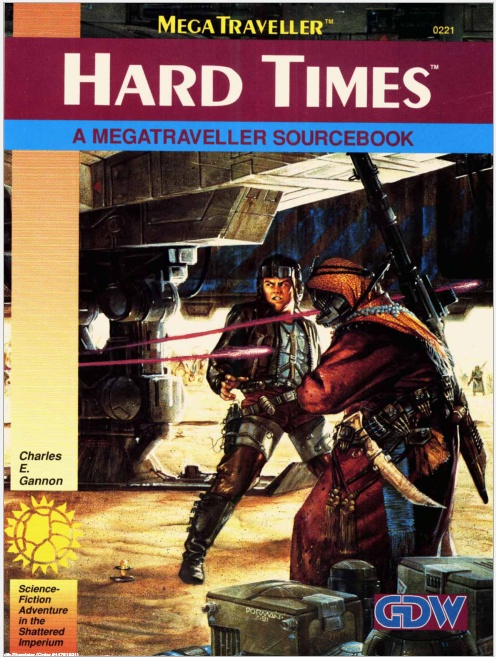
It was the Hard Times, and that cover just scratched all my Sci Fi Adventure itches. I still have my now 33 year old copy. The Hard Times advanced the Third Imperium timeline nine more years to 1125. The Rebellion War never ended with victory for anyone. Instead, all the factions fighting one another had exhausted their resources, and in the last years of war, had destroyed the infrastructure that allowed the Imperium to run. Economies collapsed, worlds failed, and communications broke down.
Library Data, the thing that the Imperium kept up to date so Travellers would have some idea of what to expect as they journeyed from system to system, lost it’s regular updates. Travel data stopped being accurate. The system you left three months ago, might be completely different when you return. It might be dead. It might have had a change in government and isolated itself from the rest of the sector. It might have become part of a Pocket Empire, and no longer recognized Imperial Law. A rival fleet could have flown through and saturation-bombed the main world. The most valuable asset that a crew could have was often the records of the recent systems they visited. Hell, in the Hard Times, even the X-Boat Routes became unreliable. The mail couldn’t get through.
My Traveller Universe advanced to the Hard Times on the spot.
Then, I moved to California and GDW changed Traveller again! Another controversy, another round of edition wars. This time it was 1993. I was excited to find a new Traveller version to go along with my new city and new state.
The New Era advanced the Third Imperium timeline to the year 1201. The collapse of the Hard Times had become a complete Apocalyptic catastrophe in year 1130 with the release of a superweapon, VIRUS. Essentially VIRUS was self-aware, weaponized software that spread through computer networks. So long as a given system was powerful enough to host an iteration of VIRUS, the weapon would turn that system against the societies that used it. Think Skynet from the Terminator Franchise. A malicious, aggressive, weaponized artificial intellect that desired the genocide or enslavement of all organic sentience it could find. VIRUS would infect a starship, and without warning purge all the airlocks (and crew) then if it were in proximity, turn any weapons on any nearby un-infected ships it could sense. VIRUS would set powerplants to overload, open habitats to vacuum, or poisonous atmosphers, or the ocean. Even most household appliances in the Imperium had enough processing power to host a fragment of VIRUS. Maybe your toaster couldn’t kill you on it’s own, but it certainly could infect the rest of your home, or vehicle and find something to murder you and your family with.
By 1201 the survivors of VIRUS had started the long road to recovery. That’s what the New Era was about, reconnecting interstellar civilization and avoiding Vampire Fleets and Murder Warbots. There were parts of the New Era I enjoyed, and there were parts I really didn’t. For me, it had changed too much. The adventures and setting supplements presupposed that Traveller was specifically taking place in this setting with these environments. If you wanted to play Traveller In Your Traveller Universe and not in The New Era, you’d have to do a fair amount of extra work. In short, The New Era didn’t feel enough like Traveller for me to really enjoy it.
My appreciation for VIRUS would come later.
I was surprised to see the 4th edition of Traveller “Marc Miller’s TRAVELLER” when I found it in my FLGS in 1996. I picked it up on the spot, but it’s setting “Mileu 0” had the same issues for me that The New Era had. It was just too different from the Traveller I enjoyed, and the game mechanics had been changed again from the system used in TNE, which was different from the system used in MegaTraveller. For me, TRAVELLER 4 wasn’t the Traveller I wanted.
Quick Link Interactive adapted Traveller to the d20 OGL in 2002. It drew me back to Traveller for the first time in almost ten years. I’d been running a lot of 3rd edition D&D in this time and Traveller20, as it came to be known, was really effective in introducing a whole new group of D&D gamers to the universe of Traveller. One of the elements of Traveller that was carried over to Traveller20 was the Life-Path mechanic adapted to the d20 system. Which I really adored!
Mongoose Publishing came to my rescue in 2008 with it’s retro-design of Classic Traveller. I remember finding a copy of Mongoose Traveller in the dealer room at KublaCon. The hardback cover was an homage to the original little black books of Classic Traveller. That became my new go-to version of Traveller. I blew the dust off My Traveller Universe and happily returned to the Far Future.
Since then, and the date of this writing, Marc Miller, with Far Future Enterprises published a Fifth Edition of Traveller, TRAVELLER5, in 2013 and a cleaned up revision 5.1 in 2019. Mongoose updated their version of Traveller into a Second edition in 2016 and published updated revisions in 2020 and 2022.
In Dezzy’s Traveller Universe, I’m mainly using the 2022 version of Mongoose Traveller 2nd edition with a fair amount of the crunchy menchanics from TRAVELLER5.1 in the background. I am setting my next campaign in Diaspora sector during the Hard Times of 1125.
Conclusion
If it’s not clear by now, I really enjoy Traveller. It’s my favorite Sci-Fi game, and I think it’s enjoying a renaissance among the older generation of gamers. Recently, Mongoose Publishing has purchased the rights to Traveller from Marc Miller and Far Future Enterprise, which places the game in good hands for the foreseeable future. I’m excited to see what Mongoose Publishing does with their stewardship.
As a role-playing community I think Traveller players have an opportunity here. We can introduce a whole new generation of gamers to Traveller and it’s rich history. Show them Your Traveller Universe.

 Lore and Legends of the Dezzyverse
Leave a reply to Only Human – Lore and Legends of the Dezzyverse Cancel reply