

Settings, Maps and Stories

This is the subcontinent of Fahr Ryasc during the End Times. I just completed the latest revision of this map on the week of publication. For you, dear reader, I redrew and redesigned the entire subcontinent. You’re welcome.
Okay, it was also time to give this map another pass. I have iterations of this map going back to 2013 (which, by the way, is two years before I started work on “Fahr Ryasc” as a setting. I’m kinda always making maps and then finding settings that fit them best. My other big project, Genzhymyl has a multilayered underground map. I still have the piece of hot press cardstock I drew the orignal location on.

And that turned into this with a little graphic computer mojo..
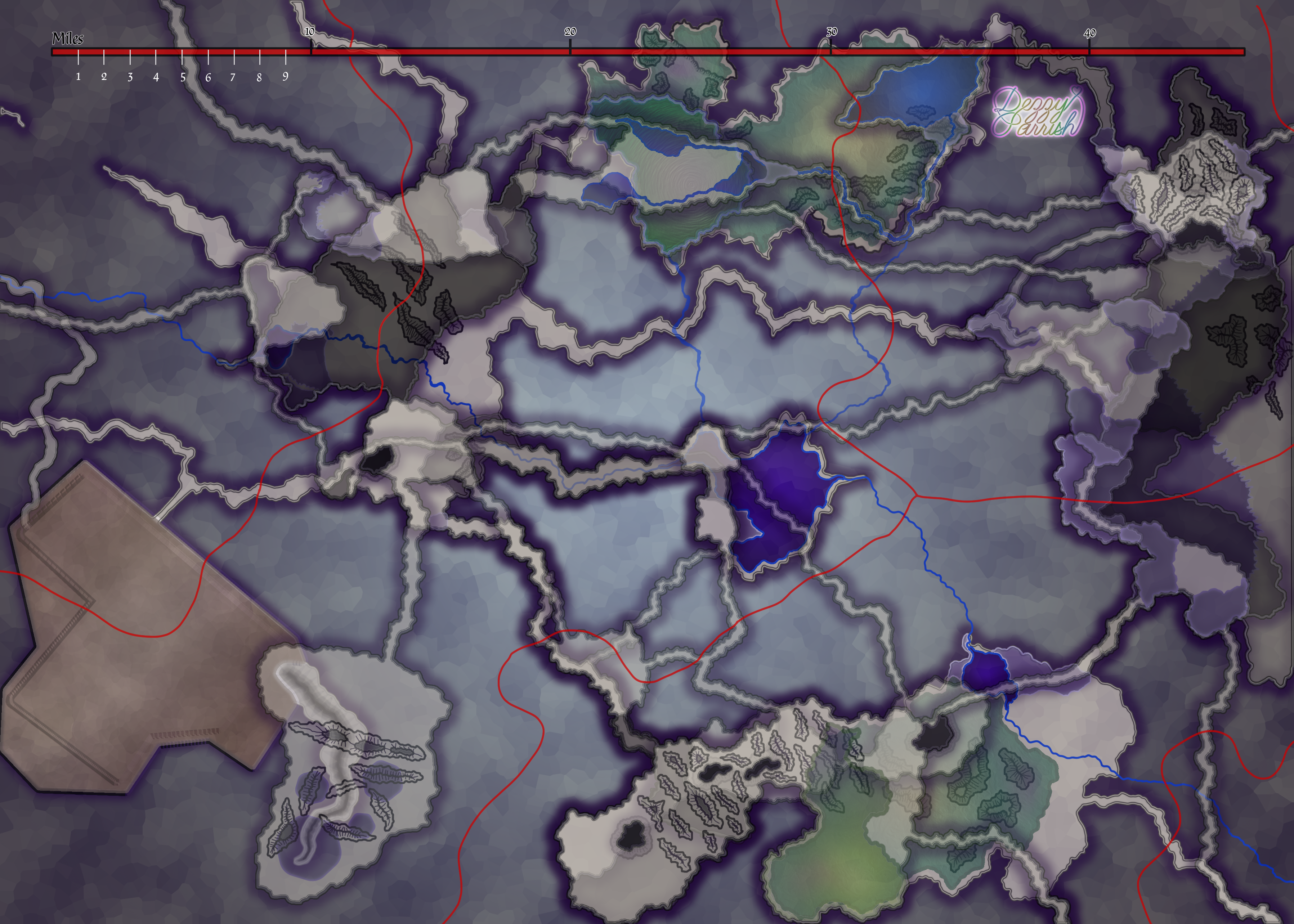
This is Version 13 of that original map. I really like dreaming up these worlds and imagining the people who live here. Genzhymyl is in Fahr Ryasc, somewhere under the Auborobua mountains. It’s in the Forgotten Realms too, somewhere in the “North”.
These two settings maps are the widest scope of a “bullseye” technique that I learned from the early days of D&D. The danger here is the temptation to fill in every last detail. I used to design settings on the world level, where all of the landmasses and oceans were drawn out at a planetary scale. I don’t recommend starting off at that scale. There is just too much that your players will never ever see, and if they do, they’ll never get the opportunity to appreciate it all. Even on the continental level, the setting can be too big to detail.
Let’s look at Middle-Earth. Professor Tolkien designed a third or half a continent. You can look at that map and see everything from the Grey Havens to Rhûn. But, even the Professor’s extensive lifetime of writing leaves most of this massive creation unexplored. After all, what stories take place in Rhûn? Or the wilds of Cardolan in old Arnor? All of that space sits fallow in the Legendarium. My lesson here is “don’t start too big”.
“It’s a dangerous business, Frodo, going out your door. You step onto the road, and if you don’t keep your feet, there’s no knowing where you might be swept off to.”
– Bilbo’s advice to his nephew.
There is a temptation, once you’ve drawn this big, beautiful map, with evocative names for locations and this epic scale, to share it with your players during a Session Zero, or even Pre-Session Zero. It’s natural, you’ve spent hours and maybe weeks or years creating a work of art and you want to share it with your friends. In the context of starting a campaign and buiding characters, this isn’t the best strategy.
Referring to Lord of the Rings again, the main characters, especially the Hobbits had never left the Shire before starting out for Bree. Even with Bilbo’s maps, they don’t have clue about the scale of the journey they’re taking. The characters in your campaign should be similar. They’re familiar with their homes, whether it is their village ,their farm or their neighborhood in the city they grew up in, and they might, if they’re well travelled have knowledge of their neighboring settlements and the terrain in between.
So, instead of rolling out the grand map of the Realm during character creation, draw up a simple small scale map that features the local area the characters will be starting in. Work from this map as you introduce your players to the setting. For an example, I’ll share with you the Kieran Slee in the Kælic Highlands
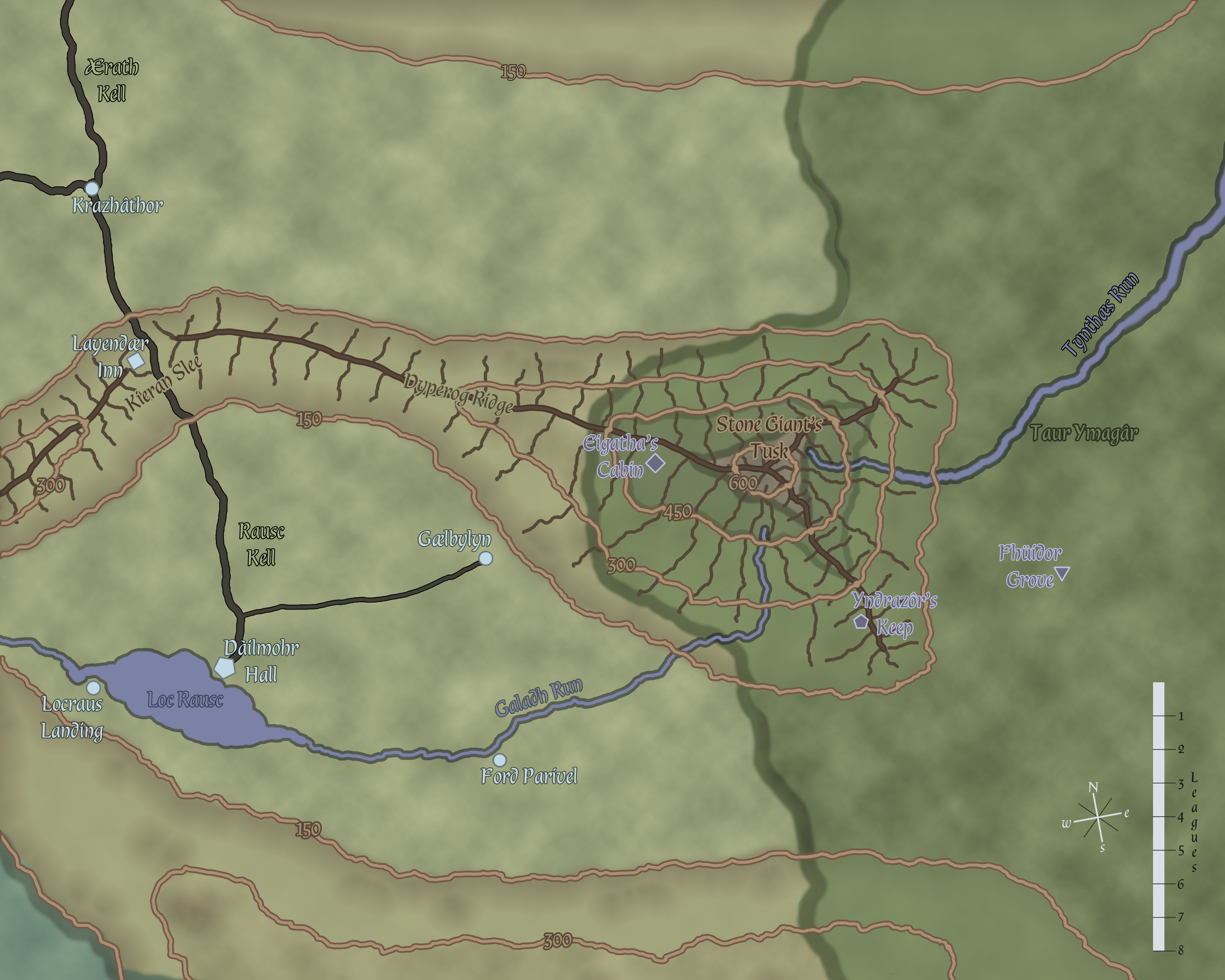
.This area is much more manageable, and believable for characters to be familiar with from the start. Everyone will know landmarks like the Stone Giant’s Tusk, the Kieran Slee with the Layender Inn. Beyond this little area, you can tell the players about what their characters have heard. Like the marshes to the South, the Great Hall of the Rígh (king) to the North, and the Great Stone Circles of the Druids somewhere off to the West.
As their characters travel beyond this small little provence and into the wider world, instead of providing a perfectly drawn map, instead, tell the players about the terrain and the time it takes to travel. Going from Layender Inn to the Kell beyond Ærath follows a road and it takes three days travel by foot. Encourage them to make their own map. It won’t be perfect, but after a few game sessions, it will be accurate and it will reflect the story the players are making with you.
A small confession…
As you might have guessed, this week’s blog was mostly an excuse to show off my map making talents, and chat a bit about my philosophies with regards to world-building. I don’t really have a design for this article. I just wanted to share the pretty picture, and maybe work in that quote from Lord of the Rings. I’ll be adding some more lore to the blog next week. Pinky Swear!
 Lore and Legends of the Dezzyverse
Leave a comment