Tag: Traveller

  • Only Human

    Only Human

    Electric Head, Cannibal Core, the Television Said..

    Most Tabletop Roleplaying Games feature humans as the dominant species in the setting. The reasoning is straightforward, Players, being humans themselves, can most easily identify with their characters when they are human as well. It also saves on lore-overload. With humans, whether they’re from Earth, Corellia, Rigel IV, or Vland do not require an essay explaining what they are. Roll up a character, and get playing, no need to wonder about why your Vulcan has green blood, or your Wookie looks suspiciously like Bigfoot. Also, with a human-centric setting, all the gear is easily designed and described. No trying to explain the kinesthetics of a laser rifle made for Hivers when your lasgun looks pretty much like the rifles and carbines that exist today on the real world.

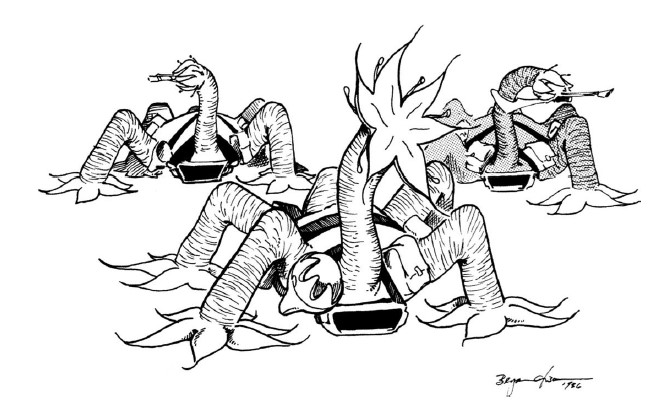
    A group of Hivers suited up and packin’ Hiver-heat!

    Impact of a Human Universe

    Human centered universes are scaled and designed to be convenient for humans. If Humans are the default species, the habitats and furnishings are familiar. Even if it’s a “space-chair” that floats it’s a chair that is designed for bipedal mammals with arms, legs, feet and hands. No need to slow the game down describing it and making the player describe how their character takes a seat. Buildings and vehicles are scaled for 1.75 meter tall 68 kg operators and passengers. Computers are designed with keyboards for manipulative digits and the ability to communicate through voice. Doorknobs are made for people with opposable thumbs.

    It’s why most of the aliens in Star Trek and Star Wars are near-human. Even Wookies, at 2.2 meters tall are human enough to pilot a YT-1300 Stock Light Freighter. All of the bumpy headed aliens of the Star Trek Universe are compatible enough that a member of one species can be disguised as a member of one of the other species. Of course, the practical reason for this is that the actors are themselves humans and it’s cheaper and more practical to throw a rubber mask on and spirit-gum some extra hair and be an alien on screen. Just look at what was needed in Return of the Jedi to operate and act Jabba the Hutt. Poor guy only got to leave his couch of perpetual indulgence after the Special Editions were released and computer graphics could be used to let the big ‘ol slug slither around Mos Eisley.

    It’s fun to speculate what a Hutt civilization, or a Tholian civilization would be like. It’s a nice place to visit as a role-player. Stepping out of the familiar into the alien, is a fun exercise, but not something many players would want to deal with week in and week out for the length of a long campaign. Being unable to pass through a door because it’s scaled for a Jawa is a challenge, Not being able to pass through ALL the doors in the city because it’s all scaled for Jawas is just tedious.

    There is Infinite Diversity in the Human Condition

    The danger of the default-human setting is that everyone starts to look, sound and act like the culture the players and game masters live in. Even a setting that presents itself as highly diverse, like Star Trek is mostly causation, especially in The Original Series. If the game master isn’t careful, the distant world of Efate can start to feel like Los Angeles, or Dallas or Tampa Bay.

    The contrasting issue is also a danger. It’s all to easy to lean on stereotypes of “exotic” human cultures. Every desert planet starts to feel like Algeria or Egypt. The primitive worlds start to look a lot like aboriginal and tribal cultures as portrayed in the pulps. As GMs I’m not saying that every world needs to have a unique culture with roots going back centuries. But if you’re designing the next world the PCs are visiting, recognize when you’re shortcutting the humans that live there as someone else’s real culture. If you spend the time to look at your setting elements, you’ll also find it really easy to change the people of the place enough to make them unique without diving into worn out stereotypes.

    Humans are highly adaptable, and as a species, we can make tools to survive in every climate imaginable, including space. Over the course of generations, populations of humans living in different climates will evolve physical characteristics that help them survive in the climate where they live. Furthermore, the humans that have evolved in one climate are able to have children with other humans from other climates and the genetic mix gives humanity a near infinite variety. You can use this for your player characters and your npcs in a campaign. It’s easy for a band of eight characters to be visually and culturally unique from one character to the next.

    More Human Than Human

    with apologies to Rob Zombie

    There has been an unfortunate standard set in tabletop role playing games over the decades of making humans the “default” species, and as such not giving them bonus or disadvantageous abilities or modifiers. Humans are characters that were played as rolled. Which, while balanced, didn’t excite players. Especially when other species could see in low light, or have superhuman agility or strength or inherent weapons like claws or fangs.

    But this really doesn’t need to be true. Humans have adapted several exceptional abilities based on their environments. People from high altitudes have developed expanded lung capacities and efficient oxygen consumption, people from cold climates have evolved heavy bodily hair, people from climates that experience excessive exposure to sunlight develop elevated melanin deposits in their skin. The list goes on and on.

    Game balance is a bit over-rated. Character abilities do not need to be a zero-sum balance. Depending on a character’s origins, it could be justifiable for human characters to have resistance to environmental toxins, or radiation, or prehensile lower extremities. Even tails. Just look at science fiction. Humans have a broad variety of almost superhuman abilities and crippling vulnerabilities. A people who evolve in orbital freefall might have exceptionally long limbs, flexibility and dexterity, but suffer incredibly under 1G pressures. People who evolve on distant dark worlds may develop the ability to see deeper into the infrared spectrum but become colorblind.

    Cat-Girls and Dog-Faced Boys

    Body modification is commonplace in several science fiction settings, for that matter, body modification is pretty common in the modern world. Human characters can begin game play modified to present as aliens, anthropomorphic animals, or any other unique combination. With enough cyberware, aesthetic surgeries, or biochemical therapies, a character’s identity can have infinite diversity.

    Again, most of this is cosmetic, but in some cases, being a modified human character can come with some abilities or modifiers, as mentioned above. Players and GMs can use some of the alien species from published settings. Aslan and Vargr from Traveller, Lyrans, Kzinti and Gorn from Star Trek, and the Lepi from Star Wars as guidance for what benefits or modifiers a character might employ on their character sheet.

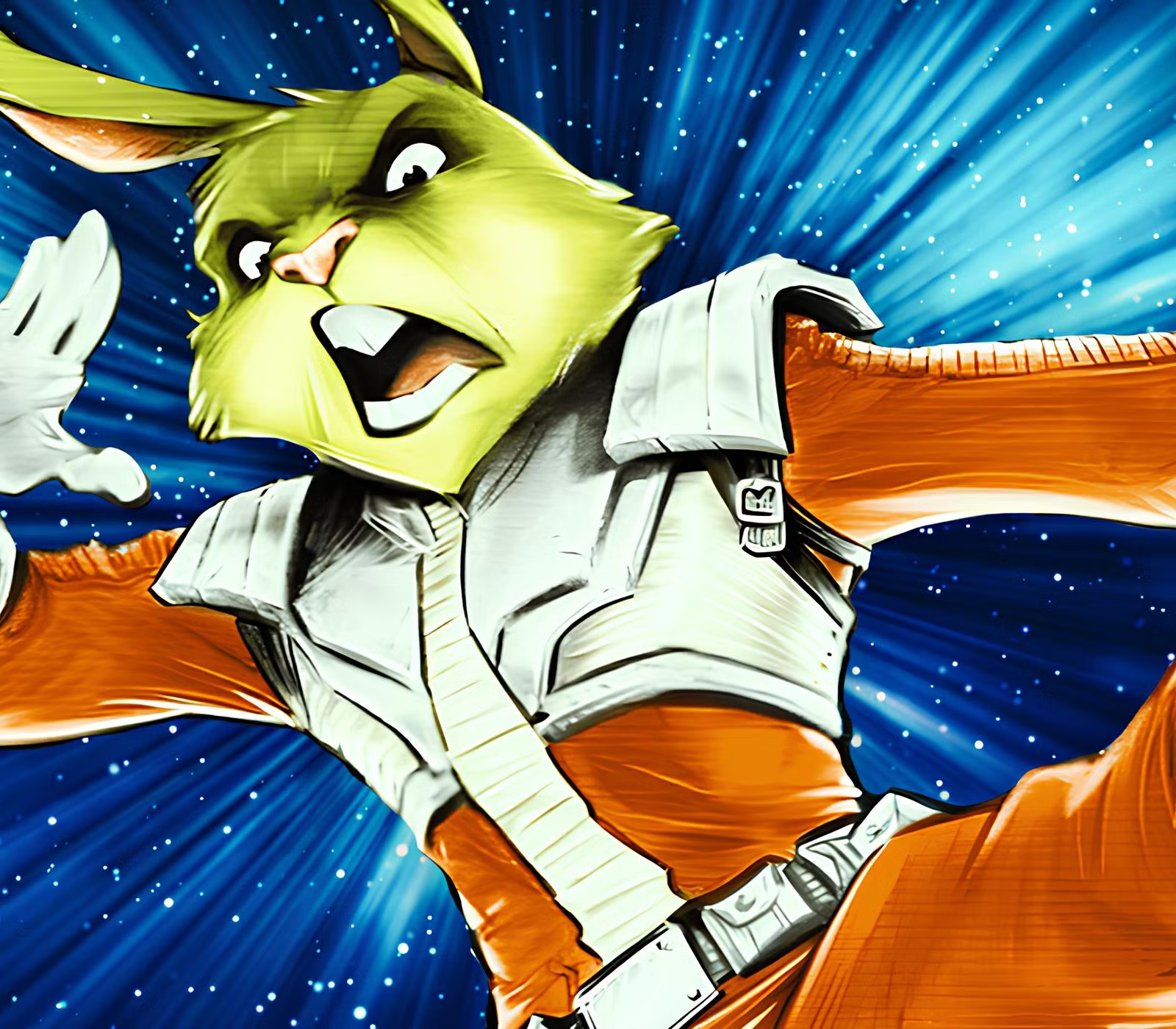
    Jaxxon, the Green Space Bunny and acquaintance of Han Solo

    Humaniti in Traveller

    In the 3rd Imperium of Traveller, humans are the majority species. Humaniti is so widespread in Traveller that there are 3 branches of humans that would be conisdered “Major Species”. Two of these species, the Vilani and the Zhodani are humans originally from Earth. 300,000 years earlier an advanced alien empire, the Ancients abducted groups of humans from Earth and brought those humans with them as they traveled among the stars. They seeded two human colonies in systems favorable to human development, Vland (where the Vilani evolved) and Zhodane (where the Zhodani evolved). The Ancients had also taken other species from Earth (and other planets, the Ancients were not shy about seeding forms of life on different planets just to see what happens) which in the case of Terran wolves, is where the Vargr originated). The humans who were left on Earth, evolved into the Solomani.

    In the current era of My Traveller Universe (3i 1125, the beginning of the Hard Times) the 3rd Imperium has Solomani populations towards the rimward sectors, Vilani populations towards the coreward sectors, and the majority of the Imperium is populated by people of mixed Vilani-Solomani ancestry. The Zhodani, being the people of a rival Empire are rare as Imperial Citizens, but in the spinward and coreward sectors (“behind the claw”) Vilani-Solomani-Zhodani ancestries are uncommon, but not unheard of.

    What does this mean? In this case this is an clear indication that humans are one species with several sub-species. The distinctions of Vilani, Solomani, Zhodani, and any of the hundreds of minor sub-species of humaniti are cultural and ethnic at best. For most characters, “human imperial citizen” commonly refers to the Solomani-Vilani ancestry, but there is nothing stopping a player from describing their human character having an ancestry that is regionally distinctive.

    As mentioned, several ancestries of the human species have developed interstellar empires, and have distinctive cultures and subcultures. The Traveller source material, especially the Alien Modules can provide deep dives into the three major cultures, Solomani, Vilani, and Zhodani. Vilani and Solomani cultures have blended over centuries into the society that is described in the 3rd Imperium. At the Rimward border of the Imperium, the Solomani have carved out what could be described as a Solomani ethno-state.

    The Solomani Sphere

    In the long history of Traveller, one of the pivotal events was the Solomani Rim War (3i 990 – 1002). In this conflict, the 3rd Imperium attempted to reassert authority over the worlds of the “Solomani Autonomous Region”. The war resulted in a contested victory for the 3rd Imperium when the Sol system was conquered. The Solomani Confederaion was unable to retake the homeworld of humaniti, and the 3rd Imperium was eager to bring an end to the war by 3i 1002. For the next 114 years, the occupied worlds of Diabei, Diaspora, the Old Expanses and the Solomani Rim were a powder-keg of ethnic conflict.

    The Solomani Confederation, previously the Solomani Sphere is distinct from the 3rd Imperium. Like most interstellar empires, the Solomani Confederation does not have a single cultural expression, but it does have a common, shared mythology. The Solomani Hypothesis, that theorises (with strong evidence in support) humaniti developed and evolved on Terra (Earth) first, and was spread into the stars first by the Ancients and then by their own technology.

    The term”Solomani” gets overused in the Confederation. One major reason stems from the Solomani Hypothesis; because humaniti originated on Earth, the Solomani are the original humans and are thus superior to all other branched species of humaniti. The Solomani Party is the political organization that governs the Confederation. The Solomani Cause is the political strategy that promotes Solomani humans outside of the Confederation. The Solomani Cause has also been the rallying point surrounding the “liberation” of Terra from the 3rd Imperium and further restoring the Solomani Sphere to it’s pre-3i 990 extents. The Solomani Movement is the Cause as a factor in politics outside the Confederation.

    Aren’t the Solomani the Bad Guys?

    It’s somewhat of a debate in the Traveller community as to whether or not the Solomani Confederation are the “bad guys” of the Rim. The veneration of the Solomani Hypothesis and the Solomani Cause gives some “supremacist” overtones, or at the very least a classist society with Solomani Humans in the position of privilege. The Solomani Party being the dominant political faction (indeed, the only legal faction) within the Solomani Confederation leans hard towards authoritarian govenrments with some really bad associations throughout history.

    It’s been pointed out that the Solomani Confederation isn’t monolithic, in the same way as the Emperor isn’t a monolith in the Third Imperium, the Hive Federation, or the 29 Clans in the Aslan Hierate are monolithic for those empire. The Solomani Confederation covers about six sectors, and contains about 2,000 inhabited systems. If you think about the current diversity of cultures, ethnicities and governmental bodies in our one star system, the idea that the Solomani Party holds and iron-fisted grip on society throughout the Solomani Confederation is farcical. Even if a given Traveller campaign portrays the Solomani Party as oppressive, it’s not the Empire from Star Wars, or the Mirror Universe Terran Empire of Star Trek. Remember the distances involved and times to send communications from one system to another that we explored in this blog.

    The Solomani of the Confederation aren’t jackbooted thugs checking for “genetic purity” at ubiquitous checkpoints. The Solomani Confederation, like all the major empires of Traveller is best described as a “tribe”. It’s a nationalistic tribe that promotes the Solomani Cause, but that’s not much different than the 3rd Imperium promotion the Emperor, or the Zhodani Consulate promoting Zhodani Psionic Society. They’re not “supremacist” but their cultures promote their own Empires.

    In My Traveller Universe, the Solomani Confederation are antagonists, at least in the rimward areas of Diaspora sector. In the Rebellion War, the Solomani Confederation launched the “Second War of Solomani Liberation” to liberate the Sol system, and reclaim the systems of the Solomani Sphere. The Imperial Occupied Region covers the four rimward subsectors of Diaspora sector, ,as well as the majority of the Solomani Rim sector. The further rimward in Diaspora one goes, the more Solomani Confederation operations one will encounter.

    During the Hard Times, in Diaspora, the Occupied Subsectors are aligning much closer to the Solomani Confederation. The vision of a re-established Solomani Sphere is clearer than it’s been in a century. The Solomani Confederation has not suffered nearly as badly as Lucan’s 3rd Imperium and the stability offered by the Confederation Navy has helped these systems weather the Black War and the Imperial Decline. It’s not an example of the Evil Empire winning, it’s an example of how a portion of the vast 3rd Imperium is keeping back a second Long Night.

  • You Got Battletech in my Traveller!

    You Got Battletech in my Traveller!

    No, you got Traveller in my Battletech!

    Two of my favorite games over my long gaming career are Traveller and Battletech. I’ve been playing both for over 40 years. Since I’ve recently moved to a new city, on a new coast of the US, and The 50th Anniversarry of Traveller is right-around-the corner. I’m starting a new campaign. With Battletech enjoying a renaissance, I’ve been throwing a healthy amount of Big Stompy Robots in my Science Fiction Adventure in the Far Future.

    The setting for this campaign leans more toward the Third Imperium than the Inner Sphere. Specifically my favorite era in Traveller’s Third Imperium, the Hard Times. I talked a bit about this back in June. The elevator pitch is, the Hard Times are a relatively brief period in the Third Imperium that takes place at the end of the Rebellion War. Technology and society are skidding towards a second Long Night in the Shattered Imperium of Megatraveller.

    How These Lego Bricks Fit Together

    Battletech’s setting features giant, piloted robot war machines called Battlemechs. They run between 20 and 100 metric tons and are powered by big fusion engines. They’re a lot more on the “space-fantasy” side of science fiction, but there’s a heavy layer of gritty over them. Sort of like Star Trek, there’s a whole glossary of technobabble that sounds enough like engineering and “science!”

    In Traveller terms, Battlemechs become practical around Tech Level (TL) 10. Fusion Power is practical here, which makes powering these war machines possible. The Inner Sphere setting ranges from a rough TL 10 or 11 in the classic Battletech era (between 3025 to 3062) to TL 12 at the height of the Star League (2750). The Clans were around the high end of TL12 and entering TL 13 so far as their engineering went, though the cluster of worlds from where they were exiled didn’t have the resources to fully exploit that level of development. Battlemechs as a practical war vehicle phases out by the time a civilization reaches TL 14, which is where fusion technology reaches it’s technological limits and more exotic power sources become commonplace.

    The average Tech Level of the Third Imperium during the Megatraveller Setting (Imperial Year 1116) was TL 12 with the maximum TL at 15 (and a couple of places like the Darrian Confederation boasting TL 16). The Hard Times sourcebook for Megatraveller goes into detail about how the average Tech Level of the Third Imperium slides backwards. Which is a great parallel to the decline experienced by the Inner Sphere through their many Succession Wars.

    Hey, Why Not Just Use the Battletech RPG Books?

    There’s nothing wrong with Mechwarrior 1st edition, 2nd edition and Catalyst Games’ A Time of War, and Destiny games. I’ve run and played them (except Destiny) over the years, but my preference and love stays with Traveller. I’ve internalized the system a lot deeper than I have the Battletech systems (which is saying a lot, because I’ve internalized Battletech down to my frakkin’ bones!) For me, it’s the life-path character generation system in Traveller. I also talk about it in more detail in this essay, long story short, Traveller Character Generation tells a story through the dice better than using a point-buy system or laying templates over one another. Rolling up a Traveller almost always has a surprise in the character that makes it exciting to play on Session 1.

    I also think in Traveller. The terminology comes more naturally to me, as we’ll explore shortly. As mentioned above, I have a good feel for where Battletech fits in the Traveller Universe, and it takes more work to fit Traveller in the Battletech universe. Advice to the new GMs out there, don’t be afraid to lean on what you know, running role-playing-games can be hard, no need to make it harder on yourself.

    Some Broad Strokes

    I’ll be using Traveller for character generation, setting info, personal combat and most space combat. I’ll be breaking out the hex-maps and Battletech Minis for vehicular combat. Both systems are 2d6 based, and the systems are pretty compatible. There are some fuzzy conflicts when dealing with Traveller small space ship combat vs Battletech’s Aerospace system, but I don’t think they’re insurmountable. Also, the Hard Times campaign isn’t about dogfights at the edge of atmosphere in a gravity well. The backdrop of War is context for the adventure.

    Most of the time, the Traveller skill system is used rules-as-written. However, when on the Battletech or Aerospace battlemap, the system will switch over to Battletech: Total War with the following modification:

    • Base Battletech Piloting is calculated using the character’s skill in Traveller Drive (Battlemech)
    • Base Battletech Gunnery is calculated using the character’s skill in Traveller Heavy Weapons (Battlemech)
    • Base Aerospace Piloting is calculated using the character’s skill in Traveller Pilot (Aerospace)
    • Base Aerospace Gunnery is calculated using the character’s skill in Traveller Gunnery (Aerospace)
      • Battletech and Aerospace Piloting skill starts at 5. This is equal to Traveller Skill at Level 0 (without any Characteristic bonuses)
      • Battletech and Aerospace Gunnery skill starts at 4. This is equal to Traveller Skill at Level 0 (without any Characteristic Bonuses)
    • For every Traveller Skill level gained, the corresponding Battletech/ Aerospace skill goes down by 1.
      • Example: A character with Traveller Skill Drive (Battlemech) 2, when moving over to the Battletech combat map, will have a Battletech Piloting skill at 3. (Base Battletech skill 5 – Traveller skill level 2 = 3.
    • This can also be reversed when adapting the NPCs in a Battletech scenario to Traveller.
      • Mechwarrior Mungo Bogsbane has Battletech Piloting 4 and Gunnery 2. His Traveller skills are Drive (Battlemech) 1 and Heavy Weapons (Battlemech) 2.
    • The Traveller Skill Jack of All Trades deserves special mention. Skill Levels in Jack of All Trades offset the penalties for trying skills without having at least Level 0 in the relevant skill. The full rules can be found in the Traveller Core Rulebook Update 2022 from Mongoose Publishing. Normally, characters need to have at least Skill Level 0 in the appropriate skill to operate a Battlemech, Aerospace vehicle or the weapon systems of either. These are too complex for someone who doesn’t have training to do anything more than flip switches, click buttons and yank levers in futility as the machine does nothing (best case scenario) or crashes in a catastrophic explosion (at worst..)
      Jack of All Trades allows a character to attempt an unskilled roll at a reduced penalty. Jack of All Trades 0 allows for the roll at a -3 penalty, with each skill level in Jack of All Trades reducing that penalty by 1. Until Jack of All Trades reaches Level 3, at which point the roll is at no penalty.
      When applied to Battletech’s Battlemech and Aerospace skills, These penalties are added to the base skill level. A character with Jack of All Trades 0 can roll Piloting at (5+3)= 8 and Gunnery at (4+3)= 7. Jack of All Trades 2 can roll Piloting at (5+1)= 6 and Gunnery at (4+1)= 5.

    Gearing up for the Cockpit

    The most critical piece of equipment for a Battlemech or Aerospace Pilot is their Neural Impulse Helmet AKA “Neurohelmet”. Neuohelmets provide direct neural links to the vehicle’s computer and sensors and are what makes Battlemechs and Aerospace craft more responsive than more conventional vehicles (even at high tech levels). Indeed, the Neurohelmet makes piloting Battlemechs and Aerospace craft possible in the first place. There are so many systems and subsystems that demand constant attention that no one person, or even a small crew of people could manage it all, but a Neurohelmet allows for a single pilot to control the vehicles full functionality.

    A Neurohelmet is a TL 10 device that masses around 6 kg and costs 10 kilocredits (KCr, 10,000 credits). It is a huge, bulky, ugly, and fixes the wearer’s face straight forward. There is a window roughly the size of the wearer’s face installed that displays visual readout data into the user’s field of vision. Inside there are multiple contact leads which use the user’s own brain to move and drive the battlemech as an extension of their body. The helmet rests on the user’s shoulders, protecting the users relatively fragile neck from injury, but restricting any head movement.

    The Neurohelmet’s bulk looks like it could deflect a direct hit from an Advanced Combat Rifle round. That is if the bullet wouldn’t damage all the internal electronics connected to the user’s brain. The Neurohelmet is not armor. Not even when deactivated. Its bulk comes from the complex hardware that creates the technological miracle which allows a human to control a titan.

    At TL 11, the Neurohelmet becomes safer and smaller. It’s no longer a rat’s nest of cabling connected to a six kilo dome. It’s half the mass that it was at TL 10, while direct connection through ports from helmet to cockpit are still necessary, a lot of the connections are wireless.. There remains safety bracing that protects the neck, but the user is able to turn their head and enjoy a restricted range of motion.

    AT TL 12, the Neurohelmet is half the size of the TL 11 helmet. It still fully covers the head, but does not require bracing to protect the neck. There is still neck protection, but not to compensate for having six extra kilos on your head. Direct connections to the cockpit have been reduced to one, two or three, depending on the model of the helmet. The user has a full range of head motion.

    Cybernetic Neural Impulse Cranial Implants (“NICIs”) are also TL 12 devices, and are cybernetic augments. The NICI at TL12 replaces portions of the pilot’s skull and cannot be removed. There is a jack-port installed to make a direct connection into the cockpit. Not counting surgery, the NICI costs 500 KCr. Using a NICI to pilot a Battlemech or an Aerospace vehicle gives the Pilot a +1 Dice Modifier (DM) bonus to Drive (Battlemech) and Pilot (Aerospace) checks. If using Battletech rules for tactical vehicle combat, add the +1 bonus to the roll (not the target number).

    The Cooling Vest is TL 10, costs 500 Cr and allows a Battlemech Pilot to survive the blazing heat in the cockpit of a Battlemech. It’s little more than cooling tubes wrapped around the pilot’s torso which circulate advanced cryogenic compounds and keeps the vital organs from cooking in the pilot’s body.

    Aerospace pilots wear an Improved Vacc Suit with enhanced temperature regulation since they often find themselves operating in the Vacuum of space or extremely thin atmosphere.
    At TL 11, the Cooling Vest is replaced with a specialized Hostile Environment Suit. The cost is much higher (22 KCr) but the HEV Suit provides protection similar to the Vacc Suit which permits the Battlemech Pilot a lot more combat endurance and focus when away from supplies.

    Some down-on-their-luck pilots try to make do with makeshift cooling vests that use cold-packs in place of circulated coolant. Cold-packs are, in essence frozen blocks of water ice or similar freezable material. The cost is almost negligible. Less than 20 Cr and the Tech Level to put one together is around 4. The pilot only needs a means to freeze and insulate the packs. However, fighting in a cold-pack vest only allows for ten-to-fifteen minutes of operation before any benefits are spent and heat exhaustion leading to stroke sets in.

    Character Creation and Development

    At it’s most basic, any skill result of Drive (cascade or any ground), Heavy Weapons (cascade or vehicles), Pilot (cascade or Small Craft), or Gunnery (cascade, Turret or Fixed) can be focused to Battlemechs or Aerospace as the player desires.

    However, should the GM desire a focused assignments for Battlemechs and Aerospace pilots, here are a couple of guidelines

    • Army – Mechwarrior (*must be a commissioned officer)
      • Survival: END 7+
      • Advancement: INT 6+
      • Assignment Skill List
        • 1: Drive (Battlemech)
        • 2: Heavy Weapons (Battlemech)
        • 3: Mechanic
        • 4: Electronics (Sensors)
        • 5: Heavy Weapons (Man-Portable)
        • 6: Recon
      • Rank Skills and Bonuses
        • Rank 1 (Lieutenant): Drive (Battlemech), Heavy Weapons (Battlemech) 0
        • Rank 2 (Captain): Leadership
        • Rank 3 (Major): Tactics (Military)
        • Rank 4 (Lt. Colonel): Admin 1
        • Rank 5 (Colonel): Broker 1
        • Rank 6 (General): SOC 10 or SOC +1 (whichever is higher)
    • Marines – Mechwarrior (*must be a commissioned officer)
      • Survival: END 7+
      • Advancement: INT 5+
      • Assignment Skill List
        • 1: Drive (Battlemech)
        • 2: Pilot (Aerospace)
        • 3: Heavy Weapons (Battlemech)
        • 4: Gunnery (Aerospace)
        • 5: Vacc Suit
        • 6: Gun Combat
      • Rank Skills and Bonuses
        • Rank 1 (Lieutenant): Drive (Battlemech), Heavy Weapons (Battlemech) 0 or Rank 2 Skills
        • Rank 2 (Captain): Pilot (Aerospace), Gunnery (Aerospace) 0 or Rank 1 Skills
        • Rank 3 (Force Commander): Tactics (Military or Naval) 1
        • Rank 4 (Lt. Colonel): Leadership 1
        • Rank 5 (Colonel): Jack-of-all-Trades 1
        • Rank 6 (General): Broker or Admin 1
    • Navy – Aerospace Pilot (*must be a commissioned officer)
      • Survival: DEX 7+
      • Advancement: EDU 5+
      • Assignment Skill List
        • 1: Pilot (Aerospace)
        • 2: Gunner (Aerospace)
        • 3: Vacc Suit
        • 4: Astrogation
        • 5: Mechanic
        • 6: Electronics (Sensors)
      • Rank Skills and Bonuses
        • Rank 1 (Ensign): Pilot (Aerospace), Gunnery (Aerospace) 0
        • Rank 2 (Sublieutenant): Astrogation 0
        • Rank 3 (Lieutenant): Tactics (Naval) 1
        • Rank 4 (Commander): Leadership 1
        • Rank 5 (Captain): Admin 1
        • Rank 6 (Admiral): SOC 10 or SOC +1 (whichever is higher)
    • Noble – Mechwarrior
      • Survival: INT 7+
      • Advancement: SOC 8+
      • Assignment Skill List
        • 1: Drive (Battlemech) or Pilot (Aerospace)
        • 2: Heavy Weapons (Battlemech) or Pilot (Aerospace)
        • 3: Vacc Suit
        • 4: Tactics (Military or Naval)
        • 5: Leadership
        • 6: Gambler
      • Rank Skills and Bonuses
        • Rank 1 (Ensign): Drive (Battlemech), Heavy Weapon (Battlemech) 0 or Pilot (Aerospace), Gunnery (Aerospace) 0
        • Rank 2 (Lieutenant): Leadership 1
        • Rank 3 (Force Commander): Advocate 1
        • Rank 4 (Lt. Colonel): Diplomat 1
        • Rank 5 (Colonel) +1 SOC
        • Rank 6 (General) +1 SOC

    When Mustering Out, vehicle or ship share benefits can be taken as a muster bonus of +1 DM when rolling on the following chart (used to provide a character with a personal Battlemech). Roll 2D + SOC + Muster Bonus

    • 4-: Dispossessed (no Battlemech or Aerospace vessel)
    • 5 – 7: Light class (20 to 35 tons)
    • 8 – 9: Medium Class (40 to 55 tons)
    • 10 – 11: Heavy Class (60 to 75 tons)
    • 12+: Assault Class (80 to 100 tons)

    The Battlemech Campaign Skills Package is designed for a Traveller campaign featuring Battlemechs and Aerospace fighters, similar to the Battletech Universe, Robotech Series’, Gundam Series’, Heavy Gear Universe, Mekton Universe and similar settings.

    Drive (Battlemech) 1, Electronics 1, Engineering 1, Gunnery (Aerospace) 1 Heavy Weapons (Battlemech) 1, Mechanics 1, Pilot (Aerospace) 1, Tactics 1

    Character Development

    After each adventure, Each character may roll EDU 8+. If successful, the player can either advance one of their character’s skills by 1 level, or they can adopt a new skill at level 0. When advancing skills this way, remember no character can have more total skill levels than three times their combined INT and EDU.

    Maintaining a Battlemech or Aerospace Craft

    Outside of repairs and rearming, Battlemechs and Aerospace craft require regular maintenance. Similar to space and star ship maintenance, once per year the Battlemech or Aerospace craft needs to be overhauled at a cost equal to 0.1% of the new cost of the vehicle. Divide by 12 to calculate a monthly maintenance cost.

    Example: A WHM-6R Warhammer Battlemech costs 6,070,984 Credits new. The yearly overhaul cost is 6,070,984 x 0.1% = 6,071 Credits. The monthly cost is 6,071 / 12 = 506 Credits.

    A SL-17 Shilone Aerospace fighter costs 3,399,045 Credits new, the yearly overhaul cost is 3,399,045 . 0.1% = 3,399 Credits. The monthly cost is 3,399/ 12 = 283 Credts

    Like a ship, skipping monthly maintenance risks a malfunction. For every monthly maintenance skipped, roll 2D + the number of months missed. On an 8+, the vehicle suffers a malfunction in the form of a critical hit, determined in the same manner as if the critical was suffered in battle. Using the Battletech chart, roll a location off of the Front/ Rear Critical table and apply a critical to the affected location.

    Battlemechs in the Rebellion War and the Hard Times

    Battlemechs and Aerospace craft are used by all the major factions in the Rebellion War. There are also countless Mercenary Outfits that use these war machines selling their services to the highest bidder. As implied by the Noble profession assignment above. Several Noble families possess ancestral Battlemechs and Aerospace craft.

    When compared to the state-of-the-art TL 15 weaponry that was deployed in the first years of the War, Battlemechs and Aerospace craft were outclassed. A company of TL 15 Battle Dress equipped infantry, TL 15 Grav Armor or a squadron of TL 15 armed space fighters are far more efficient and effective than an equivalent formation of TL 12 Battlemechs and Aerospace craft. However, as the war escalated between 1119 3i (3rd Imperium) and 1121 3i attrition forced all factions to press second and third line vehicles and equipment to the front. Battlemechs and Aerospace craft were re-deployed to replenish the attrition of years of war.

    When the War turned Black in 1122, Battlemechs and Aerospace craft became the instruments of scorched world strategies. Battlemechs as walkers were well suited to urban fighting, and the Aerospace fighters and bombers were very effective at everything from close-air support, escorting dropships, and orbital theaters. In a pinch they could be pressed into space combat. Hybrid Battlemech/ Aerospace vehicles, known by a variety of names, Veritech Fighters, Land-Air Mechs, Variable Aspect Mobile Suits and Hybrid Aeromechs, among others.

    Before the Rebellion War, Battlemechs and Aerospace fighters held a measure of prestige in the Noble Houses of the Moot. Nobles would use them to settle duels while showing off their wealth and means, in a similar way the aristocracy have used antiquated weapons and skills to settle disagreements while flexing on the less affluent. During the Rebellion War, Nobles wanting to cater to the imperial sensibilities of Lucan, Margaret, or the Ziru Sirca were eager to raise Household companies like ancient Lords calling their Banners. As the war dragged on, these same Noble houses were employed to share their tactical and technical knowledge in designing, and fielding Battlemechs and Aerospace fighters.

    In the Hard Times, the owners and employers of Battlemechs are in an excellent position to take over systems and pocket empires as Technologically Elevated Dictators. By 1125 3i, the major governments had retreated into core zones. leaving the Wilds open for pocket empires to develop. By 1130 3i, Virus has been released and was devastating the Imperium for the next seventy years.

  • Galley Service in Traveller

    Galley Service in Traveller

    Space food by Tech Level

    Out in the vastness of empty space, Your crew still needs to eat. Whether it’s food-in-a-tube from TL 6, or TL 15 replicated food. Eating also adds (dare I say) “flavor” to an otherwise boring series of downtime activities. The Life Support portion of the monthly Running Costs of operating a Space Ship or Starship covers the most basic nutritional needs for each person on board the ship. Normally running somewhere around Cr 1,000 per stateroom (Cr 3,000 per double occupancy stateroom) and Cr 1,000 per person. This is food that will keep a person adequately fed with some small variety. Sort of like Meals, Ready to Eat packages. This food is designed to travel with a minimum of environmental demand. It doesn’t need refrigerated, it’ll last for years, and is shelf-stable. As anyone who has lived off this for an extended length of time can tell you, the menu gets real old, real fast.

    There are two tech level factors that affect the quality of food on board a ship. The first is the TL of the ship itself, specifically the TL of the Life Support Systems. The second is the TL of the location where the resupply is taking place. Advances in preservation and preparation allow for more palatable and satisfying fare.

    Ship’s Larder

    Starting around TL6, and until TL9 this is some variety of “food in a tube”. TL9 is the lowest tech level where Jump Drive is an option, and this means most ships at these tech levels are intended for in-system travel with voyages lasting weeks. Galleys are luxuries at this stage, and even the most extravagant are little more than a common room with a table, chairs, and a microwave.

    TL 10 and 11 is where “reconstitution” modules are developed. This is more advanced than simply re-hydrating meals with hot water. Reconstiution uses a common base of proteins and carbohydrates to restore food resemble a wide variety of textures, flavors and smells. By the very nature of the process, the food is absent any meat product, though meats can be prepared this way. Still, it’s a critical detail for venturing into the Two-Thousand Worlds. K’kree can scent a meat eater.

    TL 12 through TL13 is where recycling organic matter reaches its peak. At this stage food can be created from compost material. From there, food can be flavored and textured into the desired composition. The process takes a few minutes (roughly 15) and the result can be eaten immediately, or further prepared through any other recipe.

    TL 14 and TL15 is where true food synthesis can create edible footstuffs in nearly any form imaginable. By combining organic chemical elements, Food can be created on demand (so long as those chemical elements remain available) in a matter of moments.

    Resupplying at Port

    Part of Life Support costs are keeping materials on hand. Even at the higher Tech Levels, equipment needs to be serviced, stores need resupplied. However, the quality of rations remain limited by the lower tech level between the ship and the port of resupply.

    TL0 through TL5 is limited to primitive food preservation techniques, smoking, salting, canning. It is possible that if a ship has to resupply here, the crew might be loading pemmican and hard tack like their ancestors on tall ships during the age of sail.

    TL6 through TL8 allow for processing foods, dehydrating and/or industrially preserving it to be shelf-stable.

    At TL9, cryogenic preservation allows for some fresh food to be added to a ships’ stores. Bulk is still an issue, it’s really difficult to miniaturize a side of beef, or a 1000kg bluefin tuna. TL9 is where the food can be maintained in cryogenic storage indefinitely.

    At TL15, stasis is in its infancy but does allow for food to be stored in a state of freshness. Food stored in stasis doesn’t need thawed or reconstituted. It can be prepared and eaten immediately.

    Bread Alone

    Using Life Support in this manner should enhance the immersion in the setting. If it becomes an annoyance in your campaign, don’t lean on it so much. The point is not to punish the characters but to give storytelling material for players to experience. Illustrate how, after months of living off of rations made from reconstituted algae, or recycled garbage and poop the intense pleasure of eating food freshly prepared.

    Think about the scene from the Matrix where the crew of the Nebuchadnezzar is eating their plates of gruel. Then compare it to Cypher eating the steak in the Matrix. The promise of a good meal after months of deprivation makes for a powerful motivator.

    Take the original Star Trek series, their replicated food was multicolored simple solid shapes. Compare that to the Next Generation where the replicator could create food to the taste of the person ordering it, whether it is “Tea, Earl Grey, Hot” or “Gakh”, and even the difference between replicated Gakh and when it is served live. As Any Klingon would tell you, Gakh is best served live.

    Science fiction roleplaying should have that same sensory feel. From Captain Pike’s exaggerated home kitchen on board the Enterprise to Luke Skywalker drinking a tall glass of blue milk. Engineers setting up stills to make rot-gut hooch from the basic amino acids and carbohydrate soups in the storage bins, “good for two things, de-greasing engines and killing brain cells” Keeping a bottle of Scotch from Rigel, or a red wine from Chateau Picard. These are ways to breathe life into the downtime stuck in Jump Space.

    Brand Loyalty

    This is also a part of world building for your campaign. Create companies and brands who can supply ships with these supplies. Military ships, of course are supplied by their branch’s quartermaster, but as any Imperial Scout can tell you, the ISS ration menus are “uninspired” to say the least. Adding a common, regional brand to the campaign, think “Triple F Burgers” from the Battletech game, or “Biscuit Baron” from WEG Star Wars. Can add role-playing moment. Smuggling a crate of Romulan Ale has more of a connection to the Star Trek Universe than simply running prohibited spirits through the Federation.

    Having a regional, or even subsector supplier of ships’ rations can give players a reason to head to that area of space.

  • A Fist Full of C-Bills

    A Fist Full of C-Bills

    ..and A Pocket-full of Credits

    Science Fiction money takes many forms. From primitive cultures trading precious baubles to vast financial networks that process electronic and digital transactions through subspace and hyperspace communications. For adventurers with bills to pay, the way they access their money can be a challenge as they jump from one star system to the next. This article relates to some ideas posted in O God, Thy Sea is so Great and Money Makes the World Go ‘Round.

    Don’t Sweat the Small Stuff

    In our real world, budgets and finance can get detailed. Most of us have had the experience of scraping every corner and couch cushion for loose change to go down to the corner store with. Some of the reasons we play role-playing games is to take a break from worrying about if we can afford that extra box of mac-and-cheese or not.

    The “small stuff” can all be abstracted into lifestyle. In Traveller, lifestyle is related to the Social Standing characteristic (at least in the Third Imperium setting). Adventurers with a low lifestyle, sleep in a fleabag flat and eat kibble from a grey box labeled “food”, those with a high lifestyle, stay in luxury apartments and eat fresh, or exotic meals. Don’t dwell too much on the details though, lifestyle is a player choice for their adventurers, there might be a regular cost, or not. Keep the action focused on the adventure and not the downtime.

    Sometimes, the Small Stuff is the Adventure

    This is different from looking over character sheets and noticing if a character has enough centi-credits to live well during the adventure. These are adventures where the characters have lost access to their normal resources. The bank fails, they’re robbed, a new government won’t accept their money (the classic “we don’t accept Federation Credits, only Gold Pressed Latinum”). The objective on these adventures is to survive without money until they recover their means to rejoin the markets.

    Speaking of Gold Pressed Latinum

    In the main cultures of most sci-fi settings, currency is electronic. (Think cryptocurrency, but hyper-efficient). In cultures where technology is advanced enough to manage an interstellar society, this form of currency is practical and mostly efficient. It also reduces incidents of fraud, the possibility of devaluation because some explorer discovers a colossal source of precious metal, or a technology like the Star Trek replicator is developed. Data as currency is extremely efficient to use. Anyone who has made a purchase with a card over the internet has experienced this convenience.

    While efficient and convenient, even at highly technically advanced cultures, there remains a need for a more physical currency. In Star Trek, that’s “Gold Pressed Latinum” which is made from a unreplicatable, rare, element suspended in gold. Other settings use similar things, though in places like the Inner Sphere, or the 3rd Imperium, that sort of hard currency is tied to the electronic economy and minted by the governmental authority.

    Hard currency has another benefit. Cold, hard, cash is difficult to trace. Especially over interstellar distances. Tracing technology can be defeated, and unlike bills, or proxy currency, as any Ferengi can tell you “Latinum is Latinum everywhere in the galaxy”. For crews and companies that don’t want to leave a trail of money behind them as they operate, sometimes across hostile borders, having a valuable, difficult to track currency is a must.

    From an adventuring perspective, hard currency gives a fun æsthetic for heist or treasure-seeking adventures. Think about the old World War 2 Movie “Kelly’s Heroes”, that would work so well in the Battletech Universe. A group of mercs learning about a cache of hard currency, like a bank in occupied territory and taking an “unauthorized expedition” to grab the vault before it gets moved somewhere “safe”. Most of the ideas presented in, Money Makes the World Go Round, can be applied, especially with regards to what happens after your holds are filled with pallets of currency.

    Battlemechs, Tanks, Space Fighters, and Starships

    Big ticket items are common in Science Fiction settings. What would Star Wars be without the Millenium Falcon? Hammer’s Slamers without Grav Tanks? Gundam without Mobile Suits? In most settings, the characters belong to organizations that assign them to their war machines or ships. Maintenance for these big ticket items is covered by the organization.

    But in settings where the characters are the crew of a Free Trader, or the pilots of a mercenary company of Battlemechs, these costs are a foundation of the campaign. We see this in Firefly, “Find a crew, find a job, keep flying”. Star Wars Episode IV also shows this off. Han Solo is charging 10,000 to take Ben and Luke to Alderran. He’s in debt to Jabba who is threatening his ship. Point being, everything involved with these big ticket items are expensive. From purchasing them to maintaining them to repairing or improving them. Costs run into the millions of credits, and they’re recurring. Ships need fuel, weapons eat ammunition, crew need food, water and air on long space journeys.

    When designing adventures, the Game Master needs to take the costs into account when they’re adding rewards. The adventurers need to make enough money to cover their expenses while turning a profit. This pushes this style of campaign into a higher scale of economy. While a group of scoundrels may well be able to retire from adventuring and “go legit” if they score a million C-bills, in a campaign that revolves around a company of Big Stompy Robots, that same million C-bills might cover two or three months of maintenance. For the owners of a starship a single Megacredit will run out quick, fast, and in a hurry.

    Filling Contracts

    Especially in Mercenary campaigns, contracts are common. These are great for Game Masters and Players Alike. Contracts outline what the adventure is expected to be. Where to go. What to do, and how much the compensation is going to be at the end. Longer term contracts can also include covering maintenance, repair, and fuel, relieving the players from that accounting for a time.

    Contracts are not only applicable to the mercenary campaign. Worlds can contract free traders to deliver mail to them, or maintain trade with nearby systems, free traders can serve as a temporary solution to these systems until they build their own fleets and infrastructures. Still, it’s an opportunity for characters to go places, do things, and have adventures.

    Many settings have an independent authority to mediate contracts and enforce their terms. The Mercenary Review Board in Battletech, merchant guilds, megacorporate syndicates, Imperial ministries, serve these roles as arbiter, and holds payment in escrow until the terms of a contract are fulfilled. But some science-fiction settings do not. Crews need to negotiate guarantees and protections for themselves, as do the parties they are contracting with. For a GM, this can lead to double-crosses, backstabs and other creative ways to introduce twists in an adventure that threatens to become boring.

    Outrunning Your Mortgage

    Especially in settings like Traveller, where interstellar communications travel at the speeds of the fastest courier as described in O God, Thy Sea is so Great. A group of adventurers can skip their bank note on their big ticket item. Jumping out to the fringe of “civilized” space and joining the pirates and nomads and homesteaders out past the perimeter. Or, in a setting where wars rage between empires, hiding from their lien-holder in one empire by escaping into it’s rival.

    This is in essence, stealing the things that are mortgaged. Considering star ships, battlemechs, tanks and space fighters are really really expensive the finances won’t just write off the loss. After all, the characters just ran off with tens of millions of C-Bills (or Megacredits) of their money. Collection agents, Repo men, Skip-tracers and Bounty Hunters will follow the ship, and the characters everywhere they go. Running them down, even out on the periphery to drag them and their ship back to face consequences.

    Characters can run, they can even run fast, but they’ll never run far enough to ever be comfortable not looking over their shoulder. Even Han Solo ended up in carbonite, hanging as a trophy in Jabba the Hutt’s palace.

  • O God, Thy Sea is so Great, and My Boat so Small

    O God, Thy Sea is so Great, and My Boat so Small

    Space is BIG

    One common quirk of science-fiction roleplaying, whether it be Traveller, Star Trek, or Battletech is that the Universe starts to seem rather small. The characters jump from world to world having adventures but they only stay as long as the adventure lasts. Once the adventure is done, they’re back on their ship and off to another world, light-years distant. The routine of interstellar travel shrinks an impossibly vast universe into a travelogue. Alien worlds, might be strange, but they’re not memorable, the planet of purple-people-eaters fades into the background along with the forest moon of cannibal teddy bears, and the world of cheese.

    Timekeeping

    One way to keep space feeling big is to keep track of time as it passes. The Universe is not a static place, everything is always in motion. Seasons change, years pass, even the stars themselves grow old and die. It helps to reinforce that your characters are on a voyage if the Universe continues to unfold even as the players hop from system to system. In Traveller, each jump between systems takes a week. Normally this is expressed in downtime, but the important thing for timekeeping is, that as the characters jump from world to world weeks pass as they are isolated in jumpspace.

    The Battletech Universe is different, jumps of 30 light years happen in an instant, but the drives require a week to recharge, and it takes days of sublight travel to reach the jump point where the drives can be engaged. Again, this is often considered downtime, but the time still passes.

    Even Star Trek, where warp travel doesn’t isolate the ship or it’s crew, the distance between systems is *vast*. It takes days or weeks for a vessel, even traveling hundreds of times the speed of light to transition from one system to the next. As Game Master, take advantage of this, let events develop without the characters needing to be involved. Keep the Universe a dynamic, ever changing place.

    Distance and Scale

    It’s time for a little Astronomy. Get out your notebooks and calculators. As I am writing this essay, I have just flown across the North American Continent from Washington DC to Sacramento. That trip of 3,000 miles (4800 km) took all day (actually it also took all night, because of an unexpected layover in Phoenix, but that’s a whole different story). One Astronomical Unit (AU) is 150 million km. One Parallax Second (ParSec) is 3.26 light years. To put all of this in scale, for Dezzy to travel to work takes about an hour (I live 30 miles from the office) by car. For Dezzy to cross the country (the US) takes a day (six-ish hours) by jet. If Dezzy was to fly to Mars, it’s a journey of eight months. Flying out to Jupiter’s moon Europa takes around 6 years. If Dezzy wanted to send a message home at light speed, it would be more-or-less immediate from most places on Earth, 1.25 seconds to the moon, 15 minutes to Mars and 35 minutes to Europa.

    Why am I throwing all these numbers at you? Well, it’s to illustrate a point. Like Douglas Adams famously said many years ago, “Space is big. You just won’t believe how vastly, hugely, mind-bogglingly big it is. I mean, you may think it’s a long way down the road to the chemist’s, but that’s just peanuts to space.” Traveling between worlds or star systems shouldn’t feel like driving to the next town over or even flying across country. In-system travel should take at least days, if not weeks unless the vessel is moving at 75% of C (light speed) or more. The point of emphasizing distance is to impart the vastness of space to the players.

    Because of the enormous distances involved, the setting needs to feel different based on scale. This can be accomplished not only with travel times, but with communication lag.

    The Mail Must Go Through

    On a planetary/ moon scale, real time communications is fairly straightforward. We experience it today in our decidedly non-science-fiction real world voice and video calls can be made in real time anywhere on the planet where a signal can be reached. The slight delay to lunar orbit can make conversation slow, and possibly awkward, but not impractical. Physical mail can be sent nearly anywhere in a mater of weeks, or even days or hours if extra resources are employed.

    On an interplanetary scale, real-time communications are not really possible. Even between nearby planets (assuming both worlds are in their close orbits), electromagnetic communications still take between fifteen minutes to an hour to reach their destination. Conversations start to resemble e-mail or messaging, even with voice or video

    Communication with the outer worlds takes hours or days. Relays are needed to even send an electromagnetic signal out that far that can deliver something as dense as voice or video communications. Settings at this scale begin to resemble the telegraph and rail eras of the 19th century. News travels over continental distances, but need to move between telegraph or railroad stations. If the recipient of the message is five days away from the closest station, then all news that recipient receives is at least five days old. Even if the setting is heavily populated, it is still possible and even preferable to present a tangible sense of isolation

    On an interstellar scale, unless Faster Than Light travel and communication is employed, news travel at generational speeds. Its simply not possible to maintain a cohesive society at this scale. Without FTL travel, an interstellar setting is a planetary or interplanetary setting. To use an example from fiction, in the novel Three Body Problem (spoilers), the invading fleet from Alpha Centauri (rougly 4.3 light years) takes 300 years to journey to the Sol system. That’s using technology so far advanced beyond what humans have developed that it may as well be magic.

    FTL Travel Changes Everything

    Interstellar settings with Faster-Than-Light travel flips communications on it’s head. Even in settings where direct communications through subspace, or hyperspace relays are possible, it is often quicker to send a ship from place to place delivering messages. This can be physical media, where a mail ship drops off packages and mail to the starport, but it can also be electronic or digital media where the mail ship simply flies in-system and transmits their messages to their destinations.

    This brings an Interstellar setting to resemble the world-spanning empires of the 16th to 19th centuries. Worlds take weeks or months to interact, large interstellar empires and megacorporations lay most of their authority on colonial governors or directors of local headquarters.

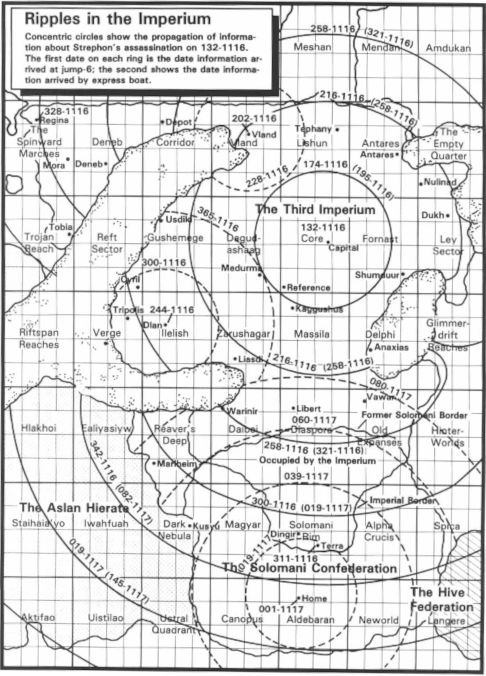
    There is a brilliant map in Megatraveller that displays how news of Emperor Strephon’s assassination spread throughout the Third Imperium. The common communication routes were the Express Boats that could jump 4 parsecs in a week, which was the limiting factor for the spread of the event. There was a second communication route used by the Imperial government and the Navy that used Couriers that could jump 6 parsecs in a week. Using this map, the GM could see who knew about the assassination, when, and how they would react.

    The map also illustrates how much distance the news had to travel. In the setting, Emperor Strephon was assassinated on the 132nd day of the Imperial Year 1116. That news took 200 days to reach Terra, on the rimward fringe of the Imperium. That was from Emergency jumps running a Pony Express route (delivering the mail through a relay of riders and fresh horses) at a pace of around 850 C. That shows that the Third Imperium is really, really vast.

    Keep Real-Time Communication Exclusive

    The Star Trek and Star Wars settings have tropes where conversations over enormous distances occur. Which works against the scope of the setting. The Enterprise is often shown as the “only ship in the Sector” that can respond to the inciting incident of the episode. The orders are delivered from StarFleet headquarters in a direct Subspace communication. Even though the Enterprise was thousands of light years distant Captain Kirk could have a video chat with the Admiralty, and receive updates while delivering progress reports. Lord Vader has video chats with Emperor Palpatine from the Phone Booth on board his Super Star Destroyer while the Emperor is at the heart of the Empire on Coruscant. This shrinks the universe to planetary scale. It’s no more inconvenient to phone HQ for info than it is to open a Zoom Call to Hong Kong from London.

    Both settings retain their sense of scale by showing that these real-time communications as requiring equipment that demands resources that are unavailable to the average citizen. Vader is the Dark Lord of the Sith, he has the biggest and bestest, literally a “Super” Star Destroyer. The Enterprise is the Flagship of the Federation. Subspace and Hyperspace Communications are not available or even a component of adventure sized ships like the characters would be crew of. A small colony carving out a settlement may not have the resources to build such a communications array.

    The Star Trek movie Into Darkness and Star Wars: Revenge of the Sith really undermines the scope of their settings (spoilers for both movies). In Into Darkness there’s a scene where “John Harrison” escapes capture on Earth by teleporting to the heart of the Klingon Empire. Using technology explained as “Transwarp Beaming” but it was effectively instant teleportation over hundreds of light years. The Enterprise follows at Warp and arrives close enough to threaten Harrison with a long-range bombardment in an indeterminate, but very short interval. This is a planetary scale event. The distances are just numbers because there is no appreciable time investment.

    In your campaigns, if your adventures travel interstellar distance this casually, then alien worlds become little more than exotic cities that can be reached by tourists on vacation. The sense of wonder is erased.

    Time is Relative

    In settings where Near-Lightspeed and Faster than Light travel is a factor, characters can age faster or slower than the rest of the setting when traveling. This is another way to emphasize the distances involved.

    When traveling at Near-Lightspeed, the subject of relativistic speeds age slower. Characters who regularly travel at these velocities start to subjectively move forward in time. They leave one world, travel for a week at relativistic speeds, and when they arrive at their destination, they have only aged a week, but the setting has gone through months of time. The GM needs to juggle three periods of time. The time from the origin passes quickly as the characters are in transit, the time on board ship seems to pass normally, and the time at the destination would be the distance travelled divided by the velocity of the vessel. This allows characters to experience vast spans of time over the course of their career while their physical life spans are unchanged.

    At Faster than Light Travel, the relativistic equation starts to flip on it’s head. Especially in settings where Jump Drives crosses the distance instantly, but the vessel has to spend a period of time (usually a week) in hyperspace, or jump space. The characters age, but the setting doesn’t. This starts to age the characters faster than the universe around them.

    In Warp-Drive settings, the ships spend travel time in a bubble of real space while the universe outside slows to a standstill. When the ship emerges, the crew, like a Jump Drive crew have aged the time they were at warp, but the universe has only aged a much smaller interval. It takes the Enterprise much, much less time to move through the galaxy at warp than light does.

    This allows adventurers the possibility of outrunning the consequences of their actions (for a time). So long as the adventurers can travel faster than the news of what they did, they can arrive in a new system before anyone can know what they’ve done. Of course, the trap here is that the adventurers need to keep moving. At least until the consequence exhausts it’s urgency.

    Setting Scale and Campaign Scope

    It’s important to apply the scale of your setting to complement the scope of the campaign you wish to run. It is tempting, especially with a game like Traveller with it’s procedurally generated system for creating worlds to create sectors’ worth of star systems, worlds, and moons. It can be fun, dreaming up pocket empires, cities, starports and NPCs to populate them. However, unless you plan to run a series of campaigns over the course of years, developing anything beyond a subsector beforehand is mostly futile. The same goes for system detail. Unless an extended adventure takes place in a single system, most groups of adventurers will never explore any given place beyond the world where the adventure takes place, and even then, the adventurers often only encounter those locations described in the adventure itself.

    Point being, unless the adventurers choose to visit a location, they won’t. You as the GM can encourage the adventurers to visit a location, but the ultimate decision is with the players. It’s the GM’s job to seed reasons for the players to want to visit the interesting locations that are designed. That being said, as GM you can present a campaign that happens in a single star system, with a plot similar to the Expanse. That type of campaign will resemble an Interplanetary Setting, with it’s distances and travel/ communication times. Everything outside of the campaign system doesn’t need any real detail. News can arrive as the GM chooses, but it is not anything that needs to be designed beforehand. Don’t make more work for yourself than you must.

    There is a balance for a campaign that revolves around travel. For example, in a Battletech campaign where the characters make up a mercenary company, contracting their military service with planetary governments and empires for c-bills, interstellar travel is common. The Company fulfills a Contract on a world, gets paid, and then they’re off to the next contract on the next world. System Detail only needs to be relevant to the current contract, and possibly outlines of the next contracts on offer. This is more of an example of a Interstellar scope on an Interstellar scale. While the campaign may never visit more than a dozen worlds or so, you as the GM can make the setting seem big. That’s part of the appeal. The mercenaries aren’t stuck on just one world or in one system. The conflicts cover hundreds of systems and thousands of light years of distance. Part of the appeal of a campaign like this is adventuring in space.

    Deep Space Exploration, like Star Trek is the ultimate expression of Campaign Scope and Setting Scale. Leaving the familiar stars behind to explore… (dare I say?) strange, new worlds. Here, the GM can use time dilation to illustrate how vast the universe is. Traveling from world to world, and revisiting some can show how much time passes on the worlds left behind. Friends who stayed on the outpost the adventurers visited at the beginning of the campaign, can have aged significantly by the time they return and the adventurers have only aged a couple of years. Campaigns out here are stories of isolation and self-sufficiency. Like the crew of a ship far beyond the boundaries of Empire, help is months or years away if it can be reached at all. News from home can be years old. I’d even go so far as to make FTL communication like subspace or hyperspace have significant delays. The goal for campaigns of this sort is, like the crew from Star Trek: Voyager, is to turn the characters’ starship into it’s own little world sailing through the stars.

    West Marches, Distant Stars

    A gaming group can adopt a setting to run a multiple-campaign game using science fiction. In this framework, GMs develop different areas in the setting, and multiple groups of players can experience adventures travelling between GMs and their areas. Coordination is key, understanding where each group of players are in time and space will inform what is occurring in the universe as it unfolds. Groups that encounter one another can exchange news and even crew. As a campaign like this matures, it becomes epic. Like a science-fiction franchise, the more campaigns that play becomes identifiable as unique expressions of the setting while remaining a part of the greater setting.

    Conclusion

    I’ve presented, a lot in this essay. Turns out, since space is big, discussing role-playing in a space setting starts to get big as well. All of this doesn’t need to be applied to any given rpg as a whole. Like all science fiction gaming, the freedom to pick and choose what works for you is a part of the fun.

    Happy Star Trek Day

  • The Dezzy Traveller Universe

    The Dezzy Traveller Universe

    A ten term career of Traveller Gaming

    I’ve been playing and running the first Science Fiction Role playing game since 1985. My high-school buddy Chuck R ran an amazing multi-session adventure based on the Aliens movie released in ’86. It was brutal and so much fun. We made so many characters during that game. Xenomorphs are freakin’ deadly.

    So are player-characters. We killed as many PCs as the Xenos did. One of our players was super-proud of the Armored Fighting Vehicle he custom-designed, and the first time he rolled it out, his character lost control of the vehicle and ran over five characters he was coming to rescue.

    Good times!

    Life-Path Characters

    Traveller was also the first game to use a life-path method of character generation. Instead of generating a bunch of stats, choosing a class and diving into the life of an adventurer, Traveller characters start as 18 year old (or the age of majority for their species and culture) young adults. Players then start choosing career options. Choices are not guaranteed, the player has to make a check for their character to qualify for and join a career. If this check fails, the player can subject the character to the Draft, start a background as a Drifter (think “Space Hobo”), or can just begin game play with the background skills their character earned growing up. Players then roll checks for their characters in four-year terms, earning skills, advancing in their careers, having life-events, and most infamously, rolling Survival checks.

    In the early editions of Traveller, failing the survival check during character generation means the character died in their career. Start over, roll some new stats, make a new 18 year old character. This made character generation into a mini-game of it’s own. Because the careers that offered skills and benefits most effective for adventures were often the most dangerous, such as Marines or Scouts, there is a risk/reward decision. Every term spent in a dangerous career can return coveted skills like Pilot (Starship), Gun Combat, Recon, Heavy Weapons, you know all those cool action-adventure skills. But every term runs the risk of the character dying in service and all those skills are lost. But, they died a hero! Probably. Maybe.

    In latter-editions of Traveller, the survival check has been re-contextualized as less lethal. Failing a survival check now results in a “mishap” and often the end of a career or character generation. But, the character is alive and with an interesting story in their history.

    There are also less risky careers, just Citizens of the galaxy. Administrators, Academics, Scientists, and the like. Survival rolls are easy to succeed with (though there almost always is a slight chance the character fails and is “hit by the Space Bus”) and though the skills are really useful (try to get your Marine friend out of the local lock-up without any Advocate skill), they won’t cover shooting guns, stabbing goons, or flying space-fighters. Players can also choose to change careers during this process, and with that, the diversity of character options is, well… galactically huge.

    This often resulted in beginning adventurers having long histories and high skill values. It wasn’t unusual to see a group of Travellers start campaigns in their 30s and 40s, with high military ranks and contacts throughout Charted Space.

    In more recent versions of Traveller, the concept of character connections have been introduced. So instead of a half-dozen random strangers being thrown on a tramp-freighter, characters can be old service buddies, ex-lovers (or ex-spouses), and all sorts of other potential connections. This encourages players to not just care about their own character, but about the other players’ characters at the table. It’s easier to abandon some guy you met an hour ago in the spaceport bar to the ravenous tooth-beasties than it is to leave the person you served with during the best times of your life.

    Charted Space and the Third Imperium

    The default setting for Traveller is called “Charted Space”. Located in a slice of the Orion Arm of our galaxy and including Terra, it echoes the universes of Asimov, and Niven, Herbert and the sci-fi fiction just before Star Wars changed everything. Traveller was first published in 1977, the same year Star Wars entered theaters. The Third Imperium is a feudal interstellar empire that rules over eleven-thousand worlds. Charted Space includes the Imperium as well as empires of alien soceities such as the Aslan (Kzinti-inspired feline aliens), the Hivers, Vargr (terran wolves uplifted by an ancient alien culture), K’kree, and dozens of others.

    While many sci-fi settings use “galaxy” as a short cut to a large interstellar setting, Charted Space illustrates just how big space is, and how unwieldy a galactic empire would be. I’ve been playing in Traveller for 40 years and in all of that time I’ve barely scratched the surface of Charted Space. Fifty years in this sandbox has created a setting as deep as those of the Foundation, Known Space, DUNE, the Star Wars Galaxy, or the Star Trek Galaxy.

    To me, one of the fundamental technologies of Traveller that is strongest is communications. There is no “Subspace” or “Hyperspace” real-time communications. Instead communications travel at the speed of the fastest ships carrying them. There are dedicated couriers called Express Boats (or “X-Boats”) that deliver the mail and communications along established X-Boat routes between systems. However, not all inhabited systems are along the X-Boat routes, and it falls to smaller courier outfits to take the mail to the backwater systems (which is an opportunity for adventurers to earn some quick credits). This results in news taking weeks or months to cross the Imperium before it arrives at a given destination. This makes the Imperial frontier a bit like our world before the Telegraph was adopted. This also allows for people to outrun their past, or to make a living tracing those who hope to do so

    IMTU: In My Traveller Universe

    Traveller can be run in nearly any science fiction genre, not just the Third Imperium. Over the years it’s been adapted, inspired, or been incorporated in all sorts of setting. I’ll borrow a page from the creator of Traveller, Marc Miller and ask the rhetorical question, “How many different worlds can you think of?”

    Most of us can imagine different biomes grown to planetary scale, desert planets, forest moons, jungle worlds, swamp worlds, worlds covered in oceans and ice, so on and so forth. But, this method is ultimately limited. There are only so many forest planets that we can design until they all start looking and feeling the same. (Star Wars really has this problem, Tattooine, Jakku, and Pasaana are different worlds, but they all feel like the same desert world.)

    For Traveller, the solution was a game mechanic where the profile of a given world can be randomly generated. Instead of classifying worlds by biome, or by it’s ability to support live (like the class M planet in Star Trek), Traveller designs worlds by Size, Atmosphere, Hydrographics, Population, Government, and Law Level. Different combinations of World Profiles can identify different, multiple trade classifications such as agricultural, or industrial, or garden worlds, offering details that can make worlds feel different, and more diverse. Referees (the Traveller title for Game Master) can fill in entire subsectors of worlds for exploration in the course of an evening. Or, if necessary, on the spot.

    Every Referee applies the Traveller rules differently in their own campaign. In the community, we refer to this as “In my Traveller universe” (IMTU). My favorite part of this, is that the Traveller Univers is large enough to contain all of this diversity in setting and campaign. Mechanically, everything in Traveller, whether it is Classic, TNE, Mongoose, or 5.1 is similar enough to be useable with nearly everything else. Honestly, in that high school campaign where I played in Chuck’s adaptation of Aliens, I played an Aslan. Big ol’ lion dude with a pulse laser and RAM grenade launchers fighting Xenomorphs. If you want to make a Wookie, or a Vulcan, or a Geminon from Battlestar Galactica, they can fit into Traveller alongside the standard Vilani/Solomani human characters and the Vargr. IMTU becomes the shorthand for the setting differences that the player can expect from this particular instance of Traveller. It has been this way for 50 years almost.

    IDTU: In Dezzy’s Traveller Universe

    I should give you all a little bit of context here. When I first started playing Traveller in the ’80s, it was the first “Classic” version. The Third Imperium was set in Year 1105 (1107, by the time the Fifth Frontier War started). I mostly ran my games in the Solomani Rim sector because my two go-to Alien Modules, Aslan and Solomani were set near this area.

    In 1987, Traveller’s publisher, Game Designer’s Workshop and their partner Digest Group Publications produced the next version of Traveller, dubbed MegaTraveller, this expanded the mechanics, updated them a bit and advanced the Third Imperium to the year 1116. It also introduced a major change to the setting, dubbed the Rebellion, or the Shattered Imperium.

    In MegaTraveller, the Emperor Strephon is assassinated by the Archduke of Ilelish doman, Dulinor, and the stable Imperium fractures into a multisided civil war. Like all major changes to RPGs (and pop culture for that matter), this was a huge controversy. Even back in 1989 gamers were really eager to dive headlong into arguments and fights over the media they felt ownership of. In My Traveller Universe, I’d chosen to ignore the Rebellion War, and continue my Solomani Rim campaigns without jumping the timeline ahead nine years. It was still 1107 (or so) and the events taking place in the Rim were still in a (relatively) stable Third Imperium.

    1n 1991 I saw a supplement for MegaTraveller that caught my imagination.

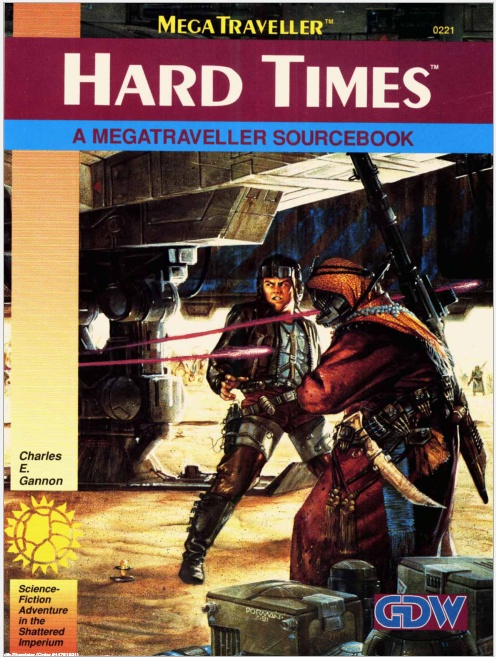
    It was the Hard Times, and that cover just scratched all my Sci Fi Adventure itches. I still have my now 33 year old copy. The Hard Times advanced the Third Imperium timeline nine more years to 1125. The Rebellion War never ended with victory for anyone. Instead, all the factions fighting one another had exhausted their resources, and in the last years of war, had destroyed the infrastructure that allowed the Imperium to run. Economies collapsed, worlds failed, and communications broke down.

    Library Data, the thing that the Imperium kept up to date so Travellers would have some idea of what to expect as they journeyed from system to system, lost it’s regular updates. Travel data stopped being accurate. The system you left three months ago, might be completely different when you return. It might be dead. It might have had a change in government and isolated itself from the rest of the sector. It might have become part of a Pocket Empire, and no longer recognized Imperial Law. A rival fleet could have flown through and saturation-bombed the main world. The most valuable asset that a crew could have was often the records of the recent systems they visited. Hell, in the Hard Times, even the X-Boat Routes became unreliable. The mail couldn’t get through.

    My Traveller Universe advanced to the Hard Times on the spot.

    Then, I moved to California and GDW changed Traveller again! Another controversy, another round of edition wars. This time it was 1993. I was excited to find a new Traveller version to go along with my new city and new state.

    The New Era advanced the Third Imperium timeline to the year 1201. The collapse of the Hard Times had become a complete Apocalyptic catastrophe in year 1130 with the release of a superweapon, VIRUS. Essentially VIRUS was self-aware, weaponized software that spread through computer networks. So long as a given system was powerful enough to host an iteration of VIRUS, the weapon would turn that system against the societies that used it. Think Skynet from the Terminator Franchise. A malicious, aggressive, weaponized artificial intellect that desired the genocide or enslavement of all organic sentience it could find. VIRUS would infect a starship, and without warning purge all the airlocks (and crew) then if it were in proximity, turn any weapons on any nearby un-infected ships it could sense. VIRUS would set powerplants to overload, open habitats to vacuum, or poisonous atmosphers, or the ocean. Even most household appliances in the Imperium had enough processing power to host a fragment of VIRUS. Maybe your toaster couldn’t kill you on it’s own, but it certainly could infect the rest of your home, or vehicle and find something to murder you and your family with.

    By 1201 the survivors of VIRUS had started the long road to recovery. That’s what the New Era was about, reconnecting interstellar civilization and avoiding Vampire Fleets and Murder Warbots. There were parts of the New Era I enjoyed, and there were parts I really didn’t. For me, it had changed too much. The adventures and setting supplements presupposed that Traveller was specifically taking place in this setting with these environments. If you wanted to play Traveller In Your Traveller Universe and not in The New Era, you’d have to do a fair amount of extra work. In short, The New Era didn’t feel enough like Traveller for me to really enjoy it.

    My appreciation for VIRUS would come later.

    I was surprised to see the 4th edition of Traveller “Marc Miller’s TRAVELLER” when I found it in my FLGS in 1996. I picked it up on the spot, but it’s setting “Mileu 0” had the same issues for me that The New Era had. It was just too different from the Traveller I enjoyed, and the game mechanics had been changed again from the system used in TNE, which was different from the system used in MegaTraveller. For me, TRAVELLER 4 wasn’t the Traveller I wanted.

    Quick Link Interactive adapted Traveller to the d20 OGL in 2002. It drew me back to Traveller for the first time in almost ten years. I’d been running a lot of 3rd edition D&D in this time and Traveller20, as it came to be known, was really effective in introducing a whole new group of D&D gamers to the universe of Traveller. One of the elements of Traveller that was carried over to Traveller20 was the Life-Path mechanic adapted to the d20 system. Which I really adored!

    Mongoose Publishing came to my rescue in 2008 with it’s retro-design of Classic Traveller. I remember finding a copy of Mongoose Traveller in the dealer room at KublaCon. The hardback cover was an homage to the original little black books of Classic Traveller. That became my new go-to version of Traveller. I blew the dust off My Traveller Universe and happily returned to the Far Future.

    Since then, and the date of this writing, Marc Miller, with Far Future Enterprises published a Fifth Edition of Traveller, TRAVELLER5, in 2013 and a cleaned up revision 5.1 in 2019. Mongoose updated their version of Traveller into a Second edition in 2016 and published updated revisions in 2020 and 2022.

    In Dezzy’s Traveller Universe, I’m mainly using the 2022 version of Mongoose Traveller 2nd edition with a fair amount of the crunchy menchanics from TRAVELLER5.1 in the background. I am setting my next campaign in Diaspora sector during the Hard Times of 1125.

    Conclusion

    If it’s not clear by now, I really enjoy Traveller. It’s my favorite Sci-Fi game, and I think it’s enjoying a renaissance among the older generation of gamers. Recently, Mongoose Publishing has purchased the rights to Traveller from Marc Miller and Far Future Enterprise, which places the game in good hands for the foreseeable future. I’m excited to see what Mongoose Publishing does with their stewardship.

    As a role-playing community I think Traveller players have an opportunity here. We can introduce a whole new generation of gamers to Traveller and it’s rich history. Show them Your Traveller Universe.