Tag: science-fiction Roleplaying

  • For A Few C-Bills More

    For A Few C-Bills More

    Heists during the Year of Peace – 3051

    The Clan Invasion of 3050-52 was interrupted by an unexpected pause in 3051. The “year of Peace” provided more than a reprieve and a strategic opportunity for the Inner Sphere. While the leaders of the Great Houses were all on Outreach training for when the invasion begins again, Survivors, Mercenaries, Outlaws, and Pirates took advantage of a special set of circumstances

    Kerenskys Are Not Money, but Gold Still Is

    The Clans invading the Inner Sphere had survived for generations on the bare minimum of resources. Rebuilding their society as a rejection of what they saw as the greed and decadence of the Successor State houses. Their currency, Kerenskys is not representative of material wealth. The Kerensky is a market currency tied to the trade engaged with the Merchant Caste. The Clans value resources and technology. But from the materialistic perspective of the Inner Sphere, the Kerensky has no value, not even a residual value. As currency it means nothing to the conquered people. It is a fiat currency imposed on the vanquished by the victors.

    C-Bills and House Bills represent the material wealth of the empire that issues it. Whether that value is in preserved technology and communication as with the C-Bill or in Territory and Treasure as with the various House Bills. Ultimately, the Inner Sphere’s currencies can be traced to something of material value. This economic system of trade stretches back through the millennia of recorded human history.

    The Clans are on a Crusade

    In 3051, the Clans are not invading the Inner Sphere to seize it’s material wealth, nor are they taking territory, except in so far as the systems they seize bring them closer to their goal. The Clans are invading with the purpose of “liberating” Terra. The culture of the Clans, militaristic and austere suppresses the desire for material comforts and luxury. Especially among the Warrior Castes, who comprise the majority of the clansfolk that occupy the conquered systems. At this point, one year into the invasion, there hasn’t been enough time for the temptations of luxury to break the discipline culturally instilled in the Clanners. The Merchant Caste still manages trade and supply with a focus on practicality and resource allocation. Strategic objectives are primarily parts and supplies with immediate military applications, port resources and protecting communications facilities, including ComStar installations. Vaults and monetary reserves are of secondary, even tertiary concern. Only the senior strategic ranks concern themselves with the money of the inner sphere, and in that capacity only because money and luxury can be used to exploit greed in the hearts of local leaders of government, industry and militaries.

    Rumors Fly Furious and Thick

    The speed and shock with which the Clans have gouged their conquest out of the Lyran Commonwealth, Draconis Combine, and Rassalhague Republic left unimaginable fortunes laying undefended in hundreds of locations throughout the Occupation Zone. In some cases, not even the conquerors know the treasures resting on the very worlds they occupy.

    The tide of refugees fleeing in front of the invasion carry with them the knowledge and locations of these vaults. Some were the owners of these treasures, others guards, and yet others managers, and many simply lived in the communities where the banks, nobility, and corporations maintained the vaults. These are the hooks for missions and adventures that go beyond recreations of operations baattles that are usually recorded throughout the timeline.

    Raids and Heists can be just as exciting as battles over tactical and strategic positions, but without the scope of a large scale battle. At this scale the stakes are small and personal, the characters (and the opposition) are not trying to fight a war. They’re trying to grab treasure. There is little or no jingoistic patriotism here, there’s little motivation beyond getting paid. Something that would appeal to a mercenary and pirate campaign.

    Why 3051?

    This is a very unique year in the grand timeline of the Battletech Universe. In the Occupied systems, the Clan invaders haven’t had the chance to absorb the vices of greed and avarice. At least as far as wealth and luxury are concerned. Furthermore, the withdrawal of the Bloodnamed back to Strana Mechty has in effect frozen the invasion offensives and left behind Provisional Garrison troops to hold the systems they’ve captured. This combination of freebirths and dezgra units simultaneously discourage personal initiative (no one wants to risk retaliation from the caste system for breaking discipline) and unintentionally filled with persons who resist the system they live in (thus, more susceptible to the temptations of the inner sphere and “going native”).

    The Houses of the Inner Sphere are similarly paralyzed. Having been beaten back with few, if any, significant victories along a front that has grown to the size of the Free Worlds League, all the Great Houses of the Inner Sphere have been paralyzed just like the Clans. The Leadership of the Inner Sphere are sequestered for most of this year on Outreach as “guests” of Wolf’s Dragoons. Between that, and the near-collapse of the Rassalhauge Republic, Draconis Combine, and Lyran Commonwealth militaries, there are no opportunities to capitalize on strategic vulnerabilities.

    For both the Clans, and the Inner Sphere, 3051 is a tidal wave, frozen in time. Which leaves extensive opportunity for the type of smash-and-grab raiding and probing that small mercenary outfits do best.

    Hit ’em Where They Ain’t

    Throughout the year, the Clans are defending their occupied territories with Provisional Garrison forces piloting second-and third-line equipment. Under leaders tied to vague orders that amounts to little more than “Don’t lose any ground, not one step!” This has left the Occupied Zones wide open for probes and raids. In fact, if the Inner Sphere had anything to put together for a counter-offensive, 3051 could have been a bad year for “Operation: REVIVAL”.

    Setting up a raid is not much different for a mercenary company (even if that company is a lance) than fulfilling a short-term contract. Objectives, Mission Plans, and Logistics need to be outlined. In a mercenary contract, these are often laid out during contract negotiations, the employer defining the objective and (usually) arranging the logistics. When raiding, the “employer” are the mercenaries themselves. They are, in essence, writing their own contracts, and need to take into account these details.

    The Objective, has to be valuable enough to justify the expenses. Ammunition cost C-Bils, repairs cost C-Bills, fuel, hiring a transport to jump to the system, hiring a drop-shop to ferry the mercenaries planetside (and pick them up after), paying for “discretion”, all of it are expenses (and expensive). Much of it needs to be paid in advance, like buying passage to the system, and food for the trip (remember, mechwarriors and their mechanics gotta eat). The Objective has to be able to recoup those expenses, and turn a profit at the end.

    As a game-master, it’s your job to make the Objective worth the trip. Hitting a “vault” to come away with loot worth a million C-bils isn’t gonna be enough. Do some homework, figure out what the characters’ expenses are and make certain that, at least based on the intelligence the characters are given, the money is worth their time and efforts.

    For most heists, the opposition isn’t going to be focused directly on protecting the objective. The mercenaries are going to be hitting lightly defended targets. At least initially. Objectives deemed not strategically important won’t be directly garrisoned, and a response to incursions are going to be delayed. This is going to start a timer on the mission. The moment the mercenaries are detected, the garrison will move out to intercept them. Thus, the mercenaries need to be gone by the time the garrison arrives. In these scenarios, a pitched battle is failure and the characters are going to lose.

    This is the point where the game-master needs to drop in twists and hurdles to the plan. Maybe the drop ship is running late, maybe the extraction point has to be moved, maybe the vault isn’t where it’s supposed to be and the characters have to find out where it’s hiding, maybe the garrison isn’t where it’s supposed to be and the characters need to fight their way in.

    Here’s the devil in the details, once the characters have committed to the raid, once they have hired the jumpship and the dropship, it’s too late for them to walk away empty-handed. The point of no return for them was the moment they left for the objective. Aborting the mission after that is a loss, and a significant one at that. Jump ship travel is not cheap, and while Jumpship Captains see themselves as “above” the politics of war, they will make sure they get paid first.

    During the mission, the locals may not appreciate offworld mercenaries dropping in, taking all their stuff and blasting off. They may hate their occupiers, but they won’t stand still and be robbed. Furthermore, the locals know that their Clan occupiers will punish them for the actions of any Inner Sphere mercenaries who raid their settlements. Clan honor demands some sort of consequence for being injured. Even the appearance of collaboration between the locals and the raiders will demand harsh retribution after the mercenaries are long gone with their loot.

    Crossing The Lines

    An exciting option that could start a campaign is playing a group of occupiers that choose to raid their own garrison, and desert or defect. In most cases this is unthinkable. Betraying Clan Honor in this way is The WORST crime imaginable.

    Being “clanners” also puts the defectors in a terrible position. The occupied population hates them, their Clan hates them and the Inner Sphere hates them. From the defectors’ perspective, they don’t speak the language, don’t understand the culture, and don’t have a grasp of how C-Bills work. On the other hand, even second-line garrison troops are head-and-shoulders above most of their Inner Sphere counterparts, their tech, even old clan tech is decades more advanced than Inner Sphere tech. 3051 might be a freebirth or dezgra’s only opportunity to escape the prison of their society and, for as long as they can, live outside the legacy of Nicholas Kerensky’s memory.

    It Comes to an End

    By November of 3051, the Fifth Wave of Operation: REVIVAL is beginning, the Blood-named and elite clan military machine have returned from the Homeworlds. The Outreach Summit had finished by August, and the Inner Sphere had reorganized their defenses. By the end of 3051 the window of opportunity for small units to pull off raids in the Occupied Zone had closed. After the Battle of Tukayyid in May of 3052 would the Clan Invasion halt and the region start to adjust to the new “normal” that would carry forward into the next conflicts and wars.

  • Galley Service in Traveller

    Galley Service in Traveller

    Space food by Tech Level

    Out in the vastness of empty space, Your crew still needs to eat. Whether it’s food-in-a-tube from TL 6, or TL 15 replicated food. Eating also adds (dare I say) “flavor” to an otherwise boring series of downtime activities. The Life Support portion of the monthly Running Costs of operating a Space Ship or Starship covers the most basic nutritional needs for each person on board the ship. Normally running somewhere around Cr 1,000 per stateroom (Cr 3,000 per double occupancy stateroom) and Cr 1,000 per person. This is food that will keep a person adequately fed with some small variety. Sort of like Meals, Ready to Eat packages. This food is designed to travel with a minimum of environmental demand. It doesn’t need refrigerated, it’ll last for years, and is shelf-stable. As anyone who has lived off this for an extended length of time can tell you, the menu gets real old, real fast.

    There are two tech level factors that affect the quality of food on board a ship. The first is the TL of the ship itself, specifically the TL of the Life Support Systems. The second is the TL of the location where the resupply is taking place. Advances in preservation and preparation allow for more palatable and satisfying fare.

    Ship’s Larder

    Starting around TL6, and until TL9 this is some variety of “food in a tube”. TL9 is the lowest tech level where Jump Drive is an option, and this means most ships at these tech levels are intended for in-system travel with voyages lasting weeks. Galleys are luxuries at this stage, and even the most extravagant are little more than a common room with a table, chairs, and a microwave.

    TL 10 and 11 is where “reconstitution” modules are developed. This is more advanced than simply re-hydrating meals with hot water. Reconstiution uses a common base of proteins and carbohydrates to restore food resemble a wide variety of textures, flavors and smells. By the very nature of the process, the food is absent any meat product, though meats can be prepared this way. Still, it’s a critical detail for venturing into the Two-Thousand Worlds. K’kree can scent a meat eater.

    TL 12 through TL13 is where recycling organic matter reaches its peak. At this stage food can be created from compost material. From there, food can be flavored and textured into the desired composition. The process takes a few minutes (roughly 15) and the result can be eaten immediately, or further prepared through any other recipe.

    TL 14 and TL15 is where true food synthesis can create edible footstuffs in nearly any form imaginable. By combining organic chemical elements, Food can be created on demand (so long as those chemical elements remain available) in a matter of moments.

    Resupplying at Port

    Part of Life Support costs are keeping materials on hand. Even at the higher Tech Levels, equipment needs to be serviced, stores need resupplied. However, the quality of rations remain limited by the lower tech level between the ship and the port of resupply.

    TL0 through TL5 is limited to primitive food preservation techniques, smoking, salting, canning. It is possible that if a ship has to resupply here, the crew might be loading pemmican and hard tack like their ancestors on tall ships during the age of sail.

    TL6 through TL8 allow for processing foods, dehydrating and/or industrially preserving it to be shelf-stable.

    At TL9, cryogenic preservation allows for some fresh food to be added to a ships’ stores. Bulk is still an issue, it’s really difficult to miniaturize a side of beef, or a 1000kg bluefin tuna. TL9 is where the food can be maintained in cryogenic storage indefinitely.

    At TL15, stasis is in its infancy but does allow for food to be stored in a state of freshness. Food stored in stasis doesn’t need thawed or reconstituted. It can be prepared and eaten immediately.

    Bread Alone

    Using Life Support in this manner should enhance the immersion in the setting. If it becomes an annoyance in your campaign, don’t lean on it so much. The point is not to punish the characters but to give storytelling material for players to experience. Illustrate how, after months of living off of rations made from reconstituted algae, or recycled garbage and poop the intense pleasure of eating food freshly prepared.

    Think about the scene from the Matrix where the crew of the Nebuchadnezzar is eating their plates of gruel. Then compare it to Cypher eating the steak in the Matrix. The promise of a good meal after months of deprivation makes for a powerful motivator.

    Take the original Star Trek series, their replicated food was multicolored simple solid shapes. Compare that to the Next Generation where the replicator could create food to the taste of the person ordering it, whether it is “Tea, Earl Grey, Hot” or “Gakh”, and even the difference between replicated Gakh and when it is served live. As Any Klingon would tell you, Gakh is best served live.

    Science fiction roleplaying should have that same sensory feel. From Captain Pike’s exaggerated home kitchen on board the Enterprise to Luke Skywalker drinking a tall glass of blue milk. Engineers setting up stills to make rot-gut hooch from the basic amino acids and carbohydrate soups in the storage bins, “good for two things, de-greasing engines and killing brain cells” Keeping a bottle of Scotch from Rigel, or a red wine from Chateau Picard. These are ways to breathe life into the downtime stuck in Jump Space.

    Brand Loyalty

    This is also a part of world building for your campaign. Create companies and brands who can supply ships with these supplies. Military ships, of course are supplied by their branch’s quartermaster, but as any Imperial Scout can tell you, the ISS ration menus are “uninspired” to say the least. Adding a common, regional brand to the campaign, think “Triple F Burgers” from the Battletech game, or “Biscuit Baron” from WEG Star Wars. Can add role-playing moment. Smuggling a crate of Romulan Ale has more of a connection to the Star Trek Universe than simply running prohibited spirits through the Federation.

    Having a regional, or even subsector supplier of ships’ rations can give players a reason to head to that area of space.

  • O God, Thy Sea is so Great, and My Boat so Small

    O God, Thy Sea is so Great, and My Boat so Small

    Space is BIG

    One common quirk of science-fiction roleplaying, whether it be Traveller, Star Trek, or Battletech is that the Universe starts to seem rather small. The characters jump from world to world having adventures but they only stay as long as the adventure lasts. Once the adventure is done, they’re back on their ship and off to another world, light-years distant. The routine of interstellar travel shrinks an impossibly vast universe into a travelogue. Alien worlds, might be strange, but they’re not memorable, the planet of purple-people-eaters fades into the background along with the forest moon of cannibal teddy bears, and the world of cheese.

    Timekeeping

    One way to keep space feeling big is to keep track of time as it passes. The Universe is not a static place, everything is always in motion. Seasons change, years pass, even the stars themselves grow old and die. It helps to reinforce that your characters are on a voyage if the Universe continues to unfold even as the players hop from system to system. In Traveller, each jump between systems takes a week. Normally this is expressed in downtime, but the important thing for timekeeping is, that as the characters jump from world to world weeks pass as they are isolated in jumpspace.

    The Battletech Universe is different, jumps of 30 light years happen in an instant, but the drives require a week to recharge, and it takes days of sublight travel to reach the jump point where the drives can be engaged. Again, this is often considered downtime, but the time still passes.

    Even Star Trek, where warp travel doesn’t isolate the ship or it’s crew, the distance between systems is *vast*. It takes days or weeks for a vessel, even traveling hundreds of times the speed of light to transition from one system to the next. As Game Master, take advantage of this, let events develop without the characters needing to be involved. Keep the Universe a dynamic, ever changing place.

    Distance and Scale

    It’s time for a little Astronomy. Get out your notebooks and calculators. As I am writing this essay, I have just flown across the North American Continent from Washington DC to Sacramento. That trip of 3,000 miles (4800 km) took all day (actually it also took all night, because of an unexpected layover in Phoenix, but that’s a whole different story). One Astronomical Unit (AU) is 150 million km. One Parallax Second (ParSec) is 3.26 light years. To put all of this in scale, for Dezzy to travel to work takes about an hour (I live 30 miles from the office) by car. For Dezzy to cross the country (the US) takes a day (six-ish hours) by jet. If Dezzy was to fly to Mars, it’s a journey of eight months. Flying out to Jupiter’s moon Europa takes around 6 years. If Dezzy wanted to send a message home at light speed, it would be more-or-less immediate from most places on Earth, 1.25 seconds to the moon, 15 minutes to Mars and 35 minutes to Europa.

    Why am I throwing all these numbers at you? Well, it’s to illustrate a point. Like Douglas Adams famously said many years ago, “Space is big. You just won’t believe how vastly, hugely, mind-bogglingly big it is. I mean, you may think it’s a long way down the road to the chemist’s, but that’s just peanuts to space.” Traveling between worlds or star systems shouldn’t feel like driving to the next town over or even flying across country. In-system travel should take at least days, if not weeks unless the vessel is moving at 75% of C (light speed) or more. The point of emphasizing distance is to impart the vastness of space to the players.

    Because of the enormous distances involved, the setting needs to feel different based on scale. This can be accomplished not only with travel times, but with communication lag.

    The Mail Must Go Through

    On a planetary/ moon scale, real time communications is fairly straightforward. We experience it today in our decidedly non-science-fiction real world voice and video calls can be made in real time anywhere on the planet where a signal can be reached. The slight delay to lunar orbit can make conversation slow, and possibly awkward, but not impractical. Physical mail can be sent nearly anywhere in a mater of weeks, or even days or hours if extra resources are employed.

    On an interplanetary scale, real-time communications are not really possible. Even between nearby planets (assuming both worlds are in their close orbits), electromagnetic communications still take between fifteen minutes to an hour to reach their destination. Conversations start to resemble e-mail or messaging, even with voice or video

    Communication with the outer worlds takes hours or days. Relays are needed to even send an electromagnetic signal out that far that can deliver something as dense as voice or video communications. Settings at this scale begin to resemble the telegraph and rail eras of the 19th century. News travels over continental distances, but need to move between telegraph or railroad stations. If the recipient of the message is five days away from the closest station, then all news that recipient receives is at least five days old. Even if the setting is heavily populated, it is still possible and even preferable to present a tangible sense of isolation

    On an interstellar scale, unless Faster Than Light travel and communication is employed, news travel at generational speeds. Its simply not possible to maintain a cohesive society at this scale. Without FTL travel, an interstellar setting is a planetary or interplanetary setting. To use an example from fiction, in the novel Three Body Problem (spoilers), the invading fleet from Alpha Centauri (rougly 4.3 light years) takes 300 years to journey to the Sol system. That’s using technology so far advanced beyond what humans have developed that it may as well be magic.

    FTL Travel Changes Everything

    Interstellar settings with Faster-Than-Light travel flips communications on it’s head. Even in settings where direct communications through subspace, or hyperspace relays are possible, it is often quicker to send a ship from place to place delivering messages. This can be physical media, where a mail ship drops off packages and mail to the starport, but it can also be electronic or digital media where the mail ship simply flies in-system and transmits their messages to their destinations.

    This brings an Interstellar setting to resemble the world-spanning empires of the 16th to 19th centuries. Worlds take weeks or months to interact, large interstellar empires and megacorporations lay most of their authority on colonial governors or directors of local headquarters.

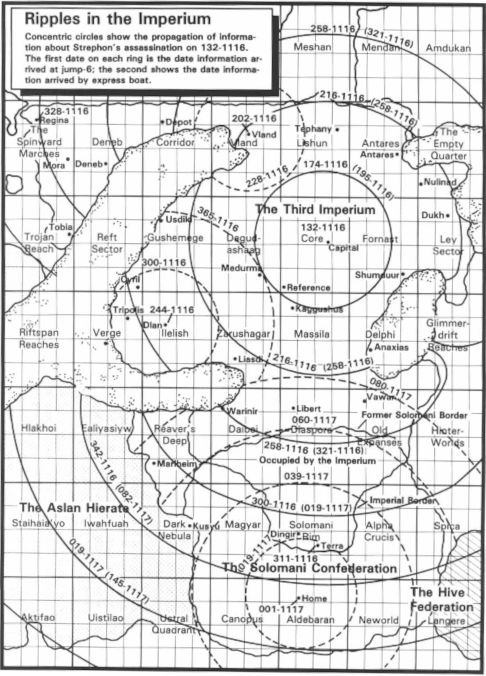
    There is a brilliant map in Megatraveller that displays how news of Emperor Strephon’s assassination spread throughout the Third Imperium. The common communication routes were the Express Boats that could jump 4 parsecs in a week, which was the limiting factor for the spread of the event. There was a second communication route used by the Imperial government and the Navy that used Couriers that could jump 6 parsecs in a week. Using this map, the GM could see who knew about the assassination, when, and how they would react.

    The map also illustrates how much distance the news had to travel. In the setting, Emperor Strephon was assassinated on the 132nd day of the Imperial Year 1116. That news took 200 days to reach Terra, on the rimward fringe of the Imperium. That was from Emergency jumps running a Pony Express route (delivering the mail through a relay of riders and fresh horses) at a pace of around 850 C. That shows that the Third Imperium is really, really vast.

    Keep Real-Time Communication Exclusive

    The Star Trek and Star Wars settings have tropes where conversations over enormous distances occur. Which works against the scope of the setting. The Enterprise is often shown as the “only ship in the Sector” that can respond to the inciting incident of the episode. The orders are delivered from StarFleet headquarters in a direct Subspace communication. Even though the Enterprise was thousands of light years distant Captain Kirk could have a video chat with the Admiralty, and receive updates while delivering progress reports. Lord Vader has video chats with Emperor Palpatine from the Phone Booth on board his Super Star Destroyer while the Emperor is at the heart of the Empire on Coruscant. This shrinks the universe to planetary scale. It’s no more inconvenient to phone HQ for info than it is to open a Zoom Call to Hong Kong from London.

    Both settings retain their sense of scale by showing that these real-time communications as requiring equipment that demands resources that are unavailable to the average citizen. Vader is the Dark Lord of the Sith, he has the biggest and bestest, literally a “Super” Star Destroyer. The Enterprise is the Flagship of the Federation. Subspace and Hyperspace Communications are not available or even a component of adventure sized ships like the characters would be crew of. A small colony carving out a settlement may not have the resources to build such a communications array.

    The Star Trek movie Into Darkness and Star Wars: Revenge of the Sith really undermines the scope of their settings (spoilers for both movies). In Into Darkness there’s a scene where “John Harrison” escapes capture on Earth by teleporting to the heart of the Klingon Empire. Using technology explained as “Transwarp Beaming” but it was effectively instant teleportation over hundreds of light years. The Enterprise follows at Warp and arrives close enough to threaten Harrison with a long-range bombardment in an indeterminate, but very short interval. This is a planetary scale event. The distances are just numbers because there is no appreciable time investment.

    In your campaigns, if your adventures travel interstellar distance this casually, then alien worlds become little more than exotic cities that can be reached by tourists on vacation. The sense of wonder is erased.

    Time is Relative

    In settings where Near-Lightspeed and Faster than Light travel is a factor, characters can age faster or slower than the rest of the setting when traveling. This is another way to emphasize the distances involved.

    When traveling at Near-Lightspeed, the subject of relativistic speeds age slower. Characters who regularly travel at these velocities start to subjectively move forward in time. They leave one world, travel for a week at relativistic speeds, and when they arrive at their destination, they have only aged a week, but the setting has gone through months of time. The GM needs to juggle three periods of time. The time from the origin passes quickly as the characters are in transit, the time on board ship seems to pass normally, and the time at the destination would be the distance travelled divided by the velocity of the vessel. This allows characters to experience vast spans of time over the course of their career while their physical life spans are unchanged.

    At Faster than Light Travel, the relativistic equation starts to flip on it’s head. Especially in settings where Jump Drives crosses the distance instantly, but the vessel has to spend a period of time (usually a week) in hyperspace, or jump space. The characters age, but the setting doesn’t. This starts to age the characters faster than the universe around them.

    In Warp-Drive settings, the ships spend travel time in a bubble of real space while the universe outside slows to a standstill. When the ship emerges, the crew, like a Jump Drive crew have aged the time they were at warp, but the universe has only aged a much smaller interval. It takes the Enterprise much, much less time to move through the galaxy at warp than light does.

    This allows adventurers the possibility of outrunning the consequences of their actions (for a time). So long as the adventurers can travel faster than the news of what they did, they can arrive in a new system before anyone can know what they’ve done. Of course, the trap here is that the adventurers need to keep moving. At least until the consequence exhausts it’s urgency.

    Setting Scale and Campaign Scope

    It’s important to apply the scale of your setting to complement the scope of the campaign you wish to run. It is tempting, especially with a game like Traveller with it’s procedurally generated system for creating worlds to create sectors’ worth of star systems, worlds, and moons. It can be fun, dreaming up pocket empires, cities, starports and NPCs to populate them. However, unless you plan to run a series of campaigns over the course of years, developing anything beyond a subsector beforehand is mostly futile. The same goes for system detail. Unless an extended adventure takes place in a single system, most groups of adventurers will never explore any given place beyond the world where the adventure takes place, and even then, the adventurers often only encounter those locations described in the adventure itself.

    Point being, unless the adventurers choose to visit a location, they won’t. You as the GM can encourage the adventurers to visit a location, but the ultimate decision is with the players. It’s the GM’s job to seed reasons for the players to want to visit the interesting locations that are designed. That being said, as GM you can present a campaign that happens in a single star system, with a plot similar to the Expanse. That type of campaign will resemble an Interplanetary Setting, with it’s distances and travel/ communication times. Everything outside of the campaign system doesn’t need any real detail. News can arrive as the GM chooses, but it is not anything that needs to be designed beforehand. Don’t make more work for yourself than you must.

    There is a balance for a campaign that revolves around travel. For example, in a Battletech campaign where the characters make up a mercenary company, contracting their military service with planetary governments and empires for c-bills, interstellar travel is common. The Company fulfills a Contract on a world, gets paid, and then they’re off to the next contract on the next world. System Detail only needs to be relevant to the current contract, and possibly outlines of the next contracts on offer. This is more of an example of a Interstellar scope on an Interstellar scale. While the campaign may never visit more than a dozen worlds or so, you as the GM can make the setting seem big. That’s part of the appeal. The mercenaries aren’t stuck on just one world or in one system. The conflicts cover hundreds of systems and thousands of light years of distance. Part of the appeal of a campaign like this is adventuring in space.

    Deep Space Exploration, like Star Trek is the ultimate expression of Campaign Scope and Setting Scale. Leaving the familiar stars behind to explore… (dare I say?) strange, new worlds. Here, the GM can use time dilation to illustrate how vast the universe is. Traveling from world to world, and revisiting some can show how much time passes on the worlds left behind. Friends who stayed on the outpost the adventurers visited at the beginning of the campaign, can have aged significantly by the time they return and the adventurers have only aged a couple of years. Campaigns out here are stories of isolation and self-sufficiency. Like the crew of a ship far beyond the boundaries of Empire, help is months or years away if it can be reached at all. News from home can be years old. I’d even go so far as to make FTL communication like subspace or hyperspace have significant delays. The goal for campaigns of this sort is, like the crew from Star Trek: Voyager, is to turn the characters’ starship into it’s own little world sailing through the stars.

    West Marches, Distant Stars

    A gaming group can adopt a setting to run a multiple-campaign game using science fiction. In this framework, GMs develop different areas in the setting, and multiple groups of players can experience adventures travelling between GMs and their areas. Coordination is key, understanding where each group of players are in time and space will inform what is occurring in the universe as it unfolds. Groups that encounter one another can exchange news and even crew. As a campaign like this matures, it becomes epic. Like a science-fiction franchise, the more campaigns that play becomes identifiable as unique expressions of the setting while remaining a part of the greater setting.

    Conclusion

    I’ve presented, a lot in this essay. Turns out, since space is big, discussing role-playing in a space setting starts to get big as well. All of this doesn’t need to be applied to any given rpg as a whole. Like all science fiction gaming, the freedom to pick and choose what works for you is a part of the fun.

    Happy Star Trek Day

  • 3051

    3051

    Battletech’s Lost Year

    3049 and 3050 were disastrous years for the Inner Sphere. The Clan Invasion began. The invading, mysterious armies looked and fought like aliens. The peripheral bandit kingdoms and pirate havens fell almost without a fight. What few reports leaked from those first battles showed everything from unknown war machines that violated all principles of known battlemech engineering to jump-capable warships the like hadn’t been seen for 200 years, since the First and Second Succession Wars.

    When the invasion washed over the peripheral systems of the Lyran Commonwealth, the Rasalhague Republic and the Draconis Combine proved the worst stories true. The Successor State Houses were neither unified, nor ready for the four coordinated Juggernauts that went from victory to victory, marching steadily towards the heart of the Inner Sphere. By the end of 3050, the Houses of the Inner Sphere had won only a bare handful of battles. All while losing hundreds of systems and nearly the entirety of the Rasalhague Republic, including its capital at Rasalhague.

    Radstadt

    On the last day of October in 3050, the Elected Prince of Rasalhague, fleeing the loss of the capital system jumped into the Radstadt system, recently conquered by Clan Wolf, and hosting the IlKhan’s flagship, the Dire Wolf. In the chaos that followed, the Elected Prince burned their ship hard to escape, with the Clan scrambling to pursue. The Flying Drakøns, the Elected Prince’s fighter escort bought time for their Prince to escape by engaging in a desperate, suicidal attack on the Dire Wolf, forcing the clan aerospace squadrons to break their pursuit of their prey to defend their IlKhan. A Rasalhague pilot, Tyra Miraborg dove her crippled Shiloh fighter into the bridge of the Dire Wolf, killing IlKhan Leo Showers. She would never know how her sacrifice would change the course of the invasion.

    A Year of Peace

    The loss of the IlKhan threatened the unity of the invasion. By tradition and culture, the Clans were exorbitantly competitive in all aspects of their society. From the individual to entire Clans. Only the IlKhan had the invested political power to lead a coordinated operation across all the Clans as a whole. Even then, each of the invading Clans would compete and bid against one another for the “honor” of attacking systems. Warriors and Commanders would engage in duels for rank, positions, equipment, or spoils.

    The Khans of the invading clans met at Radstadt to decide a way forward, and chose to elect a new Ilkhan. Thus, they called all of the Bloodnamed warriors in the invasion, and returned to the distant systems from which they came from. Leaving behind only second and third line troops to garrison the conquered systems while they elected a new IlKhan. The process would take a full year. That year was 3051.

    Peace for the Inner Sphere, Occupation for the Clan

    When the elite of the clans left to elect their new IlKhan, they left Provisional Garrison Clusters (PGCs) consisting of the freeborn, the disgraced, and solhama to hold their conquests. 1,000 light-years from their homes, barely supplied, and unsupported, the occupying armies and aerospace forces were spread thin across hundreds of hostile systems. The PGCs were subject to guerilla raids, resistance movements, and insurrections; ugly, violent, all-too-personal conflicts fought in urban centers among civilian populations.

    The leaders of the PGCs were placed in an impossible situation. Forced to govern captive populations, maintain order, and defend against revolts or uprisings without losing any captured territory, or resources. They were expected to make do with what they were given, and remain victorious in any and all conflicts with the Inner Sphere. In short, the armies were expected to accomplish the impossible, then hand control back to the bloodnamed warriors upon their return. If successful in their mission, they would not be thanked and only barely acknowledged for doing a job as expected. Anything less than meeting that standard would mean a loss of honor at best, disgrace and reassigned to the labor caste at worst.

    Probing Attacks

    The armies of the Inner Sphere that opposed the invasion were almost reduced to nothing. Entire Regiments and Brigades had been wiped out as the invading Juggernaut rolled over system after system. When the invasion abruptly paused, The Lyran Commonwealth and Draconis Combine wasted no time in throwing together lance, and company sized reconnaissance forces to test the readiness of the occupiers. Scouting missions, Raids, and Smash-and-Grab operations struck all along the Front. In the first months of 3051, these were irregular formations of shattered units that escaped systems as they fell, or bottom-of-the-barrel mercenary outfits signed on to hasty contracts, even ceremonial units and Solaris VII gladiators were folded or pressed into service. Resistance operations were contacted and given support, propaganda from the Inner Sphere was smuggled into occupied systems, surviving militias were given supplies smuggled in system by networks of criminals who had operated black markets for centuries before the Clans invaded.

    Following the Outreach Summit of January 3051, the Lyran Commonwealth, Rasalhauge Republic, and Draconis Combine, coordinating with the Federated Suns, Capellan Confederation and Free Worlds League began to apply increasing pressure to the thinly-spread and poorly supplied Provisional Garrison Clusters the Clans had left behind.

    Resistance and Insurgency

    As 3051 wore on, the intelligence services of the Inner Sphere polities developed extensive deep-cover networks throughout occupied space. By the time the Clans resumed their offensive in November of 3051, The Inner Sphere had become well-prepared for the Clan threat.

    For their part, the clans under the leadership of newly-elected IlKhan Ulric Kerensky were better unified and better able to understand the nations they were invading. But the Clans continued to have a blind spot where their Provisional Garrison Clusters were concerned. Most to the leadership continued to disregard the analysis and opinions of the very people they left behind for a year. Lessons learned by a hard-fought occupation, Intelligence gathered from first-hand sources went unheard because they came from the mouths of the despised.

    3051 as a Developing Story

    3051 represents a lot of unexplored, untapped potential for story. The Provisional Garrison Clusters occupying the captured worlds have several growth arcs. Colonization, or using a large underclass to expand Imperial ambitions, or being a (very literal) outsider in someone else’s home… or just being a person, used by an impersonal aristocracy, taken far from the place where they grew up, among the people, music, food they are familiar with and dropped somewhere else where everything is alien.

    We have had this story, in our very real planet Earth for thousands of years. Through the lens of ridiculous, giant, stompy robots and 8 foot tall genetically engineered super-soldiers, we can tell our own versions of this story. As novels, as campaigns, as scenario packs or as table top roleplaying adventures.

    Going all they way back to the Iliad

    In college I read a treatment of the Iliad. When the armies of King Agamemnon built their infamous horse and infiltrated the gates of Troy, the ensuing sack was motivated by far more than simple plunder and the rape of a city. The soldiers of Agamemnon had been laying siege for 10 years. Ten years away from home. Ten years across the sea in another land, fighting and dying without contact with their families, or their communities that are, for all intents and purposes, on another planet.

    When Troy fell, the soldiers in the army took out ten years of personal sacrifice and frustration on the newly-defenseless citizens of Troy. They took a bloody revenge for their lost decade of life. This perspective is from a story that is some 2,500 years old.

    Getting Real for a Moment at the End

    As I’m writing this, and when I’ll publish this essay on September 2, 2025, I’m a couple days more than two weeks from my 56th birthday. I have lived my entire life in the U S A. When I was young, the most recent war my parents’ generation lived through was Vietnam. I was 22 in 1991 during the First Gulf War, and though I wasn’t serving in the armed forces, most of my peers were, and they were deployed to Kuwait. One of my very close friends witnessed the “Highway of Death”. He, and my youngest brother were deployed to Iraq during the Second Gulf War in the years following 9/11. My grandparents’ generation fought in World War 2.

    Today, right now, there is a terrible war in Gaza, where my country is complicit (if not outright a direct participant) in a Genocide of the Palestinian people. There is another war in Ukraine, where the Russian Federation has been waging an aggressive war of conquest since 2022 and if you count from the annexation of the Crimean Peninsula, you can argue there has been a state of war since 2014.

    I believe it’s important to tell our own stories about these subjects of war and struggle from our perspective. It’s the job to re-contextualize the lessons of history through their own lens and pass them forward so the next generation can learn from them. It’s our turn, and if you’re younger than me, it’s your turn too. We will always have war, we’ll have evil violence inflicted on each other. In 25 years, there will be another war in another part of the world and the youth of that time will be told to fight in it.

    But, the thing about nationalism in war, it seeks to dehumanize “the enemy”. The people on the other side of the conflict aren’t human, they can’t be. Because it’s soul-destroying to kill another human being, regardless if the cause is justified or not. We must keep reminding ourselves, with each passing year that people are human. Not sub-humans, not “animals” but people. We need to see ourselves in others. That’s called Empathy, and if we lose that trait, then we might as well start dropping atomics on each other until no more tribes remain.

    I am sorry/ not sorry for harshing the mood about painting up and playing with toy models of big stompy robots with politics and the real world that we all need to escape from for a couple of hours every weekend. It needed to be said, though. If the vehicle for showing how alike we are is to pretend to be space-cowboys and eight-foot-tall super-soldiers, then buckle up buttercup, we’re going on a trip.

    Special Thanks

    I’ve been playing Battletech since ’86 or there-abouts. This universe isn’t from my imagination, it’s from the collective brilliance of thousands of minds over more than four decades. The current stewards of this legacy are the fine folks at Catalyst Game Labs. I’m playing in their sandbox

    There is also a Battletech Wiki over at sarna.net. This is a heroic work that catalogues the endless details of the Battletech universe, I may not remember when the Outreach Summit happened in Universe, but Sarna does. I appreciate the resource, and encourage you to go give them a look.

    I also want to thank the Black Pants Legion for all their hard work. It’s through them that I’ve rediscovered my love for the lore of Battletech. I feel like I’m a teenager again playing Battletech with my friends and dreaming of how awesome it would be to pilot my WHM-6R Warhammer through the battlefields of the 31st Century.