Tag: fantasy

  • A Crossroads in the Deep

    A Crossroads in the Deep

    A Settlement on the Underworld Frontier

    Far below the surface world, a vast Empire rules a web of tunnels and caverns. The Empire of the Spider Queen is a dark mirror of the Elven realms that bathes in the golden light of the Sun. The founders of the Empire of the Spider Queen were the losers of a war against their Elven cousins ages past, and driven from the sunlit world into the lightles underworld. Over generations, they recovered from their grievous loss, adapted to their subterranean world and forged a dominion to rival their sunlit cousins.

    Genzhymyl

    Genzhymyl has changed greatly over the past ten years. Initially a trading post on the K’Kephredoc River and along the shore of the lake, Genzhymyl lasted for decades as little more than a permanent camp. The closest settlement was K’zeldremn, which was on the far side of the nearby causeway tunnel.

    Genzhymyl experienced rapid change following the Year of Rage. Every House in every colony of the Empire of Spider Queen, including K’zeldremn fell into anarchy as the Demon Princes raged through the Underworld. As demonically-feuled riots and chaos tore the cities apart, refugees from K’zeldremn fled to Genzhymyl, swelling its population and growing it into a proper town, independent of domination by the Empire.

    The town’s architecture is a chaotic mess of pavilions, temporary, and permanent structures. The oldest buildings, dating from the original Flayed Matron Manor and Kyrzhiim’s Mill are made of set stone and reflect styles from the nearby city of K’zeldremn. The Dzhuol Goblin Tribes and surface-influenced styles are common among the semi-permanent buildings that have been used since before the Year of Rage. Many of the newer permanent buildings are built by Klaarg Azhgov and are designed to be very efficient and sturdy, if not decorative. Finally over the ten years since the Rage of Demons, the refugees have begun to build out their tent encampment into semi-permanent buildings, owing to no architectural style other than what is the fastest and most convenient to build at that time.

    Genzhymyl’s independence is secure for the moment, the Empire and her dispersed colonies will be rebuilding for a long time to come. Although the Demon Princes have been banished back to the Pit, Demons still roam freely in the Underworld. And it is still not known when the Demon Queen of Spiders will once more establish her direct authority over her Empire.

    Rulership in Genzhymyl

    Genzhymyl is governed by a town council consisting of Vethric Ghaul – owner of the Flayed Matron Manor, Ztorv – Preadarch (Cheiftan) of the Dzhuol (the Goblinfolk tribe across the K’kephredoc), and Johayya (Viscount) Ivynna Kvarik of Klaarg (Clan) Azhgov. Vethric acts as head of the council with Ztorv representing the Dzhoul, and Ivyanna representing Azhgov interests in Genzhymyl.

    The government of Genzhymyl becomes informal below the town council, though there are some semi-official positions that have become permanent during the past ten years. Town Herald is one such post, answerable to the town council, which makes official pronouncements and proclamations public, and likewise hears any statements made by the citizens to bring to the council’s attention. The current Town Herald is “The Khabtyn Dhahabei” (the Gold Captain in his native tongue), Ehriegan Staav, a human from a great city on the surface who has prospered as a broker in Genzhymyl for twenty years. The Khabtyn Dhahabei employs a dozen “Town Criers” as deputies.

    In addition to Town Herald, there is the post of Magistrate, who mediates disputes among the population in the name of the town council. Though not exactly a Judge, since laws in Genzhymyl are not codified, the Magistrate, and their Adjudicators provide for settlements without need for violence. The current Magistrate is a Svirfneblin woman, Ynzylith, the oldest child of the owner of the town mill, Kyrzhiim

    The Master of Markets directs the shops and stalls of the Genzhymyl Bazzar, it is their duty to maintain order and peace within the Bazzar as well as collecting the taxes and fees from the merchants trading within the settlement. At present the office is held by a ruthless woman, a Drow by the name of Avzenthe Djerrn. The Mistress of Markets (as she styles herself), employs a small team of “Managers” and “Collectors” to enforce her authority.

    Locations of Note

    • The Flayed Matron Manor
      • The Flayed Matron Manor is owned by Vethric Ghaul and managed by Jeegan Thatz. Over the past 200 years, the Flayed Matron has served as a way-stop, a gambling den, a brothel, an inn, and a tavern. Currently it is all of those, and serves as the council chambers for government.
        • Jeegan (a Half Orc/Human) is Vethric Ghaul’s chief Lieutenant. She manages the day-to-day operations of the Flayed Matron Manor in Vethric’s place when he is away or otherwise occupied. Jeegan is a priestess of the Mistress of Whips and is a sadist. She has leveraged this trait into a profitable arrangement at the Flayed Matron Manor, serving a special clientele of powerful,influential people who have masochistic or submissive needs that need to be fulfilled with discretion.
    • Kyrzhiim’s Mill
      • A large water mill used by the town for processing all manner of seeds and grains for a small fee. The owner, Kyrzhiim is a Svirfneblin and one of the wealthiest people in Genzhymyl. He lives in an ostentatious mansion on the shore of Lake K’kephredoc.
    • The Grey Lantern Inn
      • The primary house for renting rooms. Since the Year of Rage, the owner, Ghazrahd Sablemane (a Duergar with rarely-seen black hair and beard) has expanded the grounds from a single building to a small campus with stabling, barracks, and suites for extended leasing.
    • “The Tent”
      • Before the Year of Rage, a goblin by the name of Gheez set up a huge pavilion on the then-edge of the Camp. “The Tent” as it came to be called, offered cheap, moderately secure space for patrons to sleep for a few hours. Since then, Gheez has died and “The Tent” has been rebuilt as a permanent structure (but remains a large, open building) operated under management of Klaarg Azhgov through Virdiloma Yth.
      • The “innkeeper”, Virdiloma keeps a shrewd eye out among her tenants for those in desperate circumstance. Individuals who don’t have family, money, or friends who wouldn’t be missed, escaped slaves, or known fugitives from one of the power centers in the region. These vulnerable people are targeted for abduction or capture by Klaarg Azhgov.
    • The Genzhymyl Bazzar
      • Along the road stretching from the Flayed Matron Manor at one end to The Tent at the other. The Bazzar is the central forum of Genzhymyl. The Market here never fully closes, with commerce being practiced at all hours. Nearly anything can be found here for sale, timbers from the Yyngvath Forest, fish from the nearby lakes, exotic wares from the Surface word as well as the Deeps. Also, of course, slaves being auctioned by Klaarg Azhgov.

    New Background: Enslaved

    • Ability Scores
      • Strength, Constitution, Widsom
    • Feat
      • Alert
    • Skill Proficiencies
      • Insight and Survival
    • Tool Proficiencies (choose one)
      • Cooks’ Tools, Leatherworkers’ Tools, Potters’ Tools, Tinkers’ Tools, Weavers’ Tools, Woodworkers’ Tools
    • Equipment (these items are either stolen, or the property of the character’s owner)
      • A toolkit that matches the proficiency chosen, An Explorers’ Pack, (Un)Holy Symbol, Manacles
      • or 10 gold coins
    • Disadvantage
      • The Enslaved bears a permanent mark of their bondage, a tattoo, scar, brand (or similar). This mark is easily recognized by most people. All Social Interactions with folk who are aware of this mark are made at Disadvantage.

    The character is or was a slave. Owned by another person, or household as property. They have either been granted their freedom, or escaped, but the marks of their bondage remain. If a fugitive, there is likely a bounty for their capture and return (GM’s discretion). The character’s time in servitude has taught them to remain aware of the people around them, reading their body language to divine their mood or to intuit their whims.

    Conclusion

    The caverns of Genzhymyl hold endless opportunities for adventures to explore the unknown along the periphery of the Empire of the Spider Queen. During the Year of Rage, earthquakes have changed the geography in the surrounding area, caving in and closing the tunnels that led to the surface, and revealing new passages. Secrets long hidden or lost in the Deeps have been revealed, waiting for the reckless, bold and curious to discover.

    The Township of Genzhymyl functions as a “home” for adventurers to return to when they need resupply, rest, or training. It’s independence and relative stability contribute to it’s reliability. Yet, since the catastrophe of the Year of Rage, Genzhymyl has become a new center of intrigue, as survivors and refugees jockey for power and influence. There is plenty of opportunity for “agents of fortune” to find good paying work and patrons in need.

  • Diggy out the Hole

    Diggy out the Hole

    The Rise an fall of Klaarg Tordenzme

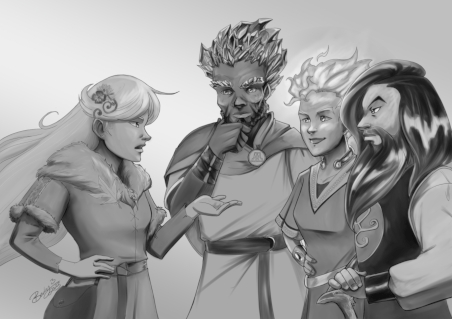
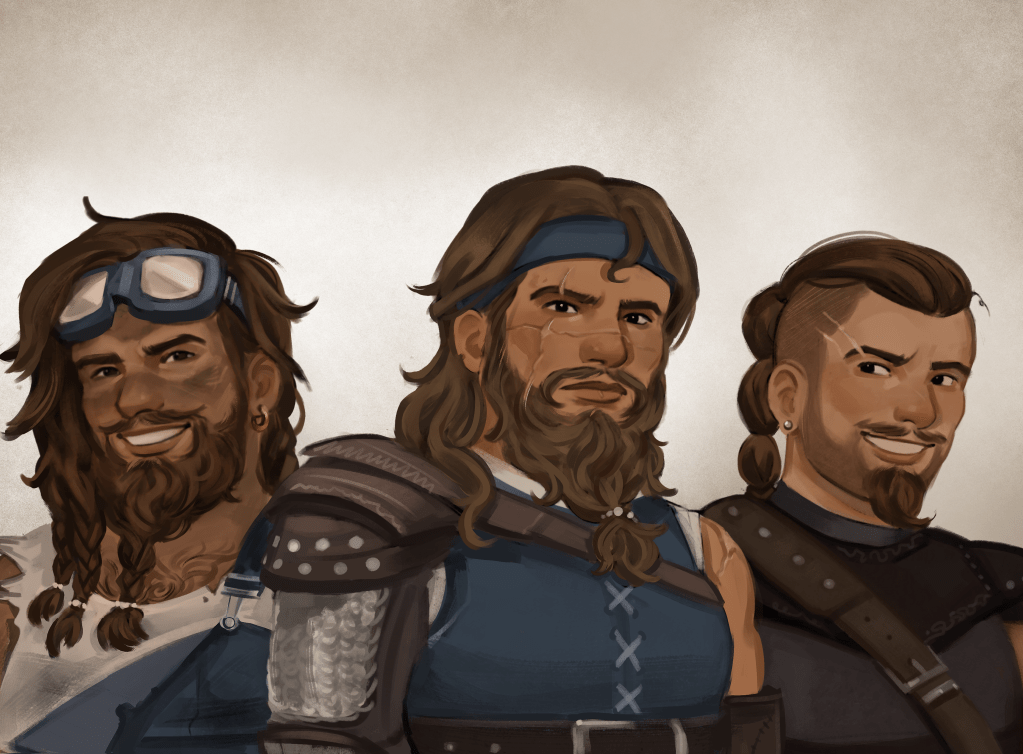
    Dwarves in fantasy roleplaying, especially in the modern sense, have become stereotypes. Loosely based on Gimli from Lord of the Rings, it’s a common shorthand, found in several fantasy settings beyond Middle Earth. Dwarves are short, bearded, stocky, gruff, capable of holding grudges across generations, masterful artisans and miners. Some sources describe Dwarven women as having beards, (like Xindi and Xandi on the masthead), others describe Dwarven women as lacking facial hair (like Disa from Rings of Power) and often Scottish coded. Part of this image is Dwarves living in extensive Clans.

    So widespread is this stereotype is that it’s common parlance. When the GM mentions a character is a Dwarf, the players will most often draw up powerful mental images of that character based on the previous description. While this “short”-hand is useful (see what I did there?), it can lead to confusion at the table as players make assumption about their Dwarven companions.

    Dwarves in the Dezzyverse

    In my campaigns I “reskin” dwarves just to shake up player assumptions. This is mostly just retitleing the names of dwarven things. I prefer to use the terms a people would use for themselves, as opposed to the terms that others would use for them. In the case of my campaigns, they call themselves Svakk as a people. (Indeed, calling them “Dwarf” might start a brawl) Though the Svakk refer to themselves most commonly by the name of their Klaarg (which is their word for “clan”). “Xandi of Klaarg Tordenzme” for example. The languages of the Svakk are collectively called Klaargspek, though like their cultural identities, most Svakk refer to their languages by the name of their Klaarg. “Tordenzme Klaargspek” or “Sohnrodt Klaargspek”.

    Even divided among dozens of distinct Klaarg, the Svakk people are tightly bound together, Klaargspek is understood even through different dialects spoken in different Klaarg. Klaargspek also shares a single runic alphabet, the Vaalbek.

    The Doom of Klaarg Tordenzme

    Once, Klaarg Tordenzme stood among the strongest and most wealthy Klaarg among the Svakk. Indeed, the grasp of Klaarg Tordenzme had stretched beyond the halls and citadels of the mountain realms, Tordenzme was a force within the kingdoms and empires throughout the lands, from sea to ocean. The heart of this mighty realm was their city of Dohrgraign. Deepest of the delves beneath the mountains, in this age, Dohrgraign was was the only city to make peaceful contact with the dark realms of the Underworld.

    Exotic and expensive trade passed through Dohrgraign, under the leadership of Theigns from Klaarg Tordenzme. Roads from the farthest realms stretched to the Grand Gate that led deep into the Underworld, a league-and-a-half below the surface world to the City of Dohrgraign. For centuries Klaarg Tordenzme stood among the greatest of these ancient empires.

    Then came the Doom of the Tordemzme, a prophecy delviered to Klarg Tordenzme that was defied, causing catastrophe. Over nine years of what the chronicles named “The Fall of Dohrgraign”, the city suffered endless misfortunes that resulted, finally in the gates being sealed from the outside world. Few detailed records survived the Fall and in the eight centuries after the Sealing, the city itself was lost to memory, fading into myth, a distant curse and reason to shun the descendants of Klaarg Tordenzme.

    Eight hundred years ago, during the reign of Theign Haaldbarg, a mysterious prophet known as the Black Vizier was recieved at court. The hooded and robed figure did not bow, nor show deference to Theign Halldbarg, speaking directly and openly their warning.

    “Trespass no further into the dark below the stone on which your thy city stands. Else the greed of Klaarg Tordenzme will become Dohrgraign’s downfall.”

    Insulted, Theign Haaldbarg ordered the Black Vizier thrown in chains. Yet, when the guards attempted to seize them, the Black Vizier vanished with a clap of thunder that felled all within two or three strides of the figure.

    Afterwards, the Black Vizier appeared again and again, and always delivering disaster where it stood. It is difficult to tell exactly when Theign Haaldbarg sealed the city, but there was one last evacuation towards the surface. History records that a foul miasma had arisen from the Wyrmansklovt and spread throughout the city, bringing horror and death. What few citizens of Dohrgraign still remained were commanded to flee to the surface.

    It was following this last escape from the Underworld that the tunnels connecting Dohrgraign to the surface collapsed. In the centuries which followed, the city that grew around the Grand Gate withered and fell into ruin and Dohrgraign was ultimately lost.

    The Doom of Klaarg Tordenzme was used by the klaargs for centuries as a warning against hubris. The few Tordenzme communities that survived the Doom have been marginalized by other klaargs as “cursed” based on this myth.

    The Year of Rage

    In the “current” year of my D&D campaign, it has been roughly ten years since the events detailed in the published adventure Out of the Abyss. With the incursion of demons, a small struggle between the Demon Prince of Undeath and the Patron Deity of Dohrgraign, the Keeper of Secrets Under the Mountain has caused lost passages to open once more as demons and the holy dead battled one another.

    The Year of Rage also corrupted the ambient magic of the Underworld. Mortals adventuring in the ruins of Dohrgraign risk Torment and corruption. The cursed city drew the Demon Prince to it. Dohrgraign had been a tomb for eight hundred years by the time the Year of Rage brought demons into the Underworld. The Keeper of Secrets Under the Mountain was not only the God of hidden treasures and secret knowledge but he is the Keeper of the Dead. Dohrgraign is one of his holy places under the mountain, and after eight centuries, it has become a secret as well.

    The Crossroads of the Underworld

    Dohrgraign was not a naturally occurring space. It was carved from the stone of the underworld by Klaarg Tordenzme over centuries. Following the seams and veins of ore, the Tordenzme miners uncovered the passages and caverns used by the civilizations below the surface. The closest of these caverns became the Gatehouse of Dohrgraign, another nearby cavern (a much larger cavern) would develop into the settlement known as Genzhymyl.

    In the present day, Genzhymyl has grown into a thriving trading center. It is independent from the competing realms in this region of the Underworld, The Empire of Llolth, the Azhgov Clan, and the various Goblinoid, Kuo-Toa, and Orcish communities that have settled in this area over the past several centuries. With the newly unblocked passages, Dohrgraign is once again able to be discovered.

  • Monsters with Clockwork Hearts

    Monsters with Clockwork Hearts

    The Mazynik of Arjenvís

    The most recent “species” to emerge in Arjenvís are the Mazynik. The Mazynik are a clockwork, machine people made possible through many of the engineering discoveries made by the scholars of the Ynstyuit Yazingyeijny college. They have been a part of the population of Arjenvís for generations at this point. Sadly, the Mazynik in all of their forms have been used as slave labor almost since their inception.

    There are seven primary variants of Mazynik

    • Type I – Tiny Mazynik designed for companionship. The type I are roughly the size of house cats or large rats and their differential brains have the cognitive abilities of a human child.
      • These Mazynik are often programmed for a variety of simple tasks for which their size and general design are suited. Fetching and retrieving small items, delivering small parcels and physical messages (like written notes), cleaning chores, vermin control, and simplistic minor patrolling. Their limbs end in small claws for grasping and gaining traction, and most Type I designs have a small dart launcher built into the body
      • Type I Mazynik can be found nearly anywhere in Arjenvís, including the rivers (for those models adapted for swimming). They are more common in the affluent Canton, like the Stare Miasto, and the Jyarmarck. But even in the slums of the Brzek Krreft, older Type I Mazynik, refurbished from spare parts can be found wandering the narrow alleys on errands or still carrying out instructions from owners who have long forgotten or simply lost them.
    • Type II – Small Mazynik designed as assistants and servants. The type II are the size of a medium to large dog and have the cognitive abilities of an average adult human.
      • These Mazynik are more capable than the smaller Type I models, and are designed to perform functions that demand greater strength and durability. The Type II models are often used to deliver small burdens, perform larger household chores (think “Roomba”), act as guards and sentries, and assist people with complex tasks by providing extra manipulative limbs.
      • Like the Type I, the Type II Mazynik can be found virtually anywhere in Arjenvís. From the estates of the Stare Miasto down to the ghettos of the Brzek Kreft. They are most common in the Jyarmarck, where they are set to delivering packages of purchased goods to destinations, and in the Zmiana, where they work towing barzos along the various canals or working the southern fields.
    • Type III – Human-sized Mazynik designed to be laborers. The type III are the size of an adult human, and have the cognitive abilities similar to the Type I.
      • The Type III Mazynik is a design intended for human-sized menial tasks. Whether household (minor repairs, cleaning, personal assistants) or industrial (labor, or dangerous/ strenuous activity). They are designed and programmed for obedience and servitude, behaving as loyal companions.
      • The Type III Mazynik can be found nearly anywhere in Arjenvís, but are most commonly found in the most wealthy cantons, the most wealthy households and industries, which can afford the expense of purchasing and maintaining the clockwork mechanisms that allow them to function
    • Type IV – Human-sized Mazynik designed for combat as guards or gladiators. The Type IV are also the size of an adult human and have the cognitive abilities similar to the Type II.
      • Type IV Mazynik are designed for heavier labor than the type III or for combat. They often resemble clockwork suits of armor, imposing and dangerous. They are in general human sized, but are larger than most average people.
      • The Type IV are less common than type I, II, or III Mazynik. Partially due to expense, and partially because of the much more narrow scope of their designed functionality. They are most commonly found near properties of the wealthiest citizens of Arjenvís, where they are used as sentries and guards or in the deepest depths of the Czarny Grzbiet Mine, where their immunity to the toxic gasses and their phenomenal physical prowess permit mining veins that would otherwise be impossible.
    • Type V – Large Mazynik the size of an ox or draft-horse. The Type V are designed to pull and carry large, heavy loads, or serve as mounts. They have cognitive abilities similar to the Type I.
      • The Type V Mazynik is very nearly a small vehicle. It’s designed as a six-limbed being, much like a centaur, a quadraped lower body and a humanoid torso. This frame allows for functions that permit the Type V to not only carry a passenger or two, or pull a burden but also manipulate objects with hands. There are Type V variants that are designed as bipedal forms that are nearly twice as large as a typical person, and other design variants that resemble large beasts.
      • Type Vs are much more rare and expensive than the more common Type I, II, or III but they can still be found in all Cantons in Arjenvís. The most common use are along the canals of the Zmiana, and the steep face of the Czarny Grzbiet and Nozca Stok cantons, pulling trolleys and barges.
    • Type VI – Large Mazynik roughly twice the size of an average adult human. The Type VI are designed to command and manage other Mazynik, their differential brains are the most advanced commonly available and they have cognitive abilities that, while still superior to humans as a whole, are within the human spectrum.
      • The Type VI Automat is a very sophisticated clockwork device. It’s nearly the size of a Type V, but has a much more advanced machine intelligence built into it’s design. The Type VI is designed for complex, independent tasks and can adapt to circumstances to an extent that they are still addressed by it’s programming.
      • Type VI are status symbols among the aristocracy of the canton and are seldomly encountered without cause in Arjenvís. They are often employed as automated stewards, chamberlains, or major-domo for households and estates. Many are in service of the Vlatza as supervisors of Type IV and V Automat which function as guards.
    • Type VII – Gargantuan Mazynik the size of buildings, designed to be “smart” buildings the type VII are expensive and rare in the extreme. Type VII can be used for a variety of purposes, from intelligent libraries to self-functioning factories and leisure residences. Type VII support between 1 and six differential brains that function in concert, depending on the Mazynik’s designed purpose. Each brain, taken by itself, have cognitive abilities which vary from that of a child to that of a mature human. When multiple brains are working in concert, the combined brains of a Type VII can perform cognitive feats of genius.
      • The Type VII Mazynik is a building sized clockwork artifact. It’s so big, in fact, that it functions like an actual building, with individuals living and existing within it’s rooms and halls. As such, the Type VII is seldom mobile, but unlike other Mazynik, the Type VII can direct it’s Actions and Abilities within itself as well as without.
      • The Type VII is rare in the extreme. There are but a handful in all of Arjenvís.

    History

    Mazynik were first developed in the manufactory of Kahlazst Vahn Ztiyer. A member of the Vahn Ztiyer household of III Canton, Kahlazst was an Artificer and a minister of the Ynstyuit Ynzingyeijny school in the Kolygiom Zyle Wednye.
    The first Mazynik designed would become the type I and type V, both of these first prototype models were meant to do work as a replacement for beasts and animals. Kahlazst designed what would become the type II as a mechanical assistant.
    These early Mazynik had primitive differential brains by current standards, but were capable of independent action with minimal supervision. As the usefulness of Kahlazst’s Mazynik became more apparent, the two core mechanisms, the differential brain and the corespring were refined and developed into ever more sophisticated iterations. Eventually the Automat was capable of matching most people in terms of intellect, but not creative thought. This made Mazynik very useful for menial labor, guard-work, and heavy labor. They could be programmed with base skills, and their difference brains would adapt them to the environment in which they were operating.

    Anatomy

    Individual Mazynik are designed to perform their directive purposes. They are generally built to resemble people and/or animals that are familiar to most people. The heart of most Mazynik (type I – VI) is the Corespring, which will allow for a day’s operation when fully wound. Type VII instead utilizes a steam engine to maintain a continual operation (so long as the engine remains fueled, that is).

    Genetics and Reproduction

    Mazynik do not reproduce biologically, they are built. They do have the ability, however to manufacture one another. Either with or without the involvement of people. Depending on the resources and facilities available, manufacturing an individual Mazynik will take periods dependent upon their complexity. This includes programming of their differential brains.

    • Type I6 to 12 weeks
    • Type II6 to 20 weeks
    • Type III12 to 28 weeks
    • Type IV 24 to 48 weeks
    • Type V18 to 36 weeks
    • Type VI30 to 50 weeks
    • Type VIIone to five years

    Mazynik designed by the same person, persons or factory will share a general resemblance to one another.

    Growth Rate & Stages

    Mazynik do not naturally grow. Their bodies can remain the same throughout their lives (for lack of a better term). However, their differential brains will experience a progression of development that reflects their accumulation of experience up to where their capacity of data storage is reached.
    Juvenile – This is the first stage of cognitive development. The Mazynik has it’s base cognitive routines and can communicate and perform the tasks for which it was designed, but not much outside of that scope.
    Prime – This is a long stage of development where the Mazynik cognitive abilities have expanded to a point where it can formulate and adapt it’s functionality based on learned experiences. Prime stage is recognized when a Mazynik can first adapt independently beyond it’s initial programming and lasts until it’s cognitive storage reaches capacity.
    Fading – This is the last stage of development where the Mazynik’s cognitive abilities have reached a point that to incorporate new experiences and new data, older experiences and older data must be eliminated. This tends to cause the development of eccentricities within the Mazynik’s persona as they begin to “forget” memories they once recalled flawlessly or skills they once had or experiences they once lived. Additionally, fading can also be brought on by damage or wear within the differential brain itself, leading to a diminished capacity.

    Ecology and Habitats

    Mazynik are curious in that they can exist in almost any environment even thrive if they are purpose-designed for those conditions. However, resources available in an urban, technologically sophisticated environment provide the most favorable conditions that Mazynik can function within.

    Dietary Needs and Habits

    Mazynik do not require sustenance in the way that biological species do. So long as their coresprings or engines remain wound or fueled, Mazynik will continue to function. However, Mazynik do require steady maintenance in the form of lubrication of moving parts, cleansing of components, care for and replacement of worn materials, etc.. Going without these essential will lead to malfunctions which can ultimately become critical enough to permanently disable the Mazynik.

    Domestication

    The Mazynik are completely domesticated as a species.  Though some advanced individuals (mostly Type VI and Type VII) can carry out self-directed “manumissions”, Mazynik are designed to follow the direct inclinations and command of those whom they serve.

    Uses, Products & Exploitation

    Mazynik are used in Arjenvís in all manner of menial, labor intensive, and dangerous tasks. They act as servants, laborers, companions, soldiers, even vehicles and homes.  To the powerful and wealthy of the city, they are merely clever tools, or toys to be used until their utility or novelty comes to an end, whereupon they are discarded.

    Naming Traditions

    Industrial, labor, and guard Mazynik are normally designated by a serial code, and recognize themselves when that code is referred to. More personalized Mazynik, those who serve as companions, assistants and servants are often given nicknames by their owners. Finally, there are some Mazynik (mostly type VI, but any sufficiently experienced Mazynik) who will name themselves

    Mazynik and Warforged

    Mazynik are not Warforged. Warforged are sentient beings with agency and free will. Mazynik are automata, and even if they have been given their manumission, they are only an imitation of sentience. Warforged are animated by magic and do not rely on wound clockwork.

    Mazynik are limited in their function. Though they are capable of great proficiency for the jobs they are designed for, they are abysmally incompetent when attempting tasks not related to their purpose. Warforged are as adaptable as any mortal person born and raised.

  • Rats in the Slums

    Rats in the Slums

    The Wererats of Arjenvís

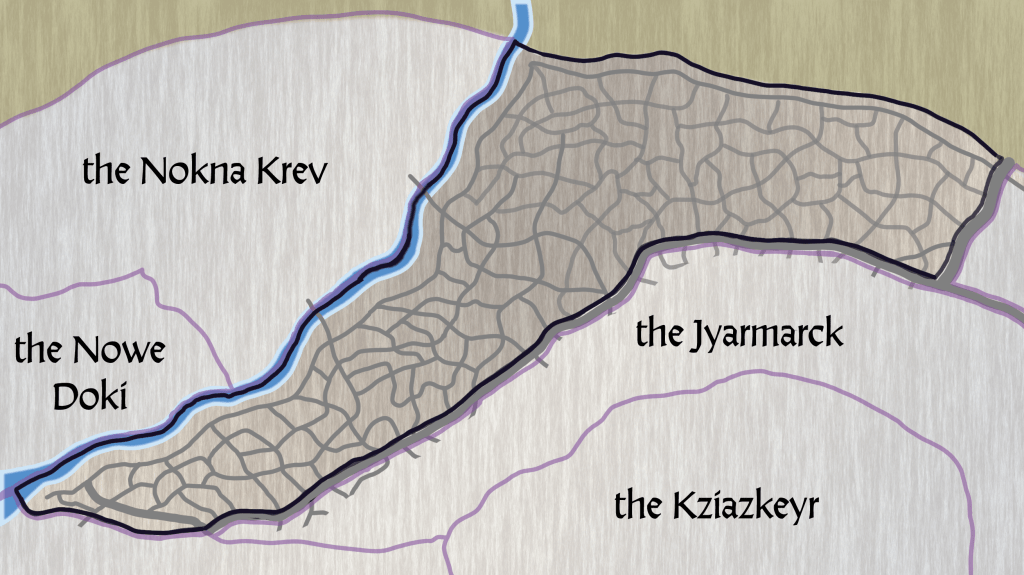
    VIII Canton, the Brzek Kreft (“verge of blood”), is home to the least and lowest of the inhabitants of Arjenvís. It stretches along the Southeastern bank of the Nozca Kreft river below the Jyarmarck (VII Canton), East of the Nozca Stok (III Canton), and wraps along the Linia Rynkowa road (the “Market Line” the border between the Jyarmarck and the Brezk Kreft) all the way East to the bottom of the Prohodt (“processional”), the road that leads from the great gates of Arjenvis to the seat of Arjenvís power, the Kziazekyr.


    The Brzek Kreft, is a warren of tight alleys, ramshackle buildings and workhouses. For the first 60 years of Arjenvís, the Brzek Kreft was a semi-permanent shantytown that grew outside the walls of the founding Cantons. Homeless and undesirable people denied a place to live within the walls of the city congregated here.


    The laborers in the Black Ridge Mines crowd the workhouses of the Trzy Makti (the “Three Mothers”) and are daily marched through the Wohz Wohlu Gate into the Norzca Stok canton. On the far side of VIII Canton, The Dommzey Tzlote workhouse provides laborers to the industrial fisheries on the Norzca Kreft river.

    The maze of alleys and narrow streets that form the VIII Canton

    The Lords of the Lowest

    Unlike the other canton which climb the slopes of the Judoas Kraigas, the river bottom of Brzek Kreft is ruled by a complex network of cartels that control competing territories throughout the slum.

    The leadership of the cartels are the nearest monsters to humanity in all of Arjenvís. Wererats. The wererat curse affects most mortal people. Humans, Halflings, Dwarves, even Orcs and Goblinkind can be brought into a nest of wererats.

    The head of the largest cartel in the Brzek Kreft, the Svenzy sits on the council of Boyars for all of Arjenvís. Called “The Myzj”, this lord of wererats may not be the strongest, or the most powerful wizard or priest of the city, but they have the tightest control over VIII Canton. Every rat from the banks of the Nozca Kreft river to the walls surrounding the First Canton, the Kziazkeyr are their spies. Even the mighty Striogi Boyars and the Vlatza himself cannot fully control the legions of rats as effectively as the Myzj.

    Wererats, even the wererats of the Brzek Kreft live in symbiotic community with both the people and the rats of the cities they inhabit. They remain monstrous, their curse pushing them to acts of violence and depravity, the spreading of urban entropy throughout their domains. At the same time, they need mortals to live amongst. Unlike more predatory monsters like Vampires, Ghouls and Werewolves, wererats cohabitate rather than dominate.

    Ironically, the mortals of the Brzek Kreft are, as a rule, happier than the residents of the more prosperous canton in Arjenvís. The wererats of the cartels, while preventing Brzek Kreft from developing beyond the poor slum that it has been since it grew out of the shantytown along the shore of the Nozca Kreft don’t visit horrors among their mortals. The least of the citizens of Arjenvís are thereby shielded from the nightly predations of the nobility.

    A Slum of Ghettos

    The Brzek Kreft is divided into several Ghettos.  Some, like the Ratzveny ghetto is centered around an institution, in this case the Szvenzy Cartel and the Myzj. Other ghettos are ethnic enclaves, like Hravzton, where Goblins, Halflings and Gnomes have built a community scaled to accommodate their stature, or the Klaarg, where the Szef of the Kuznia presides over his clan of Dwarves.  Still others are defined by their architecture or location like the Zdunthia Issekah or the Obuz.  In all cases a ghetto is governed by its own cartel. Those cartels, much like the ghettos themselves are constantly changing as their fortunes rise and fall.

    The Brzek Kreft has little in the way of formal infrastructure.  Its streets are not uniformly wide, nor uniformly paved (if they’re paved at all).  The sewers are a chaotic tangle of warren-like tunnels which are barely adequate for the purpose of draining rainfall from the streets, and wholly inadequate for keeping the place free of filth.  Brzek Kreft began as a shantytown, and in the decades since has only grown.

    The two primary industries in the Brzek Kreft are the workhouses which provide cheap labor to the factories and mines throughout Arjenvís, and the fisheries along the Nozca Kreft river which process the cheapest catches and unsold fish from the markets at the end of the day.

    It deserves mentioning that prostitution, or similar sex-work is not considered illicit, nor confined to the Brzek Kreft. While the cartels certainly use the profession as a means to generate revenue and provide services to the population, a prostitute, courtesan, or exotic dancer is no more or less specialized than a dockworker or a tradesman. Even in a City of Miseries, sex work remains work.

    Factions Within the Brzek Kreft

    The largest and most powerful organization within the Brzek Kreft is the Szvenzy Cartel. The Szvenzy receive tribute and fealty from all the other cartels eventually, whether directly as a “tax”, or indirectly when smaller cartels pay their tribute to the cartels over them.

    There are several major cartels that rival the Szvenzy, but are as yet unable to challenge them.

    1. The Lukzen Klaarg is an extended clan of people from an underground ancestry, Dwarves, Goblins,some Orcs and some Humans. The Lukzen both run the sewers beneath the Brzek Kreft and the miners who work the Czarny Grzbiet mine. All cartels of course operate in all facets of life within the Brzek Kreft, but the Lukzen are very successful as smugglers, avoiding the city’s more oppressive taxes and supplying various forms of contraband.
    2. The Ezka Cartel operate along the banks of the Nozca Kreft river along both banks, they jealously guard this lucrative terriroty. Only the Szvenzy are permitted to operate in the Ezka territory freely, and only then because the Ezka are unable to stop them.
    3. The Sheroty Cartel work near and within the Jyarmarck markets. They run protection, and petty theft there as well as extortion, blackmail, and secrets. The Sheroty adopt young, often orphaned or otherwise neglected children to become a part of their cartel, and as these children grow into adults, they are free to join other cartels in the Brzek Kreft or remain as recruiters or lieutenants of the Sheroty.
    4. The Toleria Cartel run most of the gambling houses and games in the Brzek Kreft. They loan money, regulate the houses and arrange events for their customers to wager on. While not as refined as the high stakes games that the more affluent cantons offer, these events do draw aristocratic patronage in the form of “slumming”.
    5. The Pralnia Cartel fence stolen goods throughout the Brzek Kreft. They also sanction and regulate many of the larger robberies of Noble households, and launder the more recognizable loot. The Pralnia Cartel also adjudicates and administers contract theft for clients
    6. The Zrebne Cartel is the only cartel in Brzek Kreft that engages in only one activity. The Zrebne are assassins and contract killers. They do not engage in other rackets that other cartels do. They are also not the exclusive cartel that engages in contract murder. They are the premier organization that can be employed for contract killings, and the Zrebne Cartel collect contracts throughout Arjenvís.
    7. The Vyara Zabor Church aggressively maintains a presence in the Brzek Kreft. The Priesthood is most prominent here. Since there is very little political influence Brzek Kreft has within Arjenvís itself, the Biurokratyzm are much less interested in the slum. Indeed, administrative assignment to the Ozmye Skron temple is considered a “punishment posting” among the ambitious clerics. The Inquisition is very active in Brzek Kreft as the crowded, lawless slum and it’s ghettos teeming with the desperate poor is ever rife with heresy. Most of the Inquisitorial order within the church begin their careers here, since opportunity to exercise their authority is abundant and oversight is lax.

    It’s October, and spooky season, so for this month I’ll be exploring my Fantasy Horror setting of Arjenvís, originally introduced in this blog here. Happy Halloween if you celebrate, or Samhain, or Dia de los Muertos. Stay safe, have fun, and brave your fears.

  • Alignment and Personality

    Alignment and Personality

    More Dezzy’s House Rules for D&D

    Alignment is an artifact of the earliest days of D&D. According to legend, Gary Gygax adopted the mechanic after the players in those early campaigns kept lying, cheating, and murdering one another (and the nearby town) to get treasure and magic items. Alignment was also inspired by Moorcock’s Eternal Champion stories where cosmic forces of Law and Chaos struggled to shape the multiverse. Characters, like the Eternal Champions were agents of those forces. Alignment also served as shorthand, identifying friends and foes, “good-guys” and “bad-guys”. It worked fine for those early development from wargaming, but as players explored the game, it became a crutch, or worse, a straitjacket.

    Alignment As Short-hand

    How I run alignment currently is as a short-hand to help with character consistency. In a time when weeks or months can pass between game sessions, how we remember our characters drifts. A trait that was central to the character can become neglected, especially of the current multi-session adventure provides little opportunity to express that trait. Sometimes the motivation behind a characters actions looses it’s focus. Having a simple, evocative term to help ground the character has value.

    As first edition AD&D defines Alignment, there are two axes that creates the term. One axis is a Law – Neutrality – Chaos (which is also the original Alignment spectrum), the other axis is Good- Neutrality – Evil. The combination of them tells us something about the character. Lawful characters are inclined to order and structure, Evil characters are self-serving and callous, Neutral characters have no strong associations with the poles of that axis.

    There is a well known problem with the Good-Evil axis in this system. “Good” and “Evil” in the real world are generally considered subjective based on the consensus of the culture that one is acting within. (an admittedly crude definition, I’m no Philosophy major). In the context of Dungeons and Dragons, Good and Evil are objective and aligned with cosmic forces that reflect in the outer planes. In practical terms, what constitutes Good or Evil is in the hands of the Game Master and the Players in the campaign.

    In these early editions, Alignment is restrictive towards what classes players may choose for their characters. Paladins, most famously, must be Lawful Good. Thieves cannot have Good as a component of their alignment, Druids must be “true” Neutral (meaning neutral on both axes). This often led to endless debates over what all that meant. Can a Thief really be Lawful Neutral? Their class abilities, especially Picking Pockets, Sneaking Around and that Back Stab attack are hardly reflective of a Lawful mindset. Are characters following a Chaotic Good Deity simply prevented from being Paladins? What about rebels fighting a tyrannical kingdom? Can they be Lawful and still fight the established order? Can they be Good and still support slavery because it’s legal? It was a murky pool to wade into.

    5th ed Personal Characteristics

    5th edition added more tools for character definition, Personal Characteristics. Four categories; Personality Traits, Ideals, Bonds and Flaws were one sentence or one phrase descriptors of a character’s persona. They were more detailed than just a simple two axis alignment and since the persona categories used sentences and phrases, players could define their characters much more precisely. They’re no longer simply “Chaotic Neutral”, 5th ed characters are Chaotic Neutral and Have Never Lost Their Child-like Sense of Wonder, Never Sticks to A Single Set of Rules, Does What They Can to Protect the Natural World, and Is Always Changing Their Mind.

    The “Ideals” category often has alignment recommendations. Helping the player to choose an Ideal that compliments their Alignment choice.

    Finally, ever since 3rd edition, alignment restrictions on classes have been removed, which has removed Alignment from being a requirement to make a character. In modern D&D Alignment has become nothing more than a soft statistic that shapes but not defines a character.

    Personal Characteristics as Alignment Replacement

    This is the mechanic I’ll be using in my D&D games going forward. The classic alignment axis system still exists, but only as an organizing framework for the outer planes and as shorthand for minions, NPCs and Monsters, not player characters.

    For player characters there are three Personal Characteristics that serve the purpose that Alignment did.

    Bonds: the connection the character has with others, family, companions, their home village, etc..

    Ideals: the character’s motivations, why they continue pursuing adventure even after they experience setbacks and obstacles.

    Flaws: those aspects of a character’s personality that hinder their own efforts.

    At character creation, each personal characteristic is assigned a short statement that describes them. Each characteristic will reflect an alignment component; Good, Evil, Lawful, Chaotic, or Neutral. Bonds and Ideals cannot be in opposing alignments, one cannot be good, while the other is evil, or one cannot be lawful wile the other is chaotic. Neutral alignment is not considered in opposition with any other alignment. These two personal characteristics can have the statements that invoke the same alignment.

    Flaws must invoke an alignment in opposition to at least one of the two other personal characteristics. In the case of Neutral Bonds or Ideals, the Flaw has to be non-neutral.

    If the players play their personal characteristics appropriately and in a way that disadvantages the character by the choice, the Game Master may award them Heroic Inspiration, if the character already has Heroic Inspiration they may give it to another character who does not, and if everyone in the party has Heroic Inspiration, the player can increase their character’s Doom Die by 1 die type (maximum of d8)

    Seasons change, and so did I

    (with apologies to the Guess Who for the line)

    Players may choose to change their character’s personal characteristics when the character gains a new Experience Level. They may add an additional Bond, Ideal, and Flaw when they advance to Tier 2, and again at Tiers 3 and 4. These changes and additions are optional to the player and can only be chosen upon gaining a new experience level.

    Conclusion

    This house rule for Alignment isn’t a straitjacket, and should not be enforced as such. These traits are intended to be tools for character development. Relating them to alignments helps to define a character’s morality and ethics. While the subjective terms “Good” and “Evil” are employed as components of this mechanic, I argue here that those terms, and we’ll thrown in Law, Chaos and Neutrality in there too, are intended for each group of gamers to determine for themselves and agree to amongst one another. These terms of moral and ethical philosophy can and will change for each of us over the course of our lives. Gods only know what I thought was “Good” and “Evil” when I first started playing Dungeons and Dragons four and a half decades ago are not the same as they are at the time I’m writing this, and will likely evolve some more before I’m finished playing D&D.

    (If I get my wish, that will be another four and a half decades from now, I’m not eager to reach the end of this journey any time soon)

    Point being, Dungeons and Dragons (and all tabletop roleplaying games) belong to everybody playing them and we’re allowed to define alignment and personality traits to suit our table just as much as we can decide whether or not Orcs have pig snouts or not. There is no wrong answer, there never was.

    (Featured Art by Becky Peltier http://www.artofbeckypeltier.com)

  • Slavery in Swords & Sorcery

    Slavery in Swords & Sorcery

    Veiling our crimes behind a smiling historical mask

    I’m designing an Underdark adventure. It’s deep below the surface of the world, closer to the wicked empires of Dark Elves, Grey Dwarves, Mind Flayers and Kuo-Toa. In the setting for this adventure, there is a settlement. A small semi-permanent collection of structures and tents that’s grown up at a crossroads next to an underground lake.

    And it has a slave market.

    The institution in the Underdark

    Within the adventure location there are bands of escaped slaves and posses of slave hunters playing cat-and-mouse in the lightless tunnels. There’s a party of death-worshiping drow more than willing to sacrifice anyone they capture to the Demon Prince of Undeath. Bad people making bad choices and doing bad things. It’s one of the dangers of the adventure that the characters need to overcome.

    Slavery and the trafficking of people remain an evil. Simulating this evil in game doesn’t make it better. Worse, making the institution of slavery a part of a role-playing game can trivialize the impact of it.

    It’s true that whole ethnicities of people were owned throughout history. The struggle for them to win their freedom is both centuries long and ongoing even today. Just because there’s no antebellum aristocrat in a smart white suit sipping bourbon on the front porch of his plantation, doesn’t mean that slavery remains very real, and remains an ethnically motivated practice.

    As a middle-aged, masc presenting white person, it is cruel to pretend that slavery, even in game, is normalized. Especially if I have players at my table whose families may well have been enslaved in the not-to distant past. It is likewise cruel to place a player in the position of being a slave owner, appeaser of slavery as an institution or have their character be a slave without the player’s active consent.

    Gaming and Consent

    Since I mentioned consent, I should expound. Tabletop Role Playing is a communal experience. At least two people interacting to tell an improvised story about the Game Master’s adventure and the Player’s Original Character. Because of that, the players and Game Master need mutual, and active consent when playing.

    This extends to most interactions in game. But where it runs into the question of humanity, that interaction is critical. If any party at the table doesn’t want to be confronted with dark or transgressive subject matter, those wishes need to be respected. This includes enslavement and institutional slavery.

    Real World Institutions vs In-World Lore

    For as long as I’ve been gaming, there has always been this loud, obnoxious, background noise advocating for more “Historical Realism” in Tabletop role-playing. Everything from disparaging Hit Points, to weapon space, and for the modern and future settings, the minutae of guns. I’ve seen hundreds of systems and house-rules. Most of them bogging down the game as the table comes to a screeching halt as we figure out what body-part just got hit by which attack.

    The other historical rabbit-hole is environmental realism. Great Lords ruled over peasants, the aristocracy were allowed to do whatever they wanted because they were the rulers. Gods, after Braveheart roared through the community like so many screaming extras, the term Prima Noctis started cropping up everywhere. Of course, enslavement of every historical stripe has long been a yardstick by which “immersion” was measured. Lawful and Good alignments were construed to support the institution. It was deemed, “ok” and “natural” and because it was imaginary roleplay, wasn’t really real. Like I mentioned up in the consent section, if that’s what the table agrees to, then enjoy your game. I’m not trying to police your table.

    But, when you hear my game in the FLGS, or play at my table at convention, don’t expect to go to the market and buy yourself a slave. I don’t have fun being a GM who plays the slaver, or the enslaved. I don’t care for “historical realism”. At best it’s whitewashed History, at worst it’s a power fantasy about owning people.

    What about those Slavers hanging out in the Underdark?

    I started this essay with the adventure and setting I’m designing. By having slavery as an institution in the background, I’m hoping to allow the tables who utilize my adventure some freedom to adjust it’s impact to suit their taste. There’s a group of escaped slaves and there’s a band of hunters chasing them, it’s up to the players and their characters to react to that set of encounters. It’s up to the Game Master to determine it’s importance. Slavers have made great antagonists in fiction for a very long time. One of the first series of adventures published for AD&D was the A-Series of modules, collectively known as “Against the Slave Lords”. One of the classic cues that there is something “bad” about a given realm is the presence or absence of legal slavery. I’m not saying “don’t use slavery at all in D&D”, I’m asking to put some thought into whether or not it contributes to the story that’s being made at your table.

    And, for the Seven Heavens, don’t justify it behind the excuse of “slavery was common in 3rd Century Rome (or 16th century France, or choose your historical era here)”. Tabletop roleplaying isn’t about historical accuracy, it’s about having fun with your friends, and making new ones.

  • The Síoraí

    The Síoraí

    Tribes of the North Part 3

    The Síoraí (pronounced “see-or-EYE”) were born from mortal people whose spirit had been displaced by a spirit from the Fæ realms. Though their bodies remain mortal, albeit with extended lifespans, their Færie spirits reincarnate into newborn bodies after their former body expires. Since time in the Fæ realms passes differently than it does in Fahr Ryasc, a given Síoraí’s Færie spirit may reincarnate quickly, or ages will pass before the spirit sees the world through mortal eyes again.

    Over the centuries as the Síoraí developed as a people, the influnce of the Færie spirits has become more pronounced. The Síoraí have grown more distinctive among themselves, assuming a physical form more pleasing to the Færie who live within their mortal vessels. While, in some regards, this continued metamorphosis of the moral bodies are considered beautiful by other mortal peoples, they have grown inceasingly inhuman by contrast.

    The Færie spirits inhabiting the Síoraí have long memories, sometimes being able to recall events from past incarnations. However, their time as spirits within the Færie realms is hidden from them, and they can only remember the fullness of their many lives when existing as spirits there.

    Basic Information

    Anatomy

    Síoraí are humanoid in appearance, though they are taller and thinner on average. Síoraí have two sexes and reproduce heterosexually. Their physical bodies go through puberty before reaching maturity and women experience menopause during middle-age.

    Síoraí also have two folk, which derive from the Fæ courts their spirits belong to. The Deasíoraí are connected to the Deadí Færie court of Long Days. The Bansíoraí are connected to the Banyte court of Long Nights. The Fæ are ruled by the Deadí from the Spring Equinox through the Autumnal Equinox and the Banyte from the Autumnal Equinox through the Spring Equinox.

    While the Deasíoraí and Bansíoraí are the same people, they each vary in complexion and hair color. Deasíoraí tend towards deeper brown and ruddy complexions coupled with fair red and yellow hair and light eyes of green and blue. Bansíoraí tend towards pale skin coupled with black hair and dark eyes.

    Genetics and Reproduction

    Síoraí reproduce sexually, most often births are singular, but dual and multiple births are not unheard of. Infants are not yet possessed of Færie spirit at birth, but by the time the child reaches it’s second anniversary, about the time they begin to learn how stand and take their first steps, their Færie spirit fills the mortal vessel and they develop into Deasíoraí and Bansíoraí as appropriate.

    Growth Rate & Stages

    Síoraí grow similarly to other mortal peoples, reaching maturity in 18 to 20 years. Once reaching adulthood, they age half as fast due to their Færie nature. Thus, Síoraí reach Middle Age by 60, and old age by 100. They survive for another 50 years, with a natural lifespan of 150 years.

    Behavior

    Síoraí often seem indifferent to others, and self-centered. They have an unusual perspective on events and relationships due to their multiple incarnations through out ages. Even though the mortal body they inhabit may be only decades or a century old, their spirit, being of the Færie, can recall memories from multiple lifetimes. The Síoraí have difficulty relating to the here and now, or to people who will inevitably become only distant memories of past lives.

    There is an exception in other Síoraí. Síoraí recognize and can empathize with other Síoraí in ways that are simply not possible with other mortal people. Síoraí are among the very few people in Fahr Ryasc who have the shared history of experiencing multiple lifetimes over the course of ages, and can form tight bonds with the inherent promise of those bonds renewing in future incarnations. Síoraí are able to share with one another first-hand experiences of events that no other living mortal could have been through.

    This also makes Síoraí rather archaic as a people. They derive a certain comfort from the familiar, being grounded in habits and environments of their previous lives. They tend to speak with outmoded diction, being accustomed to the language they have been conditioned to speak over dozens or hundreds of lifetimes.

    Additional Information

    Social Structure

    The Síoraí develop their societies as a mirror of their courtly civilizations within the Fæ Realms. They Organize based on their Færie nature as Deadí and Banyte Fæ and their positions within those courts, whether Noble or Small (or Common) Fæ. However, other mortals who live among the Síoraí are appointed into social positions, but are always treated as lesser, since their mortal contributions are perceived by the Síoraí as “temporary by nature”.

    Síoraí who live among the other mortal realms of Fahr Ryasc, often live so apart from the established social structures. Their multiple lives and sense of mortal impermanence extend even to the great empires of Fahr Ryasc. They can’t help but see the achievements of other mortal people, even nations, as fleeting. The Síoraí find “progress” distasteful, especially the rapid progress of mortal people, unless, of course, that progress compliments themselves or their aesthetic concerns.

    Physical characteristics

    There is a definite sense of the otherworldly about the Síoraí. They are at once beautiful and distrubing to behold, especially as they mature, their mortal bodies exaggerating the mortal form, growing tall, willowy and deft with long, delicate fingers and toes.

    A Síoraí’s face is long and oval, with sharply angled almond-shaped eyes, high cheekbones, a sharp blade of a nose, long tapered ears and a narrow mouth. There are further distinctions between the Deasíoraí and Bansíoraí. Síoraí men can grow facial hair, but it’s normally thin, fine and short, matching the hair covering their head and it usually comes in after middle-age. Síoraí women do not normally grow such facial hair. Both sexes grow sharp angled eyebrows, and tend towards high foreheads. Neither sex develops wrinkles or sagging until very late in life, 130 years or older.

    Síoraí hair remains a consistent color throughout their lives, seldom going grey or white with age.

    Geographic Origin and Distribution

    The Síoraí can be found nearly everywhere in Fahr Ryasc, but are most common in their realms located in the Tanglewild forest in the South, the Elderwild forest in the North, and beneath the Auborobua mountains.

    Average Intelligence

    The Síoraí possess typical mortal intelligence. However their Færie spirits provide them access to knowledge from their past lives and a perspective that is more supernatural than the average mortal experience. This gives the perception that Síoraí are more knowledgeable than most people (also are eternally irritating to sagacious professions that deal in secretive information as a Síoraí, after an evening of meditation can recall some bit of esoterica which takes others days or weeks of research in archives).

    Perception and Sensory Capabilities

    Síoraí, being born from mortals, have senses of smell, taste and touch that are similarly sensitive as their cousins throughout Fahr Ryasc. However, their Fæ ancestry makes their senses of sight and hearing almost supernaturally sharp.

    Civilization and Culture

    Major Language Groups and Dialects

    Lazáqo is the primary language spoken in the Síoraí’s homeland of Záqu, hidden deep in the Tanglewild forest. The Elderwilde forest is home to the northern realm of Taur Ymagar, speaks a dialect of Lazáqo named Vakláno. The Síoraí realm of Berízal deep below the Auborobua Mountains speaks a dialect of Lazáqo known as Berxáno, which is the most widespread common language of the underworld civilizations beneath Fahr Ryasc

  • Are You Afraid of the Dark?

    Are You Afraid of the Dark?

    Darkvision, Infravision, and Light in the Dungeon

    I’ve been playing D&D since the 80s. And I gotta confess. I never really liked how Darkvision (or Infravision, or Ultravision… etc) worked, either rules as written, or as played. Rules as written (5th ed, 2024), Darkvision allows your character to see in darkness as if it were dim light, and in dim light as if it were bright light out to the defined range. Such vision is monochromatic. Infravision from 1st ed is much the same, except that with infravision, the character sees sources of heat. Which allowed for all sorts of “creative” interpretations by Dungeon Masters and Players alike.

    The problem with the rules as written is, it’s just a flashlight from your vision that only your character can see. The rules imply that, except for being colorblind, the character’s vision is otherwise unimpaired. If a note, for example, is written on the wall with enough contrast, the character can read it without difficulty. Things lurking around in the dark are visible, and can be identified. They are rules designed to be simple to interpret, remember, and apply. Infravision is much the same, except instead of a flashlight, it’s IR Nightvision goggles.

    Rules as played, Darkvision and Infravision make being in the dark an inconvenience rather than a mystery. The difference between “dim light” and “bright light” are applied only mechanically, and even then, most penalties can be mitigated with class abilities or feats. There’s even the spell, Darkvision that confers the ability to a willing subject for 8 hours. Because the effects of being in the dark are so trivial, it’s often forgotten about. Exploring a dungeon is about as disorienting as a poorly-lit hallway. Descriptions include details that would likely be concealed, and when the dark is mentioned, it’s an uncommon enough detail that it becomes a hint that the adventure designers are concealing something.

    Let me tell you a story about a TPK

    Years ago, I ran a D&D campaign, and in the very first adventure, half the characters were humans, while the other half had Infravision. The characters went to the dungeon location a few miles from town and climbed down to brave danger and gather treasure. I asked how everyone was going to see down in the dark, and the players of the characters with Infravision announced they could see in the dark. Then everyone checked their character sheets. No one had brought torches, lanterns, lamps, no light sources. No one chose to go all the way back to town to get some light sources. everyone just strung rope between one another and the characters who could see in the dark led the unsighted deeper into the underground maze.

    The party ran into trouble after angering the troglodytes who lived in the caverns, and most of the party fell in combat. Except for two characters who fled when the battle was going poorly. Two human characters. And in the dark, with no light, they stumbled about until the troglodytes hunted them down. It was exciting, memorable, and some of those players tell the story about that TPK even after more than 25 years.

    The Dark is a tool for the Dungeon Master

    Part of tabletop roleplaying is the shared imagination at the table. Dungeon Masters can set the mood, pace the tension, bring the players into their characters’ experience. The dark forces the DM to describe the dungeon with senses other than sight. Sounds echo, unknown smells linger. the air can be suddenly cold, or warm, dry, or wet. Darkness closes in, and the characters’ world grows very small indeed.

    The dark also encourages the characters to stick together. One of the few comforts in these situations is simply knowing where your friends and allies are. Characters who head off into the dark by themselves often find trouble quick, fast, and in a hurry. Coming to the rescue becomes a terrifying race. Or worse, the stray character is never found, just the odd, broken piece of equipment marking their desperate fight for survival.

    The dark also grounds the environment in the players’ imagination. We expect it to be dark in deep caverns or abandoned mines. Reminding the players of the dark keeps them thinking like explorers instead of tourists. This way, when the characters enter a location even with dim light, the presence of light alone becomes a clue to the mysteries of the dungeon.

    Bring a Torch

    In current iterations of D&D there is a trend towards offering the “Standard Pack” of gear to begin their adventuring career. These packs often include critical, if often overlooked, items and among them are torches.

    Torches last one hour and cast bright light out to 20 feet and dim light an additional 20 feet. They throw shadows, and illuminate differences in color. At the DM’s discretion, a lit torch may be reflected from further still.

    I like to use torches (or candles, or lamp oil) as treasure at times. Since torches add 1 pound of encumbrance each, scrounging torches from the dungeon itself allows the group to extend their time underground. Light, even among populations that naturally possess darkvision, remains valuable. If for no other reason, no one really wants to fumble around in bad lighting, even if they can see through the darkness.

    Darkvision House Rules

    At my table, I define Darkvision as being able to perceive the magical energies that the world radiates. Perceiving these energies reveal them to be a constantly changing blend of all colors at once. In practical application, this still comes across as monochromatic, but I think it helps sell “the world is a magical place” theme.

    This also means that the environment when seen through Darkvision casts different shadows than the environment when seen by a light source. Clever people make use of this feature to aid in concealment. For example, perhaps a secret or concealed passage is present that when seen in Darkvision is concealed, but when a light source shines on it, the cast shadows reveal it’s presence without the need for a Wisdom (Perception) roll (or vice-versa). Messages written in a color of the same shade as the surrounding area would be all but invisible to Darkvision, but stand out clearly under direct light.

    Conclusion

    Tabletop Roleplaying is an exercise in immersion. The deep places of the world should feel dangerous, frightening. Denizens of the underworld have every advantage, after all, this is their native environment. The civilizations that have grown far from the open skies of the surface, use the dark of the underworld to their advantage. Natural hazards, cave-ins, deadfalls, areas of poisoned air, All of these are enhanced when presented from behind the curtain of the dark. Explorers need to be cautious, if not careful or they will find themselves lost in the dark.