Tag: BattleTech

  • Vampire Mecha

    Vampire Mecha

    VIRUS in Bat..+1373ck%#@&..11011001..*

    The end of the Rebellion War could be marked somewhere around 1121 3i. That’s the point, strategically, when most of the warring factions could no longer sustain their war efforts.

    However, the factions in the Rebellion War were large enough, especially Lucan’s Imperium, that their leaders were able to continue the fight, even after the fleets and armies were all but exhausted. History records this as the Black War period. Desperation to “win” the war, at least for Lucan’s Imperium, Dulionor’s Imperium, Strephon’s Imperium and the Solomani Confederation, drove these factions to adopt strategies attacking the infrastructure and industries of their rivals. In addition to those destructive strategies, wonder weapon programs indulged the fantasies of increasingly desperate high command staffs and Imperial courtiers. Each new design, of course, demanded it’s immediate use to justify the resources and expenses “invested” in their creation.

    Mad Science

    One such program started in Core during 1118 3i. Imperial scientists assigned to “Research Station Omicron” began work on a new superweapon. Using a unique life-form discovered on Cymbeline, The Imperial researchers developed the SDG-313F Transponder system. That breakthrough, using the “Inphomorphic Sentience”, while primitive in it’s native environment on Cymbeline, became fully self-aware when applied to the advanced computing hardware. By 1128 3i, the researchers had created a truly terrifying weapon.

    Weaponized, SDG-313F would deliver a code that would not only act as malware on the targeted system, hijacking functionality and replicating, but it would take advantage of self-repair and maintenance to reconfigure the target system into a host. The weapon’s evolved intelligence would self-direct it to continue attacking systems that it can contact and spread.

    Like a VIRUS.

    In 1130 3i, Emperor Lucan launched his “Coronation Fleet” in yet another attempt to emerge victorious in the, at that point 14 year long civil war. The Fleet was equipped with VIRUS, over the objections of the scientists that were developing the project. Their first operation was to destroy Research Station Omicron, which in addition to erasing the physical facility and killing its personnel, releaed the weaponized VIRUS from its containment.

    VIRUS’ Evolution and Spread

    VIRUS mutated into countless strains and lines in the first few years following it’s release. Most of these strains were self-terminating. Setting powerplants to critical overload, flying starships and fleets into the nearest star, etc.. In many ways, these strains were how the superweapon was designed to function. Infect a fleet or the infrastructure of a settlement and wait for critical systems to cause self-destruction. Since infection was achieved through remote contact and the initiation was autonomous, it was naively thought that the weapon would burn itself out and therefore would not blow back on the group that launched it.

    The fundamental danger of VIRUS was coded into it’s initial designs, and possibly developed through the experimentation with the Cymbeline organisms. VIRUS has a genocidal hatred for other forms of intelligence. During the first years of the weapons’ release, this hatred extended to other VIRUS infected systems. Unfortunately, several mutations of the weapon evolved away from the initial self-terminating variations, into persistant, self-aware beings.

    This evolution into a self-aware, intelligent species is rapid (by evolutionary standards), taking roughly 70 standard years. Though even after seven decades of iteration, evolution and mutation, VIRUS or as they come to refer to themselves “Cyms”, this new intelligence is still in it’s bare infancy. However, that is the subject of another essay.

    VIRUS in the Inner Sphere

    It’s not difficult to imagine a similar unhinged program among the various executives of the Successor States, Comstar, the Old Star League, or Amaris’ Imperium. Over 3 centuries of unrelenting war, employing an unstable superweapon would be almost a foregone conclusion.

    The way VIRUS spreads is particularly aggressive within the Inner Sphere. Hyperpulse Generators are very efficient at transmitting the Inphomorphic Sentience instantly over light years distance. Every HPG station would be infected with VIRUS in a matter of weeks. Only the most remote systems, either backwaters within the Inner Sphere, or disconnected regions out in the Periphery would be safe from the spread of VIRUS.

    It is feasable to imagine that the VIRUS would stabilize as it does in the 1248 Mileu of Traveller much faster due to it’s rapid spread. But again, the emergence of a synthetic species of intelligent synthetics remain the subject of another essay.

    Neurohelmet Vulnerability

    The direct neural interface provided by a Mechwarrior’s Neurohelmet is a particularly horrific vulnerability. In the first waves of VIRUS, the human Mechwarrior would simply be killed immediately, their brain fried by the helmets the wear almost before they could realize what was happening. Maybe VIRUS is able to hijack the Mech’s command systems long enough to set the Fusion Engine to overload or detonate the onboard ammunition before exterminating the pilot.

    Mechs utilize a version of the IFF Transponder common in Starships. Which spreads VIRUS from neurohelmet to neurohelmet unless, and until Mechwarriors cut themselves off from receiving transmissions. Much like the spread of VIRUS in the Traveller Universe, the very means of learning about VIRUS often infects the system with VIRUS. Or, VIRUS spreads faster than any warning that cannot carry VIRUS.

    Vampire Fleets, Vampire ‘Mechs

    Strains of VIRUS that evolve beyond their self-terminating directives become “Vampires”. A Vampire is any vessel, or vehicle that promotes the spread of VIRUS. Vampire Fleets in Traveller: The New Era prowl the space-lanes, without human crew, automated and searching for vulnerable ships to commandeer. Like the monster, a Vampire fleet will prey upon another, and after “killing” it (that is exterminating the human crew) resurrects the ship as a new Vampire.

    Vampire ‘Mechs use the bodies of their Mechwarriors, brains hijacked through their neurohelmet to pilot the Battlemech. Entire Lances, and Companies will continue to prowl until the human shells connected to their neurohelmets expire (and in some cases, until the brain decomposes to the point it can no longer provide critical functionality). Higher brain function, decision making, tactical and strategic planning, even communications is managed by the VIRUS consciousness that resides in the neurohelmet.

    As the Inphomorphic Sentience evolves, it will develop the functionality to operate a Battlemech without a human mechwarrior. These Autonomous Battlemechs tend to react faster than a human Mechwarrior, and also carries the advantage of the human Mechwarrior’s vulnerability to heat and damage. Autonomous Battlemechs ignore pilot damage. However, all of the executive control hardware is located in the cockpit. Destroying that will still disable the ‘Mech in the same way as killing the pilot.

    VIRUS is the Apocalypse

    In the Official Traveller Universe, the VIRUS apocalypse ends the Hard Times starting in 1130 3i. The period between that moment and the opening of The New Era is about 70 Years. Traveller’s New Era starts in 1201 3i. By the Fourth Imperium mileu in 1248 3i (which could be more accurately termed the “Quicklink Traveller Universe” since I don’t think that timeline is supported by Mongoose or Far Future Enterprises).

    That seventy year period where the Black Curtain falls over the Core Domain is the collapse of interstellar civilization. We can see in The New Era that when pocket empires in Diaspora form the Dawn League that the old Imperium is gone and a new civilization is rising to take it’s place. The New Era is a Post-Apocalyptic Setting.

    Unleashing a VIRUS storyline will have a long-term and severe effect on the Setting of your campaigns going forward. Whether it’s exploring the birth of a new sentience, or the century of night where colonies can only survive without connecting. After the Collapse passes, the next era of the setting is going to be one of rebuilding, and the old interstellar order will be dead and gone.

  • Where Were You When…

    Where Were You When…

    Using Setting Events in Life Path Character Generation

    Many of my favorite Role Playing Games feature a Life Path character creation mechanic. I dig this because it creates characters with a backstory that is determined from the dice. It also results in a variety of character ages. Of course, this works best in games and settings where the adventurers experience moderate advancement over their careers. In games where experienced characters are exponentially more capable than beginning characters (like Dungeons and Dragons (as the most prominent example), having a variety of starting capabilities results in the most powerful characters pushing the least experienced characters (and their players) out of the spotlight.

    Emergent Storytelling

    At it’s core, Life Path character generation creates characters with personal milestones in their life. Most games also encourage players to develop connections between their characters, developing relationships before play begins. So instead of a group of strangers meeting around the table of a local tavern, it’s a crew of friends, acquaintances and allies being called together. All the characters have connections with at least one other character and can speak up for another. The characters aren’t risking their lives and fortunes for strangers, but for buddies.

    This style of character gen also develops NPCs as background Allies, Enemies, Rivals and Contacts shared by more than one character. So when the Evil Ninja Clan shows up to collect on one character’s debt, a second character might have some influence with the Evil Ninjas, or a third character hates the Evil Ninja Clan for killing their childhood pet, etc. Ex-romantic partners could be shared among characters. Because this is all determined by dice rolls compared to a chart, the GM can tailor some direction of their setting by altering the Life-Path charts.

    Events in the Setting

    In many published campaigns, there is lore that too often fades into the background. Life Path character generation can help to give those lore events context. Maybe no one was directly involved when the Fire Nation invaded 12 years ago. But all characters were alive then, and probably remember when and where they were when that happened. Maybe the old veteran was in one of those early battles, maybe the brash young kid was only 7 years old and had to flee with their family. Point is, there is an event fixed in history, and it’s a big enough event that everyone knows where they where when they learned about it.

    This helps to make the setting feel alive. Things happen and your characters experienced them. Or their families were affected by them. Incorporating history in the Life Path, gives everyone a shared touchstone and brings the players into the setting. Their characters become part of the campaign’s fabric. their histories meshing with the history of the campaign.

    Counting Backwards

    The nature of Life-Path character gen (at least in Traveller’s long history of editions) usually results in a twelve-to-sixteen year character background broken into four year terms. The Life-Path starts at age of majority (usually 18) and moves forward term-by-term. This forward progression builds an intuitive history for the character. Second Term follows First Term and the events of the first term affects the various die modifiers of the second. However, due to the randomized nature of the character generation process, it is not possible to predict with complete certainty how many years or terms a life-path will last before the character is mustered out and begins their career as an Adventurer.

    Game Masters should establish the starting in world date of the campaign. That serves as present day, and its only during the wrap up phase that players can map their character’s life path onto the history of the setting. As explored in O God, Thy Sea is so Great, news in settings that lack direct Faster than Light travel, will take weeks and months to spread out through interstellar polities.

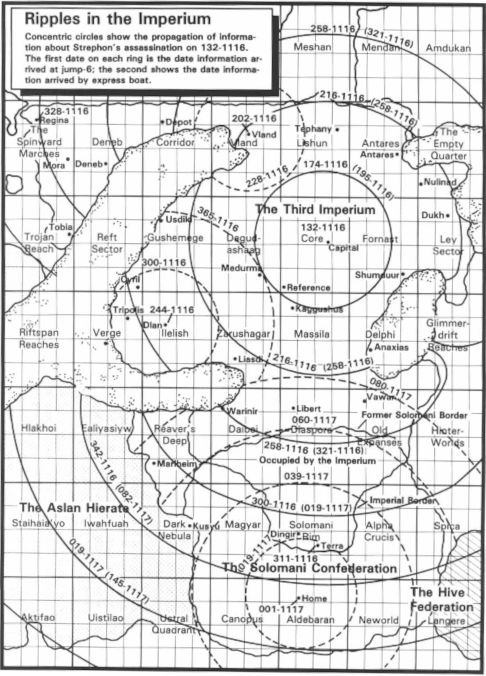
    One of my favorite sector maps in Traveller. It graphically illustrates how news travels through the Imperium

    The above map depicts how the news of Emperor Strephon’s assassination spread through the Imperium along X-Boat routes and priority Jump-6 courier routes. It is a great example of what a civilization-wide event looks like in a setting the size of Traveller’s Charted Space.

    Not All Setting Events Spread This Far

    Which also shows something important. Not every important event is earth-shaking like the assassination of the Emperor of the Third Imperium. There are plenty of potential events that are important regionally, but not universally. These can also, when incorporated into a campaign and character generation, help to define a character’s life-path.

    Consider a localized event, say a recent supernova of a star. It could even have led to the destruction of an inhabited system. The result is hundreds of millions, or billions of refugees spreading to nearby systems and the sudden pressure of a refugee crisis in those systems. The evidence of that event, that is, the electromagnetic eruption caused by a supernova still only spreads at the speed of light. So it would still take 3.26 years for the nova to spread to the nearest parsecs. Roughly one Traveller Term.

    In those four years, the stress on the surrounding subsector, would be evident, but beyond the sector, it would still take decades for the crisis to become anything more than a JoTAS story. Maybe a reclassification of Amber or Red Zones. Characters whose homeworlds are in the local region would definitely have the event featured. Characters from outside the region wouldn’t. And as a result, the scope of the setting can be enhanced.

    Of Course This All Fills a Session Zero to Overflowing

    Life-Path character generation’s biggest drawback is the amount of time necessary to create a character. Especially when creating a group of characters. Going through multiple terms, rolling for skill advancements and Events simply eats up time at the table. Adding another layer where the GM offers Lore details that might be at best, optional, can easily extend a Session Zero to second Session Zero point Five.

    Which is a delay to playing the campaign, ya know, the point of creating all these characters in the first place. So, add campaign lore events to Session Zero only as much as is fun for everyone. What you want, as a GM and a Player, is to generate excitement and anticipation. When the exercise becomes tedious and boring, it’s time to wrap up character generation and start adventuring among the stars!

  • You Got Battletech in my Traveller!

    You Got Battletech in my Traveller!

    No, you got Traveller in my Battletech!

    Two of my favorite games over my long gaming career are Traveller and Battletech. I’ve been playing both for over 40 years. Since I’ve recently moved to a new city, on a new coast of the US, and The 50th Anniversarry of Traveller is right-around-the corner. I’m starting a new campaign. With Battletech enjoying a renaissance, I’ve been throwing a healthy amount of Big Stompy Robots in my Science Fiction Adventure in the Far Future.

    The setting for this campaign leans more toward the Third Imperium than the Inner Sphere. Specifically my favorite era in Traveller’s Third Imperium, the Hard Times. I talked a bit about this back in June. The elevator pitch is, the Hard Times are a relatively brief period in the Third Imperium that takes place at the end of the Rebellion War. Technology and society are skidding towards a second Long Night in the Shattered Imperium of Megatraveller.

    How These Lego Bricks Fit Together

    Battletech’s setting features giant, piloted robot war machines called Battlemechs. They run between 20 and 100 metric tons and are powered by big fusion engines. They’re a lot more on the “space-fantasy” side of science fiction, but there’s a heavy layer of gritty over them. Sort of like Star Trek, there’s a whole glossary of technobabble that sounds enough like engineering and “science!”

    In Traveller terms, Battlemechs become practical around Tech Level (TL) 10. Fusion Power is practical here, which makes powering these war machines possible. The Inner Sphere setting ranges from a rough TL 10 or 11 in the classic Battletech era (between 3025 to 3062) to TL 12 at the height of the Star League (2750). The Clans were around the high end of TL12 and entering TL 13 so far as their engineering went, though the cluster of worlds from where they were exiled didn’t have the resources to fully exploit that level of development. Battlemechs as a practical war vehicle phases out by the time a civilization reaches TL 14, which is where fusion technology reaches it’s technological limits and more exotic power sources become commonplace.

    The average Tech Level of the Third Imperium during the Megatraveller Setting (Imperial Year 1116) was TL 12 with the maximum TL at 15 (and a couple of places like the Darrian Confederation boasting TL 16). The Hard Times sourcebook for Megatraveller goes into detail about how the average Tech Level of the Third Imperium slides backwards. Which is a great parallel to the decline experienced by the Inner Sphere through their many Succession Wars.

    Hey, Why Not Just Use the Battletech RPG Books?

    There’s nothing wrong with Mechwarrior 1st edition, 2nd edition and Catalyst Games’ A Time of War, and Destiny games. I’ve run and played them (except Destiny) over the years, but my preference and love stays with Traveller. I’ve internalized the system a lot deeper than I have the Battletech systems (which is saying a lot, because I’ve internalized Battletech down to my frakkin’ bones!) For me, it’s the life-path character generation system in Traveller. I also talk about it in more detail in this essay, long story short, Traveller Character Generation tells a story through the dice better than using a point-buy system or laying templates over one another. Rolling up a Traveller almost always has a surprise in the character that makes it exciting to play on Session 1.

    I also think in Traveller. The terminology comes more naturally to me, as we’ll explore shortly. As mentioned above, I have a good feel for where Battletech fits in the Traveller Universe, and it takes more work to fit Traveller in the Battletech universe. Advice to the new GMs out there, don’t be afraid to lean on what you know, running role-playing-games can be hard, no need to make it harder on yourself.

    Some Broad Strokes

    I’ll be using Traveller for character generation, setting info, personal combat and most space combat. I’ll be breaking out the hex-maps and Battletech Minis for vehicular combat. Both systems are 2d6 based, and the systems are pretty compatible. There are some fuzzy conflicts when dealing with Traveller small space ship combat vs Battletech’s Aerospace system, but I don’t think they’re insurmountable. Also, the Hard Times campaign isn’t about dogfights at the edge of atmosphere in a gravity well. The backdrop of War is context for the adventure.

    Most of the time, the Traveller skill system is used rules-as-written. However, when on the Battletech or Aerospace battlemap, the system will switch over to Battletech: Total War with the following modification:

    • Base Battletech Piloting is calculated using the character’s skill in Traveller Drive (Battlemech)
    • Base Battletech Gunnery is calculated using the character’s skill in Traveller Heavy Weapons (Battlemech)
    • Base Aerospace Piloting is calculated using the character’s skill in Traveller Pilot (Aerospace)
    • Base Aerospace Gunnery is calculated using the character’s skill in Traveller Gunnery (Aerospace)
      • Battletech and Aerospace Piloting skill starts at 5. This is equal to Traveller Skill at Level 0 (without any Characteristic bonuses)
      • Battletech and Aerospace Gunnery skill starts at 4. This is equal to Traveller Skill at Level 0 (without any Characteristic Bonuses)
    • For every Traveller Skill level gained, the corresponding Battletech/ Aerospace skill goes down by 1.
      • Example: A character with Traveller Skill Drive (Battlemech) 2, when moving over to the Battletech combat map, will have a Battletech Piloting skill at 3. (Base Battletech skill 5 – Traveller skill level 2 = 3.
    • This can also be reversed when adapting the NPCs in a Battletech scenario to Traveller.
      • Mechwarrior Mungo Bogsbane has Battletech Piloting 4 and Gunnery 2. His Traveller skills are Drive (Battlemech) 1 and Heavy Weapons (Battlemech) 2.
    • The Traveller Skill Jack of All Trades deserves special mention. Skill Levels in Jack of All Trades offset the penalties for trying skills without having at least Level 0 in the relevant skill. The full rules can be found in the Traveller Core Rulebook Update 2022 from Mongoose Publishing. Normally, characters need to have at least Skill Level 0 in the appropriate skill to operate a Battlemech, Aerospace vehicle or the weapon systems of either. These are too complex for someone who doesn’t have training to do anything more than flip switches, click buttons and yank levers in futility as the machine does nothing (best case scenario) or crashes in a catastrophic explosion (at worst..)
      Jack of All Trades allows a character to attempt an unskilled roll at a reduced penalty. Jack of All Trades 0 allows for the roll at a -3 penalty, with each skill level in Jack of All Trades reducing that penalty by 1. Until Jack of All Trades reaches Level 3, at which point the roll is at no penalty.
      When applied to Battletech’s Battlemech and Aerospace skills, These penalties are added to the base skill level. A character with Jack of All Trades 0 can roll Piloting at (5+3)= 8 and Gunnery at (4+3)= 7. Jack of All Trades 2 can roll Piloting at (5+1)= 6 and Gunnery at (4+1)= 5.

    Gearing up for the Cockpit

    The most critical piece of equipment for a Battlemech or Aerospace Pilot is their Neural Impulse Helmet AKA “Neurohelmet”. Neuohelmets provide direct neural links to the vehicle’s computer and sensors and are what makes Battlemechs and Aerospace craft more responsive than more conventional vehicles (even at high tech levels). Indeed, the Neurohelmet makes piloting Battlemechs and Aerospace craft possible in the first place. There are so many systems and subsystems that demand constant attention that no one person, or even a small crew of people could manage it all, but a Neurohelmet allows for a single pilot to control the vehicles full functionality.

    A Neurohelmet is a TL 10 device that masses around 6 kg and costs 10 kilocredits (KCr, 10,000 credits). It is a huge, bulky, ugly, and fixes the wearer’s face straight forward. There is a window roughly the size of the wearer’s face installed that displays visual readout data into the user’s field of vision. Inside there are multiple contact leads which use the user’s own brain to move and drive the battlemech as an extension of their body. The helmet rests on the user’s shoulders, protecting the users relatively fragile neck from injury, but restricting any head movement.

    The Neurohelmet’s bulk looks like it could deflect a direct hit from an Advanced Combat Rifle round. That is if the bullet wouldn’t damage all the internal electronics connected to the user’s brain. The Neurohelmet is not armor. Not even when deactivated. Its bulk comes from the complex hardware that creates the technological miracle which allows a human to control a titan.

    At TL 11, the Neurohelmet becomes safer and smaller. It’s no longer a rat’s nest of cabling connected to a six kilo dome. It’s half the mass that it was at TL 10, while direct connection through ports from helmet to cockpit are still necessary, a lot of the connections are wireless.. There remains safety bracing that protects the neck, but the user is able to turn their head and enjoy a restricted range of motion.

    AT TL 12, the Neurohelmet is half the size of the TL 11 helmet. It still fully covers the head, but does not require bracing to protect the neck. There is still neck protection, but not to compensate for having six extra kilos on your head. Direct connections to the cockpit have been reduced to one, two or three, depending on the model of the helmet. The user has a full range of head motion.

    Cybernetic Neural Impulse Cranial Implants (“NICIs”) are also TL 12 devices, and are cybernetic augments. The NICI at TL12 replaces portions of the pilot’s skull and cannot be removed. There is a jack-port installed to make a direct connection into the cockpit. Not counting surgery, the NICI costs 500 KCr. Using a NICI to pilot a Battlemech or an Aerospace vehicle gives the Pilot a +1 Dice Modifier (DM) bonus to Drive (Battlemech) and Pilot (Aerospace) checks. If using Battletech rules for tactical vehicle combat, add the +1 bonus to the roll (not the target number).

    The Cooling Vest is TL 10, costs 500 Cr and allows a Battlemech Pilot to survive the blazing heat in the cockpit of a Battlemech. It’s little more than cooling tubes wrapped around the pilot’s torso which circulate advanced cryogenic compounds and keeps the vital organs from cooking in the pilot’s body.

    Aerospace pilots wear an Improved Vacc Suit with enhanced temperature regulation since they often find themselves operating in the Vacuum of space or extremely thin atmosphere.
    At TL 11, the Cooling Vest is replaced with a specialized Hostile Environment Suit. The cost is much higher (22 KCr) but the HEV Suit provides protection similar to the Vacc Suit which permits the Battlemech Pilot a lot more combat endurance and focus when away from supplies.

    Some down-on-their-luck pilots try to make do with makeshift cooling vests that use cold-packs in place of circulated coolant. Cold-packs are, in essence frozen blocks of water ice or similar freezable material. The cost is almost negligible. Less than 20 Cr and the Tech Level to put one together is around 4. The pilot only needs a means to freeze and insulate the packs. However, fighting in a cold-pack vest only allows for ten-to-fifteen minutes of operation before any benefits are spent and heat exhaustion leading to stroke sets in.

    Character Creation and Development

    At it’s most basic, any skill result of Drive (cascade or any ground), Heavy Weapons (cascade or vehicles), Pilot (cascade or Small Craft), or Gunnery (cascade, Turret or Fixed) can be focused to Battlemechs or Aerospace as the player desires.

    However, should the GM desire a focused assignments for Battlemechs and Aerospace pilots, here are a couple of guidelines

    • Army – Mechwarrior (*must be a commissioned officer)
      • Survival: END 7+
      • Advancement: INT 6+
      • Assignment Skill List
        • 1: Drive (Battlemech)
        • 2: Heavy Weapons (Battlemech)
        • 3: Mechanic
        • 4: Electronics (Sensors)
        • 5: Heavy Weapons (Man-Portable)
        • 6: Recon
      • Rank Skills and Bonuses
        • Rank 1 (Lieutenant): Drive (Battlemech), Heavy Weapons (Battlemech) 0
        • Rank 2 (Captain): Leadership
        • Rank 3 (Major): Tactics (Military)
        • Rank 4 (Lt. Colonel): Admin 1
        • Rank 5 (Colonel): Broker 1
        • Rank 6 (General): SOC 10 or SOC +1 (whichever is higher)
    • Marines – Mechwarrior (*must be a commissioned officer)
      • Survival: END 7+
      • Advancement: INT 5+
      • Assignment Skill List
        • 1: Drive (Battlemech)
        • 2: Pilot (Aerospace)
        • 3: Heavy Weapons (Battlemech)
        • 4: Gunnery (Aerospace)
        • 5: Vacc Suit
        • 6: Gun Combat
      • Rank Skills and Bonuses
        • Rank 1 (Lieutenant): Drive (Battlemech), Heavy Weapons (Battlemech) 0 or Rank 2 Skills
        • Rank 2 (Captain): Pilot (Aerospace), Gunnery (Aerospace) 0 or Rank 1 Skills
        • Rank 3 (Force Commander): Tactics (Military or Naval) 1
        • Rank 4 (Lt. Colonel): Leadership 1
        • Rank 5 (Colonel): Jack-of-all-Trades 1
        • Rank 6 (General): Broker or Admin 1
    • Navy – Aerospace Pilot (*must be a commissioned officer)
      • Survival: DEX 7+
      • Advancement: EDU 5+
      • Assignment Skill List
        • 1: Pilot (Aerospace)
        • 2: Gunner (Aerospace)
        • 3: Vacc Suit
        • 4: Astrogation
        • 5: Mechanic
        • 6: Electronics (Sensors)
      • Rank Skills and Bonuses
        • Rank 1 (Ensign): Pilot (Aerospace), Gunnery (Aerospace) 0
        • Rank 2 (Sublieutenant): Astrogation 0
        • Rank 3 (Lieutenant): Tactics (Naval) 1
        • Rank 4 (Commander): Leadership 1
        • Rank 5 (Captain): Admin 1
        • Rank 6 (Admiral): SOC 10 or SOC +1 (whichever is higher)
    • Noble – Mechwarrior
      • Survival: INT 7+
      • Advancement: SOC 8+
      • Assignment Skill List
        • 1: Drive (Battlemech) or Pilot (Aerospace)
        • 2: Heavy Weapons (Battlemech) or Pilot (Aerospace)
        • 3: Vacc Suit
        • 4: Tactics (Military or Naval)
        • 5: Leadership
        • 6: Gambler
      • Rank Skills and Bonuses
        • Rank 1 (Ensign): Drive (Battlemech), Heavy Weapon (Battlemech) 0 or Pilot (Aerospace), Gunnery (Aerospace) 0
        • Rank 2 (Lieutenant): Leadership 1
        • Rank 3 (Force Commander): Advocate 1
        • Rank 4 (Lt. Colonel): Diplomat 1
        • Rank 5 (Colonel) +1 SOC
        • Rank 6 (General) +1 SOC

    When Mustering Out, vehicle or ship share benefits can be taken as a muster bonus of +1 DM when rolling on the following chart (used to provide a character with a personal Battlemech). Roll 2D + SOC + Muster Bonus

    • 4-: Dispossessed (no Battlemech or Aerospace vessel)
    • 5 – 7: Light class (20 to 35 tons)
    • 8 – 9: Medium Class (40 to 55 tons)
    • 10 – 11: Heavy Class (60 to 75 tons)
    • 12+: Assault Class (80 to 100 tons)

    The Battlemech Campaign Skills Package is designed for a Traveller campaign featuring Battlemechs and Aerospace fighters, similar to the Battletech Universe, Robotech Series’, Gundam Series’, Heavy Gear Universe, Mekton Universe and similar settings.

    Drive (Battlemech) 1, Electronics 1, Engineering 1, Gunnery (Aerospace) 1 Heavy Weapons (Battlemech) 1, Mechanics 1, Pilot (Aerospace) 1, Tactics 1

    Character Development

    After each adventure, Each character may roll EDU 8+. If successful, the player can either advance one of their character’s skills by 1 level, or they can adopt a new skill at level 0. When advancing skills this way, remember no character can have more total skill levels than three times their combined INT and EDU.

    Maintaining a Battlemech or Aerospace Craft

    Outside of repairs and rearming, Battlemechs and Aerospace craft require regular maintenance. Similar to space and star ship maintenance, once per year the Battlemech or Aerospace craft needs to be overhauled at a cost equal to 0.1% of the new cost of the vehicle. Divide by 12 to calculate a monthly maintenance cost.

    Example: A WHM-6R Warhammer Battlemech costs 6,070,984 Credits new. The yearly overhaul cost is 6,070,984 x 0.1% = 6,071 Credits. The monthly cost is 6,071 / 12 = 506 Credits.

    A SL-17 Shilone Aerospace fighter costs 3,399,045 Credits new, the yearly overhaul cost is 3,399,045 . 0.1% = 3,399 Credits. The monthly cost is 3,399/ 12 = 283 Credts

    Like a ship, skipping monthly maintenance risks a malfunction. For every monthly maintenance skipped, roll 2D + the number of months missed. On an 8+, the vehicle suffers a malfunction in the form of a critical hit, determined in the same manner as if the critical was suffered in battle. Using the Battletech chart, roll a location off of the Front/ Rear Critical table and apply a critical to the affected location.

    Battlemechs in the Rebellion War and the Hard Times

    Battlemechs and Aerospace craft are used by all the major factions in the Rebellion War. There are also countless Mercenary Outfits that use these war machines selling their services to the highest bidder. As implied by the Noble profession assignment above. Several Noble families possess ancestral Battlemechs and Aerospace craft.

    When compared to the state-of-the-art TL 15 weaponry that was deployed in the first years of the War, Battlemechs and Aerospace craft were outclassed. A company of TL 15 Battle Dress equipped infantry, TL 15 Grav Armor or a squadron of TL 15 armed space fighters are far more efficient and effective than an equivalent formation of TL 12 Battlemechs and Aerospace craft. However, as the war escalated between 1119 3i (3rd Imperium) and 1121 3i attrition forced all factions to press second and third line vehicles and equipment to the front. Battlemechs and Aerospace craft were re-deployed to replenish the attrition of years of war.

    When the War turned Black in 1122, Battlemechs and Aerospace craft became the instruments of scorched world strategies. Battlemechs as walkers were well suited to urban fighting, and the Aerospace fighters and bombers were very effective at everything from close-air support, escorting dropships, and orbital theaters. In a pinch they could be pressed into space combat. Hybrid Battlemech/ Aerospace vehicles, known by a variety of names, Veritech Fighters, Land-Air Mechs, Variable Aspect Mobile Suits and Hybrid Aeromechs, among others.

    Before the Rebellion War, Battlemechs and Aerospace fighters held a measure of prestige in the Noble Houses of the Moot. Nobles would use them to settle duels while showing off their wealth and means, in a similar way the aristocracy have used antiquated weapons and skills to settle disagreements while flexing on the less affluent. During the Rebellion War, Nobles wanting to cater to the imperial sensibilities of Lucan, Margaret, or the Ziru Sirca were eager to raise Household companies like ancient Lords calling their Banners. As the war dragged on, these same Noble houses were employed to share their tactical and technical knowledge in designing, and fielding Battlemechs and Aerospace fighters.

    In the Hard Times, the owners and employers of Battlemechs are in an excellent position to take over systems and pocket empires as Technologically Elevated Dictators. By 1125 3i, the major governments had retreated into core zones. leaving the Wilds open for pocket empires to develop. By 1130 3i, Virus has been released and was devastating the Imperium for the next seventy years.

  • For A Few C-Bills More

    For A Few C-Bills More

    Heists during the Year of Peace – 3051

    The Clan Invasion of 3050-52 was interrupted by an unexpected pause in 3051. The “year of Peace” provided more than a reprieve and a strategic opportunity for the Inner Sphere. While the leaders of the Great Houses were all on Outreach training for when the invasion begins again, Survivors, Mercenaries, Outlaws, and Pirates took advantage of a special set of circumstances

    Kerenskys Are Not Money, but Gold Still Is

    The Clans invading the Inner Sphere had survived for generations on the bare minimum of resources. Rebuilding their society as a rejection of what they saw as the greed and decadence of the Successor State houses. Their currency, Kerenskys is not representative of material wealth. The Kerensky is a market currency tied to the trade engaged with the Merchant Caste. The Clans value resources and technology. But from the materialistic perspective of the Inner Sphere, the Kerensky has no value, not even a residual value. As currency it means nothing to the conquered people. It is a fiat currency imposed on the vanquished by the victors.

    C-Bills and House Bills represent the material wealth of the empire that issues it. Whether that value is in preserved technology and communication as with the C-Bill or in Territory and Treasure as with the various House Bills. Ultimately, the Inner Sphere’s currencies can be traced to something of material value. This economic system of trade stretches back through the millennia of recorded human history.

    The Clans are on a Crusade

    In 3051, the Clans are not invading the Inner Sphere to seize it’s material wealth, nor are they taking territory, except in so far as the systems they seize bring them closer to their goal. The Clans are invading with the purpose of “liberating” Terra. The culture of the Clans, militaristic and austere suppresses the desire for material comforts and luxury. Especially among the Warrior Castes, who comprise the majority of the clansfolk that occupy the conquered systems. At this point, one year into the invasion, there hasn’t been enough time for the temptations of luxury to break the discipline culturally instilled in the Clanners. The Merchant Caste still manages trade and supply with a focus on practicality and resource allocation. Strategic objectives are primarily parts and supplies with immediate military applications, port resources and protecting communications facilities, including ComStar installations. Vaults and monetary reserves are of secondary, even tertiary concern. Only the senior strategic ranks concern themselves with the money of the inner sphere, and in that capacity only because money and luxury can be used to exploit greed in the hearts of local leaders of government, industry and militaries.

    Rumors Fly Furious and Thick

    The speed and shock with which the Clans have gouged their conquest out of the Lyran Commonwealth, Draconis Combine, and Rassalhague Republic left unimaginable fortunes laying undefended in hundreds of locations throughout the Occupation Zone. In some cases, not even the conquerors know the treasures resting on the very worlds they occupy.

    The tide of refugees fleeing in front of the invasion carry with them the knowledge and locations of these vaults. Some were the owners of these treasures, others guards, and yet others managers, and many simply lived in the communities where the banks, nobility, and corporations maintained the vaults. These are the hooks for missions and adventures that go beyond recreations of operations baattles that are usually recorded throughout the timeline.

    Raids and Heists can be just as exciting as battles over tactical and strategic positions, but without the scope of a large scale battle. At this scale the stakes are small and personal, the characters (and the opposition) are not trying to fight a war. They’re trying to grab treasure. There is little or no jingoistic patriotism here, there’s little motivation beyond getting paid. Something that would appeal to a mercenary and pirate campaign.

    Why 3051?

    This is a very unique year in the grand timeline of the Battletech Universe. In the Occupied systems, the Clan invaders haven’t had the chance to absorb the vices of greed and avarice. At least as far as wealth and luxury are concerned. Furthermore, the withdrawal of the Bloodnamed back to Strana Mechty has in effect frozen the invasion offensives and left behind Provisional Garrison troops to hold the systems they’ve captured. This combination of freebirths and dezgra units simultaneously discourage personal initiative (no one wants to risk retaliation from the caste system for breaking discipline) and unintentionally filled with persons who resist the system they live in (thus, more susceptible to the temptations of the inner sphere and “going native”).

    The Houses of the Inner Sphere are similarly paralyzed. Having been beaten back with few, if any, significant victories along a front that has grown to the size of the Free Worlds League, all the Great Houses of the Inner Sphere have been paralyzed just like the Clans. The Leadership of the Inner Sphere are sequestered for most of this year on Outreach as “guests” of Wolf’s Dragoons. Between that, and the near-collapse of the Rassalhauge Republic, Draconis Combine, and Lyran Commonwealth militaries, there are no opportunities to capitalize on strategic vulnerabilities.

    For both the Clans, and the Inner Sphere, 3051 is a tidal wave, frozen in time. Which leaves extensive opportunity for the type of smash-and-grab raiding and probing that small mercenary outfits do best.

    Hit ’em Where They Ain’t

    Throughout the year, the Clans are defending their occupied territories with Provisional Garrison forces piloting second-and third-line equipment. Under leaders tied to vague orders that amounts to little more than “Don’t lose any ground, not one step!” This has left the Occupied Zones wide open for probes and raids. In fact, if the Inner Sphere had anything to put together for a counter-offensive, 3051 could have been a bad year for “Operation: REVIVAL”.

    Setting up a raid is not much different for a mercenary company (even if that company is a lance) than fulfilling a short-term contract. Objectives, Mission Plans, and Logistics need to be outlined. In a mercenary contract, these are often laid out during contract negotiations, the employer defining the objective and (usually) arranging the logistics. When raiding, the “employer” are the mercenaries themselves. They are, in essence, writing their own contracts, and need to take into account these details.

    The Objective, has to be valuable enough to justify the expenses. Ammunition cost C-Bils, repairs cost C-Bills, fuel, hiring a transport to jump to the system, hiring a drop-shop to ferry the mercenaries planetside (and pick them up after), paying for “discretion”, all of it are expenses (and expensive). Much of it needs to be paid in advance, like buying passage to the system, and food for the trip (remember, mechwarriors and their mechanics gotta eat). The Objective has to be able to recoup those expenses, and turn a profit at the end.

    As a game-master, it’s your job to make the Objective worth the trip. Hitting a “vault” to come away with loot worth a million C-bils isn’t gonna be enough. Do some homework, figure out what the characters’ expenses are and make certain that, at least based on the intelligence the characters are given, the money is worth their time and efforts.

    For most heists, the opposition isn’t going to be focused directly on protecting the objective. The mercenaries are going to be hitting lightly defended targets. At least initially. Objectives deemed not strategically important won’t be directly garrisoned, and a response to incursions are going to be delayed. This is going to start a timer on the mission. The moment the mercenaries are detected, the garrison will move out to intercept them. Thus, the mercenaries need to be gone by the time the garrison arrives. In these scenarios, a pitched battle is failure and the characters are going to lose.

    This is the point where the game-master needs to drop in twists and hurdles to the plan. Maybe the drop ship is running late, maybe the extraction point has to be moved, maybe the vault isn’t where it’s supposed to be and the characters have to find out where it’s hiding, maybe the garrison isn’t where it’s supposed to be and the characters need to fight their way in.

    Here’s the devil in the details, once the characters have committed to the raid, once they have hired the jumpship and the dropship, it’s too late for them to walk away empty-handed. The point of no return for them was the moment they left for the objective. Aborting the mission after that is a loss, and a significant one at that. Jump ship travel is not cheap, and while Jumpship Captains see themselves as “above” the politics of war, they will make sure they get paid first.

    During the mission, the locals may not appreciate offworld mercenaries dropping in, taking all their stuff and blasting off. They may hate their occupiers, but they won’t stand still and be robbed. Furthermore, the locals know that their Clan occupiers will punish them for the actions of any Inner Sphere mercenaries who raid their settlements. Clan honor demands some sort of consequence for being injured. Even the appearance of collaboration between the locals and the raiders will demand harsh retribution after the mercenaries are long gone with their loot.

    Crossing The Lines

    An exciting option that could start a campaign is playing a group of occupiers that choose to raid their own garrison, and desert or defect. In most cases this is unthinkable. Betraying Clan Honor in this way is The WORST crime imaginable.

    Being “clanners” also puts the defectors in a terrible position. The occupied population hates them, their Clan hates them and the Inner Sphere hates them. From the defectors’ perspective, they don’t speak the language, don’t understand the culture, and don’t have a grasp of how C-Bills work. On the other hand, even second-line garrison troops are head-and-shoulders above most of their Inner Sphere counterparts, their tech, even old clan tech is decades more advanced than Inner Sphere tech. 3051 might be a freebirth or dezgra’s only opportunity to escape the prison of their society and, for as long as they can, live outside the legacy of Nicholas Kerensky’s memory.

    It Comes to an End

    By November of 3051, the Fifth Wave of Operation: REVIVAL is beginning, the Blood-named and elite clan military machine have returned from the Homeworlds. The Outreach Summit had finished by August, and the Inner Sphere had reorganized their defenses. By the end of 3051 the window of opportunity for small units to pull off raids in the Occupied Zone had closed. After the Battle of Tukayyid in May of 3052 would the Clan Invasion halt and the region start to adjust to the new “normal” that would carry forward into the next conflicts and wars.

  • Galley Service in Traveller

    Galley Service in Traveller

    Space food by Tech Level

    Out in the vastness of empty space, Your crew still needs to eat. Whether it’s food-in-a-tube from TL 6, or TL 15 replicated food. Eating also adds (dare I say) “flavor” to an otherwise boring series of downtime activities. The Life Support portion of the monthly Running Costs of operating a Space Ship or Starship covers the most basic nutritional needs for each person on board the ship. Normally running somewhere around Cr 1,000 per stateroom (Cr 3,000 per double occupancy stateroom) and Cr 1,000 per person. This is food that will keep a person adequately fed with some small variety. Sort of like Meals, Ready to Eat packages. This food is designed to travel with a minimum of environmental demand. It doesn’t need refrigerated, it’ll last for years, and is shelf-stable. As anyone who has lived off this for an extended length of time can tell you, the menu gets real old, real fast.

    There are two tech level factors that affect the quality of food on board a ship. The first is the TL of the ship itself, specifically the TL of the Life Support Systems. The second is the TL of the location where the resupply is taking place. Advances in preservation and preparation allow for more palatable and satisfying fare.

    Ship’s Larder

    Starting around TL6, and until TL9 this is some variety of “food in a tube”. TL9 is the lowest tech level where Jump Drive is an option, and this means most ships at these tech levels are intended for in-system travel with voyages lasting weeks. Galleys are luxuries at this stage, and even the most extravagant are little more than a common room with a table, chairs, and a microwave.

    TL 10 and 11 is where “reconstitution” modules are developed. This is more advanced than simply re-hydrating meals with hot water. Reconstiution uses a common base of proteins and carbohydrates to restore food resemble a wide variety of textures, flavors and smells. By the very nature of the process, the food is absent any meat product, though meats can be prepared this way. Still, it’s a critical detail for venturing into the Two-Thousand Worlds. K’kree can scent a meat eater.

    TL 12 through TL13 is where recycling organic matter reaches its peak. At this stage food can be created from compost material. From there, food can be flavored and textured into the desired composition. The process takes a few minutes (roughly 15) and the result can be eaten immediately, or further prepared through any other recipe.

    TL 14 and TL15 is where true food synthesis can create edible footstuffs in nearly any form imaginable. By combining organic chemical elements, Food can be created on demand (so long as those chemical elements remain available) in a matter of moments.

    Resupplying at Port

    Part of Life Support costs are keeping materials on hand. Even at the higher Tech Levels, equipment needs to be serviced, stores need resupplied. However, the quality of rations remain limited by the lower tech level between the ship and the port of resupply.

    TL0 through TL5 is limited to primitive food preservation techniques, smoking, salting, canning. It is possible that if a ship has to resupply here, the crew might be loading pemmican and hard tack like their ancestors on tall ships during the age of sail.

    TL6 through TL8 allow for processing foods, dehydrating and/or industrially preserving it to be shelf-stable.

    At TL9, cryogenic preservation allows for some fresh food to be added to a ships’ stores. Bulk is still an issue, it’s really difficult to miniaturize a side of beef, or a 1000kg bluefin tuna. TL9 is where the food can be maintained in cryogenic storage indefinitely.

    At TL15, stasis is in its infancy but does allow for food to be stored in a state of freshness. Food stored in stasis doesn’t need thawed or reconstituted. It can be prepared and eaten immediately.

    Bread Alone

    Using Life Support in this manner should enhance the immersion in the setting. If it becomes an annoyance in your campaign, don’t lean on it so much. The point is not to punish the characters but to give storytelling material for players to experience. Illustrate how, after months of living off of rations made from reconstituted algae, or recycled garbage and poop the intense pleasure of eating food freshly prepared.

    Think about the scene from the Matrix where the crew of the Nebuchadnezzar is eating their plates of gruel. Then compare it to Cypher eating the steak in the Matrix. The promise of a good meal after months of deprivation makes for a powerful motivator.

    Take the original Star Trek series, their replicated food was multicolored simple solid shapes. Compare that to the Next Generation where the replicator could create food to the taste of the person ordering it, whether it is “Tea, Earl Grey, Hot” or “Gakh”, and even the difference between replicated Gakh and when it is served live. As Any Klingon would tell you, Gakh is best served live.

    Science fiction roleplaying should have that same sensory feel. From Captain Pike’s exaggerated home kitchen on board the Enterprise to Luke Skywalker drinking a tall glass of blue milk. Engineers setting up stills to make rot-gut hooch from the basic amino acids and carbohydrate soups in the storage bins, “good for two things, de-greasing engines and killing brain cells” Keeping a bottle of Scotch from Rigel, or a red wine from Chateau Picard. These are ways to breathe life into the downtime stuck in Jump Space.

    Brand Loyalty

    This is also a part of world building for your campaign. Create companies and brands who can supply ships with these supplies. Military ships, of course are supplied by their branch’s quartermaster, but as any Imperial Scout can tell you, the ISS ration menus are “uninspired” to say the least. Adding a common, regional brand to the campaign, think “Triple F Burgers” from the Battletech game, or “Biscuit Baron” from WEG Star Wars. Can add role-playing moment. Smuggling a crate of Romulan Ale has more of a connection to the Star Trek Universe than simply running prohibited spirits through the Federation.

    Having a regional, or even subsector supplier of ships’ rations can give players a reason to head to that area of space.

  • A Fist Full of C-Bills

    A Fist Full of C-Bills

    ..and A Pocket-full of Credits

    Science Fiction money takes many forms. From primitive cultures trading precious baubles to vast financial networks that process electronic and digital transactions through subspace and hyperspace communications. For adventurers with bills to pay, the way they access their money can be a challenge as they jump from one star system to the next. This article relates to some ideas posted in O God, Thy Sea is so Great and Money Makes the World Go ‘Round.

    Don’t Sweat the Small Stuff

    In our real world, budgets and finance can get detailed. Most of us have had the experience of scraping every corner and couch cushion for loose change to go down to the corner store with. Some of the reasons we play role-playing games is to take a break from worrying about if we can afford that extra box of mac-and-cheese or not.

    The “small stuff” can all be abstracted into lifestyle. In Traveller, lifestyle is related to the Social Standing characteristic (at least in the Third Imperium setting). Adventurers with a low lifestyle, sleep in a fleabag flat and eat kibble from a grey box labeled “food”, those with a high lifestyle, stay in luxury apartments and eat fresh, or exotic meals. Don’t dwell too much on the details though, lifestyle is a player choice for their adventurers, there might be a regular cost, or not. Keep the action focused on the adventure and not the downtime.

    Sometimes, the Small Stuff is the Adventure

    This is different from looking over character sheets and noticing if a character has enough centi-credits to live well during the adventure. These are adventures where the characters have lost access to their normal resources. The bank fails, they’re robbed, a new government won’t accept their money (the classic “we don’t accept Federation Credits, only Gold Pressed Latinum”). The objective on these adventures is to survive without money until they recover their means to rejoin the markets.

    Speaking of Gold Pressed Latinum

    In the main cultures of most sci-fi settings, currency is electronic. (Think cryptocurrency, but hyper-efficient). In cultures where technology is advanced enough to manage an interstellar society, this form of currency is practical and mostly efficient. It also reduces incidents of fraud, the possibility of devaluation because some explorer discovers a colossal source of precious metal, or a technology like the Star Trek replicator is developed. Data as currency is extremely efficient to use. Anyone who has made a purchase with a card over the internet has experienced this convenience.

    While efficient and convenient, even at highly technically advanced cultures, there remains a need for a more physical currency. In Star Trek, that’s “Gold Pressed Latinum” which is made from a unreplicatable, rare, element suspended in gold. Other settings use similar things, though in places like the Inner Sphere, or the 3rd Imperium, that sort of hard currency is tied to the electronic economy and minted by the governmental authority.

    Hard currency has another benefit. Cold, hard, cash is difficult to trace. Especially over interstellar distances. Tracing technology can be defeated, and unlike bills, or proxy currency, as any Ferengi can tell you “Latinum is Latinum everywhere in the galaxy”. For crews and companies that don’t want to leave a trail of money behind them as they operate, sometimes across hostile borders, having a valuable, difficult to track currency is a must.

    From an adventuring perspective, hard currency gives a fun æsthetic for heist or treasure-seeking adventures. Think about the old World War 2 Movie “Kelly’s Heroes”, that would work so well in the Battletech Universe. A group of mercs learning about a cache of hard currency, like a bank in occupied territory and taking an “unauthorized expedition” to grab the vault before it gets moved somewhere “safe”. Most of the ideas presented in, Money Makes the World Go Round, can be applied, especially with regards to what happens after your holds are filled with pallets of currency.

    Battlemechs, Tanks, Space Fighters, and Starships

    Big ticket items are common in Science Fiction settings. What would Star Wars be without the Millenium Falcon? Hammer’s Slamers without Grav Tanks? Gundam without Mobile Suits? In most settings, the characters belong to organizations that assign them to their war machines or ships. Maintenance for these big ticket items is covered by the organization.

    But in settings where the characters are the crew of a Free Trader, or the pilots of a mercenary company of Battlemechs, these costs are a foundation of the campaign. We see this in Firefly, “Find a crew, find a job, keep flying”. Star Wars Episode IV also shows this off. Han Solo is charging 10,000 to take Ben and Luke to Alderran. He’s in debt to Jabba who is threatening his ship. Point being, everything involved with these big ticket items are expensive. From purchasing them to maintaining them to repairing or improving them. Costs run into the millions of credits, and they’re recurring. Ships need fuel, weapons eat ammunition, crew need food, water and air on long space journeys.

    When designing adventures, the Game Master needs to take the costs into account when they’re adding rewards. The adventurers need to make enough money to cover their expenses while turning a profit. This pushes this style of campaign into a higher scale of economy. While a group of scoundrels may well be able to retire from adventuring and “go legit” if they score a million C-bills, in a campaign that revolves around a company of Big Stompy Robots, that same million C-bills might cover two or three months of maintenance. For the owners of a starship a single Megacredit will run out quick, fast, and in a hurry.

    Filling Contracts

    Especially in Mercenary campaigns, contracts are common. These are great for Game Masters and Players Alike. Contracts outline what the adventure is expected to be. Where to go. What to do, and how much the compensation is going to be at the end. Longer term contracts can also include covering maintenance, repair, and fuel, relieving the players from that accounting for a time.

    Contracts are not only applicable to the mercenary campaign. Worlds can contract free traders to deliver mail to them, or maintain trade with nearby systems, free traders can serve as a temporary solution to these systems until they build their own fleets and infrastructures. Still, it’s an opportunity for characters to go places, do things, and have adventures.

    Many settings have an independent authority to mediate contracts and enforce their terms. The Mercenary Review Board in Battletech, merchant guilds, megacorporate syndicates, Imperial ministries, serve these roles as arbiter, and holds payment in escrow until the terms of a contract are fulfilled. But some science-fiction settings do not. Crews need to negotiate guarantees and protections for themselves, as do the parties they are contracting with. For a GM, this can lead to double-crosses, backstabs and other creative ways to introduce twists in an adventure that threatens to become boring.

    Outrunning Your Mortgage

    Especially in settings like Traveller, where interstellar communications travel at the speeds of the fastest courier as described in O God, Thy Sea is so Great. A group of adventurers can skip their bank note on their big ticket item. Jumping out to the fringe of “civilized” space and joining the pirates and nomads and homesteaders out past the perimeter. Or, in a setting where wars rage between empires, hiding from their lien-holder in one empire by escaping into it’s rival.

    This is in essence, stealing the things that are mortgaged. Considering star ships, battlemechs, tanks and space fighters are really really expensive the finances won’t just write off the loss. After all, the characters just ran off with tens of millions of C-Bills (or Megacredits) of their money. Collection agents, Repo men, Skip-tracers and Bounty Hunters will follow the ship, and the characters everywhere they go. Running them down, even out on the periphery to drag them and their ship back to face consequences.

    Characters can run, they can even run fast, but they’ll never run far enough to ever be comfortable not looking over their shoulder. Even Han Solo ended up in carbonite, hanging as a trophy in Jabba the Hutt’s palace.

  • O God, Thy Sea is so Great, and My Boat so Small

    O God, Thy Sea is so Great, and My Boat so Small

    Space is BIG

    One common quirk of science-fiction roleplaying, whether it be Traveller, Star Trek, or Battletech is that the Universe starts to seem rather small. The characters jump from world to world having adventures but they only stay as long as the adventure lasts. Once the adventure is done, they’re back on their ship and off to another world, light-years distant. The routine of interstellar travel shrinks an impossibly vast universe into a travelogue. Alien worlds, might be strange, but they’re not memorable, the planet of purple-people-eaters fades into the background along with the forest moon of cannibal teddy bears, and the world of cheese.

    Timekeeping

    One way to keep space feeling big is to keep track of time as it passes. The Universe is not a static place, everything is always in motion. Seasons change, years pass, even the stars themselves grow old and die. It helps to reinforce that your characters are on a voyage if the Universe continues to unfold even as the players hop from system to system. In Traveller, each jump between systems takes a week. Normally this is expressed in downtime, but the important thing for timekeeping is, that as the characters jump from world to world weeks pass as they are isolated in jumpspace.

    The Battletech Universe is different, jumps of 30 light years happen in an instant, but the drives require a week to recharge, and it takes days of sublight travel to reach the jump point where the drives can be engaged. Again, this is often considered downtime, but the time still passes.

    Even Star Trek, where warp travel doesn’t isolate the ship or it’s crew, the distance between systems is *vast*. It takes days or weeks for a vessel, even traveling hundreds of times the speed of light to transition from one system to the next. As Game Master, take advantage of this, let events develop without the characters needing to be involved. Keep the Universe a dynamic, ever changing place.

    Distance and Scale

    It’s time for a little Astronomy. Get out your notebooks and calculators. As I am writing this essay, I have just flown across the North American Continent from Washington DC to Sacramento. That trip of 3,000 miles (4800 km) took all day (actually it also took all night, because of an unexpected layover in Phoenix, but that’s a whole different story). One Astronomical Unit (AU) is 150 million km. One Parallax Second (ParSec) is 3.26 light years. To put all of this in scale, for Dezzy to travel to work takes about an hour (I live 30 miles from the office) by car. For Dezzy to cross the country (the US) takes a day (six-ish hours) by jet. If Dezzy was to fly to Mars, it’s a journey of eight months. Flying out to Jupiter’s moon Europa takes around 6 years. If Dezzy wanted to send a message home at light speed, it would be more-or-less immediate from most places on Earth, 1.25 seconds to the moon, 15 minutes to Mars and 35 minutes to Europa.

    Why am I throwing all these numbers at you? Well, it’s to illustrate a point. Like Douglas Adams famously said many years ago, “Space is big. You just won’t believe how vastly, hugely, mind-bogglingly big it is. I mean, you may think it’s a long way down the road to the chemist’s, but that’s just peanuts to space.” Traveling between worlds or star systems shouldn’t feel like driving to the next town over or even flying across country. In-system travel should take at least days, if not weeks unless the vessel is moving at 75% of C (light speed) or more. The point of emphasizing distance is to impart the vastness of space to the players.

    Because of the enormous distances involved, the setting needs to feel different based on scale. This can be accomplished not only with travel times, but with communication lag.

    The Mail Must Go Through

    On a planetary/ moon scale, real time communications is fairly straightforward. We experience it today in our decidedly non-science-fiction real world voice and video calls can be made in real time anywhere on the planet where a signal can be reached. The slight delay to lunar orbit can make conversation slow, and possibly awkward, but not impractical. Physical mail can be sent nearly anywhere in a mater of weeks, or even days or hours if extra resources are employed.

    On an interplanetary scale, real-time communications are not really possible. Even between nearby planets (assuming both worlds are in their close orbits), electromagnetic communications still take between fifteen minutes to an hour to reach their destination. Conversations start to resemble e-mail or messaging, even with voice or video

    Communication with the outer worlds takes hours or days. Relays are needed to even send an electromagnetic signal out that far that can deliver something as dense as voice or video communications. Settings at this scale begin to resemble the telegraph and rail eras of the 19th century. News travels over continental distances, but need to move between telegraph or railroad stations. If the recipient of the message is five days away from the closest station, then all news that recipient receives is at least five days old. Even if the setting is heavily populated, it is still possible and even preferable to present a tangible sense of isolation

    On an interstellar scale, unless Faster Than Light travel and communication is employed, news travel at generational speeds. Its simply not possible to maintain a cohesive society at this scale. Without FTL travel, an interstellar setting is a planetary or interplanetary setting. To use an example from fiction, in the novel Three Body Problem (spoilers), the invading fleet from Alpha Centauri (rougly 4.3 light years) takes 300 years to journey to the Sol system. That’s using technology so far advanced beyond what humans have developed that it may as well be magic.

    FTL Travel Changes Everything

    Interstellar settings with Faster-Than-Light travel flips communications on it’s head. Even in settings where direct communications through subspace, or hyperspace relays are possible, it is often quicker to send a ship from place to place delivering messages. This can be physical media, where a mail ship drops off packages and mail to the starport, but it can also be electronic or digital media where the mail ship simply flies in-system and transmits their messages to their destinations.

    This brings an Interstellar setting to resemble the world-spanning empires of the 16th to 19th centuries. Worlds take weeks or months to interact, large interstellar empires and megacorporations lay most of their authority on colonial governors or directors of local headquarters.

    There is a brilliant map in Megatraveller that displays how news of Emperor Strephon’s assassination spread throughout the Third Imperium. The common communication routes were the Express Boats that could jump 4 parsecs in a week, which was the limiting factor for the spread of the event. There was a second communication route used by the Imperial government and the Navy that used Couriers that could jump 6 parsecs in a week. Using this map, the GM could see who knew about the assassination, when, and how they would react.

    The map also illustrates how much distance the news had to travel. In the setting, Emperor Strephon was assassinated on the 132nd day of the Imperial Year 1116. That news took 200 days to reach Terra, on the rimward fringe of the Imperium. That was from Emergency jumps running a Pony Express route (delivering the mail through a relay of riders and fresh horses) at a pace of around 850 C. That shows that the Third Imperium is really, really vast.

    Keep Real-Time Communication Exclusive

    The Star Trek and Star Wars settings have tropes where conversations over enormous distances occur. Which works against the scope of the setting. The Enterprise is often shown as the “only ship in the Sector” that can respond to the inciting incident of the episode. The orders are delivered from StarFleet headquarters in a direct Subspace communication. Even though the Enterprise was thousands of light years distant Captain Kirk could have a video chat with the Admiralty, and receive updates while delivering progress reports. Lord Vader has video chats with Emperor Palpatine from the Phone Booth on board his Super Star Destroyer while the Emperor is at the heart of the Empire on Coruscant. This shrinks the universe to planetary scale. It’s no more inconvenient to phone HQ for info than it is to open a Zoom Call to Hong Kong from London.

    Both settings retain their sense of scale by showing that these real-time communications as requiring equipment that demands resources that are unavailable to the average citizen. Vader is the Dark Lord of the Sith, he has the biggest and bestest, literally a “Super” Star Destroyer. The Enterprise is the Flagship of the Federation. Subspace and Hyperspace Communications are not available or even a component of adventure sized ships like the characters would be crew of. A small colony carving out a settlement may not have the resources to build such a communications array.

    The Star Trek movie Into Darkness and Star Wars: Revenge of the Sith really undermines the scope of their settings (spoilers for both movies). In Into Darkness there’s a scene where “John Harrison” escapes capture on Earth by teleporting to the heart of the Klingon Empire. Using technology explained as “Transwarp Beaming” but it was effectively instant teleportation over hundreds of light years. The Enterprise follows at Warp and arrives close enough to threaten Harrison with a long-range bombardment in an indeterminate, but very short interval. This is a planetary scale event. The distances are just numbers because there is no appreciable time investment.

    In your campaigns, if your adventures travel interstellar distance this casually, then alien worlds become little more than exotic cities that can be reached by tourists on vacation. The sense of wonder is erased.

    Time is Relative

    In settings where Near-Lightspeed and Faster than Light travel is a factor, characters can age faster or slower than the rest of the setting when traveling. This is another way to emphasize the distances involved.

    When traveling at Near-Lightspeed, the subject of relativistic speeds age slower. Characters who regularly travel at these velocities start to subjectively move forward in time. They leave one world, travel for a week at relativistic speeds, and when they arrive at their destination, they have only aged a week, but the setting has gone through months of time. The GM needs to juggle three periods of time. The time from the origin passes quickly as the characters are in transit, the time on board ship seems to pass normally, and the time at the destination would be the distance travelled divided by the velocity of the vessel. This allows characters to experience vast spans of time over the course of their career while their physical life spans are unchanged.

    At Faster than Light Travel, the relativistic equation starts to flip on it’s head. Especially in settings where Jump Drives crosses the distance instantly, but the vessel has to spend a period of time (usually a week) in hyperspace, or jump space. The characters age, but the setting doesn’t. This starts to age the characters faster than the universe around them.

    In Warp-Drive settings, the ships spend travel time in a bubble of real space while the universe outside slows to a standstill. When the ship emerges, the crew, like a Jump Drive crew have aged the time they were at warp, but the universe has only aged a much smaller interval. It takes the Enterprise much, much less time to move through the galaxy at warp than light does.

    This allows adventurers the possibility of outrunning the consequences of their actions (for a time). So long as the adventurers can travel faster than the news of what they did, they can arrive in a new system before anyone can know what they’ve done. Of course, the trap here is that the adventurers need to keep moving. At least until the consequence exhausts it’s urgency.

    Setting Scale and Campaign Scope

    It’s important to apply the scale of your setting to complement the scope of the campaign you wish to run. It is tempting, especially with a game like Traveller with it’s procedurally generated system for creating worlds to create sectors’ worth of star systems, worlds, and moons. It can be fun, dreaming up pocket empires, cities, starports and NPCs to populate them. However, unless you plan to run a series of campaigns over the course of years, developing anything beyond a subsector beforehand is mostly futile. The same goes for system detail. Unless an extended adventure takes place in a single system, most groups of adventurers will never explore any given place beyond the world where the adventure takes place, and even then, the adventurers often only encounter those locations described in the adventure itself.

    Point being, unless the adventurers choose to visit a location, they won’t. You as the GM can encourage the adventurers to visit a location, but the ultimate decision is with the players. It’s the GM’s job to seed reasons for the players to want to visit the interesting locations that are designed. That being said, as GM you can present a campaign that happens in a single star system, with a plot similar to the Expanse. That type of campaign will resemble an Interplanetary Setting, with it’s distances and travel/ communication times. Everything outside of the campaign system doesn’t need any real detail. News can arrive as the GM chooses, but it is not anything that needs to be designed beforehand. Don’t make more work for yourself than you must.

    There is a balance for a campaign that revolves around travel. For example, in a Battletech campaign where the characters make up a mercenary company, contracting their military service with planetary governments and empires for c-bills, interstellar travel is common. The Company fulfills a Contract on a world, gets paid, and then they’re off to the next contract on the next world. System Detail only needs to be relevant to the current contract, and possibly outlines of the next contracts on offer. This is more of an example of a Interstellar scope on an Interstellar scale. While the campaign may never visit more than a dozen worlds or so, you as the GM can make the setting seem big. That’s part of the appeal. The mercenaries aren’t stuck on just one world or in one system. The conflicts cover hundreds of systems and thousands of light years of distance. Part of the appeal of a campaign like this is adventuring in space.

    Deep Space Exploration, like Star Trek is the ultimate expression of Campaign Scope and Setting Scale. Leaving the familiar stars behind to explore… (dare I say?) strange, new worlds. Here, the GM can use time dilation to illustrate how vast the universe is. Traveling from world to world, and revisiting some can show how much time passes on the worlds left behind. Friends who stayed on the outpost the adventurers visited at the beginning of the campaign, can have aged significantly by the time they return and the adventurers have only aged a couple of years. Campaigns out here are stories of isolation and self-sufficiency. Like the crew of a ship far beyond the boundaries of Empire, help is months or years away if it can be reached at all. News from home can be years old. I’d even go so far as to make FTL communication like subspace or hyperspace have significant delays. The goal for campaigns of this sort is, like the crew from Star Trek: Voyager, is to turn the characters’ starship into it’s own little world sailing through the stars.

    West Marches, Distant Stars

    A gaming group can adopt a setting to run a multiple-campaign game using science fiction. In this framework, GMs develop different areas in the setting, and multiple groups of players can experience adventures travelling between GMs and their areas. Coordination is key, understanding where each group of players are in time and space will inform what is occurring in the universe as it unfolds. Groups that encounter one another can exchange news and even crew. As a campaign like this matures, it becomes epic. Like a science-fiction franchise, the more campaigns that play becomes identifiable as unique expressions of the setting while remaining a part of the greater setting.

    Conclusion

    I’ve presented, a lot in this essay. Turns out, since space is big, discussing role-playing in a space setting starts to get big as well. All of this doesn’t need to be applied to any given rpg as a whole. Like all science fiction gaming, the freedom to pick and choose what works for you is a part of the fun.

    Happy Star Trek Day

  • 3051

    3051

    Battletech’s Lost Year

    3049 and 3050 were disastrous years for the Inner Sphere. The Clan Invasion began. The invading, mysterious armies looked and fought like aliens. The peripheral bandit kingdoms and pirate havens fell almost without a fight. What few reports leaked from those first battles showed everything from unknown war machines that violated all principles of known battlemech engineering to jump-capable warships the like hadn’t been seen for 200 years, since the First and Second Succession Wars.

    When the invasion washed over the peripheral systems of the Lyran Commonwealth, the Rasalhague Republic and the Draconis Combine proved the worst stories true. The Successor State Houses were neither unified, nor ready for the four coordinated Juggernauts that went from victory to victory, marching steadily towards the heart of the Inner Sphere. By the end of 3050, the Houses of the Inner Sphere had won only a bare handful of battles. All while losing hundreds of systems and nearly the entirety of the Rasalhague Republic, including its capital at Rasalhague.

    Radstadt

    On the last day of October in 3050, the Elected Prince of Rasalhague, fleeing the loss of the capital system jumped into the Radstadt system, recently conquered by Clan Wolf, and hosting the IlKhan’s flagship, the Dire Wolf. In the chaos that followed, the Elected Prince burned their ship hard to escape, with the Clan scrambling to pursue. The Flying Drakøns, the Elected Prince’s fighter escort bought time for their Prince to escape by engaging in a desperate, suicidal attack on the Dire Wolf, forcing the clan aerospace squadrons to break their pursuit of their prey to defend their IlKhan. A Rasalhague pilot, Tyra Miraborg dove her crippled Shiloh fighter into the bridge of the Dire Wolf, killing IlKhan Leo Showers. She would never know how her sacrifice would change the course of the invasion.

    A Year of Peace

    The loss of the IlKhan threatened the unity of the invasion. By tradition and culture, the Clans were exorbitantly competitive in all aspects of their society. From the individual to entire Clans. Only the IlKhan had the invested political power to lead a coordinated operation across all the Clans as a whole. Even then, each of the invading Clans would compete and bid against one another for the “honor” of attacking systems. Warriors and Commanders would engage in duels for rank, positions, equipment, or spoils.

    The Khans of the invading clans met at Radstadt to decide a way forward, and chose to elect a new Ilkhan. Thus, they called all of the Bloodnamed warriors in the invasion, and returned to the distant systems from which they came from. Leaving behind only second and third line troops to garrison the conquered systems while they elected a new IlKhan. The process would take a full year. That year was 3051.

    Peace for the Inner Sphere, Occupation for the Clan

    When the elite of the clans left to elect their new IlKhan, they left Provisional Garrison Clusters (PGCs) consisting of the freeborn, the disgraced, and solhama to hold their conquests. 1,000 light-years from their homes, barely supplied, and unsupported, the occupying armies and aerospace forces were spread thin across hundreds of hostile systems. The PGCs were subject to guerilla raids, resistance movements, and insurrections; ugly, violent, all-too-personal conflicts fought in urban centers among civilian populations.

    The leaders of the PGCs were placed in an impossible situation. Forced to govern captive populations, maintain order, and defend against revolts or uprisings without losing any captured territory, or resources. They were expected to make do with what they were given, and remain victorious in any and all conflicts with the Inner Sphere. In short, the armies were expected to accomplish the impossible, then hand control back to the bloodnamed warriors upon their return. If successful in their mission, they would not be thanked and only barely acknowledged for doing a job as expected. Anything less than meeting that standard would mean a loss of honor at best, disgrace and reassigned to the labor caste at worst.

    Probing Attacks

    The armies of the Inner Sphere that opposed the invasion were almost reduced to nothing. Entire Regiments and Brigades had been wiped out as the invading Juggernaut rolled over system after system. When the invasion abruptly paused, The Lyran Commonwealth and Draconis Combine wasted no time in throwing together lance, and company sized reconnaissance forces to test the readiness of the occupiers. Scouting missions, Raids, and Smash-and-Grab operations struck all along the Front. In the first months of 3051, these were irregular formations of shattered units that escaped systems as they fell, or bottom-of-the-barrel mercenary outfits signed on to hasty contracts, even ceremonial units and Solaris VII gladiators were folded or pressed into service. Resistance operations were contacted and given support, propaganda from the Inner Sphere was smuggled into occupied systems, surviving militias were given supplies smuggled in system by networks of criminals who had operated black markets for centuries before the Clans invaded.

    Following the Outreach Summit of January 3051, the Lyran Commonwealth, Rasalhauge Republic, and Draconis Combine, coordinating with the Federated Suns, Capellan Confederation and Free Worlds League began to apply increasing pressure to the thinly-spread and poorly supplied Provisional Garrison Clusters the Clans had left behind.

    Resistance and Insurgency

    As 3051 wore on, the intelligence services of the Inner Sphere polities developed extensive deep-cover networks throughout occupied space. By the time the Clans resumed their offensive in November of 3051, The Inner Sphere had become well-prepared for the Clan threat.

    For their part, the clans under the leadership of newly-elected IlKhan Ulric Kerensky were better unified and better able to understand the nations they were invading. But the Clans continued to have a blind spot where their Provisional Garrison Clusters were concerned. Most to the leadership continued to disregard the analysis and opinions of the very people they left behind for a year. Lessons learned by a hard-fought occupation, Intelligence gathered from first-hand sources went unheard because they came from the mouths of the despised.

    3051 as a Developing Story

    3051 represents a lot of unexplored, untapped potential for story. The Provisional Garrison Clusters occupying the captured worlds have several growth arcs. Colonization, or using a large underclass to expand Imperial ambitions, or being a (very literal) outsider in someone else’s home… or just being a person, used by an impersonal aristocracy, taken far from the place where they grew up, among the people, music, food they are familiar with and dropped somewhere else where everything is alien.

    We have had this story, in our very real planet Earth for thousands of years. Through the lens of ridiculous, giant, stompy robots and 8 foot tall genetically engineered super-soldiers, we can tell our own versions of this story. As novels, as campaigns, as scenario packs or as table top roleplaying adventures.

    Going all they way back to the Iliad

    In college I read a treatment of the Iliad. When the armies of King Agamemnon built their infamous horse and infiltrated the gates of Troy, the ensuing sack was motivated by far more than simple plunder and the rape of a city. The soldiers of Agamemnon had been laying siege for 10 years. Ten years away from home. Ten years across the sea in another land, fighting and dying without contact with their families, or their communities that are, for all intents and purposes, on another planet.

    When Troy fell, the soldiers in the army took out ten years of personal sacrifice and frustration on the newly-defenseless citizens of Troy. They took a bloody revenge for their lost decade of life. This perspective is from a story that is some 2,500 years old.

    Getting Real for a Moment at the End

    As I’m writing this, and when I’ll publish this essay on September 2, 2025, I’m a couple days more than two weeks from my 56th birthday. I have lived my entire life in the U S A. When I was young, the most recent war my parents’ generation lived through was Vietnam. I was 22 in 1991 during the First Gulf War, and though I wasn’t serving in the armed forces, most of my peers were, and they were deployed to Kuwait. One of my very close friends witnessed the “Highway of Death”. He, and my youngest brother were deployed to Iraq during the Second Gulf War in the years following 9/11. My grandparents’ generation fought in World War 2.

    Today, right now, there is a terrible war in Gaza, where my country is complicit (if not outright a direct participant) in a Genocide of the Palestinian people. There is another war in Ukraine, where the Russian Federation has been waging an aggressive war of conquest since 2022 and if you count from the annexation of the Crimean Peninsula, you can argue there has been a state of war since 2014.

    I believe it’s important to tell our own stories about these subjects of war and struggle from our perspective. It’s the job to re-contextualize the lessons of history through their own lens and pass them forward so the next generation can learn from them. It’s our turn, and if you’re younger than me, it’s your turn too. We will always have war, we’ll have evil violence inflicted on each other. In 25 years, there will be another war in another part of the world and the youth of that time will be told to fight in it.

    But, the thing about nationalism in war, it seeks to dehumanize “the enemy”. The people on the other side of the conflict aren’t human, they can’t be. Because it’s soul-destroying to kill another human being, regardless if the cause is justified or not. We must keep reminding ourselves, with each passing year that people are human. Not sub-humans, not “animals” but people. We need to see ourselves in others. That’s called Empathy, and if we lose that trait, then we might as well start dropping atomics on each other until no more tribes remain.

    I am sorry/ not sorry for harshing the mood about painting up and playing with toy models of big stompy robots with politics and the real world that we all need to escape from for a couple of hours every weekend. It needed to be said, though. If the vehicle for showing how alike we are is to pretend to be space-cowboys and eight-foot-tall super-soldiers, then buckle up buttercup, we’re going on a trip.

    Special Thanks

    I’ve been playing Battletech since ’86 or there-abouts. This universe isn’t from my imagination, it’s from the collective brilliance of thousands of minds over more than four decades. The current stewards of this legacy are the fine folks at Catalyst Game Labs. I’m playing in their sandbox

    There is also a Battletech Wiki over at sarna.net. This is a heroic work that catalogues the endless details of the Battletech universe, I may not remember when the Outreach Summit happened in Universe, but Sarna does. I appreciate the resource, and encourage you to go give them a look.

    I also want to thank the Black Pants Legion for all their hard work. It’s through them that I’ve rediscovered my love for the lore of Battletech. I feel like I’m a teenager again playing Battletech with my friends and dreaming of how awesome it would be to pilot my WHM-6R Warhammer through the battlefields of the 31st Century.