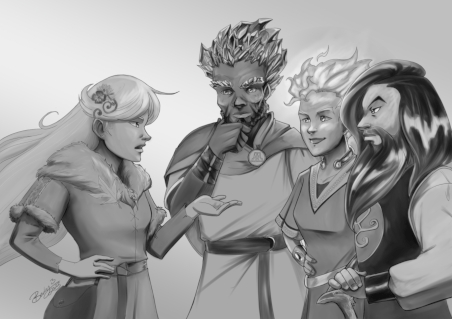
The Síoraí (pronounced “see-or-EYE”) were born from mortal people whose spirit had been displaced by a spirit from the Fæ realms. Though their bodies remain mortal, albeit with extended lifespans, their Færie spirits reincarnate into newborn bodies after their former body expires. Since time in the Fæ realms passes differently than it does in Fahr Ryasc, a given Síoraí’s Færie spirit may reincarnate quickly, or ages will pass before the spirit sees the world through mortal eyes again.
Over the centuries as the Síoraí developed as a people, the influnce of the Færie spirits has become more pronounced. The Síoraí have grown more distinctive among themselves, assuming a physical form more pleasing to the Færie who live within their mortal vessels. While, in some regards, this continued metamorphosis of the moral bodies are considered beautiful by other mortal peoples, they have grown inceasingly inhuman by contrast.
The Færie spirits inhabiting the Síoraí have long memories, sometimes being able to recall events from past incarnations. However, their time as spirits within the Færie realms is hidden from them, and they can only remember the fullness of their many lives when existing as spirits there.
Basic Information
Anatomy
Síoraí are humanoid in appearance, though they are taller and thinner on average. Síoraí have two sexes and reproduce heterosexually. Their physical bodies go through puberty before reaching maturity and women experience menopause during middle-age.
Síoraí also have two folk, which derive from the Fæ courts their spirits belong to. The Deasíoraí are connected to the Deadí Færie court of Long Days. The Bansíoraí are connected to the Banyte court of Long Nights. The Fæ are ruled by the Deadí from the Spring Equinox through the Autumnal Equinox and the Banyte from the Autumnal Equinox through the Spring Equinox.
While the Deasíoraí and Bansíoraí are the same people, they each vary in complexion and hair color. Deasíoraí tend towards deeper brown and ruddy complexions coupled with fair red and yellow hair and light eyes of green and blue. Bansíoraí tend towards pale skin coupled with black hair and dark eyes.
Genetics and Reproduction
Síoraí reproduce sexually, most often births are singular, but dual and multiple births are not unheard of. Infants are not yet possessed of Færie spirit at birth, but by the time the child reaches it’s second anniversary, about the time they begin to learn how stand and take their first steps, their Færie spirit fills the mortal vessel and they develop into Deasíoraí and Bansíoraí as appropriate.
Growth Rate & Stages
Síoraí grow similarly to other mortal peoples, reaching maturity in 18 to 20 years. Once reaching adulthood, they age half as fast due to their Færie nature. Thus, Síoraí reach Middle Age by 60, and old age by 100. They survive for another 50 years, with a natural lifespan of 150 years.
Behavior
Síoraí often seem indifferent to others, and self-centered. They have an unusual perspective on events and relationships due to their multiple incarnations through out ages. Even though the mortal body they inhabit may be only decades or a century old, their spirit, being of the Færie, can recall memories from multiple lifetimes. The Síoraí have difficulty relating to the here and now, or to people who will inevitably become only distant memories of past lives.
There is an exception in other Síoraí. Síoraí recognize and can empathize with other Síoraí in ways that are simply not possible with other mortal people. Síoraí are among the very few people in Fahr Ryasc who have the shared history of experiencing multiple lifetimes over the course of ages, and can form tight bonds with the inherent promise of those bonds renewing in future incarnations. Síoraí are able to share with one another first-hand experiences of events that no other living mortal could have been through.
This also makes Síoraí rather archaic as a people. They derive a certain comfort from the familiar, being grounded in habits and environments of their previous lives. They tend to speak with outmoded diction, being accustomed to the language they have been conditioned to speak over dozens or hundreds of lifetimes.
Additional Information
Social Structure
The Síoraí develop their societies as a mirror of their courtly civilizations within the Fæ Realms. They Organize based on their Færie nature as Deadí and Banyte Fæ and their positions within those courts, whether Noble or Small (or Common) Fæ. However, other mortals who live among the Síoraí are appointed into social positions, but are always treated as lesser, since their mortal contributions are perceived by the Síoraí as “temporary by nature”.
Síoraí who live among the other mortal realms of Fahr Ryasc, often live so apart from the established social structures. Their multiple lives and sense of mortal impermanence extend even to the great empires of Fahr Ryasc. They can’t help but see the achievements of other mortal people, even nations, as fleeting. The Síoraí find “progress” distasteful, especially the rapid progress of mortal people, unless, of course, that progress compliments themselves or their aesthetic concerns.
Physical characteristics
There is a definite sense of the otherworldly about the Síoraí. They are at once beautiful and distrubing to behold, especially as they mature, their mortal bodies exaggerating the mortal form, growing tall, willowy and deft with long, delicate fingers and toes.
A Síoraí’s face is long and oval, with sharply angled almond-shaped eyes, high cheekbones, a sharp blade of a nose, long tapered ears and a narrow mouth. There are further distinctions between the Deasíoraí and Bansíoraí. Síoraí men can grow facial hair, but it’s normally thin, fine and short, matching the hair covering their head and it usually comes in after middle-age. Síoraí women do not normally grow such facial hair. Both sexes grow sharp angled eyebrows, and tend towards high foreheads. Neither sex develops wrinkles or sagging until very late in life, 130 years or older.
Síoraí hair remains a consistent color throughout their lives, seldom going grey or white with age.
Geographic Origin and Distribution
The Síoraí can be found nearly everywhere in Fahr Ryasc, but are most common in their realms located in the Tanglewild forest in the South, the Elderwild forest in the North, and beneath the Auborobua mountains.
Average Intelligence
The Síoraí possess typical mortal intelligence. However their Færie spirits provide them access to knowledge from their past lives and a perspective that is more supernatural than the average mortal experience. This gives the perception that Síoraí are more knowledgeable than most people (also are eternally irritating to sagacious professions that deal in secretive information as a Síoraí, after an evening of meditation can recall some bit of esoterica which takes others days or weeks of research in archives).
Perception and Sensory Capabilities
Síoraí, being born from mortals, have senses of smell, taste and touch that are similarly sensitive as their cousins throughout Fahr Ryasc. However, their Fæ ancestry makes their senses of sight and hearing almost supernaturally sharp.
Civilization and Culture
Major Language Groups and Dialects
Lazáqo is the primary language spoken in the Síoraí’s homeland of Záqu, hidden deep in the Tanglewild forest. The Elderwilde forest is home to the northern realm of Taur Ymagar, speaks a dialect of Lazáqo named Vakláno. The Síoraí realm of Berízal deep below the Auborobua Mountains speaks a dialect of Lazáqo known as Berxáno, which is the most widespread common language of the underworld civilizations beneath Fahr Ryasc
I’ve been playing and running the first Science Fiction Role playing game since 1985. My high-school buddy Chuck R ran an amazing multi-session adventure based on the Aliens movie released in ’86. It was brutal and so much fun. We made so many characters during that game. Xenomorphs are freakin’ deadly.
So are player-characters. We killed as many PCs as the Xenos did. One of our players was super-proud of the Armored Fighting Vehicle he custom-designed, and the first time he rolled it out, his character lost control of the vehicle and ran over five characters he was coming to rescue.
Good times!
Life-Path Characters
Traveller was also the first game to use a life-path method of character generation. Instead of generating a bunch of stats, choosing a class and diving into the life of an adventurer, Traveller characters start as 18 year old (or the age of majority for their species and culture) young adults. Players then start choosing career options. Choices are not guaranteed, the player has to make a check for their character to qualify for and join a career. If this check fails, the player can subject the character to the Draft, start a background as a Drifter (think “Space Hobo”), or can just begin game play with the background skills their character earned growing up. Players then roll checks for their characters in four-year terms, earning skills, advancing in their careers, having life-events, and most infamously, rolling Survival checks.
In the early editions of Traveller, failing the survival check during character generation means the character died in their career. Start over, roll some new stats, make a new 18 year old character. This made character generation into a mini-game of it’s own. Because the careers that offered skills and benefits most effective for adventures were often the most dangerous, such as Marines or Scouts, there is a risk/reward decision. Every term spent in a dangerous career can return coveted skills like Pilot (Starship), Gun Combat, Recon, Heavy Weapons, you know all those cool action-adventure skills. But every term runs the risk of the character dying in service and all those skills are lost. But, they died a hero! Probably. Maybe.
In latter-editions of Traveller, the survival check has been re-contextualized as less lethal. Failing a survival check now results in a “mishap” and often the end of a career or character generation. But, the character is alive and with an interesting story in their history.
There are also less risky careers, just Citizens of the galaxy. Administrators, Academics, Scientists, and the like. Survival rolls are easy to succeed with (though there almost always is a slight chance the character fails and is “hit by the Space Bus”) and though the skills are really useful (try to get your Marine friend out of the local lock-up without any Advocate skill), they won’t cover shooting guns, stabbing goons, or flying space-fighters. Players can also choose to change careers during this process, and with that, the diversity of character options is, well… galactically huge.
This often resulted in beginning adventurers having long histories and high skill values. It wasn’t unusual to see a group of Travellers start campaigns in their 30s and 40s, with high military ranks and contacts throughout Charted Space.
In more recent versions of Traveller, the concept of character connections have been introduced. So instead of a half-dozen random strangers being thrown on a tramp-freighter, characters can be old service buddies, ex-lovers (or ex-spouses), and all sorts of other potential connections. This encourages players to not just care about their own character, but about the other players’ characters at the table. It’s easier to abandon some guy you met an hour ago in the spaceport bar to the ravenous tooth-beasties than it is to leave the person you served with during the best times of your life.
Charted Space and the Third Imperium
The default setting for Traveller is called “Charted Space”. Located in a slice of the Orion Arm of our galaxy and including Terra, it echoes the universes of Asimov, and Niven, Herbert and the sci-fi fiction just before Star Wars changed everything. Traveller was first published in 1977, the same year Star Wars entered theaters. The Third Imperium is a feudal interstellar empire that rules over eleven-thousand worlds. Charted Space includes the Imperium as well as empires of alien soceities such as the Aslan (Kzinti-inspired feline aliens), the Hivers, Vargr (terran wolves uplifted by an ancient alien culture), K’kree, and dozens of others.
While many sci-fi settings use “galaxy” as a short cut to a large interstellar setting, Charted Space illustrates just how big space is, and how unwieldy a galactic empire would be. I’ve been playing in Traveller for 40 years and in all of that time I’ve barely scratched the surface of Charted Space. Fifty years in this sandbox has created a setting as deep as those of the Foundation, Known Space, DUNE, the Star Wars Galaxy, or the Star Trek Galaxy.
To me, one of the fundamental technologies of Traveller that is strongest is communications. There is no “Subspace” or “Hyperspace” real-time communications. Instead communications travel at the speed of the fastest ships carrying them. There are dedicated couriers called Express Boats (or “X-Boats”) that deliver the mail and communications along established X-Boat routes between systems. However, not all inhabited systems are along the X-Boat routes, and it falls to smaller courier outfits to take the mail to the backwater systems (which is an opportunity for adventurers to earn some quick credits). This results in news taking weeks or months to cross the Imperium before it arrives at a given destination. This makes the Imperial frontier a bit like our world before the Telegraph was adopted. This also allows for people to outrun their past, or to make a living tracing those who hope to do so
IMTU: In My Traveller Universe
Traveller can be run in nearly any science fiction genre, not just the Third Imperium. Over the years it’s been adapted, inspired, or been incorporated in all sorts of setting. I’ll borrow a page from the creator of Traveller, Marc Miller and ask the rhetorical question, “How many different worlds can you think of?”
Most of us can imagine different biomes grown to planetary scale, desert planets, forest moons, jungle worlds, swamp worlds, worlds covered in oceans and ice, so on and so forth. But, this method is ultimately limited. There are only so many forest planets that we can design until they all start looking and feeling the same. (Star Wars really has this problem, Tattooine, Jakku, and Pasaana are different worlds, but they all feel like the same desert world.)
For Traveller, the solution was a game mechanic where the profile of a given world can be randomly generated. Instead of classifying worlds by biome, or by it’s ability to support live (like the class M planet in Star Trek), Traveller designs worlds by Size, Atmosphere, Hydrographics, Population, Government, and Law Level. Different combinations of World Profiles can identify different, multiple trade classifications such as agricultural, or industrial, or garden worlds, offering details that can make worlds feel different, and more diverse. Referees (the Traveller title for Game Master) can fill in entire subsectors of worlds for exploration in the course of an evening. Or, if necessary, on the spot.
Every Referee applies the Traveller rules differently in their own campaign. In the community, we refer to this as “In my Traveller universe” (IMTU). My favorite part of this, is that the Traveller Univers is large enough to contain all of this diversity in setting and campaign. Mechanically, everything in Traveller, whether it is Classic, TNE, Mongoose, or 5.1 is similar enough to be useable with nearly everything else. Honestly, in that high school campaign where I played in Chuck’s adaptation of Aliens, I played an Aslan. Big ol’ lion dude with a pulse laser and RAM grenade launchers fighting Xenomorphs. If you want to make a Wookie, or a Vulcan, or a Geminon from Battlestar Galactica, they can fit into Traveller alongside the standard Vilani/Solomani human characters and the Vargr. IMTU becomes the shorthand for the setting differences that the player can expect from this particular instance of Traveller. It has been this way for 50 years almost.
IDTU: In Dezzy’s Traveller Universe
I should give you all a little bit of context here. When I first started playing Traveller in the ’80s, it was the first “Classic” version. The Third Imperium was set in Year 1105 (1107, by the time the Fifth Frontier War started). I mostly ran my games in the Solomani Rim sector because my two go-to Alien Modules, Aslan and Solomani were set near this area.
In 1987, Traveller’s publisher, Game Designer’s Workshop and their partner Digest Group Publications produced the next version of Traveller, dubbed MegaTraveller, this expanded the mechanics, updated them a bit and advanced the Third Imperium to the year 1116. It also introduced a major change to the setting, dubbed the Rebellion, or the Shattered Imperium.
In MegaTraveller, the Emperor Strephon is assassinated by the Archduke of Ilelish doman, Dulinor, and the stable Imperium fractures into a multisided civil war. Like all major changes to RPGs (and pop culture for that matter), this was a huge controversy. Even back in 1989 gamers were really eager to dive headlong into arguments and fights over the media they felt ownership of. In My Traveller Universe, I’d chosen to ignore the Rebellion War, and continue my Solomani Rim campaigns without jumping the timeline ahead nine years. It was still 1107 (or so) and the events taking place in the Rim were still in a (relatively) stable Third Imperium.
1n 1991 I saw a supplement for MegaTraveller that caught my imagination.
It was the Hard Times, and that cover just scratched all my Sci Fi Adventure itches. I still have my now 33 year old copy. The Hard Times advanced the Third Imperium timeline nine more years to 1125. The Rebellion War never ended with victory for anyone. Instead, all the factions fighting one another had exhausted their resources, and in the last years of war, had destroyed the infrastructure that allowed the Imperium to run. Economies collapsed, worlds failed, and communications broke down.
Library Data, the thing that the Imperium kept up to date so Travellers would have some idea of what to expect as they journeyed from system to system, lost it’s regular updates. Travel data stopped being accurate. The system you left three months ago, might be completely different when you return. It might be dead. It might have had a change in government and isolated itself from the rest of the sector. It might have become part of a Pocket Empire, and no longer recognized Imperial Law. A rival fleet could have flown through and saturation-bombed the main world. The most valuable asset that a crew could have was often the records of the recent systems they visited. Hell, in the Hard Times, even the X-Boat Routes became unreliable. The mail couldn’t get through.
My Traveller Universe advanced to the Hard Times on the spot.
Then, I moved to California and GDW changed Traveller again! Another controversy, another round of edition wars. This time it was 1993. I was excited to find a new Traveller version to go along with my new city and new state.
The New Era advanced the Third Imperium timeline to the year 1201. The collapse of the Hard Times had become a complete Apocalyptic catastrophe in year 1130 with the release of a superweapon, VIRUS. Essentially VIRUS was self-aware, weaponized software that spread through computer networks. So long as a given system was powerful enough to host an iteration of VIRUS, the weapon would turn that system against the societies that used it. Think Skynet from the Terminator Franchise. A malicious, aggressive, weaponized artificial intellect that desired the genocide or enslavement of all organic sentience it could find. VIRUS would infect a starship, and without warning purge all the airlocks (and crew) then if it were in proximity, turn any weapons on any nearby un-infected ships it could sense. VIRUS would set powerplants to overload, open habitats to vacuum, or poisonous atmosphers, or the ocean. Even most household appliances in the Imperium had enough processing power to host a fragment of VIRUS. Maybe your toaster couldn’t kill you on it’s own, but it certainly could infect the rest of your home, or vehicle and find something to murder you and your family with.
By 1201 the survivors of VIRUS had started the long road to recovery. That’s what the New Era was about, reconnecting interstellar civilization and avoiding Vampire Fleets and Murder Warbots. There were parts of the New Era I enjoyed, and there were parts I really didn’t. For me, it had changed too much. The adventures and setting supplements presupposed that Traveller was specifically taking place in this setting with these environments. If you wanted to play Traveller In Your Traveller Universe and not in The New Era, you’d have to do a fair amount of extra work. In short, The New Era didn’t feel enough like Traveller for me to really enjoy it.
My appreciation for VIRUS would come later.
I was surprised to see the 4th edition of Traveller “Marc Miller’s TRAVELLER” when I found it in my FLGS in 1996. I picked it up on the spot, but it’s setting “Mileu 0” had the same issues for me that The New Era had. It was just too different from the Traveller I enjoyed, and the game mechanics had been changed again from the system used in TNE, which was different from the system used in MegaTraveller. For me, TRAVELLER 4 wasn’t the Traveller I wanted.
Quick Link Interactive adapted Traveller to the d20 OGL in 2002. It drew me back to Traveller for the first time in almost ten years. I’d been running a lot of 3rd edition D&D in this time and Traveller20, as it came to be known, was really effective in introducing a whole new group of D&D gamers to the universe of Traveller. One of the elements of Traveller that was carried over to Traveller20 was the Life-Path mechanic adapted to the d20 system. Which I really adored!
Mongoose Publishing came to my rescue in 2008 with it’s retro-design of Classic Traveller. I remember finding a copy of Mongoose Traveller in the dealer room at KublaCon. The hardback cover was an homage to the original little black books of Classic Traveller. That became my new go-to version of Traveller. I blew the dust off My Traveller Universe and happily returned to the Far Future.
Since then, and the date of this writing, Marc Miller, with Far Future Enterprises published a Fifth Edition of Traveller, TRAVELLER5, in 2013 and a cleaned up revision 5.1 in 2019. Mongoose updated their version of Traveller into a Second edition in 2016 and published updated revisions in 2020 and 2022.
In Dezzy’s Traveller Universe, I’m mainly using the 2022 version of Mongoose Traveller 2nd edition with a fair amount of the crunchy menchanics from TRAVELLER5.1 in the background. I am setting my next campaign in Diaspora sector during the Hard Times of 1125.
Conclusion
If it’s not clear by now, I really enjoy Traveller. It’s my favorite Sci-Fi game, and I think it’s enjoying a renaissance among the older generation of gamers. Recently, Mongoose Publishing has purchased the rights to Traveller from Marc Miller and Far Future Enterprise, which places the game in good hands for the foreseeable future. I’m excited to see what Mongoose Publishing does with their stewardship.
As a role-playing community I think Traveller players have an opportunity here. We can introduce a whole new generation of gamers to Traveller and it’s rich history. Show them Your Traveller Universe.
I’ve been playing D&D since the 80s. And I gotta confess. I never really liked how Darkvision (or Infravision, or Ultravision… etc) worked, either rules as written, or as played. Rules as written (5th ed, 2024), Darkvision allows your character to see in darkness as if it were dim light, and in dim light as if it were bright light out to the defined range. Such vision is monochromatic. Infravision from 1st ed is much the same, except that with infravision, the character sees sources of heat. Which allowed for all sorts of “creative” interpretations by Dungeon Masters and Players alike.
The problem with the rules as written is, it’s just a flashlight from your vision that only your character can see. The rules imply that, except for being colorblind, the character’s vision is otherwise unimpaired. If a note, for example, is written on the wall with enough contrast, the character can read it without difficulty. Things lurking around in the dark are visible, and can be identified. They are rules designed to be simple to interpret, remember, and apply. Infravision is much the same, except instead of a flashlight, it’s IR Nightvision goggles.
Rules as played, Darkvision and Infravision make being in the dark an inconvenience rather than a mystery. The difference between “dim light” and “bright light” are applied only mechanically, and even then, most penalties can be mitigated with class abilities or feats. There’s even the spell, Darkvision that confers the ability to a willing subject for 8 hours. Because the effects of being in the dark are so trivial, it’s often forgotten about. Exploring a dungeon is about as disorienting as a poorly-lit hallway. Descriptions include details that would likely be concealed, and when the dark is mentioned, it’s an uncommon enough detail that it becomes a hint that the adventure designers are concealing something.
Let me tell you a story about a TPK
Years ago, I ran a D&D campaign, and in the very first adventure, half the characters were humans, while the other half had Infravision. The characters went to the dungeon location a few miles from town and climbed down to brave danger and gather treasure. I asked how everyone was going to see down in the dark, and the players of the characters with Infravision announced they could see in the dark. Then everyone checked their character sheets. No one had brought torches, lanterns, lamps, no light sources. No one chose to go all the way back to town to get some light sources. everyone just strung rope between one another and the characters who could see in the dark led the unsighted deeper into the underground maze.
The party ran into trouble after angering the troglodytes who lived in the caverns, and most of the party fell in combat. Except for two characters who fled when the battle was going poorly. Two human characters. And in the dark, with no light, they stumbled about until the troglodytes hunted them down. It was exciting, memorable, and some of those players tell the story about that TPK even after more than 25 years.
The Dark is a tool for the Dungeon Master
Part of tabletop roleplaying is the shared imagination at the table. Dungeon Masters can set the mood, pace the tension, bring the players into their characters’ experience. The dark forces the DM to describe the dungeon with senses other than sight. Sounds echo, unknown smells linger. the air can be suddenly cold, or warm, dry, or wet. Darkness closes in, and the characters’ world grows very small indeed.
The dark also encourages the characters to stick together. One of the few comforts in these situations is simply knowing where your friends and allies are. Characters who head off into the dark by themselves often find trouble quick, fast, and in a hurry. Coming to the rescue becomes a terrifying race. Or worse, the stray character is never found, just the odd, broken piece of equipment marking their desperate fight for survival.
The dark also grounds the environment in the players’ imagination. We expect it to be dark in deep caverns or abandoned mines. Reminding the players of the dark keeps them thinking like explorers instead of tourists. This way, when the characters enter a location even with dim light, the presence of light alone becomes a clue to the mysteries of the dungeon.
Bring a Torch
In current iterations of D&D there is a trend towards offering the “Standard Pack” of gear to begin their adventuring career. These packs often include critical, if often overlooked, items and among them are torches.
Torches last one hour and cast bright light out to 20 feet and dim light an additional 20 feet. They throw shadows, and illuminate differences in color. At the DM’s discretion, a lit torch may be reflected from further still.
I like to use torches (or candles, or lamp oil) as treasure at times. Since torches add 1 pound of encumbrance each, scrounging torches from the dungeon itself allows the group to extend their time underground. Light, even among populations that naturally possess darkvision, remains valuable. If for no other reason, no one really wants to fumble around in bad lighting, even if they can see through the darkness.
Darkvision House Rules
At my table, I define Darkvision as being able to perceive the magical energies that the world radiates. Perceiving these energies reveal them to be a constantly changing blend of all colors at once. In practical application, this still comes across as monochromatic, but I think it helps sell “the world is a magical place” theme.
This also means that the environment when seen through Darkvision casts different shadows than the environment when seen by a light source. Clever people make use of this feature to aid in concealment. For example, perhaps a secret or concealed passage is present that when seen in Darkvision is concealed, but when a light source shines on it, the cast shadows reveal it’s presence without the need for a Wisdom (Perception) roll (or vice-versa). Messages written in a color of the same shade as the surrounding area would be all but invisible to Darkvision, but stand out clearly under direct light.
Conclusion
Tabletop Roleplaying is an exercise in immersion. The deep places of the world should feel dangerous, frightening. Denizens of the underworld have every advantage, after all, this is their native environment. The civilizations that have grown far from the open skies of the surface, use the dark of the underworld to their advantage. Natural hazards, cave-ins, deadfalls, areas of poisoned air, All of these are enhanced when presented from behind the curtain of the dark. Explorers need to be cautious, if not careful or they will find themselves lost in the dark.
Gyldport was a growing Free City and her merchant fleets are threatening to surpass the mighty trading fleets of the Old Xjinn Empire. Of the Sea Cities, she is the only city state that was never part of the Old Xjinn Empire. Rising from relative insignificance to fill the void in commerce left as the Old Xjinn Empire withdrew into itself.
Gyldport was founded on the Vokojupiv, a small, mist-shrouded island between the mouth of the Naargik Straits and the Domain of the Reef King. Initially, the island, hidden beneath almost perpetual fog from the cold waters of the strait meeting the warm water of the Marakhor Sea, and it’s treacherous approaches from the reefs, was a pirates’ haven. Dozens of small ports, harbors, and anchorages were spread across Vokojupiv, and it’s nearby islands. During the centuries that the Old Xjinn Empire had retreated from it’s place of dominance on the Marakhor, the pirates of these small ports grew prosperous. Soon, they were able to unite as a league, with their capital founded at Gold Harbor, later renamed Gyldport.
Gyldport has spread over a great deal of the island, growing up as it reached the extents of the island’s available land. The buildings, made of stone quarried from the mainland are five stories high, sometimes more. The architecture of Gyldport has advanced beyond the static designs of the other Sea Cities, engineering structures to be strong without crushing themselves beneath their own weight. Flying buttresses criss-cross the city from one building to it’s neighbor in a web of mutual support. Several of these have been built out into causeways that allow folk to walk from one building to the next above the street.
Of the Sea Cities of the Marakhor, Gyldport has the most diverse population. People from every ethnicity in Fahr Ryasc, from the Bryndlands of the north to the Old Xjinn Empire, and the Sea Cities along the eastern shores of the Marakhor Sea. Bryndffolk, Tralfolk, Xjinn, Ra’akhen, Hsaahn, they all can be found here. Ethnically homogeneous neighborhoods, exist across the street from communities of mixed heritage. Gyldport is a chaotic swirl of languages and cultures, often bordering on anarchic and lawless at times. As would befit it’s piratical history.
Gyldport’s navy rivals the Imperial Xjinn Navy, although the Imperial Navy has a large advantage in shipbuilding. The navy of Gyldport is divided into several semi-independent fleets and flotillas, each under a Lord Admiral. The navy has evolved from being a collection of pirates to merchants, pursuing valid trade with the other Sea Cities and the tribes of the North.
Gyldport’s civil administration is heavily factionalized. The city-state is governed by a council, representing the most powerful guilds and fleets. These factions maintain control over their territory, fleets, and docks including keeping the peace and collection of taxes. This makes Gyldport a patchwork territory where some boroughs are little more than gang turfs where protection is purchased through extortion and press-gangs prowl the streets at night and others are gentrified communities with municipal services and civic institutions.
The council itself varies in its membership, though it is seldom less than a score of councilors or more than thirty. The council conducts diplomacy with the other realms of Fahr Ryasc, collects taxation from the various districts, or duties from the various fleets. There are several offices independent of the council which facilitate the bureaucratic functioning of the government.
The following is a partial list of council-worthy factions in Gyldport
One of my longest-lasting characters is a Half-Orc fighter. I made Darshag in 1988, and played him in every edition of Dungeons and Dragons and Pathfnder 1st (except 4th,but we don’t talk about 4th.) After 37 years, Darshag is a fully realized character, he’s got a really rich and detailed career. Recently, I designed Darshag’s daughter Zhaagdar who has begun her own adventuring career.
With the 2024 revision of 5th edition of D&D, multiethnic characters, specifically Half-Orcs and Half-Elves have been “removed” from the Players’ Handbook. You may not be aware of this, but this isn’t the first time Half-Orcs have been removed from the Player’s Handbook. Back in 1989, with the publicaton of 2nd Edition D&D, Half-Orcs were also removed from the Players’ Handbook. At least with the 2024 revision of 5th edition, Orcs are used to replace the Half-Orcs.
Certain segments of the Fantasy Roleplaying Community are vocally and loudly outraged by this. “Orcs!” they say “being removed from the Monster Manual changes the game! The new players will no longer see orcs as faceless minions of evil! Orcs will be shown as kings, heroes, the Good Guys!” and they’ll rend their garments and fall into the dust in woe and despair. Okay, maybe only in social media will they take such extremes. Even the old grognard-gamers have the same capacity for drama (even if they often deny it) as the theater-kid post d20 gamer is. Much of this is simply that there are evolving depictions of the monsters in D&D. Some of it is that the fantasy folk in D&D have traditionally been starkly divided between “Good Guys” (humans, elves, dwarves, gnomes and halflings) and “Monsters” (orcs, goblinoids, drow, kobolds, etc..). The original treatments of player character options supported the good guys and varied between outright prohibiting and creating a labyrinth of rules if a player wanted to play a monster.
The good news for all my old-school grognard friends is that those rules still exist and are still supported by WotC (through Drive Thru RPG) and an entire segment of FRPG publishing in the Old School Revolution (or Original Spirit Rules, or a half-dozen other application of OSR as an acronym). Furthermore, most of the people who are complaining about the adjustments of the Players’ Handbook and Monster Manual in 5th edition aren’t playing 5th edition D&D anyway! They’re already playing their lovingly annotated 1st or 2nd edition D&D, or Castles and Crusades, or Swords and Wizardry, DCC, the Black Hack, or a dozen other games that scratch the itch.
Orcs as Bad Guys
There is an argument to be made that Orcs (and all Monster ethnicities, including Drow) are simply fodder for heroes to defeat, kill, and move on. They’re soulless, or damned, or grown from vats at the bottom of the spawning pits of Campaign Big Bad. This most commonly comes out of Tolkien’s Middle-Earth and similar worlds of fantasy fiction. The orcs in this case are not people, they may look like people, but they are soldier-ants with no wills of their own. They are extentions of the Sorcerers, Demigods, Demons, and Evil Emperor’s will. They don’t have families, they are spawned, fully grown and armed with their spears, falchions, shields and helmets and marched out to war.
This characterization absolves the player characters of any moral considerations when their 20th level barbarian cuts through them by the score every round. Wiping out a tribe of these orcs doesn’t involve non-combattants. Every single orc from the war-chief to the clan priest, to the cook is an active adversary. There’s no one who will miss them when their dead, mourn their loss, or wonder when they’re ever coming home.
These guys are born Evil (or spawned Evil) from the start because the will that motivates them is the Evil of their “Master”. They don’t have an inner life to make them sit down and contemplate “why”. This works great for video games, it works great for wargames, it even works for role-playing games so long as the setting isn’t concerned with three dimensional characterizations of the Orc Warrior.
It does come with problems though.
Having someone who carries all the trappings of being a person, does blur the lines of their person hood. What’s more, even the hordes of the Demon-King have some-sort of society, rudimentary and crude as it may be. That society can and often is based on real-world peoples. The language used starts to reflect the language used to classify and condemn real-world people as sub-human. “Savages, Witch-Doctors, Shaman, Chief, sub-Chief, Berzerker, Brute” these have all been used in RPGs to classify the different types of Orc. Even the classification of “Humanoid” is a perjorative.
These terms have also been used to classify people. Colonizing cultures always paint the people they colonize with these terms to justify the treatments they inflict on them. Colonizing Nations go to war with peers and have “rules”, but they cleanse the lands of the colonized people. The “rules” didn’t apply when Manifest Destiny was involved.
It’s a buzz-kill, if all you want to do is blow off steam after a week of drudgery and just be the main character of your story for a couple of hours. And then there’s this bleeding-heart making comparisons with the real-world, and honestly, at that moment you don’t care! Just roll your attack already!
The old-shool players have a point. Orcs are not the First Nations, were never intended to stand in for Africans, and are just made up. They’re just taken from Lord of the Rings, man! Even the author of Middle-Earth, and the creators of Dungeons and Dragons have been clear, they never intended their depictions of Orcs or Goblins, or Gnolls to be anything other than Orcs, Goblins and Gnolls.
The second problem, for me at least, is that having Orcs as hordes of soulless cannon-foder is boring. They’re just tallys of hit points to be whittled to zero by my dice rolls and experience to be added to my total so I can level up and gain yet more abilities to kill more of these guys faster. I’ve been playing D&D for 44 years as of this writing and I can say that I’ve done this to death. I need more.
Furthermore, video games manage this much better and far more entertaining than humans can. AND there aren’t any scheduling problems.
Orcs as people
What the trend has been over the past quarter-century is that Orcs, Goblins, Kobolds, Drow, etc.. are peoples. They do have societies, histories, individually they have goals and ambitions and parents and there’s someone back home that will wonder what happend to them when they don’t come home. People can be sympathetic. People can be complex. People, can be interestng.
In this argument, Orcs have reasons to be invading. Even if that reason is as simple as their war-chief says “invade”. They can still be minions of the big campaign bad guy. They can be devoted to the demigod, or the emperor, or the sorcerer. They can be swayed by promises that once those Elves, or Knights, or Dwarves are dealt with, their bellies will always be full. As Saruman says in the Peter Jackson adaptation of the Two Towers, “You will taste Man-Flesh!” From what I’ve read, man-flesh tastes a lot like pork, and pork products are yummy, so I can see the appeal.
Point being in this instance, that Orcs can still be Evil. They could be slaughtering villiagers (and eating them). They can be reveling in slaughter because that’s what they want to do. They can covet the riches and wealth of their neighbors because it’s riches and wealth. It’s just that in this case, the Evil of these Orcs is a choice.
Orcs as people might not even be Evil as Evil is defined by the alignment chart, they might see themselves as Good. All they really want is to make life better for themselves and their Orc-kids and Orc-families. There are non-combattants in these communities. There might be farmers who are desperate to bring in one more harvest from the blasted wasteland that their tribe lives in. The lands the orcs are invading might be fertile and rich. The Orc farmer might be telling thier chief that if they were to be farming that land, they could grow enough food for everyone and more.
Orcs with wants and needs can be negotiated with. That’s something that doesn’t happen in Middle-Earth. Orcs there don’t surrender, nor do they beg for mercy. They’re working, ultimately for Sauron, and his will is their will. When orcs are people, they want to live. In their heart of hearts they personally want to keep living, even if it’s for one more year, one more day, or even one more hour. This also provides a good opportunity to cut boring combats short. The orcs just break and run or throw down their weapons and surrender. The combat ends when the GM decides that it’s just a boring series of dice rolls and arithmetic. The orcs can be bribed. They might be convinced to look the other way with some coins offered. They can be turned. Orcs can be convinced there is a greater thread and ally with the characters. They can be shown mercy and in return, fight for their savior until they feel their no longer in debt.
This is something that video games don’t often do better than a human GM.
Like with the examples in the previous section, there are problems here as well. For one, giving NPCs goals and ambitions piles a lot more work on the shoulders of the GM, especially if these NPCs start working with the player-characters. This also threatens to pull the spotlight away from the players’ characters. Since the GM is omnipotent with regards to the adventure and the setting, that can leak over to the NPCs who interact with the characters. This can make the NPC invaluable, and coupled with the NPCs goals, the characters can end up as marginal chararacters in their own story.
This approach also makes the moral landscape more complex. When Orcs and other human adjascent monsters become people, they often have families, communities, in short, innocents. When confronted with this it becomes a moral choice for the players as to how their characters will manage a newly-defenseless Orc community. It’s one thing to burn the spawning pits of faceless hordes, it’s entirely different to put a village to the torch. For many players, this isn’t why they play D&D. Instead of being boring, this approach can become too demanding.
So what about Half-Orcs?
The simplest solution, is to just use the Half-Orc (and Half-Elf) entry from the 2014 Players’ Handbook. The 2024 revision remains very compatable with 2014, and very little alteration needs to be made.
Another very simple solution is to choose the character’s species’ abilities from one parent or the other. “Little Blorg sure takes after his Mother, an orc just like her!” Of course, the GM can make all sorts of house rules for Half-Orc player characters tailored to the character and the campaign.
With regards to the Half-Orc character’s circumstances of birth and parentage, it is imperative that the primary choice belongs to the character’s player. That being said, the other players in the group and the game master also get to have an opinion. Remember, everyone at the table, including the game master are there to have fun and everybody needs to accomodate one another if D&D is to be a positive and fun experience. But this is really true regardless of a given character’s species. Any species option could have as pleasant or problematic histories as any other. An argument can be made that even if the Half-Orce can be as virtuous as possible, if the assumption towards their history is problematic because Orcs are involved, that’s just as racist as assuming the character is “rude, crude, crass, and generally obnoxious” or mandating that all Half-Orcs get penalties to Charisma or Intelligence while getting bonuses to Strength and Constitution at the same time.
The reactions of NPCs to Half-Orcs, or Orcs for that matter should be established and agreed upon by the players and the game master. Role-playing racial abuse is difficult. “We don’t like your kind ‘round here”, while likely authentic and supportive of verisilimitude, can be uncomfortable or unfun for everyone involved. Thus, the degree to which racial segregation is detailed should be agreed upon early in the campaign, and should be open to revision at any time during game play.
What about the Drow?
Many of the same issues facing Orcs in D&D also affect Drow. On the one hand, Drow can be Evil from the start, corrupted by their intimate spiritual connection to Llolth, Demon Queen of Spiders. Only in very rare cases can individuals overcome this damnation and pursue a life not beholden to Chaos and Evil. And on the other hand, Drow can be born withough predestination towards Evil, but learn how to survive in a Chaotic Evil society. Individuals born with strong empathic instincts or kind hearts seldom survive with those virtues intact. If they survive at all.
The difference between Drow and Orcs in the fictions of D&D and fantasy literature is that Drow are seldom portrayed as mindless hordes. Drow are seldom characterized as being spawned fully grown. Drow, it is commonly agreed on in the writing, are born of mothers and have childhoods.
But Drow and Orcs do share a similarity with regards to the approach that they are both Evil from the start of their lives. With Drow it’s the influence of their Demon Goddess. In this approach, the Drow don’t have agency, never do, even Drow infants are Evil and devoted to their Goddess. This approach also suffers from the “Orcs as midless spawn” problems described earlier
Drow born into an Evil society maintains the possibility that if the Drow infant is born and raised outside of the influence of their Demon-worshiping society, they will develop with agency and free will. They may still turn out evil, of course, but it’s not a predetermined result. This approach does mitigate some of the moral quandries because Drow society is so thoroughly dominated by worship of Llolth that only the youngest non-combattants encountered will not already be devoted to the cause of evil. But it still has the same moral quandry mentioned with the Orcs. What to do with captives who are not only innocent, but helpless as well. Not every player group wants to play the adventure where they shepherd a nursery out of the dangers of the Underdark.
Conclusion
This simply is a non-controversy. Despite the amount of noise surrounding it. To which this article is contributing, if we’re keeping things 100. It still boils down to playing a game with friends telling the stories you want to tell. Showing one another some basic respect, and understanding that the ways to play Dungeons and Dragons are as varied as the millions of people who have been playing D&D for more than 50 years at this point. If you’re having fun, you’re doing it right.
The Bryndffolk are a human people who live among the Kælish Highlands, Kymrau Mountains and the Kharian Basin. As a species, the Bryndffolk are born with characteristics of the elements. These characteristics are used commonly as social distinctions within Bryndffolk culture, more so than their gender expression. They have a primal, elemental bond with the land of Fahr Ryasc. They divide themselves among three tribes and those subdivide themselves among Clans. They have a strong cultural pride on having never been conquered, and remain fiercely independent.
There are four elemental bonds among the Bryndffolk, they are spiritual (even soulful if you prefer) and established at birth. There is no known or understood connection between parentage and elemental bond. A child can be born with any elemental bond, even twins or larger multiple births can have differing elemental bonds. The Druí believe this bonding is made by the Elemental Sovereigns through their own inscrutable wills and agreements.
The Karrak Brynd
Bryndffolk with a bond to the element of Stone, the Karrak are often larger and stronger than thier other Bryndffolk cousins. They are stoic and unyeilding (some would say stubborn) like the mountains they are related to. Unsurprisingly, they have skin, hair and eye colors that tend towards earthy tones.
The Ganigan Brynd
Bryndffolk with a bond to the element of wind, the Ganigan are free and unbound, They tend to be slender when compared to their Bryndffolk cousins and have light complexions similar to those colors found in the sky. They are mercurial in nature, but possess a keen insight into the nature of others. They are swift and fleet of foot as their elemental bond woul suggest.
The Fflam Brynd
Bound to the element of fire, Fflam Brynd are passionate and excitable. They are lithe, often athletic, and can be very graceful when compared to their Bryndffolk cousins. The Fflam Brynd are exceptional acrobats and dancers, combining their inherant agility with their passionate nature to express themselves superbly when moving.
The Tonna Brynd
Tonna Brynd are bound to the element of water. They have strength that can rival the Karrak, and an agility which can rival the Fflam. However, despite these extremes, the Tonna Brynd are the most centered and balanced of the Bryndffolk. The Tonna Brynd have cool complexions in their skin, hair and eye colors.
Nations of the Bryndffolk
The Bryndffolk are numerous in the North, as common as the Tralfolk. They have organized into three nations based on their geography. Within each nation there are several Ræmse (Bryndspek for “kingdom”) that rule themselves independently, sending representatives to a Kings’ Council called a Rhæag. Within each Ræmse, the Bryndffolk further form clannish communities that are semi-autonomous.
Just like Bryndffolk families can be found amongst the Tralfolk realms, the nations of the Bryndffolk hold citizens from all the peoples that can be found in the North.
Kymrou
The Kymric Brynd consider themselves the first of the Bryndffolk. When the ancient, sorcerous realm of Vakra sank into what would be the Kharian Basin, the ancestors of the Kymrou escaped to the only lands they could find that were safe from the catastrophe, the Kymrou Mountains. There, they established communities free from the domination of Vakra. Kymric legend maintains that this is when the Bards and Druids mark the beginning of the Bryndffolk. High up the face of the Kymrou Mountains, they await the return of the Aírdrígh, and the reunification fo all the Bryndffolk.
Kælish Highlands
The Kælic Brynd are Bryndffolk from the Kælish Highlands of the North of Fahr Ryasc. The Highlands are a rough region of steep hills and deep valleys, called “Kæls”, where the Kælic clans thrive. Each clan claims a single Kæl as it’s territory. Within the Kæls, the Clan’s Taisech (Chief) serves as liege. The bond of the Taisech to the land, their Talav-Nasc, impacts its abundance as much as its people do.
Kharia
The cataclysm that sank the land that became the Kharian Basin both blessed and cursed the Bryndffolk who live there. The swamps of the Kharian Basin are rich in magic and resources, but they are also home to aggressive and hostile flora and fauna. The Kharian Brynd have adapted to this bountiful and dangerous environment. They are among the finest mariners in Fahr Ryasc and are masters of navigating the dense network of marshes, shallow lakes and connecting rivers of the Kharian Basin.
The Druí Roth Mohr
The Druí Roth Mohr is both a faith that worships the natural deities of Fahr Ryasc, named the Circle of the Cycle and the college of Druid – Priests called Druí. The Druí hold a cultural place of privelige in Bryndffolk society. In their role as keepers of Rites, Advisors and mediators among the Bryndffolk, the Druí Roth Mohr are permitted freedom of travel throughout the Bryndlands.
One of the most important rites the Druí Roth Mohr perform is the investure of the Land Binding, or “Talav-Nasc” upon the Taisech of communities within the Bryndlands. The Land Binding ties the prosperity of the land and it’s people to the rulership of the Taisech. A strong Taisech who rules in accordance with the will of the Circle of the Cycle will, through the Talav-Nasc, cause the land to flourish. Whereas a weak Taisech tho violates the will of the Circle of the Cycle, or a person who usurps the role of Taisech without being given the Talav-Nasc, cause the land, and their people to suffer and blight.
This is the subcontinent of Fahr Ryasc during the End Times. I just completed the latest revision of this map on the week of publication. For you, dear reader, I redrew and redesigned the entire subcontinent. You’re welcome.
Okay, it was also time to give this map another pass. I have iterations of this map going back to 2013 (which, by the way, is two years before I started work on “Fahr Ryasc” as a setting. I’m kinda always making maps and then finding settings that fit them best. My other big project, Genzhymyl has a multilayered underground map. I still have the piece of hot press cardstock I drew the orignal location on.
And that turned into this with a little graphic computer mojo..
This is Version 13 of that original map. I really like dreaming up these worlds and imagining the people who live here. Genzhymyl is in Fahr Ryasc, somewhere under the Auborobua mountains. It’s in the Forgotten Realms too, somewhere in the “North”.
These two settings maps are the widest scope of a “bullseye” technique that I learned from the early days of D&D. The danger here is the temptation to fill in every last detail. I used to design settings on the world level, where all of the landmasses and oceans were drawn out at a planetary scale. I don’t recommend starting off at that scale. There is just too much that your players will never ever see, and if they do, they’ll never get the opportunity to appreciate it all. Even on the continental level, the setting can be too big to detail.
Let’s look at Middle-Earth. Professor Tolkien designed a third or half a continent. You can look at that map and see everything from the Grey Havens to Rhûn. But, even the Professor’s extensive lifetime of writing leaves most of this massive creation unexplored. After all, what stories take place in Rhûn? Or the wilds of Cardolan in old Arnor? All of that space sits fallow in the Legendarium. My lesson here is “don’t start too big”.
“It’s a dangerous business, Frodo, going out your door.You step onto the road, and if you don’t keep your feet, there’s no knowing where you might be swept off to.” – Bilbo’s advice to his nephew.
There is a temptation, once you’ve drawn this big, beautiful map, with evocative names for locations and this epic scale, to share it with your players during a Session Zero, or even Pre-Session Zero. It’s natural, you’ve spent hours and maybe weeks or years creating a work of art and you want to share it with your friends. In the context of starting a campaign and buiding characters, this isn’t the best strategy.
Referring to Lord of the Rings again, the main characters, especially the Hobbits had never left the Shire before starting out for Bree. Even with Bilbo’s maps, they don’t have clue about the scale of the journey they’re taking. The characters in your campaign should be similar. They’re familiar with their homes, whether it is their village ,their farm or their neighborhood in the city they grew up in, and they might, if they’re well travelled have knowledge of their neighboring settlements and the terrain in between.
So, instead of rolling out the grand map of the Realm during character creation, draw up a simple small scale map that features the local area the characters will be starting in. Work from this map as you introduce your players to the setting. For an example, I’ll share with you the Kieran Slee in the Kælic Highlands
.This area is much more manageable, and believable for characters to be familiar with from the start. Everyone will know landmarks like the Stone Giant’s Tusk, the Kieran Slee with the Layender Inn. Beyond this little area, you can tell the players about what their characters have heard. Like the marshes to the South, the Great Hall of the Rígh (king) to the North, and the Great Stone Circles of the Druids somewhere off to the West.
As their characters travel beyond this small little provence and into the wider world, instead of providing a perfectly drawn map, instead, tell the players about the terrain and the time it takes to travel. Going from Layender Inn to the Kell beyond Ærath follows a road and it takes three days travel by foot. Encourage them to make their own map. It won’t be perfect, but after a few game sessions, it will be accurate and it will reflect the story the players are making with you.
A small confession…
As you might have guessed, this week’s blog was mostly an excuse to show off my map making talents, and chat a bit about my philosophies with regards to world-building. I don’t really have a design for this article. I just wanted to share the pretty picture, and maybe work in that quote from Lord of the Rings. I’ll be adding some more lore to the blog next week. Pinky Swear!
House Rules have been a part of Table Top Roleplaying since it’s wargaming roots. The earliest pre-D&D experiments in role playing were, in essence, house rules. Many of the developments in most of the currently published systems started as house rules that became widely adopted. Almost by definition, any game built off of an SRD could be considered a set of house rules.
Point is, we as gamers, just love to tinker and modify the rules as written to suit our own needs. Which brings us to some new house rules I’m using with my next D&D campaign. Some of these, were just alternative suggestions from the 2024 5e rules, others are lifted from, in my case, the Black Hack, and there is a “Salt Bae” pinch of Cypher System in here too. If they work during play as well as I imagine they would, I’ll keep em. Otherwise, we’ll just throw ‘em out and move on.
House Rule #1; Initiative
This one comes from an adaptation of the Cypher System initiative mechanic.
When rolling Initiative, players all roll a Dexterity ability check against the adversaries’ Difficulty Class (DC) based on 10 + their Initiative Bonus.. Characters who succeed on this check go before the adversaries and those who fail go after, in an order decided by the players. The adversaries take their turns in order decided by the GM.
In the case of varied Initiative DCs Only a single Initiative check is made against all the DC values, and characters take their turn based on the success or failure of the roll when measured against each DC in order as determined by the players.
Because Initiative is defined as a Dexterity ability check, all bonuses, penalties, buffs or debuffs that affect a Dexterity ability check applies to the initiative check. If the modifier comes as a spell or class/ monster ability, only using a bonus action or reaction will allow the spell or ability to be used in most encounters. The intention for this house rule is to encourage strategy and engagement among the players. The order of action is determined on each round, though the initiative roll is applied for the entire encounter.
House Rule #2: Usage Dice
The Black Hack defined Usage Dice as a “push your luck” mechanic. Instead of tracking the inventory of a consumable item (ammunition, rations, water, oil, magic item charges, etc..) each resource is assigned a Usage Die. The Usage Die is a single die; d4, d6, d8, d10, d12, or d20 that is rolled every time the resource is used. If a 1 or 2 is rolled on the Usage Die, it is downgraded by one die type, until the d4 is downgraded, at which point the resource in question is exhausted. This mechanic is unpredictable, and is completely dependent on the whims of the dice. Some games, the resource seems inexhaustible, other games the dice will turn against the players.
At the GM’s discretion, the Usage Die can be increased outside of the resupply or camp. In these cases the Usage Die only upgraded by a single die type.
House Rule #3: Advantage / Disadvantage
This House Rule is also lifted from the Black Hack, and is a small redefinition of the 5e Advantage / Disadvantage rule. Instead of being restricted to d20 rules, Advantage and Disadvantage can be applied to any die roll. When Rolling with Advantage, two dice of the designated type are rolled together and the player makes the choice of which result is used. When rolling with Disadvantage, two dice of the designated type are rolled together and the GM makes the choice of which result is used. Like the 5e rule, Advantage and Disadvantage can only be applied once to a single die roll, and if both are applied to the same roll, they cancel one another out.
In instances of multiple dice being rolled, Advantage and Disadvantage only add a single die to the pool, and the player or GM chooses which dice they count. Advantage or Disadvantage results are counted before the results are applied. Example: A greatsword inflicts 2d6 damage to a single target. With Advantage and Disadvantage, an extra d6 is added and two of the three dice are added together to calculate damage. If the greatsword rolls a critical hit, the damage dice are doubled to 4d6, and only one extra d6 is added. The pool of 5d6 is rolled and four die results are added together.
House Rule #4; Doom Dice and the Doomed condition
This house rule comes out of the Black Sword Hack. Doom Dice are a special application of Usage Dice that represents the role of destiny or fate plays in a character’s life. Characters only have a single Doom Die at any given time. Doom Dice start at a d6 and can be used in several ways; a Doom Die can be rolled and the result added to a die roll, the Doom Die can be rolled when the character wants to add a minor element to the scene, the GM can ask the player to roll the Doom Die in instances when fate has turned against the character. In the latter two examples the result of the Doom Die is not applied to anything. The Doom Die can only be applied to the character whose player rolled it.
Like all Usage Dice, on a result of 1 or 2, the Doom Die degrades. When a Doom Die is exhausted, the character will gain the Doomed condition. Only finishing a Recovery IV can replenish the Doom Die, and only when the Doom Die is exhausted. Under certain, special circumstances as determined by the GM, the Doom Die can be increased to a d8.
The Doomed condition is a miserable state where Fate has turned against the Character. If a character’s Doom Die is exhausted, the character will suffer this condition until they finish a Recovery IV, at which point the condition is removed and the character’s Doom Die is replenished to it’s starting value (usually a d6, but in some cases it could be higher). While suffering the Doomed condition, the afflicted character has disadvantage on every ability check, attack roll, damage roll, saving throw, and effect roll they initiate. Effects placed on the character (like a Bless spell, Bardic Inspiration, or Cure Wounds spells) by another source are not affected by the Doomed condition.
House Rule #5: Spellcasting Dice
Spellcasting Dice are another application of the Usage Dice. Spellcasting classes earn increasing Usage Dice for casting spells of a given spell level. When a spell of a given level is cast, the character rolls the appropriate spellcasting die, the result is only used to determine if the Spellcasting Die for that level is degraded or not. If the Spellcasting Die is exhausted, the caster is no longer able to cast spells of that level until they finish a Recovery that refreshes their Spellcasting Dice. Casters can roll a Doom Die to give themselves Advantage on their Spellcasting Die check. Though different spellcasting classes refresh their Spellcasting Dice differently. Characters who multiclass with two or more spellcasting classes always use the highest die their classes and levels dictate. Classes that use Sorcery Points track that resource as a Useage Die.
House Rule #6: Recovery
This system replaces the Short and Long Rest mechanic with something similar to the recovery mechanic found in Cypher System. Following a Recovery IV, characters have four Recoveries they can take. Each Recovery requires a designated amount of time to complete before the Recovery benefits can be gained. Every Recovery needs to be taken in order and once expended will only recover following a Long Recovery. Multiple available Recoveries can be used if the duration of the highest recovery is finished.
Recovery I – One Action. Finishing a Recovery I allows the character to use up to their Proficiency Bonus in available Hit Dice to regain hit points. This can be used as a character’s turn in a combat round.
Recovery II – Fifteen Minutes. Finishing a Recovery II allows the character to use up to their Proficiency Bonus in available Hit Dice to regain hit points in addition to any Hit Dice from a Recovery I, if that recovery is still unused. Some abilities and Spellcasting Dice can be recovered with this recovery as detailed in the characters classes and levels. Spells and rituals that require this amount of time or less to cast can be cast while taking this recovery.
Recovery III – One Hour. Finishing a Recovery III allows the character to use all available Hit Dice to regain hit points. Some abilities and Spellcasting Dice can be regained with this recovery as detailed in the characters clsses and levels. Magic items that require Attunement can be Attuned after finishing this recovery. Spells and rituals that require this amount of time or less to cast can be cast while taking this recovery.
Recovery IV – 12 Hours (or half-a-day depending on the campaign setting). Finishing a Recovery IV regains all lost hit points, regains one level of exhaustion, ends the Doomed condition, and makes all recoveries available to take again. All abilities, spellcasting dice and Doom Dice can be restored. Characters who are incapacitated, stable, and at 0 hit points will return to being awake and alert with all their hit points. Certain Magic Items can recover their Usage Dice for charges as described for each item. This recovery marks the end of the day (regardless of the time when the recovery is started and finished) for purposes of abilities that are daily use.
Conclusion
I’m pretty excited for these rules, they’re written to compliment a sword-and-sorcery campaign more than a standard D&D Epic High Fantasy model (though I think they can be used pretty seamlessly there). Feel free to adapt these house rules to your own campaign if you like them. Let me know your experiences and thoughts in the comments
Thanks for reading Lore and Legends of the Dezzyverse! Subscribe for free to receive new posts and support my work.
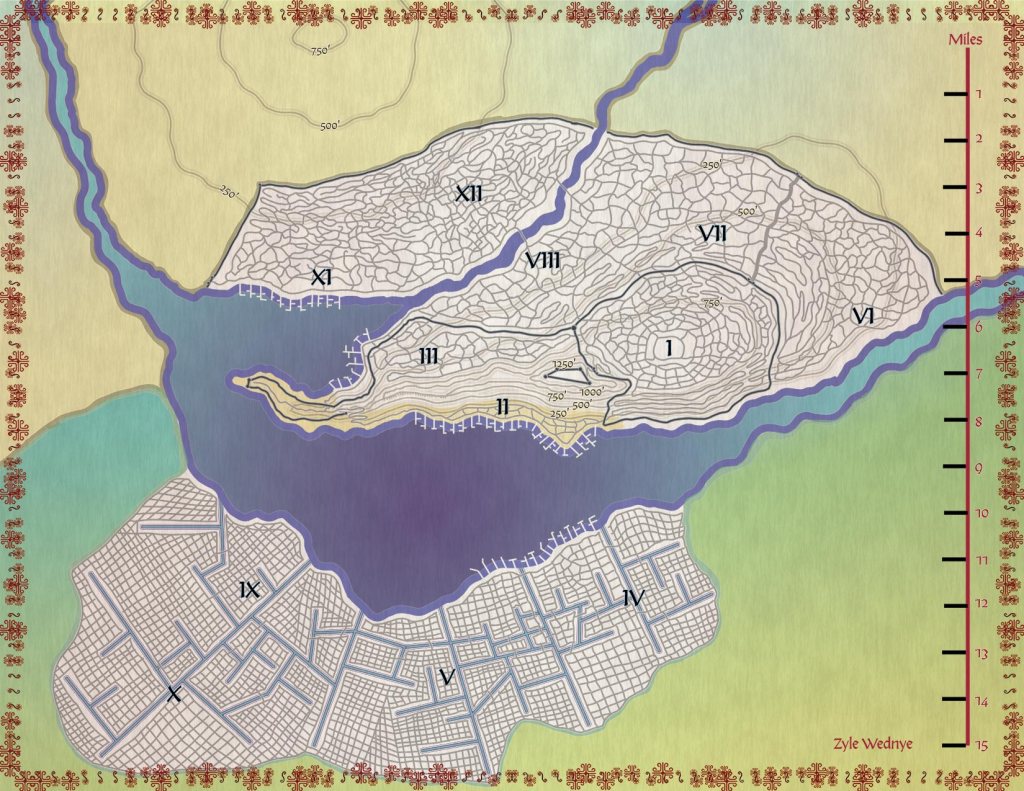
Vohrkohz was founded on at a hill inside a sharp bend on the Tyrqohz river almost 500 years ago. The settlement was fortunate in it’s position between the mouth where the Tyrqohz emptied into the Marakhor Sea and the rich ore-fields on the face of Mount Ghaul. The flood plain on the low bank of the river bend offered exceptionally rich soil for crops, the river herself was bountiful and her lower branch was wide and easily navigable to the sea. Vohrkohz was well suited to grow and support her people.
For most of it’s history Vohrkohz grew from a town on the riverbank to a modest city-state renowned for it’s artisans. They crafted beautiful and precious objects using the aurixom ore mined from the face of Mount Ghaul. When Vohrkohz joined the early Xjinn Empire, the fortunes of the city grew exceptionally fast. The markets of the expanding empire for luxury made Vohrkohz very wealthy. After the Old Xjinn Empire declined and Vohrkohz claimed its independence as a city-state and joined the Sea Cities league, their reputation and markets had been long established, and their wealth continued to grow. This was Vohrkohz’ golden age.
However, every golden age comes to an end. Vohrkohz began her decline as the Aruixom mines began to demand more and more destructive techniques to yeild enough ore to satisfy demand. The fisheries pulled more fish from the sea and the Tyrqohz became polluted with the industrial mining and forging industries.
Then, the Old Xjinn Empire, under the guidance of the Nea’Archi Doctrine religion, began to reclaim all it’s former lands. Vohrkhoz was reabsorbed into the Empire twelve years ago. The returned Empire was different than the one that Vohrkohz was first a part of. This Empire was martial, expansive, authoritarian. The Nea’Archi Doctrine was a strict and agressive religion, spreading the worship of Lords of the Higher Worlds, a pantheon of deities aligned with Cosmic Law. While in the dozen years of imperial rule have not purged the variety of faiths practiced in the city. Still, the Nea’Archi Doctrine did grow among the ranks of Vohrkohz’ aristocracy.
The Old Xjinn Empire has rejected sorcery and adopted the rational disciplines of industry and science. This influence had affected Vohrkohz with the discovered industrial properties of aurixom. The forges of Vohrkohz had long known of how aurixom, when alloyed with steel created a metal of exceptional strength and durability. the Old Xjinn Empire has rebuilt and expanded Vohrkohz’s forging district to produce industrial quantities of refined aurixom and alloyed aurixom steel. The artisan districts were also turned into factories that used the refined metals to create tools, weapons, and machined parts for clockwork engines. These processes were both labor and resource intensive. The furnaces for forges and factories burned tons of coal day and night, filled the skies above Vohrkohz with clouds of brown-black smoke and filled the air with harsh fumes that could be smelled and tasted from anywhere in the city. When close to or inside the buildings the foul air even burned the eyes and skin after two or three hours.
The Tyrqohz River was extremely polluted due to the industrialization by the Old Xjinn Empire. It had been growing more polluted due to aurixom mining operations for decades prior to industrialization. Afterwards, both the industrialized mining processes polluted the upper river, and the refining and forging districts heavily polluted the lower river. This destroyed the fishing on the Tyrqohz and affects the mouth emptying into the Marakhor Sea at Port Tir. The fishing fleets from Port Tir needed to sail further out from Tirgohro Bay into the Marakhor Sea to find fishing waters that were not corrupt.
The banks of the Tyrqohz that served as floodplains and supported the agriculture of Vohrkohz have been polluted and corrupted into a toxic, unfertile scar. The region, called the Befoulment became a deadly, poisonous wasteland choked with mutated flora and fauna hostile to the natural environment. Within the Befoulment can be found the ruins of grand, once palatial estates, and ghost towns where the populations were driven out by the encroaching poison.
All of these factors combined to make Vohrkohz an industrial Hell. The aristocracy embraced the Nea’Archi Doctrine had made the city opressively authoritarian. The traditional religoins that had been practiced among the artisans and farmers and fisherfolk were slowly but methotically driven out of the public. The merchant class was split, driven either into the aristocracy or out of business all together. The laborer classes were pushed into indentured servitude in the factories, forges, and workhouses of the city. All under the authority and dominance of the Old Xjinn Empire.
The Tralfolk were a barbarian people who lived in the northern lands of Fahr Ryasc; the Kharian Basin, the Kælic Highlands and the Kymric Mountains. In an earlier age, long before the rise of the Old Xjinn Empire, the lands now claimed by the Tralfolk and their rivals the Bryndffolk were all part of a Sorcerous Realm known as Vakra. The Tralfolk began as thralls of the Vakran people, giants who called themselves Vazdeg.
When Vakra fell to a magical catastrophe brought on by their sorcerers and hubris, the pre-Tralfolk thralls were changed into the varied peoples of the Tralfolk. The Tralfolk share common, though divergent ancestry with most other peoples of Fahr Ryasc, the Xjinn, the Hsaahn, the Bryndffolk, even the Ra’akhen and the Síoraí are cousins to all of the Tralfolk ancestries.
Thanks for reading Lore and Legends of the Dezzyverse! Subscribe for free to receive new posts and support my work.
Even before the Fall of Vakra, the Tralfolk had already been changed by their Sorcerous masters. Through a combination of sorcery and cultivation, the thralls of the Vakra were developed to serve the needs and desires of their Vazdeg patricians. The Fall of Vakra exaggerated the traits that were bred into the thralls, mutating them into Tralfolk.
The principal social unit Tralfolk community organization were formed around the klaarg, groups in which descent was reckoned through common parental lineages. Klaarg (both singular and plural), were named often for the founding families and the oldest such stretch back for centuries. Communities were commonly referred to by the klaarg of their Verkovgi (Tralspek for “chief” or “lord”).
Ethnicities of the Tralfolk
Beihtral: The Beihtral were companions for Vazdeg sporting hunts. They were cultivated for their feral instincts and sharpened senses. After the Fall of Vakra, they developed into beast-headed humanoids of two different clans, the wolf-headed Tier, and boar-headed Tohr.
Fyhrtral: Vakra used the ancestors of the Fyhrtral to assist with the cultivation and husbandry of the native flora and fauna in their realm. They were exposed to the most powerful wells of natural magic discovered by the sorcerers of Vakra for generations. The catastrophe of the Fall of Vakra changed the Fyhrtral, the powerful magics of the deep wild places took them and remade them. They were tall and graceful, Fyhrtral men grow proud horns from their heads like stags, their legs were jointed like deer, ending in cloven hooves and made them swift runners and strong leapers. Their bodies were covered in a pelt of short, soft fur, and they grew short, furry tails at the base of their spines.
Glaztral: The Glaztral were robust thralls, cultivated to thrive in high and cold altitudes found in the Kymric Mountains. After the fall, the developed to large people, covered in a thick pelt of white or pale fur across their shoulders, arms and legs.
Gundtral: Gundtral were among the most privileged thralls, serving as assistants to the Vakran sorcerers. The Gundtral were selected for their natural talents with magic and intellect, but not might or strength. They suffered most during the Fall, emerging from the devastation only half the size of most other peoples and cursed with an impish seeming. Without the privilege of their masters’ favor, the Gundtral have dropped to nearly the bottom of Tralfolk society. Still, they have retained their inherent magic and high intelligence, traits which help them to survive despite their physical frailties.
Orgtral: Physically largest of the Tralfolk, Orgtral are larger than even their Glaztral cousins. Their thick limbs and broad trunks affoard them all the physical advantages that the Gundtral lack. Their ancestors were cultivated by the Vazdeg for physical labor and service as soldiers and bodyguards. This heritage, and their size has made the Orgtral phenomonally strong when compared to other peoples.
Rukhtral: The Tralfolk people were capable of producing multiethnic offspring, both with other Tralfolk, and wih other humanoid peoples. The result of these mixed lineages had stabilized into the youngest of Tralfolk peoples, the Rukhtral. The Rukhtral carried many of the best traits from their parentage, though to a lesser degree. They were strong, but not as strong as the Orgtral, they were clever, but not as clever as the Gundtral, they felt a deep connection to the land, but not to the same extent as the Fyhrtral. Rukhtral were of average height and build of most humanoid peoples of Fahr Ryasc, with pointed ears and small horns growing from their foreheads.
Svakktral: The Svakktral when they were thralls of Vakra were used as miners and workers of stone and metal. They explored the Underworld of Fahr Ryasc and sought its treasures for their Vakran masters. After the Fall of Vakra, the thralls who retreated into their vast underground strongholds became Svakktral. The Svakktral were short and broad, thick limbed and strong as the mountains they lived beneath
Vaktral: The Vaktral as thralls, were born of a Vashdeg parent and a thrall. This did require sorcery as the Vashdeg were giants, and in the case of a thrall mother, that sorcery needed to be applied until birth. The children of this mixed parentage enjoyed an elevated status in Vakran socity, above the other thralls, but below Vakran citizens. They also were able to produce a stable ancestry of hybrid children among themselves. They, like the Gundtral, were highly intelligent and magically powerful. They were, by most cultural definitions, beautiful to look upon. Even after the Fall of Vakra, the Vaktral only became moreso. Their sorcerous prowess, inherited from their Vashdeg ancestery made them mighty sorcerers, but their numbers were very few, and they isolated themselves, preferring solitude to the harsh realities of life among others.
Language
The Tralfolk communities spoke Tralspek, a derivative form of Vakran. Over the long centuries following the Fall of Vakra, the Tralfolk continued to use their own casual dialect of Vakran until it became a distinct language of its own. Tralspek did not have a written form, most Tralfolk were illiterate, but the few who have kept written records over the centuries used the Vakran alphabet and symbology to preserve their histories, stories and culture. But, the writings made were unique to each author. No single written interpretation of Tralspek has emerged, and none was widely adopted.
Relations
The Old Xjinn Empire: The Empire considered the Tralfolk to be uncultured barbarians at best, and at worst, more beasts than people. From how the Tralfolk live to their language, worship, even their art and culture were all deemed inferior to the Old Xjinn Empire.
Bryndffolk: The Bryndffolk have been competitors for land in the north with Tralfolk since the Fall of Vakra. Longer if one considers the Bryndffolk’s struggle with Vakra pre-Fall. While the two peoples have been intermixed for centuries, and minorities of each people lived amongst the communities of the other, there was always competition for land, rescources, and survival.
The Sea Cities: The rise of the Sea Cities held many of the same prejudices that the Old Xjinn Empire had. Influenced by the Bryndffolk when their trading ships sailed north, they held the view of the Tralfolk as barbarian pirates looking for plunder rather than commerce.