
Using Setting Events in Life Path Character Generation
Many of my favorite Role Playing Games feature a Life Path character creation mechanic. I dig this because it creates characters with a backstory that is determined from the dice. It also results in a variety of character ages. Of course, this works best in games and settings where the adventurers experience moderate advancement over their careers. In games where experienced characters are exponentially more capable than beginning characters (like Dungeons and Dragons (as the most prominent example), having a variety of starting capabilities results in the most powerful characters pushing the least experienced characters (and their players) out of the spotlight.
Emergent Storytelling
At it’s core, Life Path character generation creates characters with personal milestones in their life. Most games also encourage players to develop connections between their characters, developing relationships before play begins. So instead of a group of strangers meeting around the table of a local tavern, it’s a crew of friends, acquaintances and allies being called together. All the characters have connections with at least one other character and can speak up for another. The characters aren’t risking their lives and fortunes for strangers, but for buddies.
This style of character gen also develops NPCs as background Allies, Enemies, Rivals and Contacts shared by more than one character. So when the Evil Ninja Clan shows up to collect on one character’s debt, a second character might have some influence with the Evil Ninjas, or a third character hates the Evil Ninja Clan for killing their childhood pet, etc. Ex-romantic partners could be shared among characters. Because this is all determined by dice rolls compared to a chart, the GM can tailor some direction of their setting by altering the Life-Path charts.
Events in the Setting
In many published campaigns, there is lore that too often fades into the background. Life Path character generation can help to give those lore events context. Maybe no one was directly involved when the Fire Nation invaded 12 years ago. But all characters were alive then, and probably remember when and where they were when that happened. Maybe the old veteran was in one of those early battles, maybe the brash young kid was only 7 years old and had to flee with their family. Point is, there is an event fixed in history, and it’s a big enough event that everyone knows where they where when they learned about it.
This helps to make the setting feel alive. Things happen and your characters experienced them. Or their families were affected by them. Incorporating history in the Life Path, gives everyone a shared touchstone and brings the players into the setting. Their characters become part of the campaign’s fabric. their histories meshing with the history of the campaign.
Counting Backwards
The nature of Life-Path character gen (at least in Traveller’s long history of editions) usually results in a twelve-to-sixteen year character background broken into four year terms. The Life-Path starts at age of majority (usually 18) and moves forward term-by-term. This forward progression builds an intuitive history for the character. Second Term follows First Term and the events of the first term affects the various die modifiers of the second. However, due to the randomized nature of the character generation process, it is not possible to predict with complete certainty how many years or terms a life-path will last before the character is mustered out and begins their career as an Adventurer.
Game Masters should establish the starting in world date of the campaign. That serves as present day, and its only during the wrap up phase that players can map their character’s life path onto the history of the setting. As explored in O God, Thy Sea is so Great, news in settings that lack direct Faster than Light travel, will take weeks and months to spread out through interstellar polities.
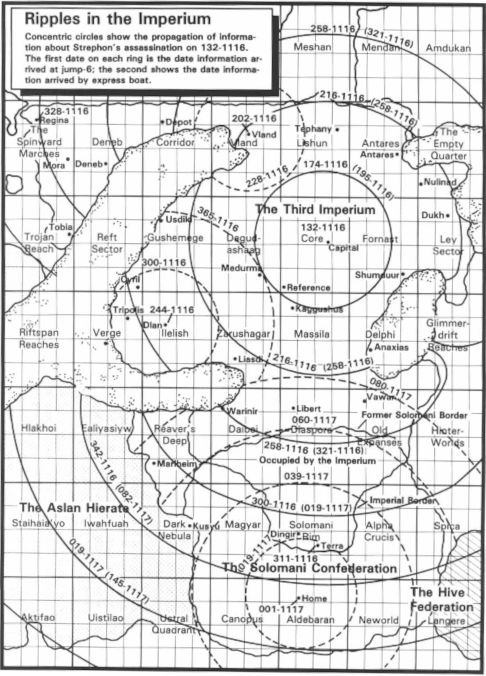
One of my favorite sector maps in Traveller. It graphically illustrates how news travels through the Imperium
The above map depicts how the news of Emperor Strephon’s assassination spread through the Imperium along X-Boat routes and priority Jump-6 courier routes. It is a great example of what a civilization-wide event looks like in a setting the size of Traveller’s Charted Space.
Not All Setting Events Spread This Far
Which also shows something important. Not every important event is earth-shaking like the assassination of the Emperor of the Third Imperium. There are plenty of potential events that are important regionally, but not universally. These can also, when incorporated into a campaign and character generation, help to define a character’s life-path.
Consider a localized event, say a recent supernova of a star. It could even have led to the destruction of an inhabited system. The result is hundreds of millions, or billions of refugees spreading to nearby systems and the sudden pressure of a refugee crisis in those systems. The evidence of that event, that is, the electromagnetic eruption caused by a supernova still only spreads at the speed of light. So it would still take 3.26 years for the nova to spread to the nearest parsecs. Roughly one Traveller Term.
In those four years, the stress on the surrounding subsector, would be evident, but beyond the sector, it would still take decades for the crisis to become anything more than a JoTAS story. Maybe a reclassification of Amber or Red Zones. Characters whose homeworlds are in the local region would definitely have the event featured. Characters from outside the region wouldn’t. And as a result, the scope of the setting can be enhanced.
Of Course This All Fills a Session Zero to Overflowing
Life-Path character generation’s biggest drawback is the amount of time necessary to create a character. Especially when creating a group of characters. Going through multiple terms, rolling for skill advancements and Events simply eats up time at the table. Adding another layer where the GM offers Lore details that might be at best, optional, can easily extend a Session Zero to second Session Zero point Five.
Which is a delay to playing the campaign, ya know, the point of creating all these characters in the first place. So, add campaign lore events to Session Zero only as much as is fun for everyone. What you want, as a GM and a Player, is to generate excitement and anticipation. When the exercise becomes tedious and boring, it’s time to wrap up character generation and start adventuring among the stars!
 Lore and Legends of the Dezzyverse
Leave a comment