
Electric Head, Cannibal Core, the Television Said..
Most Tabletop Roleplaying Games feature humans as the dominant species in the setting. The reasoning is straightforward, Players, being humans themselves, can most easily identify with their characters when they are human as well. It also saves on lore-overload. With humans, whether they’re from Earth, Corellia, Rigel IV, or Vland do not require an essay explaining what they are. Roll up a character, and get playing, no need to wonder about why your Vulcan has green blood, or your Wookie looks suspiciously like Bigfoot. Also, with a human-centric setting, all the gear is easily designed and described. No trying to explain the kinesthetics of a laser rifle made for Hivers when your lasgun looks pretty much like the rifles and carbines that exist today on the real world.
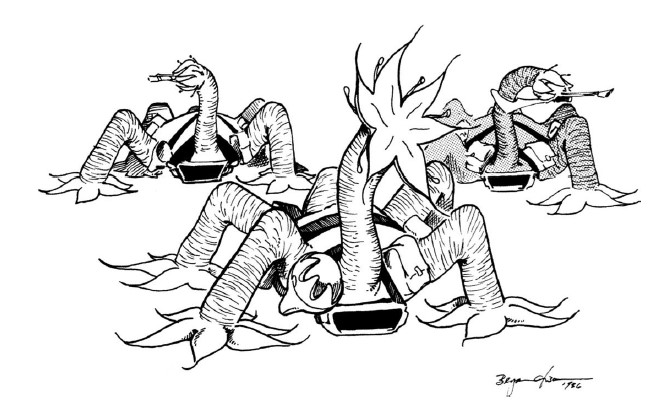
A group of Hivers suited up and packin’ Hiver-heat!
Impact of a Human Universe
Human centered universes are scaled and designed to be convenient for humans. If Humans are the default species, the habitats and furnishings are familiar. Even if it’s a “space-chair” that floats it’s a chair that is designed for bipedal mammals with arms, legs, feet and hands. No need to slow the game down describing it and making the player describe how their character takes a seat. Buildings and vehicles are scaled for 1.75 meter tall 68 kg operators and passengers. Computers are designed with keyboards for manipulative digits and the ability to communicate through voice. Doorknobs are made for people with opposable thumbs.
It’s why most of the aliens in Star Trek and Star Wars are near-human. Even Wookies, at 2.2 meters tall are human enough to pilot a YT-1300 Stock Light Freighter. All of the bumpy headed aliens of the Star Trek Universe are compatible enough that a member of one species can be disguised as a member of one of the other species. Of course, the practical reason for this is that the actors are themselves humans and it’s cheaper and more practical to throw a rubber mask on and spirit-gum some extra hair and be an alien on screen. Just look at what was needed in Return of the Jedi to operate and act Jabba the Hutt. Poor guy only got to leave his couch of perpetual indulgence after the Special Editions were released and computer graphics could be used to let the big ‘ol slug slither around Mos Eisley.
It’s fun to speculate what a Hutt civilization, or a Tholian civilization would be like. It’s a nice place to visit as a role-player. Stepping out of the familiar into the alien, is a fun exercise, but not something many players would want to deal with week in and week out for the length of a long campaign. Being unable to pass through a door because it’s scaled for a Jawa is a challenge, Not being able to pass through ALL the doors in the city because it’s all scaled for Jawas is just tedious.
There is Infinite Diversity in the Human Condition
The danger of the default-human setting is that everyone starts to look, sound and act like the culture the players and game masters live in. Even a setting that presents itself as highly diverse, like Star Trek is mostly causation, especially in The Original Series. If the game master isn’t careful, the distant world of Efate can start to feel like Los Angeles, or Dallas or Tampa Bay.
The contrasting issue is also a danger. It’s all to easy to lean on stereotypes of “exotic” human cultures. Every desert planet starts to feel like Algeria or Egypt. The primitive worlds start to look a lot like aboriginal and tribal cultures as portrayed in the pulps. As GMs I’m not saying that every world needs to have a unique culture with roots going back centuries. But if you’re designing the next world the PCs are visiting, recognize when you’re shortcutting the humans that live there as someone else’s real culture. If you spend the time to look at your setting elements, you’ll also find it really easy to change the people of the place enough to make them unique without diving into worn out stereotypes.
Humans are highly adaptable, and as a species, we can make tools to survive in every climate imaginable, including space. Over the course of generations, populations of humans living in different climates will evolve physical characteristics that help them survive in the climate where they live. Furthermore, the humans that have evolved in one climate are able to have children with other humans from other climates and the genetic mix gives humanity a near infinite variety. You can use this for your player characters and your npcs in a campaign. It’s easy for a band of eight characters to be visually and culturally unique from one character to the next.
More Human Than Human
with apologies to Rob Zombie
There has been an unfortunate standard set in tabletop role playing games over the decades of making humans the “default” species, and as such not giving them bonus or disadvantageous abilities or modifiers. Humans are characters that were played as rolled. Which, while balanced, didn’t excite players. Especially when other species could see in low light, or have superhuman agility or strength or inherent weapons like claws or fangs.
But this really doesn’t need to be true. Humans have adapted several exceptional abilities based on their environments. People from high altitudes have developed expanded lung capacities and efficient oxygen consumption, people from cold climates have evolved heavy bodily hair, people from climates that experience excessive exposure to sunlight develop elevated melanin deposits in their skin. The list goes on and on.
Game balance is a bit over-rated. Character abilities do not need to be a zero-sum balance. Depending on a character’s origins, it could be justifiable for human characters to have resistance to environmental toxins, or radiation, or prehensile lower extremities. Even tails. Just look at science fiction. Humans have a broad variety of almost superhuman abilities and crippling vulnerabilities. A people who evolve in orbital freefall might have exceptionally long limbs, flexibility and dexterity, but suffer incredibly under 1G pressures. People who evolve on distant dark worlds may develop the ability to see deeper into the infrared spectrum but become colorblind.
Cat-Girls and Dog-Faced Boys
Body modification is commonplace in several science fiction settings, for that matter, body modification is pretty common in the modern world. Human characters can begin game play modified to present as aliens, anthropomorphic animals, or any other unique combination. With enough cyberware, aesthetic surgeries, or biochemical therapies, a character’s identity can have infinite diversity.
Again, most of this is cosmetic, but in some cases, being a modified human character can come with some abilities or modifiers, as mentioned above. Players and GMs can use some of the alien species from published settings. Aslan and Vargr from Traveller, Lyrans, Kzinti and Gorn from Star Trek, and the Lepi from Star Wars as guidance for what benefits or modifiers a character might employ on their character sheet.
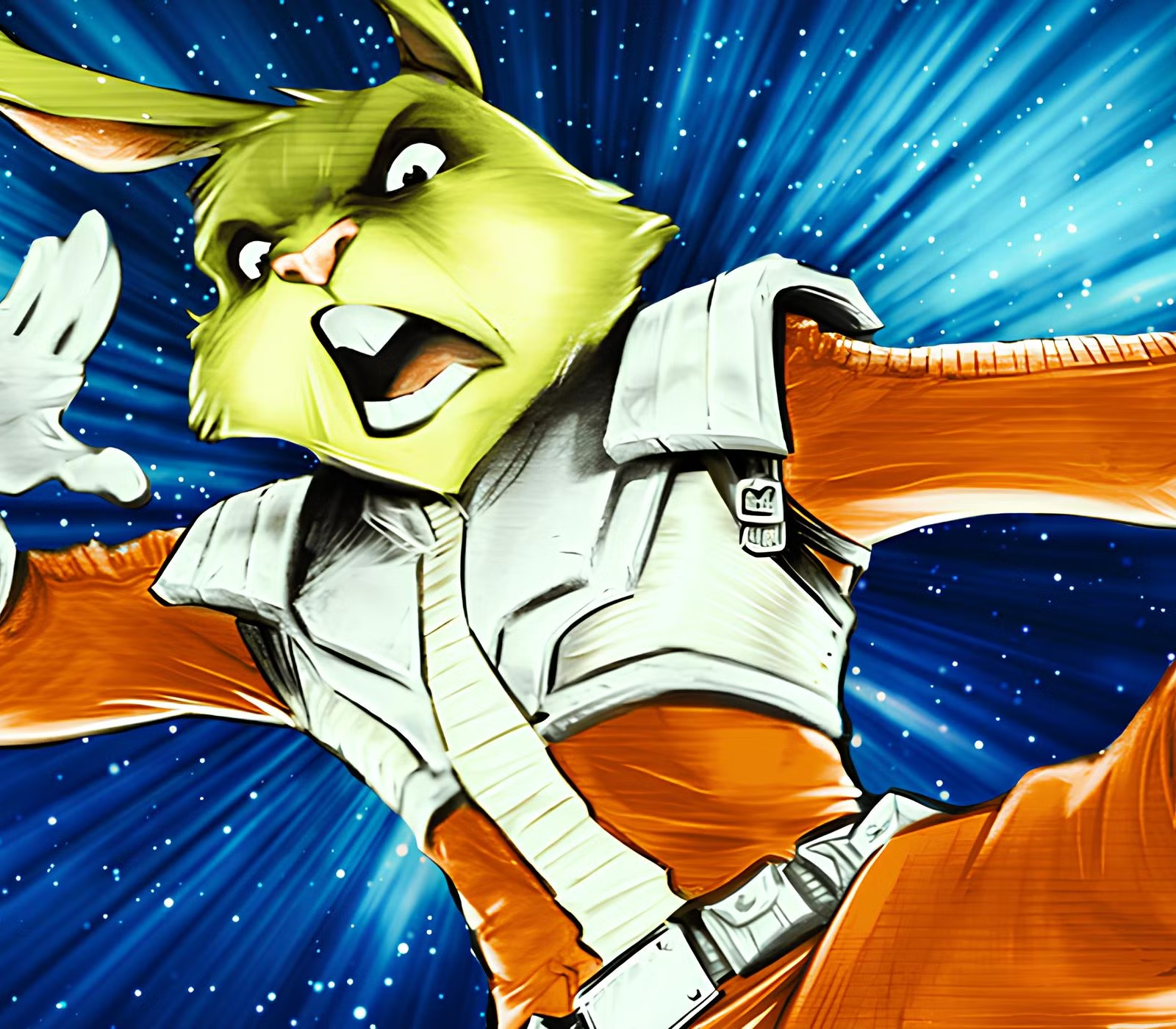
Jaxxon, the Green Space Bunny and acquaintance of Han Solo
Humaniti in Traveller
In the 3rd Imperium of Traveller, humans are the majority species. Humaniti is so widespread in Traveller that there are 3 branches of humans that would be conisdered “Major Species”. Two of these species, the Vilani and the Zhodani are humans originally from Earth. 300,000 years earlier an advanced alien empire, the Ancients abducted groups of humans from Earth and brought those humans with them as they traveled among the stars. They seeded two human colonies in systems favorable to human development, Vland (where the Vilani evolved) and Zhodane (where the Zhodani evolved). The Ancients had also taken other species from Earth (and other planets, the Ancients were not shy about seeding forms of life on different planets just to see what happens) which in the case of Terran wolves, is where the Vargr originated). The humans who were left on Earth, evolved into the Solomani.
In the current era of My Traveller Universe (3i 1125, the beginning of the Hard Times) the 3rd Imperium has Solomani populations towards the rimward sectors, Vilani populations towards the coreward sectors, and the majority of the Imperium is populated by people of mixed Vilani-Solomani ancestry. The Zhodani, being the people of a rival Empire are rare as Imperial Citizens, but in the spinward and coreward sectors (“behind the claw”) Vilani-Solomani-Zhodani ancestries are uncommon, but not unheard of.
What does this mean? In this case this is an clear indication that humans are one species with several sub-species. The distinctions of Vilani, Solomani, Zhodani, and any of the hundreds of minor sub-species of humaniti are cultural and ethnic at best. For most characters, “human imperial citizen” commonly refers to the Solomani-Vilani ancestry, but there is nothing stopping a player from describing their human character having an ancestry that is regionally distinctive.
As mentioned, several ancestries of the human species have developed interstellar empires, and have distinctive cultures and subcultures. The Traveller source material, especially the Alien Modules can provide deep dives into the three major cultures, Solomani, Vilani, and Zhodani. Vilani and Solomani cultures have blended over centuries into the society that is described in the 3rd Imperium. At the Rimward border of the Imperium, the Solomani have carved out what could be described as a Solomani ethno-state.
The Solomani Sphere
In the long history of Traveller, one of the pivotal events was the Solomani Rim War (3i 990 – 1002). In this conflict, the 3rd Imperium attempted to reassert authority over the worlds of the “Solomani Autonomous Region”. The war resulted in a contested victory for the 3rd Imperium when the Sol system was conquered. The Solomani Confederaion was unable to retake the homeworld of humaniti, and the 3rd Imperium was eager to bring an end to the war by 3i 1002. For the next 114 years, the occupied worlds of Diabei, Diaspora, the Old Expanses and the Solomani Rim were a powder-keg of ethnic conflict.
The Solomani Confederation, previously the Solomani Sphere is distinct from the 3rd Imperium. Like most interstellar empires, the Solomani Confederation does not have a single cultural expression, but it does have a common, shared mythology. The Solomani Hypothesis, that theorises (with strong evidence in support) humaniti developed and evolved on Terra (Earth) first, and was spread into the stars first by the Ancients and then by their own technology.
The term”Solomani” gets overused in the Confederation. One major reason stems from the Solomani Hypothesis; because humaniti originated on Earth, the Solomani are the original humans and are thus superior to all other branched species of humaniti. The Solomani Party is the political organization that governs the Confederation. The Solomani Cause is the political strategy that promotes Solomani humans outside of the Confederation. The Solomani Cause has also been the rallying point surrounding the “liberation” of Terra from the 3rd Imperium and further restoring the Solomani Sphere to it’s pre-3i 990 extents. The Solomani Movement is the Cause as a factor in politics outside the Confederation.
Aren’t the Solomani the Bad Guys?
It’s somewhat of a debate in the Traveller community as to whether or not the Solomani Confederation are the “bad guys” of the Rim. The veneration of the Solomani Hypothesis and the Solomani Cause gives some “supremacist” overtones, or at the very least a classist society with Solomani Humans in the position of privilege. The Solomani Party being the dominant political faction (indeed, the only legal faction) within the Solomani Confederation leans hard towards authoritarian govenrments with some really bad associations throughout history.
It’s been pointed out that the Solomani Confederation isn’t monolithic, in the same way as the Emperor isn’t a monolith in the Third Imperium, the Hive Federation, or the 29 Clans in the Aslan Hierate are monolithic for those empire. The Solomani Confederation covers about six sectors, and contains about 2,000 inhabited systems. If you think about the current diversity of cultures, ethnicities and governmental bodies in our one star system, the idea that the Solomani Party holds and iron-fisted grip on society throughout the Solomani Confederation is farcical. Even if a given Traveller campaign portrays the Solomani Party as oppressive, it’s not the Empire from Star Wars, or the Mirror Universe Terran Empire of Star Trek. Remember the distances involved and times to send communications from one system to another that we explored in this blog.
The Solomani of the Confederation aren’t jackbooted thugs checking for “genetic purity” at ubiquitous checkpoints. The Solomani Confederation, like all the major empires of Traveller is best described as a “tribe”. It’s a nationalistic tribe that promotes the Solomani Cause, but that’s not much different than the 3rd Imperium promotion the Emperor, or the Zhodani Consulate promoting Zhodani Psionic Society. They’re not “supremacist” but their cultures promote their own Empires.
In My Traveller Universe, the Solomani Confederation are antagonists, at least in the rimward areas of Diaspora sector. In the Rebellion War, the Solomani Confederation launched the “Second War of Solomani Liberation” to liberate the Sol system, and reclaim the systems of the Solomani Sphere. The Imperial Occupied Region covers the four rimward subsectors of Diaspora sector, ,as well as the majority of the Solomani Rim sector. The further rimward in Diaspora one goes, the more Solomani Confederation operations one will encounter.
During the Hard Times, in Diaspora, the Occupied Subsectors are aligning much closer to the Solomani Confederation. The vision of a re-established Solomani Sphere is clearer than it’s been in a century. The Solomani Confederation has not suffered nearly as badly as Lucan’s 3rd Imperium and the stability offered by the Confederation Navy has helped these systems weather the Black War and the Imperial Decline. It’s not an example of the Evil Empire winning, it’s an example of how a portion of the vast 3rd Imperium is keeping back a second Long Night.
 Lore and Legends of the Dezzyverse
Leave a comment