

Arjenvís; part 1
Somewhere within the DezzyVerse, the city of Arjenvís is a world unto itself. No one travels to Arjenvís, no one seeks it out. For Arjenvís is alive, and it hungers for mortals and their souls. Arjenvís draws their victims in through dreams, steals them away when they are wandering lost, takes them from the alleys and streets and tunnels.
Founding
Arjenvís was built on the Zyle Wednye cape at a slow bend in the Erixahn river, where the Nozca Kreft empties. The cape rises to a thousand feet above the river. A commanding point that could control the river from the bend all the way to the sea.
The Zyle Wednye ridge held another treasure that would make Arjenvís grow into a metropolis of 125,000 souls at it’s peak. Wegnvia Coal burned hotter and longer than any other feul known. The Zyle Wednye ridge was rich in it. Mining coal built the city into a powerhouse. The Wliajenya mine carved endless tunnels below the ridge, a black maze of stifling heat, fumes and coal dust.
Factories, mills and workhouses grew within the city to build it’s population. The workhouses especially, prisons really, fed countless lives to the mine to dig Wegnvia Coal. The hunger for more bodies to work the mine developed a brisk trade in the commodity of people. The aristocracy of Arjenvís, the Vlatza who ruled the city, the Boyars who governed it’s 13 canton, the Arzpralak and Praladts of the Vyara Zabor Church bought and sold the undesired and desperate from kingdoms and realms everywhere that the Wegnvia Coal was demanded.
The city became prosperous and wealthy above, and an industrial nightmare of suffering below. The excesses and debauchery of the aristocracy, grown wealthy beyond the dreams of avarice, the desperate poverty of the smallfolk crowding the slums of the Brzek Kreft, serfs working the fields of “the shift” on the low shore of the Erixahn, and the suffering and hopelessness of the indentured laborers in the depths of the Wliajenya mine awoke something, foul in the heart of the city.
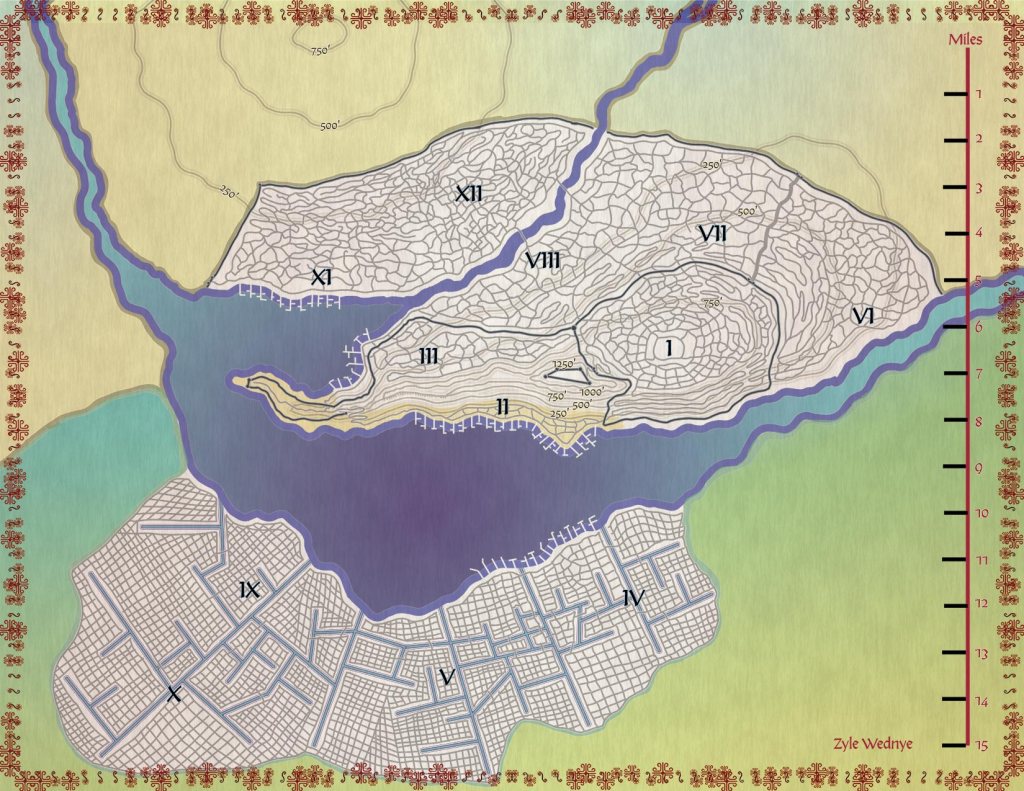
The twelve canton of Arjenvís, the City of Miseries. Map by the Author
The Black Burning Dawn
The hungers of Arjenvís became so great that the common folk rose up to demand some measure of humanity upon the monstrous inhumanity of the Vlatza and the Boyars. What began as a labor strike, spread from the Wliajenya mine to the workhouses, and to all the desperate poor of Arjenvís. Not since the Beggars’ War have the masses of Arjenvís swollen underclass expressed their anger and rage against their overlords. The labor strike turned into an uprising and then a revolt. Every effort to end the violence only amplified the horror and the evil within the City of Miseries.
A march of striking smallfolk clogged the Prohodt (the wide boulevard that climbed the back slope of the Zyle Wednye ridge to the palace of Kziaze Dwohr) until the armed soldiers of the city guard masacred them. The revolt turned into a revolution with the Noble estates and households under siege and assassinations being carried out almost nightly. Reprisal fallowed reprisal and blood flowed freely in the streets Arjenvís for more than a month.
One morning, before dawn, the Boyars’ army of household soldiers and mercenaries marched on the Wliajenya Gate, the stronghold that controlled both the access to the mines, and the Glenvoky Road that winds down to the north face of the Zyle Wednye to the Trzy Makti (“Three Mothers”) workhouses, center of the strike and the revolt. Supported by new magic from the priests of the Vyara Zabor church and “Mazynik” (Automata), a bloody battle pushed down Glenvoky Road towards the Trzy Makti and into the Wliajenya mine, inflicting terrible casualties on the smallfolk regardless if they were fighting, surrendering, or fleeing.
When dawn came it was different from any sunrise anyone had ever witnessed. It began with a green-blue glow on the horizon. The sun rose as a black circle in the sky burning from below in green, blue and violet flames. Fighting throughout the city abruptly stopped as the horror rose in the sky. Panic washed over the city as people sought a reason for the Black Burning Dawn.
Under that sun, the aristocracy of Arjenvís underwent sudden metamorphosis. As the Black Burning Sun crossed the sky the mortal members of the noble households changed from mortal folk to monsters. They became preadators, vampires, werewolves, ghouls, ghasts, liches and hundreds of others whose curse defies definition. The common mortal folk were reduced to half-alive husks, their souls consumed by the city.
The Curse of Arjenvís
Arjenvís is “alive”. While other realms of terror have a singular figure as the source of evil in their domain, Arjenvís is both the source of evil and the domain itself. The majority of it’s native population, the smallfolk who worked the mines, filled the workhouses and toiled in the fields are now half-alive parodies of their former selves. They provide sustenance (of a sort) to the monstrous fiends that Arjenvís transformed it’s nobility into. Vampires can feed on them, and avoid starving, but they will not grow strong, nor feel the rush of life that they would when feeding on a mortal being with a soul.
The half-alive also are unable to die, even if their corpus is destroyed, or consumed, they will arise as flesh-and-blood from the depths of the Wliajenya Mine and return to their pantomime lives, until misfortune befalls them once more. The monsters are similarly trapped in this cycle of rebirth. Arjenvís never lets it’s people go.
Arjenvís trapped time itself. The same year in the city repeats itself over and over again in a monotonous churn. No new children are born (save for those born during this cursed year away) no one ages, no one dies. Even those who would have died of natural causes during the year find themselves reborn within the Wliajenya Mine.
The unholy hunger of Arjenvís will never be satisfied by the half-alive, or the monstrous aristocracy. The City of Miseries reaches out across the Cosmos and draws in mortal victims and ensnares them into it’s fog-shrouded and blood-drenched streets. Escaping Arjenvís is nearly impossible, approaching the city gates will inexplicably relocate the hostage to another canton within the city. The fugitive will turn a corner, and find themselves in another place, wandering the streets. Escaping on the Erixahn or Nozca Kreft rivers is similarly frustrating. The raft or boat clears a bend in the river and finds itself approaching Arjenvís again. If there are secret ways out, they either remain undiscovered or are jealously guarded by a scant few.
Dark Streets, Dark Hearts
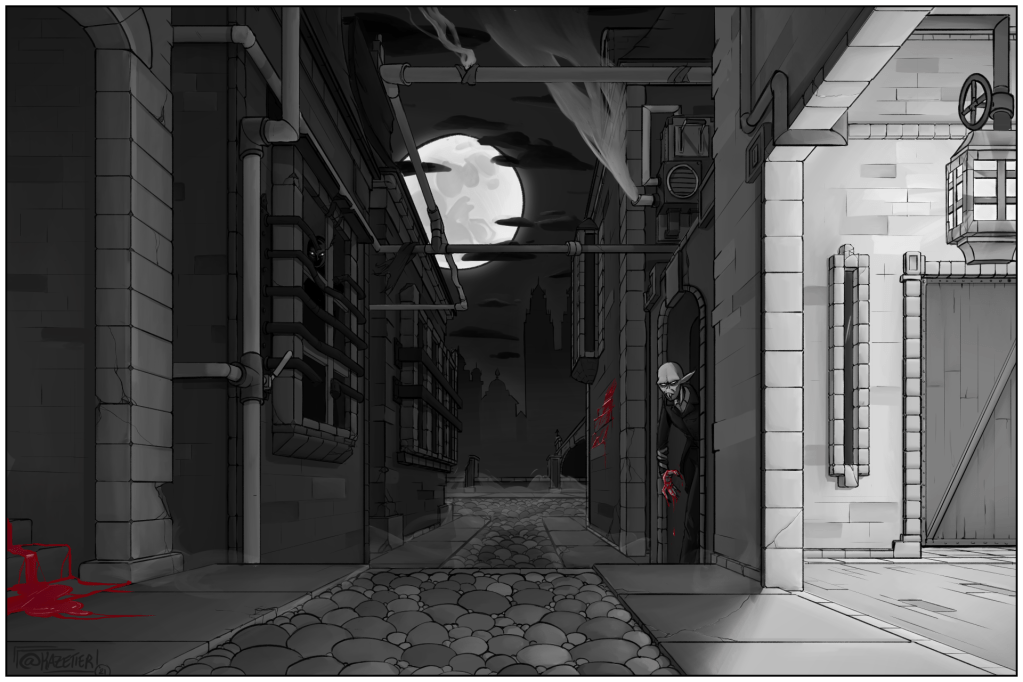
Art by Kazitier
There are several centers of power within Arjenvís, The city is ruled by the Vlatza Juliusz Dzynis, each canton is governed by Boyars, the Vyara Zabor Church is ruled by the Arzykapwan (High Bishop) through their Praladt (Bishops) and their Kziadz (Priests). Even before the Black Burning Dawn, there were feuds and rivalries among the institutions and households in Arjenvís. The Curse has changed very little. The old hatreds have not died.
The Kolegium was responsible for the technological advancements in Arjenvís, Wegnvia Coal burns at temperatures which allow for the wonders of steam power and clockwork engines. The wonders of the Kolegium workshops have become steampunk terrors after the Black Burning Dawn. The Inżynierowie (Engineers) have been transformed in the same manner of the nobility and the church.
Life in Arjenvís is cheap and violent. Even death may not permit escape.


 Lore and Legends of the Dezzyverse
Leave a comment